Schaum's Outline of Computer Graphics


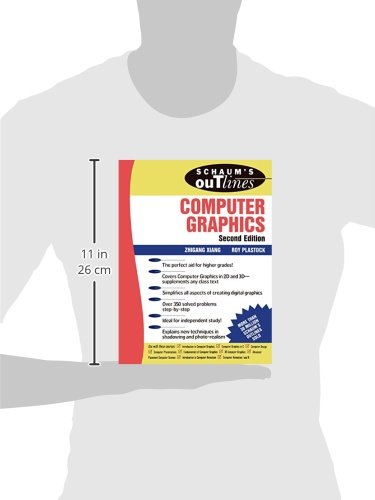
CategoryDesktop Publishing
Schaum's Outline of Computer Graphics
List Price: $52.38$47.14DEALYou Save: $5.24 (10%)
Free shippingFree Returns – 30 daysFree Order CancellationSecure Payment2–3 Days DeliveryGet It October 25, 2026In Stock (4)No marketing spamNo account requiredFulfilment by FedEx / Amazon / UPS / ShipwirePayPal / Card Buyer Protection
Customer Reviews
Reviews sourced from verified Amazon purchasers4.7
out of 5
Based on 7 reviews
5★
86%
4★
14%
3★
0%
2★
0%
1★
0%
Four Stars
Amazon Customer✓ Verified Purchase•March 31, 2017
Great book!
Five Stars
Jorge Polar Seminario✓ Verified Purchase•January 22, 2017
A classic, yet very detailed and well explained book on basic graphic subject.
WOULD RECOMMEND THIS BOOK FOR ANYONE LEARNING HOW GRAPHICS ARE DISPLAYED AND THE MATH BEHIND IT.
Dark Knight✓ Verified Purchase•July 29, 2015
Very interesting read on how computer graphics are calculated and the nitty gritty behind the scenes of how a computer processes graphics. I would highly recommend this book for someone wanting to know these details as it is fairly well written. However, caveats (cough, cough!): the book arrived in like new pristine shape, except for one thing which was several of the index pages were missing which is not good for a person who really needs this which may lower the rating 1 point. I gave it 5 stars since this, for me, is only recreational reading not for any specific purpose as I do not need to be looking a bunch of items up for a class, but only reading the book. I guess with used books it can not be expected the item is going to be perfect. In other circumstances (ie. need for a class) I may have sent it back so buyer take this caveat into consideration, and as far as the seller is concerned this may have been an "excusable error" as they may have missed this. One probably understand some basic matrix theory, and the more math the better to help understand this book The book arrived on time & in good shape.
Nice and Concise
A. T. Jones✓ Verified Purchase•August 29, 2006
I bought this for its worked examples in graphics, particularly projections and perspective transformations. It covers these topics throughly and clearly. The chapters on clipping to the view frustrum and transforming to the device coordinates were also excellent. The material on general graphics transformations was easy to follow. The appendices cover necessary parts of vector algebra and geometry. The level seems suited for a reader who has had undergraduate vectors and calculus classes. This book is complete, understandable and certainly a bargain compared to other texts costing 5 times as much
Helpful for computer graphics algorithm details
calvinnme•January 4, 2006
Two things that you'll likely find in most computer graphics textbooks are:
1. A triple digit price tag
2. Disorganized and obfuscated algorithm details
This Schaum's outline is an excellent antidote to both of these problems. Besides its low price tag, it has a very clear presentation of the basics of computer graphics algorithms. It starts out talking about image representation including common color spaces. It gives a clear definition of dithering, halftone approximations, and error diffusion. Next comes a discussion of scan conversion, which is how to translate geometric figures into pixels. Chapters 4 and 5 discuss two-dimensional graphics and their transformations. This includes good discussions and examples on matrix transformations and how they can be chained together. Chapters 6 through 8 extend these concepts to three dimensions. Very detailed information is given on transformations, projections, and clipping in 3D. This includes a definition of a typical 3D graphics "pipeline", which is basically an assembly-line of computer graphics from object definition to display. Chapter 9 on geometric representations was not as good as the other chapters in this outline, since it didn't do a very good job of talking about such representations in greater than two dimensions which is necessary for the development of wireframe models. However, the last three chapters of the book on hidden surfaces, shading models, and ray tracing had very good examples and discussions that could lead to pseudocode. I would highly recommend this guide to anyone taking or planning to take a course on computer graphics as a good language-independent guide to the basic methods and algorithms of computer graphics programming.
1. A triple digit price tag
2. Disorganized and obfuscated algorithm details
This Schaum's outline is an excellent antidote to both of these problems. Besides its low price tag, it has a very clear presentation of the basics of computer graphics algorithms. It starts out talking about image representation including common color spaces. It gives a clear definition of dithering, halftone approximations, and error diffusion. Next comes a discussion of scan conversion, which is how to translate geometric figures into pixels. Chapters 4 and 5 discuss two-dimensional graphics and their transformations. This includes good discussions and examples on matrix transformations and how they can be chained together. Chapters 6 through 8 extend these concepts to three dimensions. Very detailed information is given on transformations, projections, and clipping in 3D. This includes a definition of a typical 3D graphics "pipeline", which is basically an assembly-line of computer graphics from object definition to display. Chapter 9 on geometric representations was not as good as the other chapters in this outline, since it didn't do a very good job of talking about such representations in greater than two dimensions which is necessary for the development of wireframe models. However, the last three chapters of the book on hidden surfaces, shading models, and ray tracing had very good examples and discussions that could lead to pseudocode. I would highly recommend this guide to anyone taking or planning to take a course on computer graphics as a good language-independent guide to the basic methods and algorithms of computer graphics programming.
Page 1 of 2


