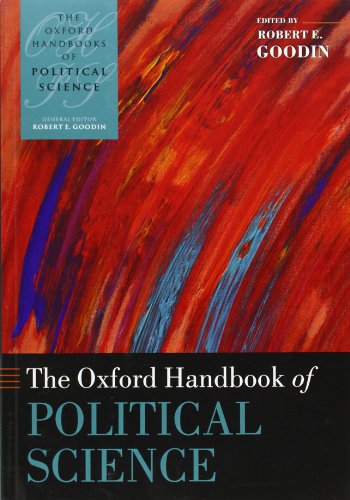
The Oxford Handbook of Political Science


CategoryLaw
The Oxford Handbook of Political Science
List Price: $92.14$82.93DEALYou Save: $9.21 (10%)
Free shippingFree Returns – 30 daysFree Order CancellationSecure Payment2–3 Days DeliveryGet It October 25, 2026In Stock (20)No marketing spamNo account requiredFulfilment by FedEx / Amazon / UPS / ShipwirePayPal / Card Buyer Protection
Customer Reviews
Reviews sourced from verified Amazon purchasers3.9
out of 5
Based on 5 reviews
5★
80%
4★
0%
3★
0%
2★
0%
1★
20%
I like
David Bean✓ Verified Purchase•December 7, 2017
This is real politics theory book, I like it
very good book, very
V Bright Saigal- Novelist, Lyricist, Poet &Advertising Consultant, Reviewer & Book PR servic•October 1, 2017
The Philosophy of Governance: AAA- Non-Fiction- very good book, very informative
Review against Kindle version—needs to be fixed
S. Marshall Priddy✓ Verified Purchase•February 8, 2016
This book is not well-suited to the Kindle format and it's much too expensive to be done as poorly as it is. I wasn't far into it when they made a reference to a list of books in Appendix 1.1. But there's no hyperlink to the appendix. So thinking that appendices are usually at the end of a book, I tried looking there. This is incredibly tedious in a Kindle format, especially since if you didn't bookmark the page you left, you need several clicks of the "back" button. And the link to the appendix in question also isn't in the TOC on the sidebar.
So I tried using the search function, which did find it. The actual table (a list of canonical books) was not enetered as text, but as a highly pixelated jpeg that was very nearly illegible. Far worse, the table was broken into two jpegs, one with the top half of the table (including the column headings) and one with the bottom "overflow" bits of the long columns.
I had to return this book. It should be better. This is by far my biggest and most consistent complaint with Kindle books: they need to fix the resolution of image files. For instance, I've seen PDFs where you can zoom in to 1,000x with resolution all the way down. They need to add a much higher degree of resolution so that you can get what you need by zooming in this way. While it would increase the size of files a bit, it would make one of the biggest weaknesses of the e-format one of the biggest strengths; theoretically, getting high res images you can zoom in for clarity should make the e-format better than paper books, but so far it's frequently worse.
The other as mentioned is hyperlinks. Again, skipping around could in theory be far easier if the included a series of hyperlinks. When these are poorly done (in this example, Appendix 1.1 had a link to the table which was right there, but the mention several pages earlier of the Appendix had no link to it), it changes a strength to a weakness.
If you're going to charge nearly as much for the Kindle version as for a paper book, some of what you save on publishing and distribution costs needs to be invested in these functions peculiar to the e-book.
So I tried using the search function, which did find it. The actual table (a list of canonical books) was not enetered as text, but as a highly pixelated jpeg that was very nearly illegible. Far worse, the table was broken into two jpegs, one with the top half of the table (including the column headings) and one with the bottom "overflow" bits of the long columns.
I had to return this book. It should be better. This is by far my biggest and most consistent complaint with Kindle books: they need to fix the resolution of image files. For instance, I've seen PDFs where you can zoom in to 1,000x with resolution all the way down. They need to add a much higher degree of resolution so that you can get what you need by zooming in this way. While it would increase the size of files a bit, it would make one of the biggest weaknesses of the e-format one of the biggest strengths; theoretically, getting high res images you can zoom in for clarity should make the e-format better than paper books, but so far it's frequently worse.
The other as mentioned is hyperlinks. Again, skipping around could in theory be far easier if the included a series of hyperlinks. When these are poorly done (in this example, Appendix 1.1 had a link to the table which was right there, but the mention several pages earlier of the Appendix had no link to it), it changes a strength to a weakness.
If you're going to charge nearly as much for the Kindle version as for a paper book, some of what you save on publishing and distribution costs needs to be invested in these functions peculiar to the e-book.
Whoa - Awesome
Daniel Schut•May 11, 2012
I just bought this one from a bookstore in Amsterdam. Obviously, with a book weighing in over 1200 pages, I haven't read every article yet. But the articles I have read are state-of-the-art: they take you right up to all current debates in political science, from political philosophy to methodology to postmodernism and it's (supposed) opponents.
The articles are though-provoking, even if, or especially if, you don't agree with every author. Robert Goodin has truly succeeded in getting together a reasonably non-partisan overview of the entire field.
This is a book that can last a lifetime and surely worth buying for any political scientist. And to think, this is just the first of a total of eleven of these handbooks, with the other ten focussing on a specific area within political science. I know what I want for my birthday....
The articles are though-provoking, even if, or especially if, you don't agree with every author. Robert Goodin has truly succeeded in getting together a reasonably non-partisan overview of the entire field.
This is a book that can last a lifetime and surely worth buying for any political scientist. And to think, this is just the first of a total of eleven of these handbooks, with the other ten focussing on a specific area within political science. I know what I want for my birthday....
Magisterial coverage of political science
Steven Peterson✓ Verified Purchase•December 29, 1969
In 1996, Oxford University Press published "A New Handbook of Political Science," edited by Robert Goodin and Hans-Dieter Klingemann. This volume is the successor of that work, valuable on its own merits.
A disciplinary handbook should give readers a sense of research and theory in the various areas of that discipline. First, the structure of the volume: there is a leisurely and solid introduction to the volume by Goodin; the second section features a major area within political science--political theory; Part III explores political institutions; Part IV examines law and politics; Part V examines political behavior; Part VI considers a rather exotic aspect of political science--contextual political analysis (not a standard field of the discipline, but an arena worth looking at); Part VII focuses on comparative politics; Part VIII features international relations; Part IX looks at political economy; Part X considers public policy; Part XI elaborates upon political methodology. There are a series of useful appendices to close out the volume.
The book closes out on page 1186. This book is not a quick read. It is meant as a handbook, a guide for professionals in the area. Some of the chapters would be tough going for a more general audience.
For graduate students in political science and for professionals in the area, this provides an overall perspective on the contours of the discipline.
A disciplinary handbook should give readers a sense of research and theory in the various areas of that discipline. First, the structure of the volume: there is a leisurely and solid introduction to the volume by Goodin; the second section features a major area within political science--political theory; Part III explores political institutions; Part IV examines law and politics; Part V examines political behavior; Part VI considers a rather exotic aspect of political science--contextual political analysis (not a standard field of the discipline, but an arena worth looking at); Part VII focuses on comparative politics; Part VIII features international relations; Part IX looks at political economy; Part X considers public policy; Part XI elaborates upon political methodology. There are a series of useful appendices to close out the volume.
The book closes out on page 1186. This book is not a quick read. It is meant as a handbook, a guide for professionals in the area. Some of the chapters would be tough going for a more general audience.
For graduate students in political science and for professionals in the area, this provides an overall perspective on the contours of the discipline.