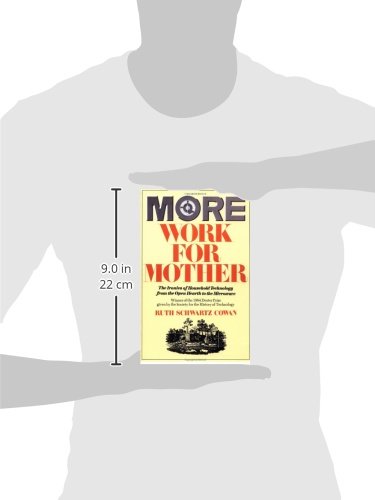
More Work For Mother: The Ironies Of Household Technology From The Open Hearth To The Microwave


BrandBasic Books
CategoryParenting & Relationships
More Work For Mother: The Ironies Of Household Technology From The Open Hearth To The Microwave
List Price: $38.39$34.55DEALYou Save: $3.84 (10%)
Free shippingFree Returns – 30 daysFree Order CancellationSecure Payment2–3 Days DeliveryGet It October 26, 2026In Stock (22)No marketing spamNo account requiredFulfilment by FedEx / Amazon / UPS / ShipwirePayPal / Card Buyer Protection
Customer Reviews
Reviews sourced from verified Amazon purchasers3.8
out of 5
Based on 10 reviews
5★
50%
4★
20%
3★
20%
2★
0%
1★
10%
Good for History Class
AE Martin✓ Verified Purchase•December 16, 2013
This book is great for a History Class on Technology, but the problem I see with it is that it seems to be jaded a bit by the writer. There is a counter position put out by Mr. Mokyr of Northwestern University.
I bought this to replace copy I lost some years ago
Karey Harrison✓ Verified Purchase•August 11, 2013
I particularly like the analysis of the interaction between social, economic and technological factors. I wanted to re-read and refer to the chapter on refrigeration, which demonstrated how market concentration meant the less efficient compression fridge came to dominate the market over more efficient absorption refridgerators.
Fabulous Story
Nell F. Boyle•March 28, 2009
I loved this book, what a fascinating study on how our culture evolved and the choices that we made that define our home life. I found the book to be well researched and engaging. I have recommended it to many friends.
Home as a technological system? It's a stretch.
James Hoogerwerf•March 30, 2007
When one thinks of industrialization, the image of a factory comes to mind. However, Cowan looks at the home as a productive venue. According to Cowan's thesis in an industrial society the work women perform as homemakers is tied to technological systems just like in a factory. Work inside or outside the home utilizes electricity, gas, or petroleum as sources of power, and manufacturing and homemaking each require the use of specialized tools.
Tools used in the home help to accomplish specific tasks but, Cowan argues, they "have a life of their own" and "set limits to our work."(9) While tools define behavior within the home, it is outside institutions (manufacturing firms, advertising agents, market researchers) that "mediate"(11) which devices are available for the woman to use in the home. For example Cowan points out that the electric refrigerator likely won out over the gas-absorption design due to the aggressiveness of electric utilities verses the more conservative gas manufacturing companies between 1920 and 1950.
Notwithstanding the use of labor savings devices, women's work has not become easier or less time consuming. Affluence and technology have made a woman's role more complicated and demanding. Partly due to circumstances such as the reduction of numbers of servants available to do drudge work in the home, the change has more to due with an innate human desire for "privacy and autonomy."(149) It is a "convention so deeply imbedded in our individual and collective consciousness that even the profound changes wrought by the twentieth century have not yet shaken it."(150)
Perhaps Cowan's best example of the effects of technology on the home is the stove. Food preparation was a cooperative effort between women and men to produce a simple one-pot meal over an open hearth in pre-industrial days. While the stove reduced the man's effort to maintain the fire, it allowed more complex meals to be prepared by the woman.
If industrialization seemingly reduces the effort necessary for a women to prepare and preserve food, make and maintain clothing, or be the health provider within the home, an entirely new role came with the advent of the automobile. The woman became the household's transportation provider!
The net effect of technology on homemaking has been to reduce drudgery but not labor. While women have become more productive in the home, what time is saved is now consumed by other tasks. In a further irony house work has helped to perpetuate the idea of homemaking as women's work thus reinforcing the stereotypical inequity between genders. However the decline in domestic servants would seem to imply greater equality between classes.
Unlike market labor, women are unpaid, work in isolated workplaces, and perform as unspecialized workers. The value of housework is difficult to quantify and critics argue that household's do not "produce" anything. But is not that the goal of industry; to produce a good or provide a service? Why does homemaking have to be seen in terms of output? What about family and childrearing? These are intangibles beyond monetary value.
Tools used in the home help to accomplish specific tasks but, Cowan argues, they "have a life of their own" and "set limits to our work."(9) While tools define behavior within the home, it is outside institutions (manufacturing firms, advertising agents, market researchers) that "mediate"(11) which devices are available for the woman to use in the home. For example Cowan points out that the electric refrigerator likely won out over the gas-absorption design due to the aggressiveness of electric utilities verses the more conservative gas manufacturing companies between 1920 and 1950.
Notwithstanding the use of labor savings devices, women's work has not become easier or less time consuming. Affluence and technology have made a woman's role more complicated and demanding. Partly due to circumstances such as the reduction of numbers of servants available to do drudge work in the home, the change has more to due with an innate human desire for "privacy and autonomy."(149) It is a "convention so deeply imbedded in our individual and collective consciousness that even the profound changes wrought by the twentieth century have not yet shaken it."(150)
Perhaps Cowan's best example of the effects of technology on the home is the stove. Food preparation was a cooperative effort between women and men to produce a simple one-pot meal over an open hearth in pre-industrial days. While the stove reduced the man's effort to maintain the fire, it allowed more complex meals to be prepared by the woman.
If industrialization seemingly reduces the effort necessary for a women to prepare and preserve food, make and maintain clothing, or be the health provider within the home, an entirely new role came with the advent of the automobile. The woman became the household's transportation provider!
The net effect of technology on homemaking has been to reduce drudgery but not labor. While women have become more productive in the home, what time is saved is now consumed by other tasks. In a further irony house work has helped to perpetuate the idea of homemaking as women's work thus reinforcing the stereotypical inequity between genders. However the decline in domestic servants would seem to imply greater equality between classes.
Unlike market labor, women are unpaid, work in isolated workplaces, and perform as unspecialized workers. The value of housework is difficult to quantify and critics argue that household's do not "produce" anything. But is not that the goal of industry; to produce a good or provide a service? Why does homemaking have to be seen in terms of output? What about family and childrearing? These are intangibles beyond monetary value.
Gimmie a break - just look around!
Avid Reader•November 16, 2005
More work for mother? Gimmie a break!! This book attempts to further the fiction that it's women who are still doing the housework. While this may have been true 40 years ago, the feminization of the American male that's occurred since then makes this a thing of the past. Just look around! Men are pushing strollers, cleaning houses, cooking dinners, involved in selecting décor, PLUS doing all the "men's work" that they previously did, such as yard work, fixing the car, and doing all those other heavy and dirty jobs. To make matters worse, these are often men who work demanding jobs with lots of travel to bring in the money, often for wives that are just sitting home on their asses! When these men come home from a grinding business trip, the wife is on them to "be more involved," so you see them running around killing themselves around the house and with the kids while their wives are over at the spa or having coffee with their yenta friends. More work for Mother? The book we need is "Modern Marriage: What's in it for Father?"
Page 1 of 2