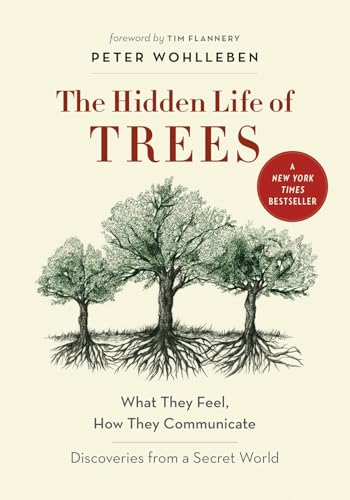
The Hidden Life of Trees: What They Feel, How They Communicate―Discoveries from A Secret World (The Mysteries of Nature, 1)


Key features
- •G
- •r
- •e
- •y
- •s
- •t
BrandGreystone Books
CategoryPlants & Animals
The Hidden Life of Trees: What They Feel, How They Communicate―Discoveries from A Secret World (The Mysteries of Nature, 1)
List Price: $27.82$25.04DEALYou Save: $2.78 (10%)
Free shippingFree Returns – 30 daysFree Order CancellationSecure Payment2–3 Days DeliveryGet It June 25, 2026In Stock (38)No marketing spamNo account requiredFulfilment by FedEx / Amazon / UPS / ShipwirePayPal / Card Buyer Protection
Customer Reviews
Reviews sourced from verified Amazon purchasers4.6
out of 5
Based on 10 reviews
5★
80%
4★
20%
3★
0%
2★
0%
1★
0%
Fascinating Book
David R. Risser✓ Verified Purchase•November 26, 2016
I picked this book up from my local library, and rapidly discovered that it was a remarkable book and a joy to read. From Peter Wohllenben's discussion of the "Wood Wide Web", to his explanations of the amazing processes of life, death, regeneration, and of course, communication, this book is truly a paradigm-smashing work of interest to anyone with an interest in trees, whether as a forester (as is the author), or as a landscaper, or anyone who just enjoys walks in the woods. It may strike some as odd, to discuss the "feelings" of trees, but after reading this book the reader can have no doubt trees can, indeed, feel, and they express those feelings in many different ways.
The author, Peter Wohlleben, is a German forester, and that may also seem an odd occupation for the author of a book about tree communication, but Wohlleben clearly has strong feelings for trees, and his work with trees has led to a much greater understanding of their "inner life" than is held by the casual tree observer. The book is beautifully written, and though translated from the original German, the descriptions of trees are truly enchanting. After reading this book, enchanted forests such as the ones in the Lord of the Rings, where the trees can see and hear and communicate with one another, do not seem so far-fetched.
As Wohlleben points out, trees are not well-understood by humans due to the fact that trees live on a completely different time scale than humans. Some trees may live over 100 times as long as the average human lifespan, and for them, transmitting information can occur very slowly, at 1/3 of an inch per second for the electrical impulses that pass through the roots of trees, versus milliseconds for the electrical impulses in humans and other animals. A human being can be born, live a long and full life, and die when old, while a tree that begins at the same time is still experiencing its childhood or early adolescence. But trees communicate in many different ways, not just by electrical impulses. They may use the senses of taste and smell by releasing chemicals into the air. This may be done to warn other nearby trees to be prepared for a pest invasion, or to attract other predators that will feed on particular leaf-eating insects that may have found a particular tree attractive.
Also of interest is Wohlleben's description of trees as social beings, and he makes it clear that most trees require the presence of other trees of the same species to live a healthy and productive life. These trees, in a forest, provide nurturing of the young, and provide protections for one another. It is in the forest that tree communication is at its best. This book is truly enchanting, and will be loved and appreciated by anyone who enjoys a walk in the woods.
The author, Peter Wohlleben, is a German forester, and that may also seem an odd occupation for the author of a book about tree communication, but Wohlleben clearly has strong feelings for trees, and his work with trees has led to a much greater understanding of their "inner life" than is held by the casual tree observer. The book is beautifully written, and though translated from the original German, the descriptions of trees are truly enchanting. After reading this book, enchanted forests such as the ones in the Lord of the Rings, where the trees can see and hear and communicate with one another, do not seem so far-fetched.
As Wohlleben points out, trees are not well-understood by humans due to the fact that trees live on a completely different time scale than humans. Some trees may live over 100 times as long as the average human lifespan, and for them, transmitting information can occur very slowly, at 1/3 of an inch per second for the electrical impulses that pass through the roots of trees, versus milliseconds for the electrical impulses in humans and other animals. A human being can be born, live a long and full life, and die when old, while a tree that begins at the same time is still experiencing its childhood or early adolescence. But trees communicate in many different ways, not just by electrical impulses. They may use the senses of taste and smell by releasing chemicals into the air. This may be done to warn other nearby trees to be prepared for a pest invasion, or to attract other predators that will feed on particular leaf-eating insects that may have found a particular tree attractive.
Also of interest is Wohlleben's description of trees as social beings, and he makes it clear that most trees require the presence of other trees of the same species to live a healthy and productive life. These trees, in a forest, provide nurturing of the young, and provide protections for one another. It is in the forest that tree communication is at its best. This book is truly enchanting, and will be loved and appreciated by anyone who enjoys a walk in the woods.
Enchanting
Naturalist✓ Verified Purchase•November 9, 2016
I loved this book. You will never look at trees the same way again.
Very well written (and translated) and very engaging. Highly recommended.
The only two points I'd like to add are:
1) At location 1609, "Ash and elders behave in a similar manner" should instead be, "Ash and alders behave in a similar manner."
2) At location 2342, he writes, "It's dangerous when foreigners pop up that are genetically very similar to native species. The Japanese larch is just such a case. When it arrived here, it met the European larch. The European larch often grows crooked and, in addition, quite slowly, and so in the last century it was often replaced with the Japanese tree. Both species cross easily to form hybrids. This raises the danger that one day, a long time from now, the last purebred European larches will disappear." I wonder what the problem is exactly if the European larches disappear. He himself just stated that they often grow crooked and quite slowly. So, what's wrong with the hybrids (or even the Japanese larch) replacing them?
Very well written (and translated) and very engaging. Highly recommended.
The only two points I'd like to add are:
1) At location 1609, "Ash and elders behave in a similar manner" should instead be, "Ash and alders behave in a similar manner."
2) At location 2342, he writes, "It's dangerous when foreigners pop up that are genetically very similar to native species. The Japanese larch is just such a case. When it arrived here, it met the European larch. The European larch often grows crooked and, in addition, quite slowly, and so in the last century it was often replaced with the Japanese tree. Both species cross easily to form hybrids. This raises the danger that one day, a long time from now, the last purebred European larches will disappear." I wonder what the problem is exactly if the European larches disappear. He himself just stated that they often grow crooked and quite slowly. So, what's wrong with the hybrids (or even the Japanese larch) replacing them?
The excellent and the execrable.
Mr. C. Doyle✓ Verified Purchase•October 31, 2016
The excellent
I heard Peter Wohlleben on a radio interview about this book, and found his discussion of tree communication, community and interactions with mushrooms, so interesting that I bought the book. What impressed me was that his answers were all scientific and to the point, though some of the questions were pretty whacky. The good part of his book is that Peter brings together in one place a really good look at forest ecology. He outlines how trees work in terms of light and water, their intricate relationship and co-dependence with the mushroom family. How they communicate, how they deal with pests and warn nearby trees of danger, how they even feed and support each other. He goes into soil ecology and also that of birds, animals and insects that live among and in the trees. I found that after reading this book, as I walked in the forest I started noticing things I had not before. That is all excellent
The execrable.
The style of the book is readable, but not elegant, and occasionally repetitive. But the problem with Peter's style is that he loves trees so much he want them to be people, and his anthropomorphism can really grate. (I am not the only reviewer to note this problem.) When we talk of trees we look to ourselves to help our descriptions thus "parenting trees" is a fair metaphor. (It also works the other way when we consider our "roots" or our project "bears fruit"). But in this book metaphor morphs into reality and may have confused the author along with some of his readers. For example Peter seriously talks about trees feeling pain and trees having an emotional balance. These are very human characteristics and we share them with most animals as they are necessary to stop us killing ourselves as we learn to move about our environment and also to make choices. But it is hard to see how they would be of any advantage to a sessile tree with limited options, and so there is no obvious reason to think they would have evolved in plants. I can't help feeling that in trying to humanize trees, the wonder of what they are and how they work becomes diminished. However, this is not to say don't get this book, do! Just be forewarned to take the humanization as metaphor, not reality.
I heard Peter Wohlleben on a radio interview about this book, and found his discussion of tree communication, community and interactions with mushrooms, so interesting that I bought the book. What impressed me was that his answers were all scientific and to the point, though some of the questions were pretty whacky. The good part of his book is that Peter brings together in one place a really good look at forest ecology. He outlines how trees work in terms of light and water, their intricate relationship and co-dependence with the mushroom family. How they communicate, how they deal with pests and warn nearby trees of danger, how they even feed and support each other. He goes into soil ecology and also that of birds, animals and insects that live among and in the trees. I found that after reading this book, as I walked in the forest I started noticing things I had not before. That is all excellent
The execrable.
The style of the book is readable, but not elegant, and occasionally repetitive. But the problem with Peter's style is that he loves trees so much he want them to be people, and his anthropomorphism can really grate. (I am not the only reviewer to note this problem.) When we talk of trees we look to ourselves to help our descriptions thus "parenting trees" is a fair metaphor. (It also works the other way when we consider our "roots" or our project "bears fruit"). But in this book metaphor morphs into reality and may have confused the author along with some of his readers. For example Peter seriously talks about trees feeling pain and trees having an emotional balance. These are very human characteristics and we share them with most animals as they are necessary to stop us killing ourselves as we learn to move about our environment and also to make choices. But it is hard to see how they would be of any advantage to a sessile tree with limited options, and so there is no obvious reason to think they would have evolved in plants. I can't help feeling that in trying to humanize trees, the wonder of what they are and how they work becomes diminished. However, this is not to say don't get this book, do! Just be forewarned to take the humanization as metaphor, not reality.
Unabatedly fascinating
glenn melton✓ Verified Purchase•October 27, 2016
I waited for a long time for this book to be translated and I am just amazed at how it has changed my viewpoint. I worked at Weyerhaeuser for a couple of years and I don't think anyone there is aware of this information. I would recommend this to anyone interested in lifes' questions about trees being much more than a resource.
I Think That I Shall Never See...
Thomas H. Arthur✓ Verified Purchase•October 13, 2016
Loved the book. Live on a tree-filled island in the summer and have always "felt" the companionship of the trees but thought I was crazy. Not any more. Bought it for my four children because they will "know" those same trees too.
Page 1 of 2