Elenco Snap Circuit Extreme



Key features
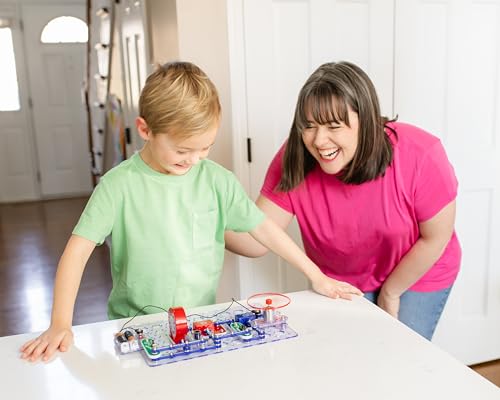
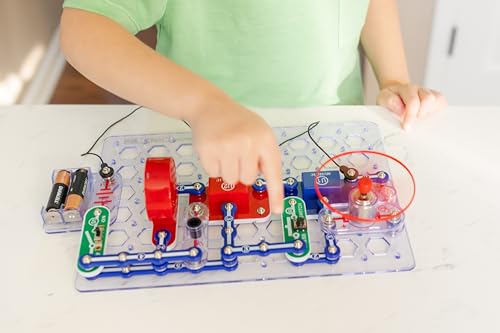
- •Build over 750 experiments with 80 parts
- •Experiments include: sound activated switch, Lie detector, adjustable light controller, Am radio, rechargeable battery and many more!
- •Parts included: Photo resistor, power amplifier, variable capacitor, Analog meter, solar Cell, computer interface, full color manuals
- •No soldering - no tools - it's a snap! Snap Circuits parts require no tools and and click together to ensure solid electrical connections
- •With the included software and pc-interface cable, your child can view waveforms and frequencies, just like an electronics engineer. How cool is that?!
- •Our AWARD-WINNING product line of snap Circuits supports a vigorous STEM/ steam educational curriculum
BrandSnap Circuits
CategoryScience Kits & Toys
Size750 Projects
ColorMulticolor
Warranty1 Year Warranty Against Manufacturer Defects
Elenco Snap Circuit Extreme
List Price: $183.32$164.99DEALYou Save: $18.33 (10%)
Free shippingFree Returns – 30 daysFree Order CancellationSecure Payment2–3 Days DeliveryGet It October 25, 2026In Stock (1)No marketing spamNo account requiredFulfilment by FedEx / Amazon / UPS / ShipwirePayPal / Card Buyer Protection
Customer Reviews
Reviews sourced from verified Amazon purchasers4.8
out of 5
Based on 10 reviews
5★
80%
4★
20%
3★
0%
2★
0%
1★
0%
Fantastic kit! Engineer and Father Approved!
Scott✓ Verified Purchase•November 7, 2023
My 9-year old son and 7-year old daughter love this thing, heck, I love this thing!
The after-school care that my kids go to has the less expensive model (the SC-300) and the kids were always playing with this, so when Christmas 2014 rolled around, I knew exactly what to get my kids. They've had 7 months to play and build and imaginate (yup, that's a new word) with this kit and they've absolutely loved it. I remember as a kid having a similar electronics kit that I spent much of my youth playing with, and I think I was just as excited to get this as my kids were. It's a little pricey, but after seeing how much all the kids at after-school care played with it"”and being able to view it in person"”I knew that it was worth it.
The kit is very well laid out and there are plastic blow-molded trays that hold all the pieces together. This makes it very easy to tell if you're missing any pieces. There a 5 books of designs chock full of things for the kids to build and the instructions are very easy to understand and all the electronic components are clearly marked.
One of the coolest things about this kit is it comes with hardware (a cable) that connects to your PC or laptop via the microphone port that turns your computer into an oscilloscope! It's basic stuff, but it works very well I and really takes this kit to a whole new level. It's really educational being able to show the kids voltages and currents and waveforms on the computer screen. It pulls together nicely the ability for the kids to physically see what's happening (motors turning, LEDs flashing), and see why it's happening (voltages/waveforms) on the oscilloscope.
Now, you know you've got something good when the kids start taking apart old toys (anything with a motor in it) and start adding on to this kit with pieces of wire (from the same cannibalized toy). Real MacGyver stuff going on here! The kids have even joined forces and connected their kit with friend's kits"”just make sure you have all your parts before the kids leave!
I've read some other reviews that are little hard on this kit and that it doesn't really teach kids about electronics"”that this kit it to "cartoony" and more of a puzzle than anything. Is this kit fun? You betcha. Is there learning and teaching happening? Absolutely. Are my kids going to learn about Maxwell's equation, Lorentz's law, Gauss' law? Probably not. I'm an electrical engineer and I can see the fun and educational aspects that this kit provides. If your kids outgrow this and want something more advanced, than by all means get one of the more technical kits that are available. When you were teaching your kids to read, you didn't start with Tolstoy, did you?
This is a fantabulous kit for kids and I'm very happy I purchased it. It's well built, well thought out, and is definitely one of those toys that your children one day will blow the dust off the box and tell their children, "Look at this toy I had when I was your age!"
The after-school care that my kids go to has the less expensive model (the SC-300) and the kids were always playing with this, so when Christmas 2014 rolled around, I knew exactly what to get my kids. They've had 7 months to play and build and imaginate (yup, that's a new word) with this kit and they've absolutely loved it. I remember as a kid having a similar electronics kit that I spent much of my youth playing with, and I think I was just as excited to get this as my kids were. It's a little pricey, but after seeing how much all the kids at after-school care played with it"”and being able to view it in person"”I knew that it was worth it.
The kit is very well laid out and there are plastic blow-molded trays that hold all the pieces together. This makes it very easy to tell if you're missing any pieces. There a 5 books of designs chock full of things for the kids to build and the instructions are very easy to understand and all the electronic components are clearly marked.
One of the coolest things about this kit is it comes with hardware (a cable) that connects to your PC or laptop via the microphone port that turns your computer into an oscilloscope! It's basic stuff, but it works very well I and really takes this kit to a whole new level. It's really educational being able to show the kids voltages and currents and waveforms on the computer screen. It pulls together nicely the ability for the kids to physically see what's happening (motors turning, LEDs flashing), and see why it's happening (voltages/waveforms) on the oscilloscope.
Now, you know you've got something good when the kids start taking apart old toys (anything with a motor in it) and start adding on to this kit with pieces of wire (from the same cannibalized toy). Real MacGyver stuff going on here! The kids have even joined forces and connected their kit with friend's kits"”just make sure you have all your parts before the kids leave!
I've read some other reviews that are little hard on this kit and that it doesn't really teach kids about electronics"”that this kit it to "cartoony" and more of a puzzle than anything. Is this kit fun? You betcha. Is there learning and teaching happening? Absolutely. Are my kids going to learn about Maxwell's equation, Lorentz's law, Gauss' law? Probably not. I'm an electrical engineer and I can see the fun and educational aspects that this kit provides. If your kids outgrow this and want something more advanced, than by all means get one of the more technical kits that are available. When you were teaching your kids to read, you didn't start with Tolstoy, did you?
This is a fantabulous kit for kids and I'm very happy I purchased it. It's well built, well thought out, and is definitely one of those toys that your children one day will blow the dust off the box and tell their children, "Look at this toy I had when I was your age!"
Overall a great kit to very quickly snap together circuits and learn about electronics
user111✓ Verified Purchase•October 29, 2023
I got this today. I will first confess that I bought this for myself for my 40th birthday. I have ALWAYS wanted a big kit like this. I've always been interested in electronics and I thought it would be great to have something to toy around with that doesn't take a lot of work, just snap snap go.
The set comes with several components, and they have snaps on them, basically the same type of snap you have on clothing, and you just snap things together according to the diagrams. Included are several project books with various levels of projects in them. For example, book 1 had projects 1-100 or so. Being an adult, I spent the past 2 or 3 hours blasting through book 1. I probably built something like 15 projects out of the 100. There were a lot of projects that were somewhat repetitive and I really was not interested in snapping them all together, even though it is really fast and easy. And I'm always impatient. They give pretty detailed instructions, describing snapping things in stages as things stack vertically. I'm way to impatient for all that. I just snapped it together the way I wanted as long as I knew it was "the same thing". I think it is great that you can follow exactly if you are just learning or "make your own path" if you are a little more advanced. There are several cautions about what NOT to do and of course those should be heeded for safety reasons. But a conductor is a conductor and it isn't really critical how you get from point A to point B to satisfy the basic connections. When it came to building variations, I usually just looked at the change in the diagram and convinced myself that I understood the difference and moved on without snapping anything. Children of various ages would probably take more time and experiment more. I did grab Book 2 and the first few projects did look interesting so I expect there will be several more that I'll want to do. And I may way to go back after I've devoured everything and play a little more. I think kids would want to do the same. I have two daughters, aged 5 and 2 and when I bought it *for myself* I told myself that they would probably be interested in the kit sooner or later, and I do think that will be the case. I'll enjoy doing that with my kids for sure.
I do really like how easy it is to snap it together and get the results. Because it was so easy I was encouraged to try some things -- basically "what if" scenarios that popped into my head as I built the projects. I think kids would do that also, and that is one of the high points of how this set works. I do wish that there was a lot more explanation about the projects. The explanations given are kind of middle of the road, not going really deep but not totally devoid of info about the circuit either. Given that I'm an adult and I already know a few things about electronics and basic circuits I feel like I filled in most of the blanks but I would not expect a child to do that. It is my understanding there is some sort of student guide that would go along with the project book and would go into more detail. My personal opinion on that is: Just include it. Selling it separately only reduces the utility of the kit and makes people irritated that they have to go buy more stuff. I can't imagine that the actual cost of a few more pages of paper would make a huge difference. One thing that is glaringly missing as far as I can tell is an explanation of each IC. Each one has several pins which I'm sure have a designated function, and the projects certainly use various pins, but there does not seem to be any explanation of what exactly each pin is for. This would normally be given for any IC that you really bought in the real world and I think it should be given for a project kit like this also. Maybe I just missed it. In summary: Great kit, really fast and easy, enough projects and flexibility to provide fun and learning for a long time. A ding for lack of supporting materials that should be present by default to make an excellent 5 star set.
The set comes with several components, and they have snaps on them, basically the same type of snap you have on clothing, and you just snap things together according to the diagrams. Included are several project books with various levels of projects in them. For example, book 1 had projects 1-100 or so. Being an adult, I spent the past 2 or 3 hours blasting through book 1. I probably built something like 15 projects out of the 100. There were a lot of projects that were somewhat repetitive and I really was not interested in snapping them all together, even though it is really fast and easy. And I'm always impatient. They give pretty detailed instructions, describing snapping things in stages as things stack vertically. I'm way to impatient for all that. I just snapped it together the way I wanted as long as I knew it was "the same thing". I think it is great that you can follow exactly if you are just learning or "make your own path" if you are a little more advanced. There are several cautions about what NOT to do and of course those should be heeded for safety reasons. But a conductor is a conductor and it isn't really critical how you get from point A to point B to satisfy the basic connections. When it came to building variations, I usually just looked at the change in the diagram and convinced myself that I understood the difference and moved on without snapping anything. Children of various ages would probably take more time and experiment more. I did grab Book 2 and the first few projects did look interesting so I expect there will be several more that I'll want to do. And I may way to go back after I've devoured everything and play a little more. I think kids would want to do the same. I have two daughters, aged 5 and 2 and when I bought it *for myself* I told myself that they would probably be interested in the kit sooner or later, and I do think that will be the case. I'll enjoy doing that with my kids for sure.
I do really like how easy it is to snap it together and get the results. Because it was so easy I was encouraged to try some things -- basically "what if" scenarios that popped into my head as I built the projects. I think kids would do that also, and that is one of the high points of how this set works. I do wish that there was a lot more explanation about the projects. The explanations given are kind of middle of the road, not going really deep but not totally devoid of info about the circuit either. Given that I'm an adult and I already know a few things about electronics and basic circuits I feel like I filled in most of the blanks but I would not expect a child to do that. It is my understanding there is some sort of student guide that would go along with the project book and would go into more detail. My personal opinion on that is: Just include it. Selling it separately only reduces the utility of the kit and makes people irritated that they have to go buy more stuff. I can't imagine that the actual cost of a few more pages of paper would make a huge difference. One thing that is glaringly missing as far as I can tell is an explanation of each IC. Each one has several pins which I'm sure have a designated function, and the projects certainly use various pins, but there does not seem to be any explanation of what exactly each pin is for. This would normally be given for any IC that you really bought in the real world and I think it should be given for a project kit like this also. Maybe I just missed it. In summary: Great kit, really fast and easy, enough projects and flexibility to provide fun and learning for a long time. A ding for lack of supporting materials that should be present by default to make an excellent 5 star set.
Great for kids and better for Teachers
Mr MAC✓ Verified Purchase•October 27, 2023
Love this product. Game changer for teaching my Automotive students about electricity in all facets. Engaging and fun. Highly recommend
Kiddo loves them!
TN Belle✓ Verified Purchase•September 25, 2023
My 10 year old has never been hugely into toys, as soon as the novelty wears off they're largely forgotten. Except for these. He got these for Christmas last year and *still* spends hours every week playing with them.
After four years - still fun, affordable, easy to use and picked by schools for STEM classes
Justbooking✓ Verified Purchase•September 12, 2023
If you're wondering what to buy your child this year that is not another toy or video game, consider Snap Circuits. Elementary schools in my area have introduced them as part of their STEM curriculum and they have been a hit with the students as they are able to create all sorts of projects, including alarms, fans, lamps, AM radio, doorbells, special sound and light effects, etc. I will compare it to Little Bits and Lego Mindstorm below.
There are materials and training out there to build more elaborate toys that could potentially get your child a Science Fair prize, but if you're looking for something affordable that doesn't require an advance degree, allows kids to have fun on their own and spend hours tinkering with, you'll soon find that the Snap Circuits 750 sets is the best investment. It is the one my child's school picked in the end for ease of use and because - let's face it - kids love it. A Top 10 Educational Toy award and a 5-star overall review speaks for itself.
Don't let the nondescript look and fancy name fool you - this is a high quality, five-star rated toy, voted one of the best of the year. You can buy smaller Snap Circuit sets with the individual manuals, but the price overall will be higher when you buy all five separately. Get the whole set instead - the SC-750 set is a bargain for the hours of fun this will bring your child and your family for years to come. This set includes the 5 easy-to-follow manuals of the smaller sets and all the parts needed to build 750 projects in all, in a sturdy carrying case to hold it all. It's for kids 8-15 but grown-ups love to help as well
This SC-750 set grows with your child. As a learning tool, the projects are meant to be done in some sequence, with each one explaining a part and what happens if you move this or that - at least in the beginning. We started working on the Jr (100) set which is the pink manual (1-101) when my son was five and he was able to do it with our help. Every step is explained, once you learn one project you move to the next and see what happens to a siren when you add a resistor, for example. The descriptions are kept short and to the point - for example, that the resistor lowers the volume.
One reviewer wished each part of each project was explained in detail each time. As one project builds on the knowledge from a previous project, it's impossible to explain what happens with each part in any one project. This would fill the page with tons of text. Rather, it's a gradual learning process and it's assumed that earlier projects have been done.
Four years later my son still loves it but is able to do it on his own, and is doing projects from other manuals. He can skip ahead too as the diagrams clearly show how to put all the parts together - though he might miss some explanations about the "why" of using each circuit part in a particular project if he doesn't do them in sequence. Not a big issue at this age where assembly-type toys with lots of parts are the norm.
My now nine-year old considers the R-750 set to be - in his words - awesome. Seeing how each varies intrigues him to no end. He's still fascinated with the set, more so now that he's also using them in school.
I've also had the opportunity to see other STEM toys in action. A month ago, Barnes and Noble hosted Mini Makers fairs in stores nationwide and one that was featured was Little Bits. It is probably more along the lines of more traditional circuits, where small components are put together to create alarm clocks and moving parts in legos. It is also exorbitantly expensive. Fortunately some libraries are investing thousands of dollars in buying these so you may soon be able to find them free of charge near you. It too ends up creating gizmos and gadgets, but for a lot of $$.
Today I covered another STEM event at a library, this time with Lego Mindstorm. A teacher helped students for two hours to build a Lego robot, starting with the base Mindstorm unit, programming it on a computer, setting up parameters for instructions to make the robot spin, turn lights on and off, etc. This class was free but if you decide to buy it on amazon, a Lego Mindstorm Kit is very expensive and only lets you do a handful of projects. Now the big "BUT" kids have a hard time doing these on their own which is why schools are bringing teachers to train them and companies - not schools, at least in my area - are doing after-school classes and summer camps just to learn how to use this Lego Mindstorm. If the teacher leaves, the kids are left with a bunch of technology they don't know how to use because it can be so complex.
In all, either as an introduction to circuits or simply as an assembly toy, it's a winner.
There are materials and training out there to build more elaborate toys that could potentially get your child a Science Fair prize, but if you're looking for something affordable that doesn't require an advance degree, allows kids to have fun on their own and spend hours tinkering with, you'll soon find that the Snap Circuits 750 sets is the best investment. It is the one my child's school picked in the end for ease of use and because - let's face it - kids love it. A Top 10 Educational Toy award and a 5-star overall review speaks for itself.
Don't let the nondescript look and fancy name fool you - this is a high quality, five-star rated toy, voted one of the best of the year. You can buy smaller Snap Circuit sets with the individual manuals, but the price overall will be higher when you buy all five separately. Get the whole set instead - the SC-750 set is a bargain for the hours of fun this will bring your child and your family for years to come. This set includes the 5 easy-to-follow manuals of the smaller sets and all the parts needed to build 750 projects in all, in a sturdy carrying case to hold it all. It's for kids 8-15 but grown-ups love to help as well
This SC-750 set grows with your child. As a learning tool, the projects are meant to be done in some sequence, with each one explaining a part and what happens if you move this or that - at least in the beginning. We started working on the Jr (100) set which is the pink manual (1-101) when my son was five and he was able to do it with our help. Every step is explained, once you learn one project you move to the next and see what happens to a siren when you add a resistor, for example. The descriptions are kept short and to the point - for example, that the resistor lowers the volume.
One reviewer wished each part of each project was explained in detail each time. As one project builds on the knowledge from a previous project, it's impossible to explain what happens with each part in any one project. This would fill the page with tons of text. Rather, it's a gradual learning process and it's assumed that earlier projects have been done.
Four years later my son still loves it but is able to do it on his own, and is doing projects from other manuals. He can skip ahead too as the diagrams clearly show how to put all the parts together - though he might miss some explanations about the "why" of using each circuit part in a particular project if he doesn't do them in sequence. Not a big issue at this age where assembly-type toys with lots of parts are the norm.
My now nine-year old considers the R-750 set to be - in his words - awesome. Seeing how each varies intrigues him to no end. He's still fascinated with the set, more so now that he's also using them in school.
I've also had the opportunity to see other STEM toys in action. A month ago, Barnes and Noble hosted Mini Makers fairs in stores nationwide and one that was featured was Little Bits. It is probably more along the lines of more traditional circuits, where small components are put together to create alarm clocks and moving parts in legos. It is also exorbitantly expensive. Fortunately some libraries are investing thousands of dollars in buying these so you may soon be able to find them free of charge near you. It too ends up creating gizmos and gadgets, but for a lot of $$.
Today I covered another STEM event at a library, this time with Lego Mindstorm. A teacher helped students for two hours to build a Lego robot, starting with the base Mindstorm unit, programming it on a computer, setting up parameters for instructions to make the robot spin, turn lights on and off, etc. This class was free but if you decide to buy it on amazon, a Lego Mindstorm Kit is very expensive and only lets you do a handful of projects. Now the big "BUT" kids have a hard time doing these on their own which is why schools are bringing teachers to train them and companies - not schools, at least in my area - are doing after-school classes and summer camps just to learn how to use this Lego Mindstorm. If the teacher leaves, the kids are left with a bunch of technology they don't know how to use because it can be so complex.
In all, either as an introduction to circuits or simply as an assembly toy, it's a winner.
Page 1 of 2