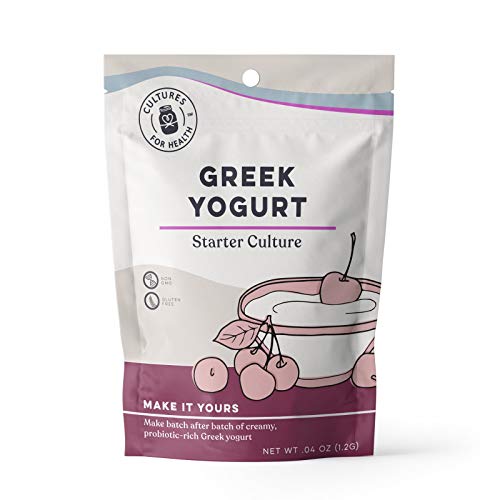
Cultures for Health Greek Yogurt Starter Culture | 2 Packets Dehydrated Heirloom Style DIY Probiotic Yogurt | Delicious for Smoothies, Granola and Berries, Tzatziki, Soup, & Other Healthy Snacks


Key features
- •MAKE YOUR OWN GREEK YOGURT USING YOGURT STARTER CULTURE
- •RE-USE HEIRLOOM PROBIOTIC YOGURT CULTURES MANY TIMES WITHOUT LOSS IN POTENCY: the yogurt probiotic starter from Cultures For Health are of heirloom quality, meaning that they'll not lose potency even if you were to re-use them many times; oom yogurt starters have a greater biodiversity in microorganisms that allows them to reculture over and over again, so you can use the same batch of starters to make greek yogurt with no loss in health benefits time and again - that's great savings
- •GLUTEN-FREE AND NON-GMO YOGHURT STARTER: make your own healthy Greek yogurt with absolute peace of mind using this organic yogurt starter sachet as it contains only the right ingredients and nothing artificial.
- •EASY-TO-USE GREEK YOGURT STARTER:each packet yields 1 quart of Greek yogurt and takes only a few minutes to prepare, and thereafter, you can continue making your own delicious yogurt batch after batch
- •VERSATILE YOGURT CULTURE STARTER: when you buy Cultures For Health yogurt starter, you not only make great-tasting Greek yogurt (you know what goes into it too), you can also get FREE access to our 155-page yogurt ebook with a treasure trove of easy recipes, articles and how-to videos
Cultures for Health Greek Yogurt Starter Culture | 2 Packets Dehydrated Heirloom Style DIY Probiotic Yogurt | Delicious for Smoothies, Granola and Berries, Tzatziki, Soup, & Other Healthy Snacks
List Price: $29.08$26.17DEALYou Save: $2.91 (10%)
Free shippingFree Returns – 30 daysFree Order CancellationSecure Payment2–3 Days DeliveryGet It June 25, 2026In Stock (1)No marketing spamNo account requiredFulfilment by FedEx / Amazon / UPS / ShipwirePayPal / Card Buyer Protection
Customer Reviews
Reviews sourced from verified Amazon purchasers3.9
out of 5
Based on 10 reviews
5★
90%
4★
10%
3★
0%
2★
0%
1★
0%
Greek yogurt
Leonora R✓ Verified Purchase•September 10, 2023
Very tasty like flavor very sweet and stern with great flavor.
Makes great Greek yogurt!
Kindle Customer✓ Verified Purchase•September 1, 2023
I first tried the Greek yogurt culture a few years ago. I wish I had started making my own yogurt years ago! I use a gallon of milk to make yogurt in my crockpot. Eating it with my homemade blueberry and raspberry jam, it tastes even better than the Chobani yogurt I used to buy!
Wait for the second or third batch
BookWorm✓ Verified Purchase•July 28, 2023
My first batch was, as promised, not good. It was basically slightly thickened milk. It tasted like I had added a spoonful of yogurt to a glass of milk and tried to call it Laben. I was disappointed. But the directions say the first batch may not be great, so I made a second batch, using from the "eh" batch. And y'all. The second batch is great. It's perfect. I'm thrilled not to have to buy cups of yogurt from the store to turn into large batch yogurt at home anymore. And I'm looking forward to sharing some culture with my friends, so they can make delicious yogurt at home, too. YAY!
Not absolutely necessary but makes good yogurt
B. Hanley✓ Verified Purchase•July 18, 2023
I've made greek yogurt in an immersion cooker container starting with live cultures from commercial greek yogurt but if you want to start from dry cultures, this is the ticket. Works either way.
Tasty Yogurt
Amazon Customer✓ Verified Purchase•July 11, 2023
I started making yogurt about a month ago using the Cultures for Health Traditional Yogurt starter, which is a direct-set (one time use) starter. After getting my technique down (I don't have a yogurt maker), I wanted to switch to a reusable starter. I ordered this one, and made my activating batch yesterday and got to eat some this morning. The starter took about 10 hours to set for me, but it did set eventually. It tasted pleasantly tangy and was a little less thick than the traditional yogurt starter, but it was not thin. I'm told that it improved each time you use it, so I'm excited to see how it goes with my next batch.
Here is what I did: I heated 1 quart of whole milk to 175 degrees F (usually I do this with a half-gallon, but the directions specified to active it with only 1 quart), and I held it between 160-175 degrees for about 25 minutes before letting it cool to a little over 110 degrees. I then stirred in one packed of the starter culture and ladled the milk mixture into mason jars. I then put some hot water from my kettle in my 7-quart enamel dutch oven (I have a Le Creuset one, but I suspect any brand will work if it's big enough to hold enough water and jars) and add cold water until the water is 115-120 degrees F. You could also just heat the water in the dutch oven to that temperature, it's easier for me to multitask with the kettle, since I also use the dutch oven to heat the milk. I then put the mason jars in the water, put the lid on the dutch oven, and cover it with a couple kitchen towels to help insulate it (and to remind me that in the morning that it's incubating yogurt and not just sitting on the stove empty). I usually start this at night right before going to bed. Then when I get up in the morning, the water is warm but not hot (about 85 degrees F), so it's probably sat for the recommended 2 hours at room temperature, and I put it directly in the fridge. This has worked for me every time I've done it. I came up with this method after trying to use my Instant Pot and not being impressed with the results. I also tried to use my Crock Pot using this method (I did not have it plugged it--it was just there to insulate the water), but the water didn't stay warm enough. I suspect that the ceramic insert absorbed too much heat from the water.
Here is what I did: I heated 1 quart of whole milk to 175 degrees F (usually I do this with a half-gallon, but the directions specified to active it with only 1 quart), and I held it between 160-175 degrees for about 25 minutes before letting it cool to a little over 110 degrees. I then stirred in one packed of the starter culture and ladled the milk mixture into mason jars. I then put some hot water from my kettle in my 7-quart enamel dutch oven (I have a Le Creuset one, but I suspect any brand will work if it's big enough to hold enough water and jars) and add cold water until the water is 115-120 degrees F. You could also just heat the water in the dutch oven to that temperature, it's easier for me to multitask with the kettle, since I also use the dutch oven to heat the milk. I then put the mason jars in the water, put the lid on the dutch oven, and cover it with a couple kitchen towels to help insulate it (and to remind me that in the morning that it's incubating yogurt and not just sitting on the stove empty). I usually start this at night right before going to bed. Then when I get up in the morning, the water is warm but not hot (about 85 degrees F), so it's probably sat for the recommended 2 hours at room temperature, and I put it directly in the fridge. This has worked for me every time I've done it. I came up with this method after trying to use my Instant Pot and not being impressed with the results. I also tried to use my Crock Pot using this method (I did not have it plugged it--it was just there to insulate the water), but the water didn't stay warm enough. I suspect that the ceramic insert absorbed too much heat from the water.
Page 1 of 2


