Hanna Instruments HI736 Phosphorus Ultra Low Range Checker HC for Saltwater Aquariums
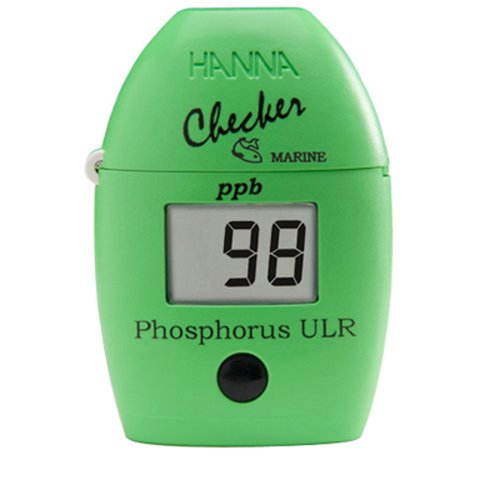
Key features
- •More accurate than chemical test kits, less expensive than professional testing
- •Accuracy of + or - 5% using an adaptation of Standard Method Ascorbic Acid
- •Single button operation for ease of use
- •Large LCD screen for readability
- •Auto shut-off to prolong battery life
- •Sample cuvettes with caps (2)
- •Powder reagents for phosphorus (6)
- •Battery
- •Instructions
BrandHanna Instruments
CategoryAquarium Test Kits
Hanna Instruments HI736 Phosphorus Ultra Low Range Checker HC for Saltwater Aquariums
List Price: $73.68$66.31DEALYou Save: $7.37 (10%)
Free shippingFree Returns – 30 daysFree Order CancellationSecure Payment2–3 Days DeliveryGet It October 25, 2026In Stock (11)No marketing spamNo account requiredFulfilment by FedEx / Amazon / UPS / ShipwirePayPal / Card Buyer Protection
Customer Reviews
Reviews sourced from verified Amazon purchasers3.9
out of 5
Based on 10 reviews
5★
60%
4★
30%
3★
10%
2★
0%
1★
0%
Ignore the grumblers, its a fast and very accurate ...
Chris Smith•March 17, 2017
Ignore the grumblers, its a fast and very accurate device. When testing use both vials, one for the sample and one for the reagent and sample. Mix the reagent first then start the test. Less stress and having done it both ways several times it seems to make no difference at all. Be sure the vials are clean before inserting them into the tester as fingerprint, salt, etch will screw up the accuracy.
It works well. I just wish it would have ...
Amazon Customer•November 30, 2016
It works well. I just wish it would have come with a ppm conversion chart . Or something that would tell you what an acceptable range was.
Top quality test kit, but reagent packets are tricky.
Dan & Karissa•August 24, 2016
I purchased this checker for testing my saltwater reef at home. I was having a GHA outbreak and had no idea what my Phosphate numbers were. Other 'hobby' test kits were very inaccurate and hard to read. This seemed to be the way to go!
What I like- It comes in a nice sturdy case, with 2 vials, reagents, batteries, and directions. The idea of having a digital readout is sooooo nice, after years of trying to decide what shade of pink I was looking at! And the directions are simple and easy to follow.
What I don't like- The reagent packets. As I understand, to get an accurate reading, you have to get ALL of the reagent into the vial. And the design of the packets make it difficult to get the last little bits of powder out of the corners of the packet. Lots of tapping and shaking, while trying not to spill any.
Otherwise, it is a very quality test kit, and MUCH easier to read than traditional hobby test kits that require you to compare colors.
What I like- It comes in a nice sturdy case, with 2 vials, reagents, batteries, and directions. The idea of having a digital readout is sooooo nice, after years of trying to decide what shade of pink I was looking at! And the directions are simple and easy to follow.
What I don't like- The reagent packets. As I understand, to get an accurate reading, you have to get ALL of the reagent into the vial. And the design of the packets make it difficult to get the last little bits of powder out of the corners of the packet. Lots of tapping and shaking, while trying not to spill any.
Otherwise, it is a very quality test kit, and MUCH easier to read than traditional hobby test kits that require you to compare colors.
Works well, be careful as you may run out ...
PAXpress•May 7, 2016
Works well, be careful as you may run out of time. Also be sure to wipe of the glass as fingerprints can throw off the reading.
Best way for a hobbiest to check phosphates
John Fugett•April 23, 2016
I left my previous review from a year and a half ago so you can compare. After using this for a year and a half and improving my technique, I am completely satisfied with it. I use a Red Sea test kit, which is hard to read (trying to match colors, especially at the lower levels), for comparison. Hanna is as accurate as you are going to get with a hobby grade instrument (and price). My problem was experience using it and probably that my phosphorous levels were just a lot higher than I thought possible at the time and the ULR is intended for very low readings. Also, I think I was just too OCD in my expectations. Phosphates are now controlled and phosphates translate to 0 - .02 consistently. Best advice I have is use a bottle brush on the vials before and after each test, to insure cleanliness and put the vial in the checker the same way each time. I remember this by always facing the 10ml numbers toward the front. This solved the consistency problem completely for me. Also if you have an Apex controller, Fusion makes the conversion from phosphorous to phasphate for you. So easy with no confusion.
My problem with this checker is that the accuracy is always suspect. I am sure it is a problem with the way the reagent is managed when doing the test, but I have done three tests in a row with the same tank water and gotten a range of 141 to 86 to 41 ppb. Which one is right? Who knows. This is a consistent problem. All test kits have a similar problem and the reason it is noticeable with this checker is that it can give you a specific reading down to 0 ppb when other test kits read 0 or .26 or higher reading from color cards, which I feel is not accurate at all. So this is much better, but still frustrating and leaves you guessing.
My problem with this checker is that the accuracy is always suspect. I am sure it is a problem with the way the reagent is managed when doing the test, but I have done three tests in a row with the same tank water and gotten a range of 141 to 86 to 41 ppb. Which one is right? Who knows. This is a consistent problem. All test kits have a similar problem and the reason it is noticeable with this checker is that it can give you a specific reading down to 0 ppb when other test kits read 0 or .26 or higher reading from color cards, which I feel is not accurate at all. So this is much better, but still frustrating and leaves you guessing.
Page 1 of 2


