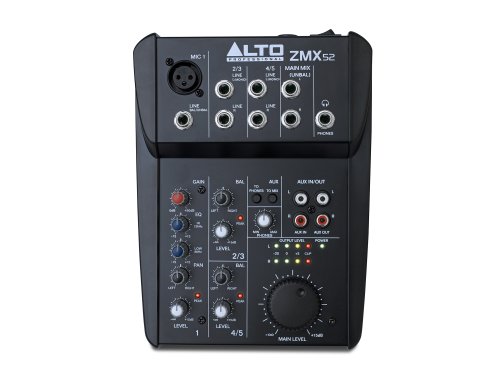
Alto Professional ZMX52 | Studio Quality 5 Channel Compact Audio Mixing Desk with an XLR Microphone Input, 2 Stereo Inputs and an Aux Output


Key features
- •Compact mixer for live sound, mobile A/V, DJ and home studio use
- •(6) total inputs including an XLR jack with phantom power and EQ on Channel 1
- •RCA inputs & outputs for connectors for seamless integration of A/V gear
- •1/4-Inch input for channels 2-5; use mono or stereo with dedicated balance control for stereo groupings
- •Ultra-low noise discrete mic pre with +18V Phantom power; compatible with condenser and dynamic mics
- •Switchable Aux input (to headphones or main mix)
Alto Professional ZMX52 | Studio Quality 5 Channel Compact Audio Mixing Desk with an XLR Microphone Input, 2 Stereo Inputs and an Aux Output
List Price: $145.49$130.94DEALYou Save: $14.55 (10%)
Free shippingFree Returns – 30 daysFree Order CancellationSecure Payment2–3 Days DeliveryGet It October 25, 2026In Stock (1)No marketing spamNo account requiredFulfilment by FedEx / Amazon / UPS / ShipwirePayPal / Card Buyer Protection
Customer Reviews
Reviews sourced from verified Amazon purchasers4.5
out of 5
Based on 10 reviews
5★
60%
4★
30%
3★
0%
2★
0%
1★
10%
Good quality in a small form factor
Leo Reading✓ Verified Purchase•January 27, 2018
This thing is fantastic! With only 3 EQ settings per channel, I was a bit skeptical that I'd be able to get the sound quality I wanted out of it. With that said, I hooked it up and started doing sample recordings (voice only, podcast style) and this little guy impressed me!
It's small enough that it fits on the corner of my desk, just out of the way. Also, having phantom power is a huge bonus, especially if you're using a condenser mic.
The only thing I wish it had was a USB port, however, this can easily be overcome with a $20 cable ( https://www.amazon.com/gp/product/B01DT827FA/ref=oh_aui_detailpage_o01_s00?ie=UTF8&psc=1 )
It's small enough that it fits on the corner of my desk, just out of the way. Also, having phantom power is a huge bonus, especially if you're using a condenser mic.
The only thing I wish it had was a USB port, however, this can easily be overcome with a $20 cable ( https://www.amazon.com/gp/product/B01DT827FA/ref=oh_aui_detailpage_o01_s00?ie=UTF8&psc=1 )
I am happy with this mixer!
Mar Vi✓ Verified Purchase•January 7, 2018
I previously bought another mixer (ammoon 4 channel console), which had an issue, the tendency of picking up system audio through the mic/line in input. I returned it for this Alto ZMX682 mixer. I was a bit concerned as I read from the manufacturer's support area of their site that the mixer isn't ideal to use with a desktop computer. However, I made it work with mine by purchasing a stereo line in to USB cable. The mixer has 48v phantom power, which I needed for my AT2020 condenser mic. It worked great. Excellent build quality and color. The few qualities/features that set this mixer apart from the ammoon's version is that the ZMX862 has a dedicated control room/phones and main to aux switches. This helped to turn off my voice feedback (I didn't need to hear myself all the time). Most importantly, I don't hear system audio through mic/line input! It has an actual power switch, so that I didn't have to constantly pull the plug out when not in use. It has far more pots to use, as well as have a long meter to measure audio sources. It's a pretty powerful console as I don't need to raise much gain or volume for anyone to hear me speak. The system audio comes in clean and clear!
The mixer so far has satisfied my needs! I highly recommend it.
The mixer so far has satisfied my needs! I highly recommend it.
Good mixer with rotary fader controls.
Douglas Nichols✓ Verified Purchase•May 18, 2017
My old Peavey PV6's fader was getting very noisy over the years - if you have a mixer with sliding faders, cover them to keep the dust out - they will eventually go bad. This is one reason I purchased this Alto ZMX862. Nice, basic no frills mixer for personal use, small bands, pod-casting, etc. No sliding faders! Pretty quiet and seems pretty well built. I am a fan of Behringer products, but some of the reviewers mentioned the power supply was proprietary and could end up being a problem. Based on this product, I will be trying more Alto products.
Did not last
Amazon Customer✓ Verified Purchase•February 27, 2017
I am having to change my review. I used this board once for a DJ wedding and it worked perfect. I packed it away and a year later pulled it put of the box that was properly stored in a closet and tried to use it and it failed. I had bought an identical board as a backup. I plugged that one in and it also didn't work. The second board had never been used. I would recommend you stay away from this board.
Seems Bullet :Proof,Versatile and Sounds Great
Leo Volont✓ Verified Purchase•November 3, 2016
I shopped for Hours looking at Mixers here on Amazon"¦ reading all of the Reviews. Finally I decided on the ALTO ZMX862 Mixer. I was surprised it arrived so quickly"¦ I had to double check my Order to make sure I didn't accidentally pay as much for the Postage as for the Product. I ordered the new ALTO ZMX862 Mixer to replace my old Peavey 6 Mixer "“ I loved that old Peavey Six"¦ I think I had been using it HARD (every day!) for the last 8 years, but finally the Fader Pot on the Main Output (that big Slide Volume Control) developed dead spots and or it would rise and fall in volume all by itself, or make crackle snap and pop noises. Usually squirting a little bit of Shop Grade Alcohol into the Slide, and exercising it and then letting it dry for a while brings back some temporary Life to a Fader that is, well, "˜fading', but this one was finally shot. So I liked the Fact that the ALTO ZMX862 Mixer has no Faders, just regular Turn Pots. Check the Reviews for every single mixer being sold, and see what a common problem it is to have failing faders "“ it's a Big Problem with Mixers. Now, there were reviews for the ALTO ZMX862 Mixer that took issue with the "˜fact' that the different Pots on the ALTO ZMX862 Mixer have different "˜feels'"”some are stiff and some turn more easily. Well, I spent two days "dialing in" my New ALTO ZMX862 Mixer and there is One Thing I am Absolutely Certain About, and that is I DID NOT NOTICE ANYTHING FUNNY ABOUT HOW THE POTS WORKED. Besides, if THAT is the worst problem with this Mixer, then it is probably the Best Mixer on the Planet, don't you think?
I DID notice that everything was much Brighter through this ALTO ZMX862 Mixer then in my old Peavy6, so I had to dial down the mids and the highs a bit more, but that could mean that this Mixer has a much higher effective Bandwidth. The Peavey had great Total Harmonic Distortion specs (THD), and the ALTO ZMX862 Mixer wasn't spec'd for THD, but I haven't noticed any blurring or fogginess in the audio. After "˜dialing it in' the ALTO ZMX862 Mixer sounds great.
Now, something about how Useful the ALTO ZMX862 Mixer is "“ I was using the Old Peavey to Mix IPOD Audio in with my Guitar and then running Both the IPOD and the Guitar Audio back through my Guitar Amp (a Fender Mustang III)"¦ you know, instead of having separate speakers for the "˜Music' and for the Guitar, I was using just the Guitar Amp. The way it works in detail is I got the "˜Conditioned' Guitar Signal from the Amp's FX Send and ran it to one of the Peavey's Mic Inputs (mono). From the Peavey Mixer I ran the Mixed Signal back to the Amp's FX Return through the Peavey's own FX Send (and from there in the Amp it goes to the Final Power Amplification and then to the Speaker, and so the nice Clean IPOD Music isn't "˜stepped on' by "˜Guitar Effects'.). To keep the Peavey Working all the way through to the Main Out and the Headphone Out, I "˜Split' the Peavey's FX Send signal and plugged it back into the Mixer's own FX Return Input (FX Sends need FX Returns, or that's the end of the Line). But the new ALTO ZMX862 Mixer works a bit differently. With the ALTO ZMX862 Mixer to do the same thing with the Guitar Amp's FX Send and Return and with the Mixers effective Send and Return, you use the AUX Circuits. You still run the Amp's FX Send to a Mic Input (mono), but the ALTO ZMX862 Mixer has an "AUX Send" and the connector marked "2 FX". It is a STEREO Send, and my Mustang III FX Return is a Mono, but all you have to do to convert a Stereo Out to a Mono Out is shove a ¼ inch Mono Plug into the Mixer Stereo Jack, and it all comes out Mono in the end. I originally tried using the Control Room Out for the Return Signal to my Amp's FX Return, and although it did "˜kind of work', it effectively locked in the Headphone Volume from the ALTO ZMX862 Mixer to the Main Level and Control Room Volume, which I had to adjust way down in order to not overdrive the Mustang III amplifier. I wasn't getting much headphone amplitude that way. That is what made me think of using the AUX Circuits "“ there seems to be Volume Controls Everywhere in the AUX Circuit, so you can balance all the Volumes and keep the headphone volume on a different branch of the circuit. It was all very handy, as soon as I figured out what it was all for.
But yes, this new ALTO ZMX862 Mixer works a lot better in this application. With the old Peavey, I had to keep the Master Volume of the Amp really low because the Peavey Signal into the Amp could not be adjusted down far enough so that the Amp had a chance to work in its Sweet Spot. My next project will be running a mixed audio signal to a Video Camera, and so the ability to set those Output Levels will definitely come in handy there too.
I love this new ALTO ZMX862 Mixer. But if anything squirrelly happens "˜down the road' I will be sure to come back and take off a few Stars and explain why.
I DID notice that everything was much Brighter through this ALTO ZMX862 Mixer then in my old Peavy6, so I had to dial down the mids and the highs a bit more, but that could mean that this Mixer has a much higher effective Bandwidth. The Peavey had great Total Harmonic Distortion specs (THD), and the ALTO ZMX862 Mixer wasn't spec'd for THD, but I haven't noticed any blurring or fogginess in the audio. After "˜dialing it in' the ALTO ZMX862 Mixer sounds great.
Now, something about how Useful the ALTO ZMX862 Mixer is "“ I was using the Old Peavey to Mix IPOD Audio in with my Guitar and then running Both the IPOD and the Guitar Audio back through my Guitar Amp (a Fender Mustang III)"¦ you know, instead of having separate speakers for the "˜Music' and for the Guitar, I was using just the Guitar Amp. The way it works in detail is I got the "˜Conditioned' Guitar Signal from the Amp's FX Send and ran it to one of the Peavey's Mic Inputs (mono). From the Peavey Mixer I ran the Mixed Signal back to the Amp's FX Return through the Peavey's own FX Send (and from there in the Amp it goes to the Final Power Amplification and then to the Speaker, and so the nice Clean IPOD Music isn't "˜stepped on' by "˜Guitar Effects'.). To keep the Peavey Working all the way through to the Main Out and the Headphone Out, I "˜Split' the Peavey's FX Send signal and plugged it back into the Mixer's own FX Return Input (FX Sends need FX Returns, or that's the end of the Line). But the new ALTO ZMX862 Mixer works a bit differently. With the ALTO ZMX862 Mixer to do the same thing with the Guitar Amp's FX Send and Return and with the Mixers effective Send and Return, you use the AUX Circuits. You still run the Amp's FX Send to a Mic Input (mono), but the ALTO ZMX862 Mixer has an "AUX Send" and the connector marked "2 FX". It is a STEREO Send, and my Mustang III FX Return is a Mono, but all you have to do to convert a Stereo Out to a Mono Out is shove a ¼ inch Mono Plug into the Mixer Stereo Jack, and it all comes out Mono in the end. I originally tried using the Control Room Out for the Return Signal to my Amp's FX Return, and although it did "˜kind of work', it effectively locked in the Headphone Volume from the ALTO ZMX862 Mixer to the Main Level and Control Room Volume, which I had to adjust way down in order to not overdrive the Mustang III amplifier. I wasn't getting much headphone amplitude that way. That is what made me think of using the AUX Circuits "“ there seems to be Volume Controls Everywhere in the AUX Circuit, so you can balance all the Volumes and keep the headphone volume on a different branch of the circuit. It was all very handy, as soon as I figured out what it was all for.
But yes, this new ALTO ZMX862 Mixer works a lot better in this application. With the old Peavey, I had to keep the Master Volume of the Amp really low because the Peavey Signal into the Amp could not be adjusted down far enough so that the Amp had a chance to work in its Sweet Spot. My next project will be running a mixed audio signal to a Video Camera, and so the ability to set those Output Levels will definitely come in handy there too.
I love this new ALTO ZMX862 Mixer. But if anything squirrelly happens "˜down the road' I will be sure to come back and take off a few Stars and explain why.
Page 1 of 2