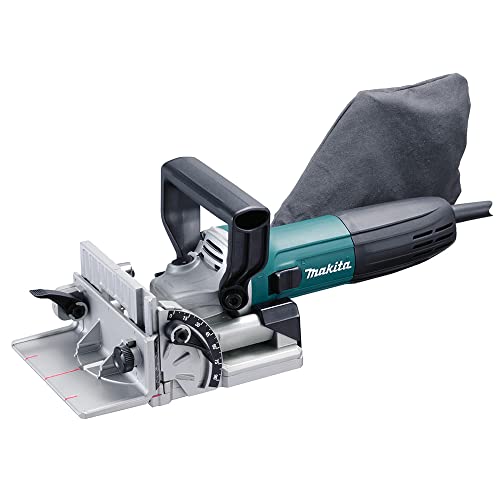
Makita PJ7000 Plate Joiner, Blue


Key features
- •Power Tools and Accessories
- •Country of manufacture: United States
- •Manufacturer: Makita
- •Powerful 5.6 AMP motor with delivers 11,000 RPM
- •Rack-and-pinion fence system
- •Cast pivot fence with three positive stops
Makita PJ7000 Plate Joiner, Blue
List Price: $324.81$292.33DEALYou Save: $32.48 (10%)
Free shippingFree Returns – 30 daysFree Order CancellationSecure Payment2–3 Days DeliveryGet It October 25, 2026In Stock (18)No marketing spamNo account requiredFulfilment by FedEx / Amazon / UPS / ShipwirePayPal / Card Buyer Protection
Customer Reviews
Reviews sourced from verified Amazon purchasers4.6
out of 5
Based on 10 reviews
5★
90%
4★
10%
3★
0%
2★
0%
1★
0%
Love it when I ordered it I dident know it ...
Britt•February 23, 2018
Love it when I ordered it I dident know it came
With a case very happy it did it gives me peice of mind it won't get banged around as much as if I were to
Put it in a bag
With a case very happy it did it gives me peice of mind it won't get banged around as much as if I were to
Put it in a bag
Stair tread repair
R. Bushay•June 13, 2017
I bought this to repair a broken stair tread, having never repaired a stair or used a biscuit joiner, I didn't really know how it would turn out, but the joiner was incredibly easy to use and figure out. I used a size 10 biscuit, I probably should have used the bigger size but the tread looks great and is in better condition than it was. You can adjust height, depth and angle of joiner. Cut was smooth and easy in hard wood.
She's a beauty! Great way to join 2 pieces of wood! Beats Kreg Jig!
Silicon Valley Geek•May 30, 2017
Best Biscuit Joiner! If you need to glue two big pieces of lumber together this is the tool to use! Stronger than nails, prettier than screws!
Bought this and the Kreg HD Jig to have two alternatives for putting 2x4's together for a work bench I'm building.
Feedback for Makita:
Love that it is Japanese Engineered and USA assembled. The attention to detail is good, but here is where you can improve...
The two plastic levers are replaceable, but should be metal!
The depth guage with 6 settings is IMPOSSIBLE to read. Raised small lettering on chrome is no good! Use the debossed red line method for the dial too. Use color coding for biscuit sizing - I ended up using finger nail polish dots to coordinate with my 3 air tight jars of biscuits. The S, D and Max are meaningless. D looks like the 0! Put a depth chart next to the dial. 0-8mm, 10-10mm, 20-12.3mm, S-13mm, D-14.7mm, Max-20mm.
Design the wrench to fit inside the handle instead of the tool case.
Tool case too small. Forces cord to bend and the most vulnerable place. I suspect this is where a lot of cords will eventually break.
Like that the dust port is replaceable but look at using larger standard PVC elbow joints to improve dust collection (sawdust is cancer causing in California P65).
Sawdust bag can't be on tool when putting into the case. Means users without dust collectors will likely skip using the case :(
PLEASE include some sample 0,10,20 biscuits in a sealed bag with desiccant. Also include a sample wood glue tube. You should be able to get free samples from
manufacturers.
Like the spare blade storage!
Case has a plastic fence (set plate) that you use for cutting biscuits in thin pieces of wood. Any chance you can spell out min and max sizes you can join?
Design the manual so I can easily pull out the other language sections I don't want and toss.
Design the manual so it fits in the storage section of the case (trim a couple inches either side).
Bought this and the Kreg HD Jig to have two alternatives for putting 2x4's together for a work bench I'm building.
Feedback for Makita:
Love that it is Japanese Engineered and USA assembled. The attention to detail is good, but here is where you can improve...
The two plastic levers are replaceable, but should be metal!
The depth guage with 6 settings is IMPOSSIBLE to read. Raised small lettering on chrome is no good! Use the debossed red line method for the dial too. Use color coding for biscuit sizing - I ended up using finger nail polish dots to coordinate with my 3 air tight jars of biscuits. The S, D and Max are meaningless. D looks like the 0! Put a depth chart next to the dial. 0-8mm, 10-10mm, 20-12.3mm, S-13mm, D-14.7mm, Max-20mm.
Design the wrench to fit inside the handle instead of the tool case.
Tool case too small. Forces cord to bend and the most vulnerable place. I suspect this is where a lot of cords will eventually break.
Like that the dust port is replaceable but look at using larger standard PVC elbow joints to improve dust collection (sawdust is cancer causing in California P65).
Sawdust bag can't be on tool when putting into the case. Means users without dust collectors will likely skip using the case :(
PLEASE include some sample 0,10,20 biscuits in a sealed bag with desiccant. Also include a sample wood glue tube. You should be able to get free samples from
manufacturers.
Like the spare blade storage!
Case has a plastic fence (set plate) that you use for cutting biscuits in thin pieces of wood. Any chance you can spell out min and max sizes you can join?
Design the manual so I can easily pull out the other language sections I don't want and toss.
Design the manual so it fits in the storage section of the case (trim a couple inches either side).
Other than dust collection, A+
Doc1•October 19, 2016
Just finishing a project where I make a set of nested doors. All panels were solid hardwood, joined with with joiner.
As a comparison, I tried a Ryobi, low-end joiner originally. The plate fence and the blade had more slop than I would have liked. This resulted in a lot of joining and clamping issues. The Ryobi also bogged down a fair amount. This Makita has zero slop. It sliced through hardwood with ease. It's the difference between an entry-level tool and a pro-tool.
One complaint:
The dust control is not good. None of the dust ever ends up in the bag. And after attaching it to my collection system, I still get a lot of dust exiting out the front. Not sure what is going on there. I have cleaned the output and around the blade, but still likes to kick out more dust than any other tool I own.
As a comparison, I tried a Ryobi, low-end joiner originally. The plate fence and the blade had more slop than I would have liked. This resulted in a lot of joining and clamping issues. The Ryobi also bogged down a fair amount. This Makita has zero slop. It sliced through hardwood with ease. It's the difference between an entry-level tool and a pro-tool.
One complaint:
The dust control is not good. None of the dust ever ends up in the bag. And after attaching it to my collection system, I still get a lot of dust exiting out the front. Not sure what is going on there. I have cleaned the output and around the blade, but still likes to kick out more dust than any other tool I own.
Should have got one sooner.
Mr Champ•September 16, 2015
Great machine. I build cabinets and find myself reaching for it with pleasure. I do like the fence better than the Dewalt I used about 15 years ago. Be careful where you set it, The cord goes staight out the back and can hang in your walking space. I tripped on the cord, jerked mine off the table, and broke the fence. Replacement parts were surprisingly reasonable. Now I set it down on the floor when not in use. If the fence gets a little sticky use wax. Also I like the way the fence tilts 45 degrees, joints with this toy turn out great.
Page 1 of 2