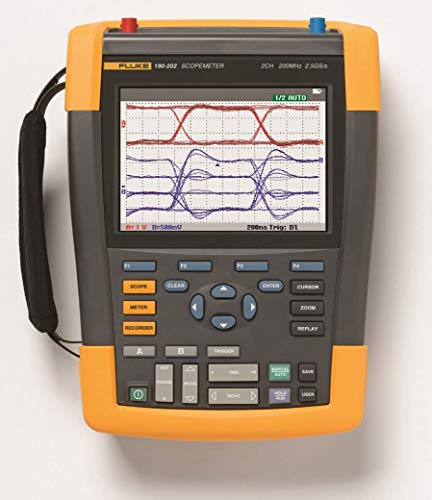
Fluke 190-204/AM/S 4 Channel LCD Color ScopeMeter Oscilloscope with SCC290 Kit, 200 MHz Bandwidth, 1.7ns Rise time
Key features
- •Handheld, four-channel digital oscilloscope for viewing electrical signals with multimeter mode for measuring voltage, frequency, duty cycle, and power
- •Real-time sample rate is 1.25GS/s for 100MHz models and 2.5GS/s for 200MHz models, and record length is 10,000 points per channel for acquiring detailed waveforms
- •Zoom function, three math functions plus FFT, and automatic and cursor measurements for analyzing waveforms
- •6" color LCD shows up to four readings or waveforms simultaneously
- •Meets EN and IEC 61010-1:2001 and 61010-031:2002+A1:2008, ANSI/ISA 61010-1 (82.02.01), and CAN/CSA C22.2 61010-1-04 safety standards, and is rated CAT III installations to 1,000V and CAT IV installations to 600V
- •Fluke ScopeMeter 190 series handheld oscilloscope/multimeter
- •(4) voltage probe sets
- •FlukeView software (demonstration version for models without kit, full version for models with kit)
- •USB interface cable
- •Rechargeable lithium ion battery pack
- •AC adapter/battery charger
- •User manual
- •Hard carrying case (for models with kit)
Fluke 190-204/AM/S 4 Channel LCD Color ScopeMeter Oscilloscope with SCC290 Kit, 200 MHz Bandwidth, 1.7ns Rise time
List Price: $8517.19$7665.47DEALYou Save: $851.72 (10%)
Free shippingFree Returns – 30 daysFree Order CancellationSecure Payment2–3 Days DeliveryGet It October 26, 2026In Stock (8)No marketing spamNo account requiredFulfilment by FedEx / Amazon / UPS / ShipwirePayPal / Card Buyer Protection
Customer Reviews
Reviews sourced from verified Amazon purchasers3.0
out of 5
Based on 1 reviews
5★
0%
4★
0%
3★
100%
2★
0%
1★
0%
Fluke's 190C is functional and earns high safety points but cannot compete with Rohde & Schwarz's new Rider oscilloscope.
Amazon Customer•June 2, 2016
Up until the late 90's, early 2000's, Fluke was renowned for its multimeters and Tektronix for its oscilloscopes. Both attempted to branch out into each other's area of strength but neither produced any decent products; Fluke's early scopemeters were unimpressive and non-intuitive and Tektronix's meters couldn't compete on quality with Flukes already establish meters like the popular Fluke 87. Then Danaher bought both companies and essentially abandoned it seemed support for Tektronix's field scopes. The last best scope Tektronix made was the THS700 series - it was monochrome but very intuitive and an excellent field scope for engineers and technologists working in the industry who needed isolated inputs for high-voltage power electronics, but then support died and the THS700 series faded with no subsequent products on the horizon. Usher in the Fluke 190C series II scope that promised to be best in class, four channel, color display, built in strip recorder, with a raft of new features. Having reviewed earlier scopes from Fluke, I hesitated but my beloved THS710 was packing it in and I had no choice but to dive in and purchase the Fluke 190C as Tektronix had no comparable offering at the time.
While the 190C certainly offered considerable upgrades and advanced features, it was also a serious let down. It's display resolution was pathetic with poor viewing contrast that looks washed out at a time when Apple I-Pads were in vogue with hi-Res screens popping up everywhere. Although limited to a monochrome screen in only 2 channels, I found the THS710 scope easier to view and far more scope like in its user interface with intuitive menus. The 190C is cumbersome to use for anyone familiar with lab scopes who must also perform field work. Common features as simple as being able to press a single button to center the trace on the screen are absent on the Fluke 190C. It's DMM (metering) functions are a joke - don't expect any accuracy here, the device can only capture voltages to 8 bit accuracy and when you factor in noise, not even that.
Cursor functions are awkward and many menu operations feel clunky and frustrating at times. The built in FFT is difficult to see given the poor screen resolution. The FlukeView software helps with this but is a poor interface in its own right and not always reliable when connecting to the device by USB. Memory runs out quick when capturing too many trends so keep a USB key handy. One truly has to wonder where all the previous Tektronix expertise in designing great oscilloscopes went when Danaher bought the two companies. Sadly, at the time of my purchase, it was however the only truly isolated, four channel scope on the market that could handle CAT IV 600V levels. Since then however, Tektronix came out with its own modified version, the THS3000, but their engineers told me not to feel bad about my purchase as it really didn't change that much from the Fluke version. Both are built on the same chassis and tweaked a bit to look different but it's otherwise the same animal to my understanding. Another blow to the Tektronix revamp is that they de-rated its safety level to CAT III for 600V.
In the last year however, I have had the opportunity to witness the performance the newly released "Rider" oscilloscope from Rohde & Schwarz, a top of the line instrument manufacturer from Europe. This oscilloscope is also safety approved with numerous agencies for operation in Europe and North America including CSA and UL. Like the Fluke 190C it boasts safe use for CAT IV 600V, CAT III 1000V and comes in 4 channel up to 500MHz. It is a true 10 bit resolution scope with far more advanced functions and the screen alone will sell you on it (it's a crisp 800x640 full color capacitive touch screen vs Fluke's pathetic 320x240). Moreover, it's entry price is around the same as the Fluke 190C and it has real time WiFi Ethernet communications so you can operate it remotely, unlike the Fluke 190C that needs a physical USB connection to control remotely with limited functionality. Only screen shots can be captured remotely on the Fluke 190C but the "Rider" scope can see waveforms in real time on a remote I-Pad or laptop with full interface control wirelessly. Had this scope been available at the time, it would have been a no-brainer for me. The new Rohde and Schwarz scope wins hands down and is technologically miles ahead of the Fluke 190C which had all the opportunity to be a great scope in its day but never saw the investment commitment that Rohde and Schwarz have clearly made in their product. So if you're looking to make a new purchase for a field scope, do yourself a favor and examine the "Rider". You won't be disappointed and no I do not work for either company. I am a professional Engineer who once worked for Westinghouse in Field Services and Design, started my own engineering firm in 1997, and now teach as a Professor at a community college. I own the 190C from Fluke and only regret that there wasn't a better alternative available at the time.
The Fluke 190C gets a three out of five score with me because despite my many frustrations with it, it is a reliable piece of hardware that does get the job done reasonably well once you wrap your head around its many nuances. In fairness, its capabilities and safety ratings do make it a significant asset to any troubleshooter or seasoned engineer but it is disappointing that the executive at Fluke did not take advantage of the technological advances available to them at the time of development nor capitalize on the former skillsets of their sister company Tektronix. Power Systems Engineers will also be interested in knowing that the "Rider" is a true multitasking device. Not only is it generations ahead of the Fluke 190C but it provides optional software modules (already built in, just need to purchase an activation key) that will permit full three phase power measurements, FFT, etc. to be performed. You'd have to buy a whole new Power Measurement Meter from Fluke to achieve the same.
Bottom line: The Fluke 190C was king for a time, but that time has passed. The competition has arrived and in this engineer's humble opinion, the 190C is looking very much like yesterday's technology. It is however a known beast and it works. If the Rhode & Schwarz "Rider" is able to prove itself reliable and bug-free then I can well imagine that at current pricing Fluke will have its work cut out for it just to compete if they don't find a way to bridge the current technology gap between the two products. The race is on.
While the 190C certainly offered considerable upgrades and advanced features, it was also a serious let down. It's display resolution was pathetic with poor viewing contrast that looks washed out at a time when Apple I-Pads were in vogue with hi-Res screens popping up everywhere. Although limited to a monochrome screen in only 2 channels, I found the THS710 scope easier to view and far more scope like in its user interface with intuitive menus. The 190C is cumbersome to use for anyone familiar with lab scopes who must also perform field work. Common features as simple as being able to press a single button to center the trace on the screen are absent on the Fluke 190C. It's DMM (metering) functions are a joke - don't expect any accuracy here, the device can only capture voltages to 8 bit accuracy and when you factor in noise, not even that.
Cursor functions are awkward and many menu operations feel clunky and frustrating at times. The built in FFT is difficult to see given the poor screen resolution. The FlukeView software helps with this but is a poor interface in its own right and not always reliable when connecting to the device by USB. Memory runs out quick when capturing too many trends so keep a USB key handy. One truly has to wonder where all the previous Tektronix expertise in designing great oscilloscopes went when Danaher bought the two companies. Sadly, at the time of my purchase, it was however the only truly isolated, four channel scope on the market that could handle CAT IV 600V levels. Since then however, Tektronix came out with its own modified version, the THS3000, but their engineers told me not to feel bad about my purchase as it really didn't change that much from the Fluke version. Both are built on the same chassis and tweaked a bit to look different but it's otherwise the same animal to my understanding. Another blow to the Tektronix revamp is that they de-rated its safety level to CAT III for 600V.
In the last year however, I have had the opportunity to witness the performance the newly released "Rider" oscilloscope from Rohde & Schwarz, a top of the line instrument manufacturer from Europe. This oscilloscope is also safety approved with numerous agencies for operation in Europe and North America including CSA and UL. Like the Fluke 190C it boasts safe use for CAT IV 600V, CAT III 1000V and comes in 4 channel up to 500MHz. It is a true 10 bit resolution scope with far more advanced functions and the screen alone will sell you on it (it's a crisp 800x640 full color capacitive touch screen vs Fluke's pathetic 320x240). Moreover, it's entry price is around the same as the Fluke 190C and it has real time WiFi Ethernet communications so you can operate it remotely, unlike the Fluke 190C that needs a physical USB connection to control remotely with limited functionality. Only screen shots can be captured remotely on the Fluke 190C but the "Rider" scope can see waveforms in real time on a remote I-Pad or laptop with full interface control wirelessly. Had this scope been available at the time, it would have been a no-brainer for me. The new Rohde and Schwarz scope wins hands down and is technologically miles ahead of the Fluke 190C which had all the opportunity to be a great scope in its day but never saw the investment commitment that Rohde and Schwarz have clearly made in their product. So if you're looking to make a new purchase for a field scope, do yourself a favor and examine the "Rider". You won't be disappointed and no I do not work for either company. I am a professional Engineer who once worked for Westinghouse in Field Services and Design, started my own engineering firm in 1997, and now teach as a Professor at a community college. I own the 190C from Fluke and only regret that there wasn't a better alternative available at the time.
The Fluke 190C gets a three out of five score with me because despite my many frustrations with it, it is a reliable piece of hardware that does get the job done reasonably well once you wrap your head around its many nuances. In fairness, its capabilities and safety ratings do make it a significant asset to any troubleshooter or seasoned engineer but it is disappointing that the executive at Fluke did not take advantage of the technological advances available to them at the time of development nor capitalize on the former skillsets of their sister company Tektronix. Power Systems Engineers will also be interested in knowing that the "Rider" is a true multitasking device. Not only is it generations ahead of the Fluke 190C but it provides optional software modules (already built in, just need to purchase an activation key) that will permit full three phase power measurements, FFT, etc. to be performed. You'd have to buy a whole new Power Measurement Meter from Fluke to achieve the same.
Bottom line: The Fluke 190C was king for a time, but that time has passed. The competition has arrived and in this engineer's humble opinion, the 190C is looking very much like yesterday's technology. It is however a known beast and it works. If the Rhode & Schwarz "Rider" is able to prove itself reliable and bug-free then I can well imagine that at current pricing Fluke will have its work cut out for it just to compete if they don't find a way to bridge the current technology gap between the two products. The race is on.
![【Upgraded Model 10X Probe] DSO-TC3 Oscilloscope 3-in-1 Handheld Oscilloscope DDS Signal Generator Transistor Tester Oscilloscope 500Khz Bandwidth 10MSa/s Sampling Rate, 6 Types of Waveforms](https://m.media-amazon.com/images/I/51PZP6vlHIL._SL500_.jpg)