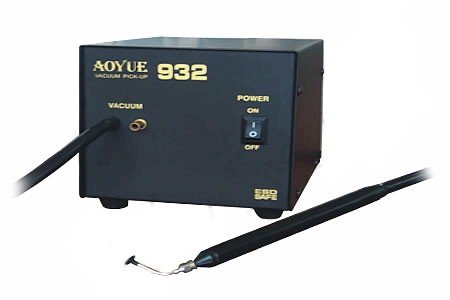
Aoyue 932 Vacuum Pickup Station
Key features
- •This is vacuum pickup station that picks up chip easily after desoldering
- •Self Contained Vacuum Pump
- •Includes a large size 40g, medium size 18g and small size 3g suction heads.
BrandAoyue
CategorySoldering Stations
Aoyue 932 Vacuum Pickup Station
List Price: $80.49$72.44DEALYou Save: $8.05 (10%)
Free shippingFree Returns – 30 daysFree Order CancellationSecure Payment2–3 Days DeliveryGet It October 26, 2026In Stock (2)No marketing spamNo account requiredFulfilment by FedEx / Amazon / UPS / ShipwirePayPal / Card Buyer Protection
Customer Reviews
Reviews sourced from verified Amazon purchasers4.3
out of 5
Based on 10 reviews
5★
60%
4★
10%
3★
30%
2★
0%
1★
0%
Five Stars
Amazon Customer•October 15, 2017
GOOD QUALITY
Great for BGAs and SMD.
Robert•October 8, 2017
I love it. No more scratched up components. Only issue is I have to pinch the hose to drop devices that are smaller than a grain of sand. I can add an electric valve later for that. I also wish it I clouded the pick up needles.
Great little unit
Diarmuid Battisson•July 1, 2017
Great little unit. Works well with the larger SMD parts but sucks a bit too hard for the smaller ones. I fitted an aquarium air manifold inline which allowed me to restrict the suction to the pickup with one outlet and provide an alternate input, to avoid loading the compressor, with one of the others. The manifold cost about AU$2.00 and came with double-sided tape so it could be mounted on the case of the compressor unit.
Aoyue 932 Vacuum Pickup Station
Lariat150•January 21, 2017
Item operated as designed. I have however modified the unit to increase it's usefulness in that I can now place SMD components on a circuit board as well as remove them with reasonable ease using an appropriate needle size tip for the component size.
With the addition and installation inside the cabinet, of the following components:
1) A 12 Volt 2-Position, 3 Way Ported solenoid valve.
2) A few vacuum hoses.
3) Necessary wiring and 2-female panel sockets.
The vacuum at the pen is controlled from by means of the solenoid, a foot switch to energize / de-energize the solenoid, and the 12V 1A power supply to power the solenoid.
When the solenoid is de-energized, valve Port 1 and Port 2 are connected, Port 3 is not connected. Port 1 goes to the pump, Port 2 is connected to the pen. Vacuum is created at the pen tip.
When the solenoid is energized, port 2 is connected to Port 3, Port 1 is not connected. Vaccum at the tip of the pen is lost as atmospheric pressure is allowed in to equalized pressure between the pen tip and vent intake connected to Port 3.
The unit's exterior has not been changed except for the 5.5 mm Female Panel Sockets ( 1 above the power unit switch for the foot switch to be plugged in, and 1 on the back of the unit for the power supply to plug into in the upper left corner).
To prevent small components, solder particles and the like from getting into the vacuum valve and pump unit, I have used a small engine fuel filter with the fine 10 micron mess screen, inserted in the hose just outside the unit. The filter is easily cleaned and reused as needed.
Good with modifications and adjustments
rcvirt•November 30, 2016
I do surface mount on 0805 size components and so did my tests on standard surface mount resistor of that size. Like others, the out-of-the-box vacuum is too powerful to let go of the part when you let your finger off the suction hole. In my pneumatic and plumbing supplies I had two brass hose barbs with 3/16" ID and a 1/4" male fitting. I used a Harbor Freight 1/4" pneumatic ball valve and screwed the two hose barbs into the ball valve to act as a bleed valve. I just trimmed about 3" of the flexible hose and spliced in the valve assembly. It was quite easy at that point to find the position on the ball valve that would bleed off enough vacuum to be able to both pick up and let go of an 0805 resistor. Of course this could all be done with PVC parts given the pressures are very low.
Then it was on solving the "hole problem". I used a 3/16" bit in a drill press and drilled a new hole in the pickup much closer to the tip, but still on the main barrel. I used a piece of electrical tape to cover the initial hole. I didn't use any of the rubber tips, just the metal part of the main pickup tip worked fine. I have a selection of other sizes of industrial dispensing needles to try, but at this time did not need to use them.
It seems clear there is some work to do on the design of this thing from the pipe to the user, but I suspect the vacuum pump itself is good and I should get a lot of good use out of this.
Page 1 of 2


