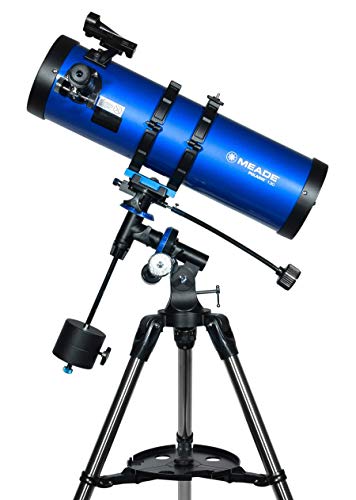
Meade Instruments 216006 Polaris 130 EQ Reflector Telescope (Blue)
Key features
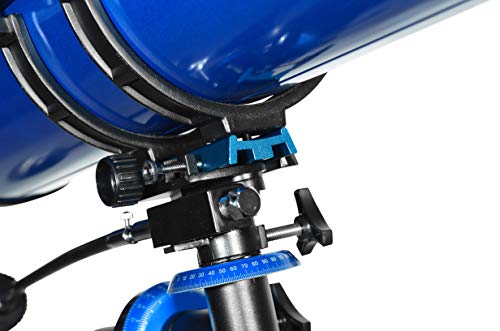
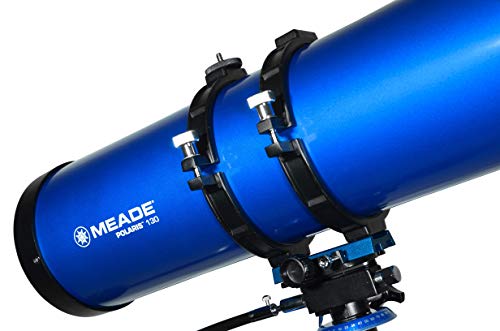
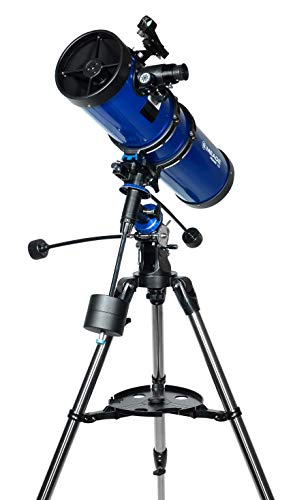
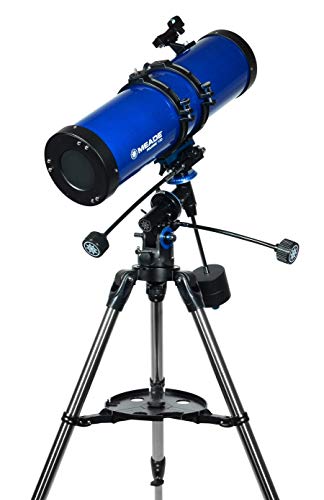
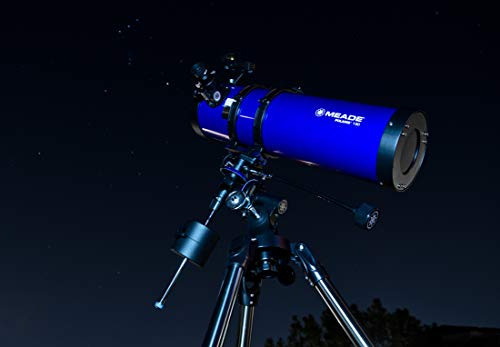
- •Aperture: 130mm(5. 1"). Focal Length: 650mm. Focal Ratio: f/5. 0. Rack-and-Pinion Focuser, Setting Circles, Latitude Control w/ Scale
- •Large, stable German equatorial mount with slow motion controls makes tracking celestial objects smooth and simple
- •Low (26mm), medium (9mm), and high (6. 3mm) magnification eyepieces give you variety for any viewing situation & 2x barlow lens doubles the magnifying power of each eyepiece
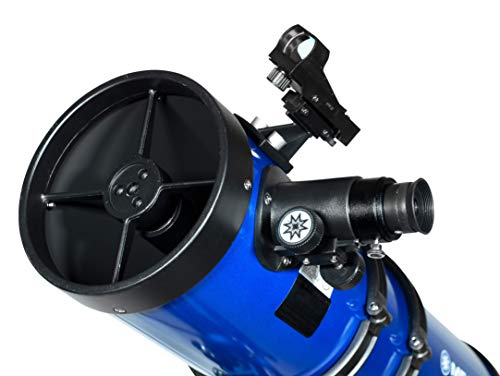
- •Red dot viewfinder helps you point your scope at objects you want to observe & accessory tray stores accessories while observing
- •Includes astronomical software and instructional DVD
Meade Instruments 216006 Polaris 130 EQ Reflector Telescope (Blue)
List Price: $254.63$229.17DEALYou Save: $25.46 (10%)
Free shippingFree Returns – 30 daysFree Order CancellationSecure Payment2–3 Days DeliveryGet It October 25, 2026In Stock (4)No marketing spamNo account requiredFulfilment by FedEx / Amazon / UPS / ShipwirePayPal / Card Buyer Protection
Customer Reviews
Reviews sourced from verified Amazon purchasers3.7
out of 5
Based on 10 reviews
5★
80%
4★
20%
3★
0%
2★
0%
1★
0%
On the whole I have been impressed and I am very happy with my purchase
Waylon✓ Verified Purchase•December 27, 2017
After playing around with inexpensive, smaller telescopes for a year (two years ago) this is the one I settled on as my upgrade scope. On the whole I have been impressed and I am very happy with my purchase, but I was surprised by a few things. Now that I've used the Polaris 130 for a year I finally decided I was ready to share my impressions.
First a quick summary since some people don't like to read all of my ramblings.
Pros:
-Good balance between portability and capability (my most important criteria)
-Doesn't come with useless accessories
-Solid tripod and mount
-I like the versatile tripod tray
-Quick to set up and tear down
-Convenient carrying case is available (but not included)
-Impressive low and medium power views, especially with eyepiece upgrades
Cons:
-Not capable of quite as high a magnification as I expected
-Doesn't include collimation tools (this is common)
-Eyepieces and Barlow are okay, but the scope really benefits from upgrades (easily remedied)
-I don't like red dot finders (again, easily remedied)
-Mine required some adjustments to secondary mirror position (easy to fix)
-Slow motion control for RA axis gets in the way sometimes (not a big deal)
I'll start with some backstory: Two years ago my wife got me a couple telescopes for Christmas (a Rokinon 76mm reflector and a Coleman 50mm refractor). The reflector was good, the refractor... not so much. However, it sparked my interest in astronomy and I fell I love with the hobby. I also quickly outgrew the 76mm scope and wanted something with more horsepower. I didn't want my wife to feel like I was rejecting her thoughtful gift by immediately replacing it with something else, so I decided to live with the scope I had for a year before upgrading. I think that ended up being a good decision. I learned how to push the limits of what small scopes are capable of, and by using my small scope on as many targets as possible I learned what kind of things I enjoyed observing. Mostly I liked nebulae and star clusters and I didn't particularly care for splitting double stars, which helped direct my shopping for the next telescope: a fairly fast telescope with more aperture that was still portable since I have to carry my telescope down a fight of stairs outside in the dark, then down the block and across the street to a vacant lot in order to use it without being blocked by trees.
I liked the Rokinon scope a lot, so I first looked at other Rokinon offerings. There was a long tube 130 that was appealing, but when looking at reviews everyone seemed to recommend Orion scopes, so I then looked there. Orion sold two 130s: the long tube "EQ" and the shorter "ST". Again, reviewers seemed to steer people toward the ST for its parabolic mirror. The shorter focal length sounded like it would be ideal for my needs.
Then I noticed Celestron and Meade also made short tube 130s with parabolic mirrors. Which to get? What was the difference? Not a lot other than price it turns out, at least not that I can tell. The Orion scope came with more expensive accessories, but I didn't want all that junk. I already had decent eyepieces and star charts and a flashlight, etc. and while the Orion's mirror came center-marked that wasn't hard to do myself on the Rokinon. The Orion came with a collimation cap but I already had a Cheshire and had gotten good at collimating my mirrors. The Meade was the cheapest of the three, seemed to come with the best tripod legs and didn't come with anything I didn't want. I was sold.
I think the first thing I looked at was the Orion nebula, and I was not disappointed. There was a noticeable difference between the 130mm and the 76mm I'd been used to. Nice.
I then noticed some other things: the phrase "gnat's rear end" comes to mind when it comes to focusing and high power views
(anything over 100x) seemed to be not as sharp as I expected. Getting a good focus required a lot of effort since the "sweet spot" was very small and easy to miss at higher powers. A two-speed focuser would have been wonderful, and I'm still looking for a way to upgrade the focuser that won't break the bank.
Somewhere along the way I'd picked up a broken cheap junk Bushnell 114mm f/7.8 reflector from a thrift store to fix up and use as a loaner, so I set them up side-by-side to compare using Series 4000 Super Ploessls and a #140 apochromatic 2x Barlow and #128 3x Barlow (not at the same time) in the Meade and generic Chinese Ploessls and 2x Barlow in the Bushnell. To my surprise, while the Meade had the edge in low and medium power views, the 130 fell off bigtime at higher power. At 180x the Bushnell was considerably sharper on the moon than the Meade was at 160x. I then discovered that the phrase "gnat's rear end" also applied to the Meade's collimation tolerances. Tweaking collimation improved things a bit but for whatever reason (slower optics? smaller secondary obstruction?) the beat up Bushnell I bought for $25 remained the better high power scope. The Meade is better in every other way, though. The general rule says scopes should be capable of 2x their objective diameter in magnification, or 260x in this case, but this doesn't seem to be so for the Polaris 130. That's okay, high power viewing of the moon and planets was not why I bought the scope.
Okay, down to business. The scope comes in several pieces but isn't hard to assemble. Some reviewers complain about the assembly but it's really not that complicated even without directions if you look at the picture on the box and take your time. The manual does a good job of explaining how everything works and how to use the scope. Equatorial mounts take some getting used to if you haven't used on before but once you get the hang of it you won't want to use anything else. Adjust the tripod for your latitude (easy to do with the adjustment screw), point it vaguely North, and voila, you're good to go for visual observing.
I had some pleasant surprises when I opened the box. Some of the things that look plastic in the online pictures are actually metal, specifically the "spider" (secondary mirror holder on the open end of the tube) and the tube rings.
My biggest challenge was balancing aperture and portability. Since I have to go down a flight of stairs with my telescope and carry all my gear (book, eyepieces, camp chair) in one trip to my observing site 75 yards away size and weight mattered a lot to me. Many, many seasoned astronomers recommend nothing smaller than an 8" Dob for beginners, then go on to say that you should really consider a 10" or 12" Dob instead. Yeah? I'd love to see them manhandle something the size and weight of a hot water heater down a flight of stairs in the dark. I'll wait at the bottom with my finger ready to press "call" to 911 for an ambulance. At 26 pounds, the Polaris 130 is the biggest thing I felt like I could carry one handed since my other hand needs to carry the camp chair and star chart book.
One thing I really liked was that you can actually use everything in the box. Too many other telescopes come with 3x Barlows and SR 4mm eyepieces so they can claim "675x power!" on the box when the SR 4mm eyepiece alone has too much magnification to be useful with the scope. Not so here. The eyepieces are decent quality and work fine and the Barlow works pretty well, too. With that said, they could use some improvement, though. Better quality Ploessl eyepieces are sharper and give a bigger image with wider field of view. Makes the views much more pleasing. The medium and higher power views seem to benefit the most, although a nice wide angle makes the low power field more enjoyable, and low power is where this scope really shines. I use the more "expendable" Cassini 26mm Erfle most of the time (to keep my older Series 400 eyepieces in tiptop shape) as well as a 10mm Ploessl and the 2x Barlow the scope came with for medium (65x) and high (130x) powers. I also use a Celestron 7-21 zoom eyepiece to help find faint things since I can use it to quickly vary the background darkness. a UHC nebula filter works well with this telescope, too. I have found that several objects (like M1, the Crab Nebula) that were completely invisible in the 76mm scope may also be invisible at low power in the 130mm, but if I gradually increase the power the background darkens enough that I can finally see the object. There's a balance: too much magnification and the target object dims too much.
I don't like the red dot finder because I live in a light polluted area and I like to star hop, so I need some sort of magnifying finder to help me see stars I can't see with the naked eye. It's also much easier to follow the directions in my beat up copy of Turn Left At Orion with a traditional finderscope. Fortunately, it was an easy fix since most 5x24 and some 6x30 finders will attach to the mounting bolts with minimum fuss. The Orion 6x30 finders are nice, but because of their dovetail connection you'll need to modify the Polaris 130 a bit to put a dovetail receiver on it. I bought an older Meade 6x30 finder to use that matched up to the existing mounting bolts without modification. They've gotten harder to come by, though.
The tripod and mount are pretty robust. They hold the scope solidly, it's less likely to tip over than the more precarious Bushnell 114, and with the legs shortened almost all the way the eyepiece is at a perfect height to use while seated in my little folding camp chair and the shorter legs keep vibration to a minimum. It's a comfortable telescope to use, and the controls are easy to find by feel in the dark. The dovetail connection makes set up and tear down amazingly quick, and the optional carrying case fits well. I can take the scope from zipped up in the bag to set up ready to observe in less than 2 minutes. Grab and go anyone?
In general I prefer the flat triangular trays with raised sides (like my Rokinon and the Infinity 60 and 70 scopes come with) over the more traditional thin tray with holes in it for eyepieces (Tasco and entry level Celestron scopes come with these) because they're more versatile at storing things. This one manages to be the best of both worlds. There are holes for three eyepieces and lots of flat space for everything else. I ended up liking it way more than I expected. It attaches securely and makes the tripod very rigid.
My only complaint about the mount controls is that in certain orientations the scope tube pushes against the RA axis control cable. Not a big deal, I usually just remove the cable and use the big gear for the optional motor drive to control the RA axis. On my EQ1 refractor mounts you can move the RA adjustment cable from one side to the other but that's not the case here.
I mentioned before that collimation required "gnat's rear end" precision but that shouldn't scare you off from the telescope. Any reflector scope is gong to need collimation now and then so you'll have to get used to the idea eventually. Fortunately, it's not hard to do with the right tools. I personally find a Cheshire to be more useful than a laser but either one works. The nice thing with the Polaris 130 is that the tube is short enough you can make adjustments while looking through the Cheshire which speeds the process up and makes learning to collimate the mirrors easier. The secondary mirror adjusting screws were extremely tight the first time I adjusted them (I was afraid the Allen wrench would strip out the heads) but after removing them and giving them a small dose of lubricant they work better. The primary mirror has a sort of soft rubber o-ring between it and the tube meaning you only have to use the three "pulling" screws to adjust the primary and once you get it in the right spot the three "pushing" screws can be tightened down to secure the mirror in position. As easy as it gets.
The only problem I had with the scope was that the secondary mirror was not positioned correctly when I got it. Basically, the secondary mirror was too far away from the primary mirror and thus wasn't centered with the focuser. It wasn't very hard to fix: loosen the center bolt and then tighten the three adjustment bolts, then repeat as necessary until the mirror was further away from the spider. Having a Cheshire made it easy to center the secondary mirror. That might be trickier with a laser.
I usually spend a lot of time modifying, improving, and tinkering with my telescopes but the only additional modification I've done to this one was to install some flock paper to the inside of the tube. This was something of a pain since there's not a lot of room to work with inside the tube but it does seem to have helped with contrast and helped battle stray light in my neighborhood.
Really the only weakness is with high power views, so if your interest lies only with the moon and planets then a different scope might be a better choice. In my case, I just supplemented the Polaris 130 with another scope for lunar/planetary observing. I'd intended to get a Polaris 90 refractor for that purpose but ended up getting an unbelievable deal on an older ETX 90 RA that is now my moon and planets scope. The Polaris 130 is my "everything else" scope.
One thing I wondered about for a long time but only recently found the answer to is whether the Polaris series telescopes would work on the Infinity 80, 90, and 102 tripods and vice versa. The answer is yes and no. I bought my dad an Infinity 102 for Christmas and while the 102 happily sits on the EQ2 mount from the 130, the 130 is simply too heavy for the Infinity Alt-Az mount. I think the Polaris 70, 80, and 90 refractors would probably work fine on the Infinity mount, but the114, 127, and 130 reflectors are simply too big. Bummer.
I don't mean for any of my criticisms above to imply there is anything inherently wrong with the scope or that potential buyers should be concerned. On the contrary, I've been extremely pleased with the telescope and it and I have spent many hours out in the dark together. A year later and I still smile every time I bring it out. Occasionally I think a little more aperture might be nice but then I look at the stairs and decide, "Nope." For me, at least, the Polaris 130 has been the perfect balance between aperture and portability. Because the scope's performance is better suited for low and medium power I'm not sure it makes the best first telescope for someone but if you want to make a leap of faith it's not hard to learn with and will take much longer to outgrow than a smaller scope would as long as you keep I mind the scope's limitations. As a second scope it has been phenomenal at meeting my needs and there's no way I would trade it for anything else.
First a quick summary since some people don't like to read all of my ramblings.
Pros:
-Good balance between portability and capability (my most important criteria)
-Doesn't come with useless accessories
-Solid tripod and mount
-I like the versatile tripod tray
-Quick to set up and tear down
-Convenient carrying case is available (but not included)
-Impressive low and medium power views, especially with eyepiece upgrades
Cons:
-Not capable of quite as high a magnification as I expected
-Doesn't include collimation tools (this is common)
-Eyepieces and Barlow are okay, but the scope really benefits from upgrades (easily remedied)
-I don't like red dot finders (again, easily remedied)
-Mine required some adjustments to secondary mirror position (easy to fix)
-Slow motion control for RA axis gets in the way sometimes (not a big deal)
I'll start with some backstory: Two years ago my wife got me a couple telescopes for Christmas (a Rokinon 76mm reflector and a Coleman 50mm refractor). The reflector was good, the refractor... not so much. However, it sparked my interest in astronomy and I fell I love with the hobby. I also quickly outgrew the 76mm scope and wanted something with more horsepower. I didn't want my wife to feel like I was rejecting her thoughtful gift by immediately replacing it with something else, so I decided to live with the scope I had for a year before upgrading. I think that ended up being a good decision. I learned how to push the limits of what small scopes are capable of, and by using my small scope on as many targets as possible I learned what kind of things I enjoyed observing. Mostly I liked nebulae and star clusters and I didn't particularly care for splitting double stars, which helped direct my shopping for the next telescope: a fairly fast telescope with more aperture that was still portable since I have to carry my telescope down a fight of stairs outside in the dark, then down the block and across the street to a vacant lot in order to use it without being blocked by trees.
I liked the Rokinon scope a lot, so I first looked at other Rokinon offerings. There was a long tube 130 that was appealing, but when looking at reviews everyone seemed to recommend Orion scopes, so I then looked there. Orion sold two 130s: the long tube "EQ" and the shorter "ST". Again, reviewers seemed to steer people toward the ST for its parabolic mirror. The shorter focal length sounded like it would be ideal for my needs.
Then I noticed Celestron and Meade also made short tube 130s with parabolic mirrors. Which to get? What was the difference? Not a lot other than price it turns out, at least not that I can tell. The Orion scope came with more expensive accessories, but I didn't want all that junk. I already had decent eyepieces and star charts and a flashlight, etc. and while the Orion's mirror came center-marked that wasn't hard to do myself on the Rokinon. The Orion came with a collimation cap but I already had a Cheshire and had gotten good at collimating my mirrors. The Meade was the cheapest of the three, seemed to come with the best tripod legs and didn't come with anything I didn't want. I was sold.
I think the first thing I looked at was the Orion nebula, and I was not disappointed. There was a noticeable difference between the 130mm and the 76mm I'd been used to. Nice.
I then noticed some other things: the phrase "gnat's rear end" comes to mind when it comes to focusing and high power views
(anything over 100x) seemed to be not as sharp as I expected. Getting a good focus required a lot of effort since the "sweet spot" was very small and easy to miss at higher powers. A two-speed focuser would have been wonderful, and I'm still looking for a way to upgrade the focuser that won't break the bank.
Somewhere along the way I'd picked up a broken cheap junk Bushnell 114mm f/7.8 reflector from a thrift store to fix up and use as a loaner, so I set them up side-by-side to compare using Series 4000 Super Ploessls and a #140 apochromatic 2x Barlow and #128 3x Barlow (not at the same time) in the Meade and generic Chinese Ploessls and 2x Barlow in the Bushnell. To my surprise, while the Meade had the edge in low and medium power views, the 130 fell off bigtime at higher power. At 180x the Bushnell was considerably sharper on the moon than the Meade was at 160x. I then discovered that the phrase "gnat's rear end" also applied to the Meade's collimation tolerances. Tweaking collimation improved things a bit but for whatever reason (slower optics? smaller secondary obstruction?) the beat up Bushnell I bought for $25 remained the better high power scope. The Meade is better in every other way, though. The general rule says scopes should be capable of 2x their objective diameter in magnification, or 260x in this case, but this doesn't seem to be so for the Polaris 130. That's okay, high power viewing of the moon and planets was not why I bought the scope.
Okay, down to business. The scope comes in several pieces but isn't hard to assemble. Some reviewers complain about the assembly but it's really not that complicated even without directions if you look at the picture on the box and take your time. The manual does a good job of explaining how everything works and how to use the scope. Equatorial mounts take some getting used to if you haven't used on before but once you get the hang of it you won't want to use anything else. Adjust the tripod for your latitude (easy to do with the adjustment screw), point it vaguely North, and voila, you're good to go for visual observing.
I had some pleasant surprises when I opened the box. Some of the things that look plastic in the online pictures are actually metal, specifically the "spider" (secondary mirror holder on the open end of the tube) and the tube rings.
My biggest challenge was balancing aperture and portability. Since I have to go down a flight of stairs with my telescope and carry all my gear (book, eyepieces, camp chair) in one trip to my observing site 75 yards away size and weight mattered a lot to me. Many, many seasoned astronomers recommend nothing smaller than an 8" Dob for beginners, then go on to say that you should really consider a 10" or 12" Dob instead. Yeah? I'd love to see them manhandle something the size and weight of a hot water heater down a flight of stairs in the dark. I'll wait at the bottom with my finger ready to press "call" to 911 for an ambulance. At 26 pounds, the Polaris 130 is the biggest thing I felt like I could carry one handed since my other hand needs to carry the camp chair and star chart book.
One thing I really liked was that you can actually use everything in the box. Too many other telescopes come with 3x Barlows and SR 4mm eyepieces so they can claim "675x power!" on the box when the SR 4mm eyepiece alone has too much magnification to be useful with the scope. Not so here. The eyepieces are decent quality and work fine and the Barlow works pretty well, too. With that said, they could use some improvement, though. Better quality Ploessl eyepieces are sharper and give a bigger image with wider field of view. Makes the views much more pleasing. The medium and higher power views seem to benefit the most, although a nice wide angle makes the low power field more enjoyable, and low power is where this scope really shines. I use the more "expendable" Cassini 26mm Erfle most of the time (to keep my older Series 400 eyepieces in tiptop shape) as well as a 10mm Ploessl and the 2x Barlow the scope came with for medium (65x) and high (130x) powers. I also use a Celestron 7-21 zoom eyepiece to help find faint things since I can use it to quickly vary the background darkness. a UHC nebula filter works well with this telescope, too. I have found that several objects (like M1, the Crab Nebula) that were completely invisible in the 76mm scope may also be invisible at low power in the 130mm, but if I gradually increase the power the background darkens enough that I can finally see the object. There's a balance: too much magnification and the target object dims too much.
I don't like the red dot finder because I live in a light polluted area and I like to star hop, so I need some sort of magnifying finder to help me see stars I can't see with the naked eye. It's also much easier to follow the directions in my beat up copy of Turn Left At Orion with a traditional finderscope. Fortunately, it was an easy fix since most 5x24 and some 6x30 finders will attach to the mounting bolts with minimum fuss. The Orion 6x30 finders are nice, but because of their dovetail connection you'll need to modify the Polaris 130 a bit to put a dovetail receiver on it. I bought an older Meade 6x30 finder to use that matched up to the existing mounting bolts without modification. They've gotten harder to come by, though.
The tripod and mount are pretty robust. They hold the scope solidly, it's less likely to tip over than the more precarious Bushnell 114, and with the legs shortened almost all the way the eyepiece is at a perfect height to use while seated in my little folding camp chair and the shorter legs keep vibration to a minimum. It's a comfortable telescope to use, and the controls are easy to find by feel in the dark. The dovetail connection makes set up and tear down amazingly quick, and the optional carrying case fits well. I can take the scope from zipped up in the bag to set up ready to observe in less than 2 minutes. Grab and go anyone?
In general I prefer the flat triangular trays with raised sides (like my Rokinon and the Infinity 60 and 70 scopes come with) over the more traditional thin tray with holes in it for eyepieces (Tasco and entry level Celestron scopes come with these) because they're more versatile at storing things. This one manages to be the best of both worlds. There are holes for three eyepieces and lots of flat space for everything else. I ended up liking it way more than I expected. It attaches securely and makes the tripod very rigid.
My only complaint about the mount controls is that in certain orientations the scope tube pushes against the RA axis control cable. Not a big deal, I usually just remove the cable and use the big gear for the optional motor drive to control the RA axis. On my EQ1 refractor mounts you can move the RA adjustment cable from one side to the other but that's not the case here.
I mentioned before that collimation required "gnat's rear end" precision but that shouldn't scare you off from the telescope. Any reflector scope is gong to need collimation now and then so you'll have to get used to the idea eventually. Fortunately, it's not hard to do with the right tools. I personally find a Cheshire to be more useful than a laser but either one works. The nice thing with the Polaris 130 is that the tube is short enough you can make adjustments while looking through the Cheshire which speeds the process up and makes learning to collimate the mirrors easier. The secondary mirror adjusting screws were extremely tight the first time I adjusted them (I was afraid the Allen wrench would strip out the heads) but after removing them and giving them a small dose of lubricant they work better. The primary mirror has a sort of soft rubber o-ring between it and the tube meaning you only have to use the three "pulling" screws to adjust the primary and once you get it in the right spot the three "pushing" screws can be tightened down to secure the mirror in position. As easy as it gets.
The only problem I had with the scope was that the secondary mirror was not positioned correctly when I got it. Basically, the secondary mirror was too far away from the primary mirror and thus wasn't centered with the focuser. It wasn't very hard to fix: loosen the center bolt and then tighten the three adjustment bolts, then repeat as necessary until the mirror was further away from the spider. Having a Cheshire made it easy to center the secondary mirror. That might be trickier with a laser.
I usually spend a lot of time modifying, improving, and tinkering with my telescopes but the only additional modification I've done to this one was to install some flock paper to the inside of the tube. This was something of a pain since there's not a lot of room to work with inside the tube but it does seem to have helped with contrast and helped battle stray light in my neighborhood.
Really the only weakness is with high power views, so if your interest lies only with the moon and planets then a different scope might be a better choice. In my case, I just supplemented the Polaris 130 with another scope for lunar/planetary observing. I'd intended to get a Polaris 90 refractor for that purpose but ended up getting an unbelievable deal on an older ETX 90 RA that is now my moon and planets scope. The Polaris 130 is my "everything else" scope.
One thing I wondered about for a long time but only recently found the answer to is whether the Polaris series telescopes would work on the Infinity 80, 90, and 102 tripods and vice versa. The answer is yes and no. I bought my dad an Infinity 102 for Christmas and while the 102 happily sits on the EQ2 mount from the 130, the 130 is simply too heavy for the Infinity Alt-Az mount. I think the Polaris 70, 80, and 90 refractors would probably work fine on the Infinity mount, but the114, 127, and 130 reflectors are simply too big. Bummer.
I don't mean for any of my criticisms above to imply there is anything inherently wrong with the scope or that potential buyers should be concerned. On the contrary, I've been extremely pleased with the telescope and it and I have spent many hours out in the dark together. A year later and I still smile every time I bring it out. Occasionally I think a little more aperture might be nice but then I look at the stairs and decide, "Nope." For me, at least, the Polaris 130 has been the perfect balance between aperture and portability. Because the scope's performance is better suited for low and medium power I'm not sure it makes the best first telescope for someone but if you want to make a leap of faith it's not hard to learn with and will take much longer to outgrow than a smaller scope would as long as you keep I mind the scope's limitations. As a second scope it has been phenomenal at meeting my needs and there's no way I would trade it for anything else.
Excellent for the money
chris16✓ Verified Purchase•August 13, 2016
This is this first telescope I have perched but not the first I have used. I am more then impressed with the quality for the price. It functions very well and is also nice to look at. I would highly recommend this for anyone especially if its your first one.
The set up of this telescope was very easy. It was what I expected when I ordered
James Fry✓ Verified Purchase•March 16, 2016
The set up of this telescope was very easy. It was what I expected when I ordered. The only 2 things I would change would be a better tripod and better hardware on the mount. One of the adjustment bolts broke the first time I used it. Other than that this is a very good telescope for beginners.
Good Value
rlson✓ Verified Purchase•January 25, 2016
So far so good, got it together with little trouble, still getting familiar with the operation...I'm a novice so there is a learning curve, I'm starting at the bottom of the curve. The moon looks great, just like the professional photos I have seen.
Awesome telescope
ILUVTOTRAVEL✓ Verified Purchase•August 13, 2015
I love this. I was expecting something smaller and it's huge! You definitely need to have a place for this telescope. It is a very sturdy telescope. I haven't gotten to use it yet but can't wait
Page 1 of 2