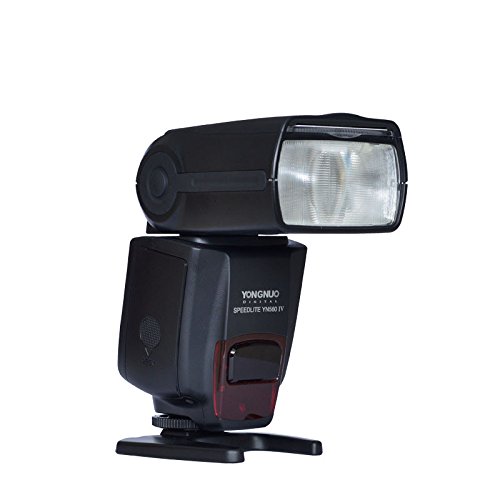
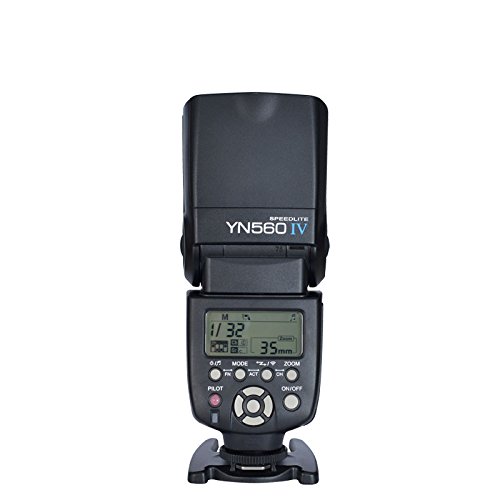
YONGNUO YN560 IV Wireless Flash Speedlite Master + Slave Flash + Built-in Trigger System for Canon Nikon Pentax Olympus Fujifilm Panasonic Digital Cameras

Key features
- •YN560 IV=YN560III+YN560-TX, Supports Wireless Master Function.
- •Supports Wireless Slave Function, fully supports YN560-TX, RF-603 II RF-602 Wireless Transmitter.
- •Supports Multiple Trigger Synchronous Mode. Endure the battery is fully changed.
- •Supports setting save automatically, custom settings ( fan ). Verify the flash light setting
- •Supports ultra-fast charging recycle system, external power supply. Check the remote control settings before use
YONGNUO YN560 IV Wireless Flash Speedlite Master + Slave Flash + Built-in Trigger System for Canon Nikon Pentax Olympus Fujifilm Panasonic Digital Cameras
List Price: $118.03$106.23DEALYou Save: $11.80 (10%)
Free shippingFree Returns – 30 daysFree Order CancellationSecure Payment2–3 Days DeliveryGet It October 25, 2026In Stock (13)No marketing spamNo account requiredFulfilment by FedEx / Amazon / UPS / ShipwirePayPal / Card Buyer Protection
Customer Reviews
Reviews sourced from verified Amazon purchasers4.4
out of 5
Based on 10 reviews
5★
90%
4★
10%
3★
0%
2★
0%
1★
0%
A great value, but not perfect.
David G.✓ Verified Purchase•July 22, 2023
Summary: This is a China made value flash that cost a fraction of a name brand flash. Only recommend if you use it with Yongnuo triggers, and for the cost there is no reason not to. Although I have had no issues with any of my Yongnuo flashes I would recommend professionals on a budget purchase and extra one, because thats what professionals should do. You will learn more on how to use this by watching online how to videos than you will by reading the manual.
I use this in RX mode with the YN 560 TX controller. For the price it works very well. Plenty of light output for everything I have needed it for. If used in RX mode make sure you understand how the standby functions work so the flash will be ready to fire when you are ready to press the shutter. I have been using Yongnuo flashes for a couple years and have had no failures. Reading reviews you will notice many who say that they have had issues with them, but when you consider how many of these are sold some failures should be expected, especially when you consider the price point these are being sold at. If you absolutely NEED complete reliability either buy an extra flash or spend ten times as much on the name brand flash.
These days, there is almost no reason to use an optical trigger when the wireless triggers are so reliable, especially with the YN 560 TX that offers so much control. I have never had a trigger or failure to fire issue on mine, even when shooting thousands of pictures at wedding receptions. I always carry extra gear so I am not worried about my discount flash failing, which has not happened. Yet.
It is noteworthy that the different Yongnuo lines are not compatible with each other, at least not easily. Make sure you understand your needs before buying into either system.
I use this in RX mode with the YN 560 TX controller. For the price it works very well. Plenty of light output for everything I have needed it for. If used in RX mode make sure you understand how the standby functions work so the flash will be ready to fire when you are ready to press the shutter. I have been using Yongnuo flashes for a couple years and have had no failures. Reading reviews you will notice many who say that they have had issues with them, but when you consider how many of these are sold some failures should be expected, especially when you consider the price point these are being sold at. If you absolutely NEED complete reliability either buy an extra flash or spend ten times as much on the name brand flash.
These days, there is almost no reason to use an optical trigger when the wireless triggers are so reliable, especially with the YN 560 TX that offers so much control. I have never had a trigger or failure to fire issue on mine, even when shooting thousands of pictures at wedding receptions. I always carry extra gear so I am not worried about my discount flash failing, which has not happened. Yet.
It is noteworthy that the different Yongnuo lines are not compatible with each other, at least not easily. Make sure you understand your needs before buying into either system.
After 3 years - Still an incredible flash unit for the price!
Micheal Mathews✓ Verified Purchase•July 18, 2023
I realize there are already almost 400 reviews for these flash units and mine will most likely get lost in the flood but I just wanted to weigh in on what makes them so awesome.
First of all I have used Canon Speedlights in the past, still own a 430EX that sits in a box and collects dust.
I really don't like using ETTL as I find it rarely gives me the kind of exposure I like in my photo's. I personally feel it looks flat and unprofessional so this review will be based on manual functions. This unit doesn't have a TTL function anyway so... on to the review.
I have been using Yongnuo flashes for about 3 years now and I honestly have no gripes. None at all. Especially now that I've upgraded to the IV models and get the added wireless functionality built in.
I dropped a 560III model about 4 feet onto the concrete a couple years back and the bottom of it broke off. It actually kept working for a full 2 hour shoot after that before it blew out completely. Probably due to some shorts after wires coming loose. But that just speaks to the durability of the Flash.
Here's the thing, at this price, I was not upset. I dropped a Speedlight onto the concrete, watched a chunk of it fly off and thought, "Darn... well I guess I need to buy another."
Try having that mentality with a Canon or Nikkon Speedlight.
I take these hiking, out on major event shoots where I'm running around bumping into stuff, sometimes outside and getting rained on etc. etc.
I never worry about breaking one because I know I can afford to grab another. It's a freeing feeling. I worry enough about my camera and my lenses as it is.
Here's the other reason I love these.
While I have a master controller for my speed lights, I prefer to use my flash in manual mode even when it's attached to my camera or on a trigger. On the Canon speed lights switching power while in manual mode takes a few extra clicks and requires you to depress the tiny center button first to let the unit know you want to start changing power level. It drives me a bit crazy now that I'm used to these.
With the Yongnuo in manual mode, you just click one side or the other on the interface and your power level changes by standard stops. Click up or down to change power in smaller increments.
I can get the exposure I want so quickly with these now that I really don't understand why Canon chose to design theirs differently.
The wireless works well with the YN560-TX master controller though my shutter speed needs to drop to about 160 to avoid shutter shadow.
They work flawlessly with the RF-603CII-C1 triggers.
The power is also definitely up to par. Just one of these is enough to light up a medium-sized room with some bounced light.
I have 3 (still less $$ than 1 canon) and dial them in at different levels for a better effect but have gotten by with 2 in very large rooms and been happy with my results.
I've used them on both a t2i, t3i and a 6D and have friends who use them with 5D MarkIII's and love them just as much.
If I had to pick one thing I don't like... I guess that they heat up and delay quickly. If you are firing off shot after shot the batteries get hot quick and the unit will force a delay until they cool down. You can attach an external power pack to eliminate the problem but I have learned to just work around it. I'm a bit more intentional with my shots anyway so I'm not one to just blast away, spray and pray style.
I'd say I can get about 8 minutes of continuous shooting, full power, at maybe a shot per second before I start experiencing delays.
You should also consider the speed, if you need to shoot at High Speeds like 250+ then these will not work. If you're using a controller you may even need to drop down to 160.
Beyond that, no issues.
Again, if you like automatic exposure and using the TTL or ETTL functions then this is obviously not for you since it doesn't offer that functionality at all. But if you use manual adjustments with your speed lights or you use a master controller then these are not only up to the job but they are incredibly affordable meaning you can have multiple flash units on standby if one gets broken.
Really can't recommend them enough. I've bought 5 so far, broke one 560III and gave the other away once I got my IV's.
I plan to buy a few more as backup and can happily say that I feel confident in my purchase.
First of all I have used Canon Speedlights in the past, still own a 430EX that sits in a box and collects dust.
I really don't like using ETTL as I find it rarely gives me the kind of exposure I like in my photo's. I personally feel it looks flat and unprofessional so this review will be based on manual functions. This unit doesn't have a TTL function anyway so... on to the review.
I have been using Yongnuo flashes for about 3 years now and I honestly have no gripes. None at all. Especially now that I've upgraded to the IV models and get the added wireless functionality built in.
I dropped a 560III model about 4 feet onto the concrete a couple years back and the bottom of it broke off. It actually kept working for a full 2 hour shoot after that before it blew out completely. Probably due to some shorts after wires coming loose. But that just speaks to the durability of the Flash.
Here's the thing, at this price, I was not upset. I dropped a Speedlight onto the concrete, watched a chunk of it fly off and thought, "Darn... well I guess I need to buy another."
Try having that mentality with a Canon or Nikkon Speedlight.
I take these hiking, out on major event shoots where I'm running around bumping into stuff, sometimes outside and getting rained on etc. etc.
I never worry about breaking one because I know I can afford to grab another. It's a freeing feeling. I worry enough about my camera and my lenses as it is.
Here's the other reason I love these.
While I have a master controller for my speed lights, I prefer to use my flash in manual mode even when it's attached to my camera or on a trigger. On the Canon speed lights switching power while in manual mode takes a few extra clicks and requires you to depress the tiny center button first to let the unit know you want to start changing power level. It drives me a bit crazy now that I'm used to these.
With the Yongnuo in manual mode, you just click one side or the other on the interface and your power level changes by standard stops. Click up or down to change power in smaller increments.
I can get the exposure I want so quickly with these now that I really don't understand why Canon chose to design theirs differently.
The wireless works well with the YN560-TX master controller though my shutter speed needs to drop to about 160 to avoid shutter shadow.
They work flawlessly with the RF-603CII-C1 triggers.
The power is also definitely up to par. Just one of these is enough to light up a medium-sized room with some bounced light.
I have 3 (still less $$ than 1 canon) and dial them in at different levels for a better effect but have gotten by with 2 in very large rooms and been happy with my results.
I've used them on both a t2i, t3i and a 6D and have friends who use them with 5D MarkIII's and love them just as much.
If I had to pick one thing I don't like... I guess that they heat up and delay quickly. If you are firing off shot after shot the batteries get hot quick and the unit will force a delay until they cool down. You can attach an external power pack to eliminate the problem but I have learned to just work around it. I'm a bit more intentional with my shots anyway so I'm not one to just blast away, spray and pray style.
I'd say I can get about 8 minutes of continuous shooting, full power, at maybe a shot per second before I start experiencing delays.
You should also consider the speed, if you need to shoot at High Speeds like 250+ then these will not work. If you're using a controller you may even need to drop down to 160.
Beyond that, no issues.
Again, if you like automatic exposure and using the TTL or ETTL functions then this is obviously not for you since it doesn't offer that functionality at all. But if you use manual adjustments with your speed lights or you use a master controller then these are not only up to the job but they are incredibly affordable meaning you can have multiple flash units on standby if one gets broken.
Really can't recommend them enough. I've bought 5 so far, broke one 560III and gave the other away once I got my IV's.
I plan to buy a few more as backup and can happily say that I feel confident in my purchase.
Frugal alternative to name brand. Works on virtually any camera w/standard hot shoe.
Daniel Vincent✓ Verified Purchase•July 10, 2023
The flash will work with any of my Nikon, Sony or Panasonic cameras without issue. It's a single pin connection with no TTL functionality. So everything is manual but I don't find this to be a problem and I'm okay with that.
I got this after doing some research and hearing they might work with my Sony a6000. This review is for both the Yongnuo flash and 603N II triggers. This setup was a fraction of what it would cost to buy any of the name brand flash/triggers.
When I first got it it was frustrating as it wasn't clear what I needed to do to get this setup to work on the Sony.
First thing is to get the trigger and flash to communicate. They both need to be on the same channel, same group, in TX mode. Since I was already pairing it with the Yongnuo triggers this website http://www.davidpartington.com/m43/2015/01/03/yongnuo-yn560-iv-speedlite-review/ and this video review https://youtu.be/C-VukG3Cw9M gives a much better way to see how to set up the flash as the manual wasn't much help. Once the trigger and flash are communicating now you need to get the trigger on the camera.
I read that the hot shoe on my Sony would need to have the black paint removed in order for it to work. This was false as the paint has nothing to do with it working or not.
The pins on the triggers have to make a good contact with the hot shoe. What I found is that once you put the trigger on the camera the pins were not making a contact like they should. This is the key thing put some pressure down on the trigger pushing towards the hot shoe. Take a test photo while holding the trigger. It should fire and once it does lock down the trigger via the wheel lock.
That is it...it just needed to have the pins make good contact before locking down. These also work for my Panasonic Lumix DMC-FZ1000. I highly recommend both the flash and triggers by Yongnuo. Very cheap alternative when comparing to big name brand components.
I got this after doing some research and hearing they might work with my Sony a6000. This review is for both the Yongnuo flash and 603N II triggers. This setup was a fraction of what it would cost to buy any of the name brand flash/triggers.
When I first got it it was frustrating as it wasn't clear what I needed to do to get this setup to work on the Sony.
First thing is to get the trigger and flash to communicate. They both need to be on the same channel, same group, in TX mode. Since I was already pairing it with the Yongnuo triggers this website http://www.davidpartington.com/m43/2015/01/03/yongnuo-yn560-iv-speedlite-review/ and this video review https://youtu.be/C-VukG3Cw9M gives a much better way to see how to set up the flash as the manual wasn't much help. Once the trigger and flash are communicating now you need to get the trigger on the camera.
I read that the hot shoe on my Sony would need to have the black paint removed in order for it to work. This was false as the paint has nothing to do with it working or not.
The pins on the triggers have to make a good contact with the hot shoe. What I found is that once you put the trigger on the camera the pins were not making a contact like they should. This is the key thing put some pressure down on the trigger pushing towards the hot shoe. Take a test photo while holding the trigger. It should fire and once it does lock down the trigger via the wheel lock.
That is it...it just needed to have the pins make good contact before locking down. These also work for my Panasonic Lumix DMC-FZ1000. I highly recommend both the flash and triggers by Yongnuo. Very cheap alternative when comparing to big name brand components.
Great flash, invaluable flash/backup TX
John Becker✓ Verified Purchase•June 16, 2023
I use my flashes every day in my real estate photography business, and I need everything to work. I also need some redundancy to keep me going if something fails/breaks/gets dropped. My current flash setup starts with a YN560-TX in my camera's hot shoe, with YN560-III flashes. I recently had my tripod tip over and dump camera/lens/TX to the floor. This resulted in the TX snapping in half when it hit a chair on the way down. Problem -- I could stick a flash in the hot shoe and set the rest to trigger optically, but then I wouldn't have remote power control.
The perfect solution - I ordered a YN560-IV for roughly the same price as a III. It serves as another flash in the arsenal, but it's also a natural backup for the TX. If I lose another TX in the field, I can put the IV in the hot shoe and I'll still have remote power control. It's a good addition to my camera bag.
It's not perfect, though. The YN flashes are reasonably solid, but they're not the same as Nikon SB080DXs. Those things are built like tanks. I also note that going from one power setting to another can be inconsistent - increase by 1/3 stop and get a little change in power, increase by another 1/3 stop and get a much larger change in power. This isn't always noticeable, but spend enough time with them and you'll run into it. They also can have a very slight pinkish cast. Not a big deal if they're your only light source, just fix it in post. But if you're in a mixed light environment (daylight/incandescent/fluorescent) it's a pain in the neck to have to account for *another* different color of light.
Having said all that, you can't beat 'em for the price. Nikon would be selling these things for $300 if they had the sense to make something for the "Strobist" community.
The perfect solution - I ordered a YN560-IV for roughly the same price as a III. It serves as another flash in the arsenal, but it's also a natural backup for the TX. If I lose another TX in the field, I can put the IV in the hot shoe and I'll still have remote power control. It's a good addition to my camera bag.
It's not perfect, though. The YN flashes are reasonably solid, but they're not the same as Nikon SB080DXs. Those things are built like tanks. I also note that going from one power setting to another can be inconsistent - increase by 1/3 stop and get a little change in power, increase by another 1/3 stop and get a much larger change in power. This isn't always noticeable, but spend enough time with them and you'll run into it. They also can have a very slight pinkish cast. Not a big deal if they're your only light source, just fix it in post. But if you're in a mixed light environment (daylight/incandescent/fluorescent) it's a pain in the neck to have to account for *another* different color of light.
Having said all that, you can't beat 'em for the price. Nikon would be selling these things for $300 if they had the sense to make something for the "Strobist" community.
Full-featured manual flash, perfectly suited to studio strobism on a shoestring
Patrick Perdu✓ Verified Purchase•May 23, 2023
I have been using Yongnuo 560-II and 560-III for quite some time for their power and simplicity of use in the studio.
The -II I used with YN603 and procured a pair of -III when I needed more flash since they feature the 603 receiver.
Last time I needed to expand my pool I came across these YN560-IV and lo and behold not only do they feature the 603 receiver, they also feature the emitter and even better they allow to adjust remotely the power and the zoom of the other -IV but (great surprise!) the -III as well.
(At the same time Yongnuo came up with their YN560-TX which allows for simple remote control of up to six independent groups of 560-III and -IV in a way even simpler than with the -IV. I reviewed it separately.)
Triggering modes:
* Hot-shoe - that's when the flash is on your camera.
* Rx - The flash is triggered remotely by a YN602, YN603, YN560-TX or another YN560-IV
* S1 - Synchro on the first flash it sees - useful if you are using a small manual flash on your camera to trigger your other flashs
* S2 - Synchro on the second flash it sees - great if you are using a TTL flash to trigger your setup. That can be an external TTL flash on your camera (e.g. Canon 580ExII or 430ExII) or your camera popup flash.
* Tx - This mode is not available on the YN560-III, only on the 560-IV reviewed here: the flash controls the other flashs in the room as long as they are on the same channel.
A note about S1, S2 and the optical TTL mode of Canon flashs:
As noted above, S2 is useful for light-triggering a Yongnuo flash from a TTL flash - however this does not work well when using optical control of a remote TTL flash such as the 580ExII or the 430ExII from either a 580ExII mounted on your camera or the popup flash of some of the more recent Canon cameras such as the 7D, 70D or 7DmkII. In that case the master flash communicates with the remote flash using bursts of light that get counted by the S1/S2 synchro mode of the optical manual slaves and they trigger on the TTL measurement burst instead of the actual picture illumination flash.
I could get them to work nonetheless by making sure that only the Canon slave flash(s) could see the master flash and that the YongNuo flashs are set on S2 and also see the Canon slave flashs but not the camera and the master flash - but this gets complicated and is prone to failure. In that case, unless you really need the remote TTL capability, I would go for the YN560-TX or a YN560-IV to control the setup.
In addition, don't give your older YN603 away: they can trigger the 560-TX remotely and they can be controlled by it or by the -IV to trigger any other flash including YN560-II, Canon 580ExII or studio monolight (using a small, inexpensive PC sync cord). Of course these are only manual in that case and cannot be adjusted from the camera position, plus they always fire when the -TX shoots.
I could probably have done as well with just the YN560-TX and additional YN560-III instead of the YN560-IV if these were more expensive but the current going price for the -IV is slightly lower than that of the -III so why bother?
[Edited the same day: I see the -III is now $5 or $6 lower than the -IV. In that case it makes sense to get one or two -IV (for backup) or a 560-TX, and a few -III for the rest.]
As a first test I attached a Brunca mask onto a stand (see the picture somewhere on that page), two -IV with red gels on Justin Clamps ot that same stand facing opposite: one towards the black side of a reflector used as a backdrop and one aimed at a piece of paper jammed in the mask, plus one -III on a stand at camera right, in front of which I held a simple sheet of white paper as a diffuser. I did not even take a softbox out for that picture.
All in all a few YN560-IV are all you need for strobism in manual, possibly with a YN560-TX and, if you can afford it, a small flash meter.
The -II I used with YN603 and procured a pair of -III when I needed more flash since they feature the 603 receiver.
Last time I needed to expand my pool I came across these YN560-IV and lo and behold not only do they feature the 603 receiver, they also feature the emitter and even better they allow to adjust remotely the power and the zoom of the other -IV but (great surprise!) the -III as well.
(At the same time Yongnuo came up with their YN560-TX which allows for simple remote control of up to six independent groups of 560-III and -IV in a way even simpler than with the -IV. I reviewed it separately.)
Triggering modes:
* Hot-shoe - that's when the flash is on your camera.
* Rx - The flash is triggered remotely by a YN602, YN603, YN560-TX or another YN560-IV
* S1 - Synchro on the first flash it sees - useful if you are using a small manual flash on your camera to trigger your other flashs
* S2 - Synchro on the second flash it sees - great if you are using a TTL flash to trigger your setup. That can be an external TTL flash on your camera (e.g. Canon 580ExII or 430ExII) or your camera popup flash.
* Tx - This mode is not available on the YN560-III, only on the 560-IV reviewed here: the flash controls the other flashs in the room as long as they are on the same channel.
A note about S1, S2 and the optical TTL mode of Canon flashs:
As noted above, S2 is useful for light-triggering a Yongnuo flash from a TTL flash - however this does not work well when using optical control of a remote TTL flash such as the 580ExII or the 430ExII from either a 580ExII mounted on your camera or the popup flash of some of the more recent Canon cameras such as the 7D, 70D or 7DmkII. In that case the master flash communicates with the remote flash using bursts of light that get counted by the S1/S2 synchro mode of the optical manual slaves and they trigger on the TTL measurement burst instead of the actual picture illumination flash.
I could get them to work nonetheless by making sure that only the Canon slave flash(s) could see the master flash and that the YongNuo flashs are set on S2 and also see the Canon slave flashs but not the camera and the master flash - but this gets complicated and is prone to failure. In that case, unless you really need the remote TTL capability, I would go for the YN560-TX or a YN560-IV to control the setup.
In addition, don't give your older YN603 away: they can trigger the 560-TX remotely and they can be controlled by it or by the -IV to trigger any other flash including YN560-II, Canon 580ExII or studio monolight (using a small, inexpensive PC sync cord). Of course these are only manual in that case and cannot be adjusted from the camera position, plus they always fire when the -TX shoots.
I could probably have done as well with just the YN560-TX and additional YN560-III instead of the YN560-IV if these were more expensive but the current going price for the -IV is slightly lower than that of the -III so why bother?
[Edited the same day: I see the -III is now $5 or $6 lower than the -IV. In that case it makes sense to get one or two -IV (for backup) or a 560-TX, and a few -III for the rest.]
As a first test I attached a Brunca mask onto a stand (see the picture somewhere on that page), two -IV with red gels on Justin Clamps ot that same stand facing opposite: one towards the black side of a reflector used as a backdrop and one aimed at a piece of paper jammed in the mask, plus one -III on a stand at camera right, in front of which I held a simple sheet of white paper as a diffuser. I did not even take a softbox out for that picture.
All in all a few YN560-IV are all you need for strobism in manual, possibly with a YN560-TX and, if you can afford it, a small flash meter.
Page 1 of 2