Craft Wok Traditional Hand Hammered Chinese Carbon Steel Wok with Wooden and Steel Helper Handle (14 Inch, Round Bottom Pow Wok Pan) / 731W88




Key features
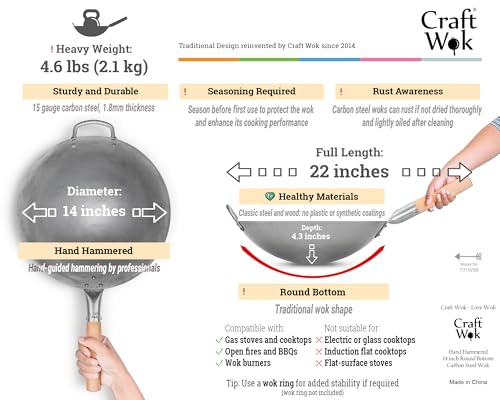
- •15 gauge (1.8mm) carbon steel, commercial grade. Original design by Craft Wok since 2014, proven quality over the years.
- •Traditional chinese wok pan with round bottom: not suitable for flat electric or flat induction stove. Do not forget to season it before use! Instructions for easy seasoning are included with the wok. Our customer service is ready to guide through the process whenever you need it.
- •Hand hammered by Chinese professionals in Guangzhou. This wok is the proven choice of many professional Chinese chefs.
- •Steel helper handle will not burn when you stir fry over high heat, also helpful for hanging the wok for storage. Wooden handle has special hygroscopic not slippery surface for tight grip when you stir-fry.
- •Craft Wok - Love Wok! We are a team of professionals drawn together by our passion for the carbon steel wok. Our mission is to bring you as much pleasure from Stir-frying in a wok, as chefs get in restaurants across China. To do this, we have found the best manufacturers in China. Our range of branded products is 100% authentic traditional carbon steel woks, 5 years on market.
Craft Wok Traditional Hand Hammered Chinese Carbon Steel Wok with Wooden and Steel Helper Handle (14 Inch, Round Bottom Pow Wok Pan) / 731W88
List Price: $86.55$77.90DEALYou Save: $8.65 (10%)
Free shippingFree Returns – 30 daysFree Order CancellationSecure Payment2–3 Days DeliveryGet It June 25, 2026In Stock (2)No marketing spamNo account requiredFulfilment by FedEx / Amazon / UPS / ShipwirePayPal / Card Buyer Protection
Customer Reviews
Reviews sourced from verified Amazon purchasers4.6
out of 5
Based on 10 reviews
5★
90%
4★
10%
3★
0%
2★
0%
1★
0%
The near perfect 14" wok!
Stephen Page•June 27, 2017
After first purchasing the wonderful Big 16 Inch Heavy Canton Style Hand Hammered Carbon Steel Wok (Round Bottom) / 731W87 by Craft Wok , I decided to also get this 14" version with wood handle. Just like it's bigger brother, this is a fantastic and substantial wok. By my measure (using dial calipers), it is 1.8mm thick - solid, with no "give" in any manner when pulling/pushing on the handles. This wok is the ideal size for cooking for 3 or 4 people at once. The wok may have had a light oil coating on arrival, but nothing that was difficult to remove with a quick soapy rinse in the sink. Using my wok stove Thunder Group IRFS001 5B Fast Stove on the lanai, this was easy and quick to season for use - less than 15 minutes. Just fire the stove to high heat and slowly reposition the wok, watching as the steel cycles through the colors of the rainbow and settles on gray/silver. Bring the wok down to medium heat and wipe with a light coat of vegetable oil using a folded paper towel and tongs. I had a slick, non-stick surface the very first use and it has remained such after many more uses. I suspect the vast majority of people who have trouble seasoning their woks are trying to do so on inadequate heat sources. A true high BTU wok stove makes this a simple affair (and avoids filling your home with smoke!). This is not a light wok, so even with the long handle for leverage, it takes some wrist and forearm strength to try to toss it around, so just be aware. The handle on my wok was a tad loose, which was easily fixed by snugging up the two wood screws holding it in place. A high quality, solidly built cooking tool that I highly recommend!
Well made wok, looks amazing after tempering
Scott Willis•May 10, 2017
Wok is very well constructed. It's a little on the heavy side but is the right size if you are serious about cooking in a wok.
I previously had a 10 inch wok instead of this 14inch and food would often fall out while cooking. Never a problem with this Wok.
The wooden handle will start to wobble guaranteed after some light use so you may have to put in a new screw or find some other fix but the wobbling is more of an annoyance than a problem so far after a week of use.
Don't forget to temper the Wok as it will look amazing afterwards and be much less susceptible to food sticking. There is a great review on Amazon with detailed instructions.
I previously had a 10 inch wok instead of this 14inch and food would often fall out while cooking. Never a problem with this Wok.
The wooden handle will start to wobble guaranteed after some light use so you may have to put in a new screw or find some other fix but the wobbling is more of an annoyance than a problem so far after a week of use.
Don't forget to temper the Wok as it will look amazing afterwards and be much less susceptible to food sticking. There is a great review on Amazon with detailed instructions.
Beautiful Wok - AND here is the ONLY correct and complete guide to tempering this great Wok!
Lance S. Owens•April 25, 2017
Excellent traditional carbon steel wok. BUT -- and I emphasize this -- it MUST be properly tempered before use. None of the YouTube videos or comments I have seen understand this process, and you probably will not either. So read on.
This process of preparing the wok is NOT really a "seasoning" -- that implies some sort of cooking process. What is need is very high temperature tempering of the bare steel surface. This is metallurgy, not cooking! It is an ancient process used on steel to "blue" it. It is the same process used on old steel swords and gun barrels, to give them a protective non-rusting black-blue coating. Let me explain the "bluing process" you need to perform on your new wok.
Carbon steel is chemically very reactive. It rusts -- it reacts with oxygen and forms red iron oxide, Fe2O3, when exposed to oxygen, such as the oxygen in H20 water. Rusting, or red iron oxide, will form quickly on naked steel that is not properly prepared. The naked iron is also reactive with food moisture, and food will stick to it. BUT black iron oxide, formed on a steel surface that has been heated to HIGH temperatures, is less reactive, more stable, and adheres extremely well with oils. When well-oiled, the oil incorporates in the black iron oxide surface on the steel; this provides a non-reactive coating that protects the steel.
So what you need to do is BLUE the steel -- heat it to a very high temperature, and let the surface steel oxidize to black iron, Fe3O4, also called magnetite. Again this is not cooking. This is metallurgy!!
Let me repeat: If clean carbon steel is heated to above 550 degrees F. it reacts with the oxygen in the air, and the surface steel will oxidize to black iron oxide, Fe3O4. This black surface gives the steel a beautiful black-blue to aqua-blue patina. This blued steel, or black iron oxide surface, adheres quickly to oils. When coated with oil, the oiled blued steel is very rust resistant, it is also a non-stick surface for cooking. And it has been used by blacksmiths (and Chinese cooks) for millennia to treat steel surfaces.
The instructions that come with the wok tell you what to do. Do it. But they are brief. Here are the details.
FIRST STEP, you must clean the steel. It comes covered with oils to prevent rusting. You MUST strip all this oil off, to expose the bare steel surface. As instructed, use a scouring pad and go at it with detergent. Plan on working 30 minutes at this. Scrub, and rinse. Scrub and rinse. Take a white paper towel and rub the surface dry. If you are still getting black staining on the paper towel, then scrub some more. You want NAKED steel, without any oil residue on it. If there is oil on it, the oxygen cannot reach the surface when it is heated and oxidize the surface steel to black iron oxide, the beautiful blue magnetite surface you want.
SECOND step is heating to HIGH temperature. The instructions say put the wok on high heat until the steel turns BLUE. Few people understand what that means. It means REALLY heat the steel, really really really heat the steel -- all of it, all of the wok.
This requires a very hot gas flame. Use a 12,000 to 15,000 BTU (or higher) burner to do this. A BBQ is not hot enough, your oven is not hot enough. This is big flame on bare steel hot. Most modern stoves have at least one big high output burner. On my stove, I can take off the top diffuser plate from the big burner and and get a single huge gas jet -- this is what I use both for the bluing and for wok cooking. So get going. You might want to wear some heavy gloves while doing this. This is blacksmith work, not cooking. Keep animals and children away. If you touch that hot steel, it will not just burn you, it will brand you. Over a 15,000 BTU jet flame, it took my about 30 to 45 minutes to totally blue the entire wok.
Turn the heat on high. Put the wok on the hot flame, and wait. And wait. And wait. You must heat the steel to over 550 F. (around 300 C.) before the steel will begin oxidizing properly. First you will see orange yellow steel, then suddenly it will start to look "blue." That blue is the black iron oxide surface forming -- the black iron on top of the silvery steel underneath gives a bluish color. If you have properly cleaned the wok, there will be very little to NO smoke. Smoking indicates you did not properly clean off the oils, which are burning and smoking, and probably contaminating your steel surface. If you are getting lots of smoke, STOP. Go back to step one and get the steel cleaned of oils.
Now watch the blue surface expand. Carefully turn the wok over the hottest portion of the flame, move the wok very slowly so the blue transformation moves all the way to the edge. Slowly, very slowly, move up and down and around over the fire, working outward from the hottest blue edge, from center to top, expanding the blue area. When you are done, the ENTIRE surface of the wok should be beautiful blue steel. This is the the black iron oxide coat to the steel called "bluing." If there are orange or yellow-orange areas on the wok, then you did not fully heat and transform them. Heat them again until they turn blue.
Okay, blacksmith work done. The factory could do this I suppose, but none do. Chinese cooks know how to do it on a hot fire -- and a wok lasts a lifetime, so one only needs to do it once in a life!
STEP THREE. We are following the instructions that came with the wok. I am just explaining. Let the wok cool. If you put oil on that 550 degree F. steel, you will have a kitchen of smoke! When it cools quite a bit, put it back on medium flame. Now oil it, following instructions. This part may cause some smoke. It you are getting lots of smoke, turn the heat down. Use a high-temperature tolerant cooking oil, like Safflower oil, refined Light Olive Oil (NOT regular olive oil), or Peanut oil. Canola oil also works, but I hate the smell of hot Canola oil.
The black iron oxide surface you have created on your "blued" carbon steel wok loves oil. It combines with oil quickly, it hugs and bonds with oil. And when coated with oil, it is a surface that is both non-stick, and non-reactive to rusting. Look at the color! It will be shimmering with an agua-blue hue, not a really black color.
Cool the wok a bit. Turn it over. Look at that beautiful blue-black surface of magnetite you have created by proper tempering. It will be darker and thicker on the outside surface, which got hotter. Coat the outside with a thin coat of oil. Marvel at the pretty color. Coat it with more oil occasionally.
There you have it. Your are now ready to use the wok. It is properly tempered, blued; you have created a traditional non-rusting, and non-sticking surface. Traditionally, now start the wok by cooking onions and ginger. This "seasons" the surface. This is the only part of the process properly called "seasoning a wok"!
Attached are a few photos. In the first one, I added a faded blue sink cloth to help show the color. Notice the aqua-blue hue of the metal? This is blued steel color. (I have cooked a few dishes in this pan, so there is some brown oil gunk at the bottom.) At the top of wok, by the handle rivets, you will see an area that is orangish to silver -- well, that is an area I did not get properly blued. It was hard to get that area hot enough. So it goes, the job was less than perfect. But you should not have many areas like this on your perfectly blued steel wok.
The second photo shows the outside surface, and its beautiful blue-black iron oxide surface. This is what you are shooting to obtain in this process.
The third photo shows my stove burner on high flame, with the top diffusion plate remove. This gives a real jet flame, and I use it this way for wok cooking. I used this flame for the bluing process. Is that safe, you ask? Well, so far, both I and the stove are doing well, thank you. But I can offer no further guarantees. I added a photo of the wok on the jet gas flame, with the diffuser plater removed. Believe me, it is perfect for wok cooking.
Addendum: Someone asked me about the handle wrap. I added another photo. The lower metal section of the handle gets very hot while cooking, and it is easy to slide your hand on to it. Ouch. I do what our cook in Taiwan did when I was a kid fifty years ago. I wrap it tightly with cotton fabric. Take an old t-shirt, cut a three inch wide and fairly long piece. Wrap the metal very tightly with several wraps of the cotton strip. Then put on a wrap of old-fashion friction tape over that to hold the wrap tight. Tuck the top and bottom ends of the cotton under the wrap. Coat the friction tape with some corn starch or flour to take away its sticky surface. This lasts a long time, and is easy to redo if needed.
How to maintain: Simple. Never use abrasives (like a steel scrub) on the surface; doing so will remove the finish. Never use a detergent on the pan; doing so will remove the oil finish on the bluing, and detergent may contaminate the oil coating. One can usually clean the surface with very hot water and a kitchen dish brush. It really is a non-stick surface, when properly prepared and used. After washing, dry well and wipe a few drops of cooking oil over the inside and outside. And of course, don't store it in a wet place.
Loose handle problems, another addendum: The wood of the handle of the wok dries and shrinks, and the handle may get loose after a few weeks of use; mine did, others report the same thing. This is a common problem with wood from high-humidity climates. To fix the problem, take out the two screws that hold the wood handle in the metal sleeve, then twist the wood as far as you can into the sleeve. Give it a couple solid taps with a hammer to set it tightly into the sleeve. Reinsert the screws. Fixed. Repeat if necessary later; my handle needed only the one fix. The wood of the handle will eventually dry and stop shrinking.
This process of preparing the wok is NOT really a "seasoning" -- that implies some sort of cooking process. What is need is very high temperature tempering of the bare steel surface. This is metallurgy, not cooking! It is an ancient process used on steel to "blue" it. It is the same process used on old steel swords and gun barrels, to give them a protective non-rusting black-blue coating. Let me explain the "bluing process" you need to perform on your new wok.
Carbon steel is chemically very reactive. It rusts -- it reacts with oxygen and forms red iron oxide, Fe2O3, when exposed to oxygen, such as the oxygen in H20 water. Rusting, or red iron oxide, will form quickly on naked steel that is not properly prepared. The naked iron is also reactive with food moisture, and food will stick to it. BUT black iron oxide, formed on a steel surface that has been heated to HIGH temperatures, is less reactive, more stable, and adheres extremely well with oils. When well-oiled, the oil incorporates in the black iron oxide surface on the steel; this provides a non-reactive coating that protects the steel.
So what you need to do is BLUE the steel -- heat it to a very high temperature, and let the surface steel oxidize to black iron, Fe3O4, also called magnetite. Again this is not cooking. This is metallurgy!!
Let me repeat: If clean carbon steel is heated to above 550 degrees F. it reacts with the oxygen in the air, and the surface steel will oxidize to black iron oxide, Fe3O4. This black surface gives the steel a beautiful black-blue to aqua-blue patina. This blued steel, or black iron oxide surface, adheres quickly to oils. When coated with oil, the oiled blued steel is very rust resistant, it is also a non-stick surface for cooking. And it has been used by blacksmiths (and Chinese cooks) for millennia to treat steel surfaces.
The instructions that come with the wok tell you what to do. Do it. But they are brief. Here are the details.
FIRST STEP, you must clean the steel. It comes covered with oils to prevent rusting. You MUST strip all this oil off, to expose the bare steel surface. As instructed, use a scouring pad and go at it with detergent. Plan on working 30 minutes at this. Scrub, and rinse. Scrub and rinse. Take a white paper towel and rub the surface dry. If you are still getting black staining on the paper towel, then scrub some more. You want NAKED steel, without any oil residue on it. If there is oil on it, the oxygen cannot reach the surface when it is heated and oxidize the surface steel to black iron oxide, the beautiful blue magnetite surface you want.
SECOND step is heating to HIGH temperature. The instructions say put the wok on high heat until the steel turns BLUE. Few people understand what that means. It means REALLY heat the steel, really really really heat the steel -- all of it, all of the wok.
This requires a very hot gas flame. Use a 12,000 to 15,000 BTU (or higher) burner to do this. A BBQ is not hot enough, your oven is not hot enough. This is big flame on bare steel hot. Most modern stoves have at least one big high output burner. On my stove, I can take off the top diffuser plate from the big burner and and get a single huge gas jet -- this is what I use both for the bluing and for wok cooking. So get going. You might want to wear some heavy gloves while doing this. This is blacksmith work, not cooking. Keep animals and children away. If you touch that hot steel, it will not just burn you, it will brand you. Over a 15,000 BTU jet flame, it took my about 30 to 45 minutes to totally blue the entire wok.
Turn the heat on high. Put the wok on the hot flame, and wait. And wait. And wait. You must heat the steel to over 550 F. (around 300 C.) before the steel will begin oxidizing properly. First you will see orange yellow steel, then suddenly it will start to look "blue." That blue is the black iron oxide surface forming -- the black iron on top of the silvery steel underneath gives a bluish color. If you have properly cleaned the wok, there will be very little to NO smoke. Smoking indicates you did not properly clean off the oils, which are burning and smoking, and probably contaminating your steel surface. If you are getting lots of smoke, STOP. Go back to step one and get the steel cleaned of oils.
Now watch the blue surface expand. Carefully turn the wok over the hottest portion of the flame, move the wok very slowly so the blue transformation moves all the way to the edge. Slowly, very slowly, move up and down and around over the fire, working outward from the hottest blue edge, from center to top, expanding the blue area. When you are done, the ENTIRE surface of the wok should be beautiful blue steel. This is the the black iron oxide coat to the steel called "bluing." If there are orange or yellow-orange areas on the wok, then you did not fully heat and transform them. Heat them again until they turn blue.
Okay, blacksmith work done. The factory could do this I suppose, but none do. Chinese cooks know how to do it on a hot fire -- and a wok lasts a lifetime, so one only needs to do it once in a life!
STEP THREE. We are following the instructions that came with the wok. I am just explaining. Let the wok cool. If you put oil on that 550 degree F. steel, you will have a kitchen of smoke! When it cools quite a bit, put it back on medium flame. Now oil it, following instructions. This part may cause some smoke. It you are getting lots of smoke, turn the heat down. Use a high-temperature tolerant cooking oil, like Safflower oil, refined Light Olive Oil (NOT regular olive oil), or Peanut oil. Canola oil also works, but I hate the smell of hot Canola oil.
The black iron oxide surface you have created on your "blued" carbon steel wok loves oil. It combines with oil quickly, it hugs and bonds with oil. And when coated with oil, it is a surface that is both non-stick, and non-reactive to rusting. Look at the color! It will be shimmering with an agua-blue hue, not a really black color.
Cool the wok a bit. Turn it over. Look at that beautiful blue-black surface of magnetite you have created by proper tempering. It will be darker and thicker on the outside surface, which got hotter. Coat the outside with a thin coat of oil. Marvel at the pretty color. Coat it with more oil occasionally.
There you have it. Your are now ready to use the wok. It is properly tempered, blued; you have created a traditional non-rusting, and non-sticking surface. Traditionally, now start the wok by cooking onions and ginger. This "seasons" the surface. This is the only part of the process properly called "seasoning a wok"!
Attached are a few photos. In the first one, I added a faded blue sink cloth to help show the color. Notice the aqua-blue hue of the metal? This is blued steel color. (I have cooked a few dishes in this pan, so there is some brown oil gunk at the bottom.) At the top of wok, by the handle rivets, you will see an area that is orangish to silver -- well, that is an area I did not get properly blued. It was hard to get that area hot enough. So it goes, the job was less than perfect. But you should not have many areas like this on your perfectly blued steel wok.
The second photo shows the outside surface, and its beautiful blue-black iron oxide surface. This is what you are shooting to obtain in this process.
The third photo shows my stove burner on high flame, with the top diffusion plate remove. This gives a real jet flame, and I use it this way for wok cooking. I used this flame for the bluing process. Is that safe, you ask? Well, so far, both I and the stove are doing well, thank you. But I can offer no further guarantees. I added a photo of the wok on the jet gas flame, with the diffuser plater removed. Believe me, it is perfect for wok cooking.
Addendum: Someone asked me about the handle wrap. I added another photo. The lower metal section of the handle gets very hot while cooking, and it is easy to slide your hand on to it. Ouch. I do what our cook in Taiwan did when I was a kid fifty years ago. I wrap it tightly with cotton fabric. Take an old t-shirt, cut a three inch wide and fairly long piece. Wrap the metal very tightly with several wraps of the cotton strip. Then put on a wrap of old-fashion friction tape over that to hold the wrap tight. Tuck the top and bottom ends of the cotton under the wrap. Coat the friction tape with some corn starch or flour to take away its sticky surface. This lasts a long time, and is easy to redo if needed.
How to maintain: Simple. Never use abrasives (like a steel scrub) on the surface; doing so will remove the finish. Never use a detergent on the pan; doing so will remove the oil finish on the bluing, and detergent may contaminate the oil coating. One can usually clean the surface with very hot water and a kitchen dish brush. It really is a non-stick surface, when properly prepared and used. After washing, dry well and wipe a few drops of cooking oil over the inside and outside. And of course, don't store it in a wet place.
Loose handle problems, another addendum: The wood of the handle of the wok dries and shrinks, and the handle may get loose after a few weeks of use; mine did, others report the same thing. This is a common problem with wood from high-humidity climates. To fix the problem, take out the two screws that hold the wood handle in the metal sleeve, then twist the wood as far as you can into the sleeve. Give it a couple solid taps with a hammer to set it tightly into the sleeve. Reinsert the screws. Fixed. Repeat if necessary later; my handle needed only the one fix. The wood of the handle will eventually dry and stop shrinking.
Great customer service and a good, traditional wok
SunnyDay•April 25, 2017
The first one I ordered had a defective handle and the seller addressed it immediately and is sending me a new one. I did use the defective one last night because I couldn't wait - and it works well. You must season it though - if you don't season it well, everything will stick and it wont be the wok's fault! My gas stove has a wok ring accessory, if yours doesn't then you will need to get one because this is a traditional round-bottom wok.
Watch those seasoning instructions... otherwise it's wonderful
Kay_Rock•April 23, 2017
This is a gorgeous wok. Make sure you buy a good quality ring. I wish one was included, but no such luck.
The instructions included for tempering/seasoning the wok were a bit confusing and hard to follow. I looked at several videos on youtube and finally found one that made sense, and that improved everything quickly.
Once properly seasoned, it is lovely and works very well.
DO NOT USE without seasoning.
The instructions included for tempering/seasoning the wok were a bit confusing and hard to follow. I looked at several videos on youtube and finally found one that made sense, and that improved everything quickly.
Once properly seasoned, it is lovely and works very well.
DO NOT USE without seasoning.
Page 1 of 2