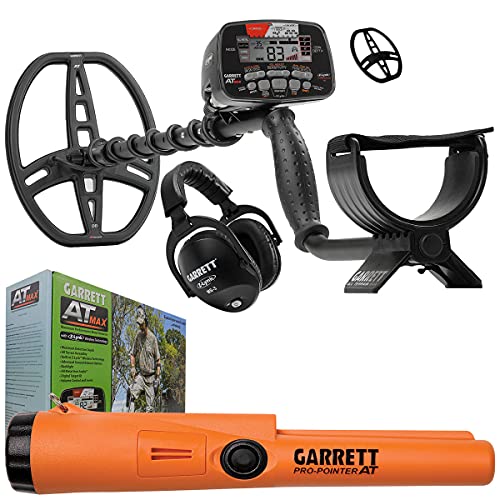
Garrett Pro-Pointer A.T. Pinpointer Metal Detector for Adults, Made in USA, Waterproof


Key features
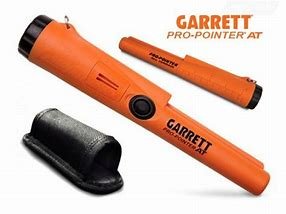
- •Fully waterproof to 10 feet with orange color for added visibility underwater
- •Maximum Sensitivity for improved detection of nuggets and other small targets. Choose from three Sensitivity levels
- •Fast Retune: Quick button press instantly tunes out environment or narrows detection field for precise pinpointing of larger targets
Garrett Pro-Pointer A.T. Pinpointer Metal Detector for Adults, Made in USA, Waterproof
List Price: $160.05$144.05DEALYou Save: $16.00 (10%)
Free shippingFree Returns – 30 daysFree Order CancellationSecure Payment2–3 Days DeliveryGet It October 25, 2026In Stock (2)No marketing spamNo account requiredFulfilment by FedEx / Amazon / UPS / ShipwirePayPal / Card Buyer Protection
Customer Reviews
Reviews sourced from verified Amazon purchasers4.8
out of 5
Based on 10 reviews
5★
80%
4★
20%
3★
0%
2★
0%
1★
0%
Good waterproof Pointer.
Amazon Customer✓ Verified Purchase•November 8, 2017
I like this pointer better than the Whites II. First it is water proof up to a depth of 10 feet. Second it has a proximity chirp in other words the closer you come to you target the beeps shorten to a continuous beep. And it has sensitivity settings that are adjustable and also you can go to silent mode with the sensitivity settings as well. It also has a led that lights the search area in low light. It also comes with a belt holster, and a ring loop which is good to clip to a harness to keep from miss placing it. Keep the seal lightly coated with a silicone gel to help with water tight integrity. It does come with a 9v battery installed, and the packaging was excellent.
Learn how this pin-pointer responds to target geometry - it will allow more precise location
AUgie the Prospector✓ Verified Purchase•July 17, 2017
Everybody has these things (Garrett Pro-Pointer AT - the Garrett Carrot), and everybody likes them - a good many people love them. The Whites Bullseye TRX has it beat on range/depth (and price), and is the "Carrot's" most worthy competitor (from what I can tell)..
I'll leave a complete review to others (there are plenty), and comment on something that I've not seen discussed very much - though it may be out there in an Amazon review, YouTube, etc.
The Garrett Pro-Pointer AT is sensitive along the length of its probe (up to and past the 4" mark), and you'll see some people map that out on YouTube. This "wand" of sensitivity can be swept horizontally to survey a dirt pile, vertically to search the side of a deep hole, or horizontally on the surface seeking a shallow target. This is useful, but is not uniformly sensitive along its length. Garrett even remarks in the manual that maximum sensitivity to small targets is obtained a little above the tip, and from the side.
To get maximum pin-pointing precision from it, try testing how it reacts to typical flat targets (coins, rings, pull tabs, etc.), depending on their orientation. I'll leave you to experiment and get a feel for it, but here is an example of what I am talking about:
Think of laying the Pro-Pointer AT on its side and sweeping it across the surface, looking for a shallow coin. Most coins are buried flat, so the coin will be facing the side of the pin-pointer. You'll find that there is a "dumbbell" of sensitivity in this case, peaking at around the 0.5 inch line and the 3.5 inch line. A weak signal is probably near the tip or near the LED area (4" mark). Try it in the air.
Now think of sweeping the Pro-Pointer AT into and around a hole that missed the coin. The Pro-pointer will be close to vertical and the coin will be "co-linear" with the shaft (facing down, and the shaft is pointed down). In this case, the sensitivity pattern is reversed. The sensitivity drops at the ends (near 0" and 4") and peaks in the middle (near 2"). If you get a moderate signal in the wall of a hole, the target may not be down by the tip, but two inches higher up along the shaft, because that is where the most sensitivity is for a target oriented that way. Try it in the air.
You'll notice that a coin edge-on to the shaft, with the edge parallel to the shaft, is very weakly sensed, but has the "dumbbell" sensitivity pattern encountered in the first example.
Experimenting in the air with this pin-pointer and commonly found items will help avoid issues in the field with targets that seem to move around as you orient the pin-pointer differently. We are all familiar with detecting "moving targets" from nails, long screws, bobby pins, and pieces of wire, and issues detecting targets buried on edge. Pin-pointers can suffer from similar issues on a smaller scale, and in a worst case this can slow recovery or cause an unnecessarily large hole to be dug. By reorienting the pin-pointer, and knowing its sensitivity pattern, we can avoid being mislead.
Other brands of pin-pointers have different sensitivity patterns, with potential advantages or trade-offs.
I'll leave a complete review to others (there are plenty), and comment on something that I've not seen discussed very much - though it may be out there in an Amazon review, YouTube, etc.
The Garrett Pro-Pointer AT is sensitive along the length of its probe (up to and past the 4" mark), and you'll see some people map that out on YouTube. This "wand" of sensitivity can be swept horizontally to survey a dirt pile, vertically to search the side of a deep hole, or horizontally on the surface seeking a shallow target. This is useful, but is not uniformly sensitive along its length. Garrett even remarks in the manual that maximum sensitivity to small targets is obtained a little above the tip, and from the side.
To get maximum pin-pointing precision from it, try testing how it reacts to typical flat targets (coins, rings, pull tabs, etc.), depending on their orientation. I'll leave you to experiment and get a feel for it, but here is an example of what I am talking about:
Think of laying the Pro-Pointer AT on its side and sweeping it across the surface, looking for a shallow coin. Most coins are buried flat, so the coin will be facing the side of the pin-pointer. You'll find that there is a "dumbbell" of sensitivity in this case, peaking at around the 0.5 inch line and the 3.5 inch line. A weak signal is probably near the tip or near the LED area (4" mark). Try it in the air.
Now think of sweeping the Pro-Pointer AT into and around a hole that missed the coin. The Pro-pointer will be close to vertical and the coin will be "co-linear" with the shaft (facing down, and the shaft is pointed down). In this case, the sensitivity pattern is reversed. The sensitivity drops at the ends (near 0" and 4") and peaks in the middle (near 2"). If you get a moderate signal in the wall of a hole, the target may not be down by the tip, but two inches higher up along the shaft, because that is where the most sensitivity is for a target oriented that way. Try it in the air.
You'll notice that a coin edge-on to the shaft, with the edge parallel to the shaft, is very weakly sensed, but has the "dumbbell" sensitivity pattern encountered in the first example.
Experimenting in the air with this pin-pointer and commonly found items will help avoid issues in the field with targets that seem to move around as you orient the pin-pointer differently. We are all familiar with detecting "moving targets" from nails, long screws, bobby pins, and pieces of wire, and issues detecting targets buried on edge. Pin-pointers can suffer from similar issues on a smaller scale, and in a worst case this can slow recovery or cause an unnecessarily large hole to be dug. By reorienting the pin-pointer, and knowing its sensitivity pattern, we can avoid being mislead.
Other brands of pin-pointers have different sensitivity patterns, with potential advantages or trade-offs.
Less Digging, More Finding
Jared Hall✓ Verified Purchase•January 4, 2017
If you enjoy metal detecting and don't own a pin-pointer, save up and get one -- you'll spend much less time digging and more time looking at your finds. This one in particular is durable, sensitive, and easy to use in the field with one hand. Key operations via the single multi-function button are
1. On/Off
2. Cycle through 6 sensitivity / alert modes (Hi/Med/Lo sensitivity levels and vibrate vs beep alerts)
3. Quick retuning
One thing that could be made clearer (and is an important point) is to auto ground-balance it by turning it on with the point contacting a neutral area of the soil you are searching in first. The "quick retuning" feature allows you to starting homing in on a signal; when the beeps or vibrations start, a quick press of the button resets the sensitivity so the alerts stop and then will only continue as you get closer to the target -- handy!
As far as field experience goes, I can say this has shortened my time finding dug Civil War relics immensely. I have had no weather-proofing issues and have not tried it underwater yet. However, as with all metal detection equipment and detecting in general it is a tool, not a magic wand, and getting benefit from it will take some practice and use in the field. Following some forum chatter about these "falsing" for poor initial battery strength, I did not use the 9v that shipped with it. Other features are as-advertised: ruler marks, LED light, and lanyard ring. The battery in mine now has been on about 10 digs in vibrate-only mode (assume that draws more power than the beep) and is still going strong with no signs of bad detection or running out of juice.
1. On/Off
2. Cycle through 6 sensitivity / alert modes (Hi/Med/Lo sensitivity levels and vibrate vs beep alerts)
3. Quick retuning
One thing that could be made clearer (and is an important point) is to auto ground-balance it by turning it on with the point contacting a neutral area of the soil you are searching in first. The "quick retuning" feature allows you to starting homing in on a signal; when the beeps or vibrations start, a quick press of the button resets the sensitivity so the alerts stop and then will only continue as you get closer to the target -- handy!
As far as field experience goes, I can say this has shortened my time finding dug Civil War relics immensely. I have had no weather-proofing issues and have not tried it underwater yet. However, as with all metal detection equipment and detecting in general it is a tool, not a magic wand, and getting benefit from it will take some practice and use in the field. Following some forum chatter about these "falsing" for poor initial battery strength, I did not use the 9v that shipped with it. Other features are as-advertised: ruler marks, LED light, and lanyard ring. The battery in mine now has been on about 10 digs in vibrate-only mode (assume that draws more power than the beep) and is still going strong with no signs of bad detection or running out of juice.
Using one of these tools reduces recovery time by a great deal in many scenarios
Gazrok✓ Verified Purchase•September 26, 2016
If you are considering getting into metal detecting dirt or farm fields you absolutely must get a pinpointer. I am a big proponent of buying the gold standard and the Garrett Pro-Pointer AT is most certainly that. Using one of these tools reduces recovery time by a great deal in many scenarios. Picture yourself digging plugs where the target does not immediately turn up. This tool allows you with a swipe of the wand to tell what side of the hole it's on or if its just deeper. The next scenario is you're on a gravel parking lot and you get a beep, how on earth are you ever going to dig through tiny rocks to find the target? all you have to do is rustly the rocks around with this thing and when you're on top of the coin it vibrates for a near instant recovery. The best part is that it is completely waterproof! you can actually use it in rivers and in the rain etc, or hose it off when you're done to clean it!
If you're on the fence, buy this tool!
If you're on the fence, buy this tool!
The best got better
Axilla✓ Verified Purchase•March 30, 2016
I've been using the pro pointer and pro pointer 2 for years and after getting this AT pointer I am confident that this is the best I have used by far.
First I love that it can go to vibrate only mode and stay there until you change it back. Sometimes I'll do some stealth night hunts and having this option is awesome. I wish I could turn the light off but maybe in the next version.
Next is the switch, what a way better control switch than any of the previous units. It's solid, easy to use, and just a better design than before.
You no longer need to power the unit off to retune just simply quick press and boom, done. Also it's easier to operate with gloves on. I used to have problem with my pro pointer before when using gloves because the switch required pushing all the way in to turn on and off. This is more like a switch than a button.
Obviously it waterproof as well. No more taping or silicone in the holes to keep water out. That's a plus in itself.
At first I wasn't sure I wanted to spend the money for it but I'm glad I did. Now I can't wait to get it into the river this summer.
First I love that it can go to vibrate only mode and stay there until you change it back. Sometimes I'll do some stealth night hunts and having this option is awesome. I wish I could turn the light off but maybe in the next version.
Next is the switch, what a way better control switch than any of the previous units. It's solid, easy to use, and just a better design than before.
You no longer need to power the unit off to retune just simply quick press and boom, done. Also it's easier to operate with gloves on. I used to have problem with my pro pointer before when using gloves because the switch required pushing all the way in to turn on and off. This is more like a switch than a button.
Obviously it waterproof as well. No more taping or silicone in the holes to keep water out. That's a plus in itself.
At first I wasn't sure I wanted to spend the money for it but I'm glad I did. Now I can't wait to get it into the river this summer.
Page 1 of 2