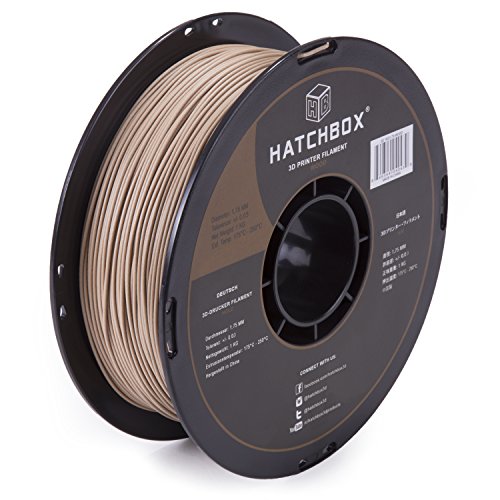
HATCHBOX 1.75mm Wood PLA 3D Printer Filament, 1 KG Spool, Dimensional Accuracy +/- 0.03 mm, 3D Printing Wood Filament



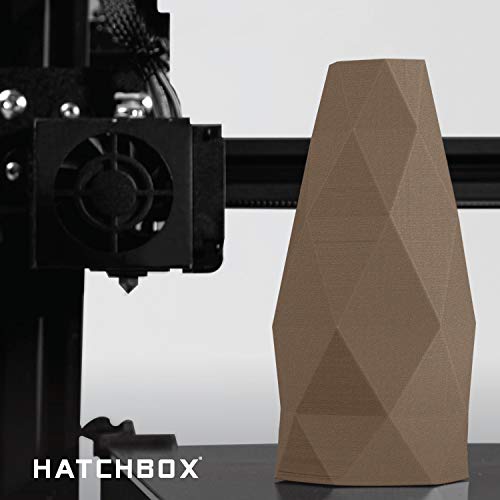
Key features
- •1KG (2.2 lb) Spool
- •Wood 3D Printer Filament Vacuumed Sealed With Desiccant
- •Recommended Extrusion/Nozzle Temperature 175°C - 220°C (347°F - 428°F)
- •1.75mm Filament Diameter (Dimensional Accuracy +/- 0.03mm)
- •Spool Diameter: 7.88" - Spool Width: 2.69" - Spool Hub Hole Diameter: 2.20"
HATCHBOX 1.75mm Wood PLA 3D Printer Filament, 1 KG Spool, Dimensional Accuracy +/- 0.03 mm, 3D Printing Wood Filament
List Price: $62.86$56.57DEALYou Save: $6.29 (10%)
Free shippingFree Returns – 30 daysFree Order CancellationSecure Payment2–3 Days DeliveryGet It October 25, 2026In Stock (2)No marketing spamNo account requiredFulfilment by FedEx / Amazon / UPS / ShipwirePayPal / Card Buyer Protection
Customer Reviews
Reviews sourced from verified Amazon purchasers4.5
out of 5
Based on 10 reviews
5★
90%
4★
10%
3★
0%
2★
0%
1★
0%
Has its advantages and disadvantages
JustMKollum•October 3, 2017
This filament has its advantages and disadvantages.
Advantages:
1. Has a unique surface appeal. This material tends to hide the slicing lines on the model compared to your average PLA filament. The slicing lines are visible, but not as visible due to its matted appearance. This advantage can also make fine details on your model more visible!
2. Has a nice wooden aroma when printing and after its printed. It smells like smoked wood on the grill.
3. Can be sanded and painted on easier than average PLA filament. This filament can even be stained and polished.
4. No special settings required to print, therefore it's great for beginners, such as myself!
Disadvantages:
1. This filament tends to be more brittle/fragile than pure PLA filament, due to being mixed with chips of wood. I would use caution when printing with rafts, skirts/brims, because I have had parts of my model snap off with the rafts, even support structures, leaving the pattern of the infill on the broken surface. This is still a strong filament, just be careful with printing thin parts of a model. I had arms break off of characters when accidentally dropped.
2. The wood filament is more stringy. To prevent stringing/oozing, I would print at exactly 200 degrees, no higher unless your printer requires otherwise; and make sure "Retraction" is enabled on your 3D Printing settings/software. Increasing the retraction distance by double usually works best for this printing filament.
Advantages:
1. Has a unique surface appeal. This material tends to hide the slicing lines on the model compared to your average PLA filament. The slicing lines are visible, but not as visible due to its matted appearance. This advantage can also make fine details on your model more visible!
2. Has a nice wooden aroma when printing and after its printed. It smells like smoked wood on the grill.
3. Can be sanded and painted on easier than average PLA filament. This filament can even be stained and polished.
4. No special settings required to print, therefore it's great for beginners, such as myself!
Disadvantages:
1. This filament tends to be more brittle/fragile than pure PLA filament, due to being mixed with chips of wood. I would use caution when printing with rafts, skirts/brims, because I have had parts of my model snap off with the rafts, even support structures, leaving the pattern of the infill on the broken surface. This is still a strong filament, just be careful with printing thin parts of a model. I had arms break off of characters when accidentally dropped.
2. The wood filament is more stringy. To prevent stringing/oozing, I would print at exactly 200 degrees, no higher unless your printer requires otherwise; and make sure "Retraction" is enabled on your 3D Printing settings/software. Increasing the retraction distance by double usually works best for this printing filament.
Great filament from a great brand
Aaron G.•September 1, 2017
Hatchbox filament is my go to brand for all my printing. I have never had issues with it! My only complaint is that they are usually out of stock of one color or another that I need. I needed some wood PLA for a project recently and the hatchbox brand was sold out so I figured I'd give another brand a chance. Huge mistake! The other brand caused several serious extruder jams and nozzle blockages making it completely unusable. I tried may different setting and to no avail. Despite it haveing good reviews on amazon. As soon as the hatchbox filament was back in stock I promptly purchased some. It printed beautifully the very first time. I am almost done with this spool and it has performed flawlessly. I learned my lesson! Next time I'll just be paitcient and wait for it to come back in stock.
Great work hatchbox ! You guys rock! You make 3d printing a joy instead of a constant frustration like many other brands!
Great work hatchbox ! You guys rock! You make 3d printing a joy instead of a constant frustration like many other brands!
While the finished product looks very slightly better, I would get constant clogs due to the ...
Brian J. Chapin•June 30, 2017
Prints well, takes stain well and is sandable. Needs a much higher temp then normall hatchbox or the old woodfill. Under 220 and I get layer adhesion issues with use of a fan. 230 with fan and it's prints perfect at 45mm/s. Probably could take mote heat/speed but i havent tried yet. Overhangs prints amazingly well. No burning or clogs. Does seems to have a similar glass temp to regular hatchbox, becomes very soft at 65 degrees.
Tried colorfab previously. While the finished product looks very slightly better, I would get constant clogs due to the wood fibers burning in the nozzle, even at 200 and printing fairly fast. Hatchbox is MUCH easier to work with. Box states a huge temp range, from 175 to over 250.
Tried colorfab previously. While the finished product looks very slightly better, I would get constant clogs due to the wood fibers burning in the nozzle, even at 200 and printing fairly fast. Hatchbox is MUCH easier to work with. Box states a huge temp range, from 175 to over 250.
Superb every-day go-to PLA filament.
Packratt•March 11, 2017
I love this wood-filled filament after dialing in the settings just right this stuff prints like a dream and accepts sanding far better than regular PLA. I like this so much I've pretty much made this my go-to filament for most printing projects that don't need high-stress or temp tolerances and just paint it to the color I want in post-process because it finishes so nicely.
Very smooth prints! Perfect for aesthetic pieces.
Vvanderfell•February 26, 2017
Now this is some good filament. I don't know what about this stuff makes it print so smoothly, but this wood PLA has aced every other filament I've tried when it comes to aesthetic print quality.
It has its pros and cons.
This filament looks so nice. If you compare this to other standard PLAs, this stuff (for me at least) has turned out much nicer looking prints using the same settings. Tops/bottoms come out very smooth, and even the striations on the sides of prints are less noticeable, in my experience.
I've seen other people say that this filament sands like wood, but it really doesn't. It DOES sand down, however, but it's not as smooth of a process as normal wood. Which is totally fine because I haven't been able to sand down any other PLAs without it looking like trash. You can get a nice finish with the right sandpaper, but this stuff sands down like you're removing material, but also pushing it around, so sometimes edges will smooth over or become harder to sand. You just have to let it cool down and clean off your sandpaper before giving it another go. Fine grits will give you a harder time.
This filament is more brittle. I didn't think it was a whole lot weaker at first, but comparing it to other PLA prints, it's obvious that it doesn't hold up to the strength of standard plastics. But, that being said, it is still a strong material, and it will hold up to some pretty impressive forces when parts are thick, but you have to be careful about impacts or thin pieces. It's not necessarily a whole lot weaker than normal PLA, but definitely more brittle.
This PLA has jammed on me in the extruder twice, but after turning the temp up, I haven't had a problem since.
In my experience, this PLA doesn't really take a stain that well. I've tried some darker stain pens, but it doesn't soak in like it would with normal wood. HOWEVER, using the darker stain pens, I find that when it leeches its way into cracks and crevices, you get a really nice weathered look that brings a lot more depth to your parts. I haven't tried many stains, but an ebony stain pen has given me great visual results. I recommend sanding your part after print, then running a very rough, low grit sandpaper over the surface a few times to give the stain something to sink into. The results are a very nice, textured look. The stain will darken then entire print a tiny bit, but the scratches put into the piece will stick out the most.
You can put something like oil or sealant over the print if you like. Again, it won't soak in that much, but it will soak in enough.
All that being said, this, so far, has been my favorite filament for printing pretty things. I can not recommend it enough. I've gone through 3 rolls already, and I plan on buying more.
It has its pros and cons.
This filament looks so nice. If you compare this to other standard PLAs, this stuff (for me at least) has turned out much nicer looking prints using the same settings. Tops/bottoms come out very smooth, and even the striations on the sides of prints are less noticeable, in my experience.
I've seen other people say that this filament sands like wood, but it really doesn't. It DOES sand down, however, but it's not as smooth of a process as normal wood. Which is totally fine because I haven't been able to sand down any other PLAs without it looking like trash. You can get a nice finish with the right sandpaper, but this stuff sands down like you're removing material, but also pushing it around, so sometimes edges will smooth over or become harder to sand. You just have to let it cool down and clean off your sandpaper before giving it another go. Fine grits will give you a harder time.
This filament is more brittle. I didn't think it was a whole lot weaker at first, but comparing it to other PLA prints, it's obvious that it doesn't hold up to the strength of standard plastics. But, that being said, it is still a strong material, and it will hold up to some pretty impressive forces when parts are thick, but you have to be careful about impacts or thin pieces. It's not necessarily a whole lot weaker than normal PLA, but definitely more brittle.
This PLA has jammed on me in the extruder twice, but after turning the temp up, I haven't had a problem since.
In my experience, this PLA doesn't really take a stain that well. I've tried some darker stain pens, but it doesn't soak in like it would with normal wood. HOWEVER, using the darker stain pens, I find that when it leeches its way into cracks and crevices, you get a really nice weathered look that brings a lot more depth to your parts. I haven't tried many stains, but an ebony stain pen has given me great visual results. I recommend sanding your part after print, then running a very rough, low grit sandpaper over the surface a few times to give the stain something to sink into. The results are a very nice, textured look. The stain will darken then entire print a tiny bit, but the scratches put into the piece will stick out the most.
You can put something like oil or sealant over the print if you like. Again, it won't soak in that much, but it will soak in enough.
All that being said, this, so far, has been my favorite filament for printing pretty things. I can not recommend it enough. I've gone through 3 rolls already, and I plan on buying more.
Page 1 of 2