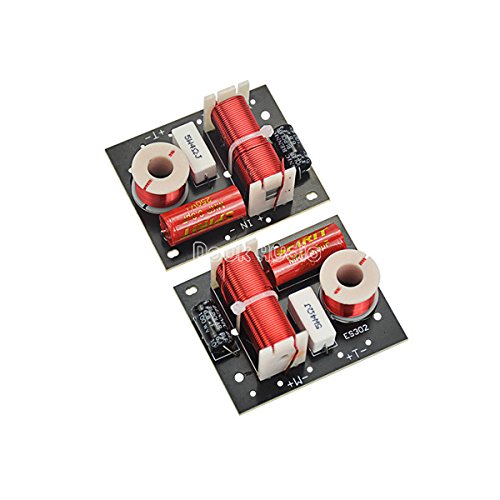
uxcell 2 Pcs 100W 2-Way Speaker System Audio Crossover Filters Frequency Distributor


Key features
- •Frequency: 3500Hz; Maximum Power: 130W
- •Circuit Filter Characteristics: Bass 12 dB/oct, Treble 12 dB/oct; Product Name: Crossover Filters Frequency Divider
- •Color: White,Red,Yellow; Material: Plastic,Metal,Electronic Parts
- •Dimension: 8.5 x 6 x 2cm/ 3.3 x 2.4 x 0.8 inches(L*W*H); Package Content: 2 x Crossover Filters Frequency Divider
- •Rated Power: 100W
uxcell 2 Pcs 100W 2-Way Speaker System Audio Crossover Filters Frequency Distributor
List Price: $34.90$31.41DEALYou Save: $3.49 (10%)
Free shippingFree Returns – 30 daysFree Order CancellationSecure Payment2–3 Days DeliveryGet It October 24, 2026In Stock (1)No marketing spamNo account requiredFulfilment by FedEx / Amazon / UPS / ShipwirePayPal / Card Buyer Protection
Customer Reviews
Reviews sourced from verified Amazon purchasers4.1
out of 5
Based on 10 reviews
5★
70%
4★
10%
3★
10%
2★
10%
1★
0%
these are quality
jerry•February 25, 2018
These crossovers work great. I have some old sony boxes that are very heavy the woofers went so i replaced them and decided i wanted better sound than when they were new. These did that boy did they do that.
two thumbs up
Samplerman•January 17, 2018
Works great in my latest speaker project. Sound is clear and crosses well. Nice price!
upgrade for Dayton Airs
john stone•October 17, 2017
Wow,these improved the sound greatly.They made a really nice sounding inexpensive set of speakers sound absolutely amazing. Improved mid range and sound stage immensley . Perfect for Dayton b652 airs!
Inexpensive upgrade for 2-way speakers
The Nannerpus•July 18, 2017
I bought these crossovers mainly as an experiment. I have two pairs of Sony SS B1000 (among several others) and thought they were mediocre performers, even at $50/pr, but they seemed like a decent foundation to improve and I felt there was little risk considering the costs involved. After reading the review 'The Real Deal' in the review section for these crossovers, I was convinced to give it a try.
Short answer:
Absolutely, no question, these crossovers are worth it for this application. They made my speakers go from sounding like wet-blanket-covered and sloppy to front-and-center-concert seat, so the clarity is much improved. I think the bass was even improved, not deeper, just more accurate. They are a lot brighter sounding and might be fatiguing in long listening sessions, but these are perfect for surround speakers, which is where they reside. Read on for interesting (to me) info.
Not-so-short answer:
I removed the B1000's fake trim panel (with the fake screw heads) as carefully as I could. A scratch awl and a flathead screwdriver helped immensely. Also note, there are 6 dowels that are glued into the speaker, 2 at each bottom fake screw, and 1 at each top fake screw. The speakers received some very minor cosmetic damage as I pried the trim off, but I kept telling myself "$50 speakers, $50 speakers." After removing the molding and unscrewing the woofer and tweeter, I pulled out the wiring and the high-pass capacitor. From sources on the internet, this speaker is apparently crossed over at 16khz! No wonder I heard improvement. I never soldered before, so I spent about 3 days watching youtube videos and practicing various soldering methods. Then I soldered 3 pairs of new speaker wire onto crossover (one for input, woofer and tweeter), then soldered to the input clips inside the speaker and also to the woofer. The B1000 has an external tweeter, so DO NOT solder this connection until after you've installed crossover and woofer (I learned the hard way). I also added some anti-vibration material from old car stereo projects on several surfaces. I used industrial-strength Velcro (my new favorite method of securing things) to hold the crossover to the bottom of the speaker and buttoned it all back up. The 2nd speaker took me only an hour.
I hooked up my SMSL 25w x 2 digital amp to a monster speaker selector and hooked up various pairs of speakers for comparison testing, including my other pair of factory B1000s. I played through an old Sony CD player I had lying around. I played the modified B1000 first to make sure everything worked right and I started grinning because I knew there was an improvement, particularly in the vocals and upper midrange. As the music continued, I used the speaker selector to switch over to the factory B1000s and basically started dancing. It's not like a created a pair of Wharfedale Diamonds or anything, but success was sweet. I clicked back and forth and was very happy with the improvement. I decided I was going to leave the factory B1000s unmodified so I could always go back and remind myself of the improvement.
I used my Sheffield test CD to do some tone testing from 20hz up to 20khz and a basic decibel meter for SPL (not an exact method, but good enough for some proof). Keep in mind, these meters are only accurate from about 30hz to 8khz. After measuring both pairs of speakers in the exact same fashion, I had solid proof that the upper-mids were improved as my graph shows a noticeable improvement in the 3khz to 8khz range, 13dB at its peak difference at 6.5khz! (Green line is modified B1000s, blue line is unmodified and gray line is my noise floor. Again, the drop-off above 8khz is the limitation of the sound meter.) This improvement makes sense - if the woofer was playing up to 16khz before the tweeter took over without the x-over, now the tweeter takes over around 3 or 4khz, improving both their performance.
I am very pleased with the upgrade these x-overs provided.
Short answer:
Absolutely, no question, these crossovers are worth it for this application. They made my speakers go from sounding like wet-blanket-covered and sloppy to front-and-center-concert seat, so the clarity is much improved. I think the bass was even improved, not deeper, just more accurate. They are a lot brighter sounding and might be fatiguing in long listening sessions, but these are perfect for surround speakers, which is where they reside. Read on for interesting (to me) info.
Not-so-short answer:
I removed the B1000's fake trim panel (with the fake screw heads) as carefully as I could. A scratch awl and a flathead screwdriver helped immensely. Also note, there are 6 dowels that are glued into the speaker, 2 at each bottom fake screw, and 1 at each top fake screw. The speakers received some very minor cosmetic damage as I pried the trim off, but I kept telling myself "$50 speakers, $50 speakers." After removing the molding and unscrewing the woofer and tweeter, I pulled out the wiring and the high-pass capacitor. From sources on the internet, this speaker is apparently crossed over at 16khz! No wonder I heard improvement. I never soldered before, so I spent about 3 days watching youtube videos and practicing various soldering methods. Then I soldered 3 pairs of new speaker wire onto crossover (one for input, woofer and tweeter), then soldered to the input clips inside the speaker and also to the woofer. The B1000 has an external tweeter, so DO NOT solder this connection until after you've installed crossover and woofer (I learned the hard way). I also added some anti-vibration material from old car stereo projects on several surfaces. I used industrial-strength Velcro (my new favorite method of securing things) to hold the crossover to the bottom of the speaker and buttoned it all back up. The 2nd speaker took me only an hour.
I hooked up my SMSL 25w x 2 digital amp to a monster speaker selector and hooked up various pairs of speakers for comparison testing, including my other pair of factory B1000s. I played through an old Sony CD player I had lying around. I played the modified B1000 first to make sure everything worked right and I started grinning because I knew there was an improvement, particularly in the vocals and upper midrange. As the music continued, I used the speaker selector to switch over to the factory B1000s and basically started dancing. It's not like a created a pair of Wharfedale Diamonds or anything, but success was sweet. I clicked back and forth and was very happy with the improvement. I decided I was going to leave the factory B1000s unmodified so I could always go back and remind myself of the improvement.
I used my Sheffield test CD to do some tone testing from 20hz up to 20khz and a basic decibel meter for SPL (not an exact method, but good enough for some proof). Keep in mind, these meters are only accurate from about 30hz to 8khz. After measuring both pairs of speakers in the exact same fashion, I had solid proof that the upper-mids were improved as my graph shows a noticeable improvement in the 3khz to 8khz range, 13dB at its peak difference at 6.5khz! (Green line is modified B1000s, blue line is unmodified and gray line is my noise floor. Again, the drop-off above 8khz is the limitation of the sound meter.) This improvement makes sense - if the woofer was playing up to 16khz before the tweeter took over without the x-over, now the tweeter takes over around 3 or 4khz, improving both their performance.
I am very pleased with the upgrade these x-overs provided.
Amazing
vincent•March 25, 2017
Pretty amazing crossover for the price. I was sceptic but there are amazing and well build. Of course they are not on par with 100$ crossover but damn they are amazing. I used them in a 2 way system. Amazing!!
Page 1 of 2