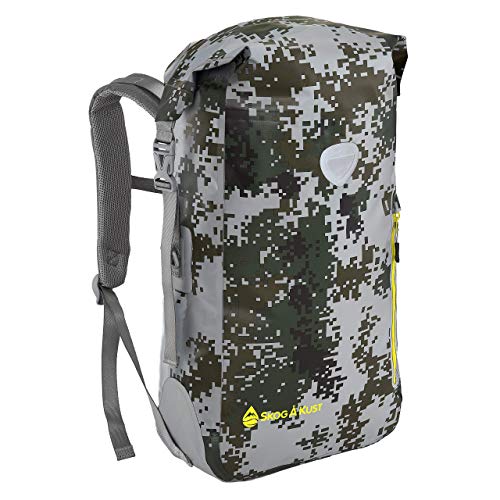
Earth Pak Waterproof Backpack - Heavy Duty Hiking Backpack - Roll-Top Closure Bag - Cushioned Dry Bag Waterproof Phone Case


Key features
- •COMPLETE WATERPROOF PROTECTION: Ensure your gear stays completely dry while traveling, kayaking, biking, commuting, camping, hiking and fishing.
- •EASY TO USE: Designed with a roll-top closure and single reinforced strip to ensure water stays out. Simply fold the bag down 3-4 times, buckle, and you are ready to go!
- •PLENTY OF EXTRA STORAGE: Equipped with pockets on both the inside and outside of the bag. A large splash-proof zipper on the outside for quick grab and go items, and a built-in zippered pocket, mesh compartment, & key ring on the inside.
- •SAFE FOR TRAVEL: Compact and lightweight for easy carry on an airplane & roll top closure provides ultimate protection while traveling. Convenient D-Rings attached to both shoulder straps and MOLLE system looping both provide anchor points to latch onto while boating or biking.
- •BUILT FOR COMFORT: Constructed with an ergonomic padded backpanel, reinforced contoured shoulder straps, and low-profile sternum strap providing ultimate comfort by taking the weight off your back. In addition, a heavy duty waist-belt relieves added pressure to help support your load.
Earth Pak Waterproof Backpack - Heavy Duty Hiking Backpack - Roll-Top Closure Bag - Cushioned Dry Bag Waterproof Phone Case
List Price: $85.32$76.79DEALYou Save: $8.53 (10%)
Free shippingFree Returns – 30 daysFree Order CancellationSecure Payment2–3 Days DeliveryGet It October 25, 2026In Stock (1)No marketing spamNo account requiredFulfilment by FedEx / Amazon / UPS / ShipwirePayPal / Card Buyer Protection
Customer Reviews
Reviews sourced from verified Amazon purchasers4.7
out of 5
Based on 10 reviews
5★
80%
4★
20%
3★
0%
2★
0%
1★
0%
Great bag for kayak and camping
Jose Santos✓ Verified Purchase•September 18, 2023
A group of friends went to a 4 day kayak camping trip and we all got various versions of EarthPak dry bags (I got the 85L backpack (way on the back of the photo in the red kayak)). It was a good purchase. Nobody had issues with their packs. Things stayed dry even when one of us had a turnover incident. It was also nice to be able to leave a bulk of our camping gear outside the tent without worrying about things getting wet. The material is thick and seems durable with proper use. The 85L size was a good size to pack my sleeping bag, pillow, inflatable pad, a star tracker, and 4 days of clothes changes.
I like it so much that I will purchase the larger 120L duffle bag for bigger trips and a smaller one for those short days in the river trip.
I like it so much that I will purchase the larger 120L duffle bag for bigger trips and a smaller one for those short days in the river trip.
Great dry bag
Amazon Customer✓ Verified Purchase•August 26, 2023
I ended up buying two. We've put them through a lot so far. We use them on the boat all the time (freshwater and saltwater), took a 600 mile road trip in the back of the pickup in the rain, everything stayed dry. No weak points so far. Zipper, straps and clips all functioning as advertised. I think these bags are going to last forever.
PVC Protection. VG Quality. 5 YEAR Warranty. Yes, 5 Years. But...Exterior Could Use More Features.
J✓ Verified Purchase•August 16, 2023
Upon inspecting the backpack, the material, construction, and workmanship look good, but...
The one area that I'm not keen on is the stitching, particularly at the opening and on the shoulder straps. The thread pitch is @ 5 stitches per inch. That's too spread apart from stitch to stitch. It invites snags. Snags that lead to loose threads, which attract more snags, which lead to cut threads, which unravel the stitching... Is being *just good-enough* really good enough? I feel a much tighter pitch and stronger/thicker/better threads should be used.
When I was comparing packs, what grabbed my attention was the 5-year warranty offered by earth"¢pak. If it's willing to repair or replace for 5 years, that indicates to me that the company has confidence in how well-made their products are and how they'll hold up to the rigors of outdoor adventure use.
Now, a 5-year warranty is meaningless if the company goes belly-up just before you need warranty coverage. Fortunately, they've been around for a while (since 2017) and sold tons and tons of products, so, although there are no guarantees, it's a good bet that they will remain viable for many, many years to honor the warranty.
To be clear, you should assume that the warranty is LIMITED, not unlimited, so "normal wear and tear" isn't covered, nor is abuse. So, if a pack is run over by an M-1 Abrams tank, it ain't covered. If you douse it with lighter fluid and throw it in the campfire while you're sleepwalking, it ain't covered. If your soon-to-be ex Ginsus (or is it Ginsues) the pack into countless puzzle pieces, it ain't covered.
That said, when the 5-year warranty is being described, they do say, "Rest assured our guarantee covers even the most unpredictable accidents --- we've been there!" So, it sounds like the company *may* cover damages outside of "normal wear and tear," if they truly are from "unpredictable accidents." Maybe, they'll even cover the first two of my three extreme examples. It will be, however, at the company's sole discretion to decide to, or not to, repair or replace.
But I digress...
When I wanted a LARGE waterproof backpack, I checked Amazon and elsewhere. Besides earth"¢pak, a few other brands had backpacks with capacities from 70 L to 120 L, but they were double to quadruple the cost of this pack. This was the only one with a large capacity (85 liters), made by a reputable company, and priced below $100. Criteria met; purchase made.
(There are plenty of 35 liter to 55 liter waterproof backpacks from a bunch of manufacturers, including earth"¢pak. Since my purchase, there is now another manufacturer, GVANCA, that has an 85 liter waterproof backpack available here that's priced about the same.)
Although this pack is considered "waterproof," it has a roll-top closure. Roll-top closures aren't exactly conducive to airtight or waterproof SEALING, so I don't consider this as being TRULY waterproof. It's waterproof-light as long as you tightly, not t--i--g--h--t--l--y, fold the roll-top at least 3X, AT LEAST. So don't pop a vein if you notice some dampness inside. Expect some seepage and, just in case, be prepared for it by taking precautions.
For my liking, this pack's exterior is too minimalist. It only has a splash-proof (not waterproof), zippered pocket and two PALS slots for MOLLE. There are plenty of unused real estate, so why not include more useful features: a pocket on each side for a water bottle or stuff; more PALS slots for MOLLE; lashing system using cord/bungee. These are features that earth"¢pak already offers on its backpack coolers. Why those but not these? (Now that I already bought this backpack, they probably will come out with a new version with the added features! Welcome to my life...)
The interior has a zippered pocket (9"H x 8"W), a mesh pouch (7" x 7"), and a plastic, push-to-open, carabiner-type clip for keys. The mesh pouch is stacked on the outside of the zippered pocket and the key clip is on the north-east corner. They're on the inside of the back panel---the side with the back straps. They're definitely useful, but somewhat smallish.
The shoulder straps are padded, but very minimally, so they aren't cushiony and forgiving. They wouldn't be comfortable with heavy loads, nor on long adventures; you'll wish they had thicker, softer padding.
The straps are contoured, so they'll curve around your chest for better ergonomics. Each strap has a D-ring.
There is a sternum strap that's height adjustable, which women will appreciate for two reasons...be they small or large.
One distinguishing feature with this 85 liter pack is that the shoulder straps have "load lifters." What are "load lifters"? They're adjustable straps that connect from the upper ends of the shoulder straps to the back---toward the top---of the pack. It pulls in the top half of the pack toward your upper-back and neck area.
The back panel of the pack has padded, vertical ribs (@ 3.5" wide) that run parallel to your vertebrae. One to the left and one to the right of your spine.
Unfortunately, the panel lacks an insert that enables you to adjust its position on your back and tailor it to best fit the pack to your torso length.
The pack has a waist strap to wrap around your...uh, waist. But, it's just a waist strap, not a HIPBELT. What's the difference? On a backpack for "backpacking," the HIPBELT is an integral component that's vital to the load carrying system (shoulder straps, HIPBELT, load lifters, sternum strap). It's usually about 3" to 4" tall/wide, well padded (about an inch thick), and somewhat firm lengthwise. A waist strap is just a strap, thin and limp, like a regular belt for your pants.
A HIPBELT is positioned over your left and right ILIAC CREST (top ridge of pelvic bone), then fastened. When it's TIGHTENED, it grips and rides your hips and "lifts" the pack to support the weight. It's akin to resting or leaning a part of the pack on the edge of a shelf to unburden your shoulders from the full weight of the load. The HIPBELT relieves your shoulders from having to bear 100% of the pack weight. The weight is shared by the shoulder straps and HIPBELT.
When you lift a can of beer with your hand, the thumb and index finger are analogous to the shoulder straps, and the middle, ring, and little fingers are the HIPBELT. It's a shared distribution of the weight of the can. So, even if you were to pull off your thumb and index finger, the remaining fingers are able to maintain a grip and sustain the can.
When the load carrying system (shoulder straps, HIPBELT, load lifters, and sternum strap) is adjusted correctly, the backpack becomes a "part of you," not a weighty lump of mass that's hanging from your shoulders.
So, if you weigh 150 pounds and the pack weighs 50 pounds, with a properly adjusted load carrying system, you become a person weighing 200 pounds. With no load carrying system, you're a 150 pound person with 50 additional pounds hanging from your shoulders.
Now, in an ideal world, you would start with the right size pack for your torso length (measured from base of your neck, C7 vertebra, to your ILIAC CREST which is level to your navel) or one with an adjustable back panel for the load carrying system to work most effectively and proficiently. Like I said, ideally... We'll just have to make do with what you already have.
I'm sidetracking here, AGAIN, but let me explain the steps on how to properly adjust this or any backpack on you. (Because this pack has a waist strap, not a HIPBELT, it's not a full-fledged load carrying system.)
1. ADD bulk and weight to your pack. Strap on the backpack. (I said strap on. Two separate words. No hyphen between them!)
2. Position and tighten the waist strap or HIPBELT over your ILIAC CREST. It's the upper-outside ridge---toward the front left and front right---of your pelvic bone. Again, this pack just has a waist strap, so it doesn't "lift" the load as well as a HIPBELT. It mostly keeps the pack from bouncing off and separating from your back. It prevents the pack from moving front-to-back, side-to-side, up-and-down.
3. Adjust your shoulder straps so they're snug from your shoulders to your sides, mid-torso.
4. Adjust the load lifters and pull in the pack toward your neck and head to eliminate the unwanted separation that promotes undesirable movement. In a way, the pack becomes a headrest. By pulling in the top half, the pack doesn't sag and slouch.
5. Adjust the sternum strap so the shoulder strap(s) stay in place and can't easily slide off your shoulder(s).
I hate being redundant, but at the risk of being redundant, let me be redundant and repeat myself...again.
This pack has a waist strap, not a HIPBELT. And, although even a waist strap, if adjusted properly, can transfer some of the pack's weight onto the hips, it's not nearly as proficient, nor comfortable, as a well-padded HIPBELT. This waist strap mostly "ties" the pack onto you to limit undesirable movement and shifting.
Because of the shortcomings with the shoulder straps and waist strap, it's not the best fit for serious "backpacking" adventures when you're having to hump your pack for hours and hours, even days.
This 85 liter pack is mostly for short outings, day trips, and day hikes on excursions to places and for activities that require protection from H²O: beach, ocean, lake, and river; kayaking and boating; rainy days and wet environments, etc.
So, although the minimally padded shoulder straps and basic waist strap leave me wanting, I do realize that this pack wasn't designed for serious backpacking. Nevertheless, I do wish it had much better shoulder straps with more padding plus a true HIPBELT to minimize the discomfort and burden from heavy loads and multiday treks.
Would I buy this again? Hell yes! The material, construction, and workmanship (save the issue with the stitches) look good, and the 5-year warranty separates it well ahead of competitors. Plus it's reasonably priced. But...
...I probably would take a close look and consider the other 85 liter backpack that's available now because it does have a feature that I *want* that the earth"¢pak 85 liter lacks: a mesh pocket on each side for a water bottle or stuff.
In fact, I have both the 35 liter and 55 liter packs from GVANCA exactly for the reason stated above. Their packs have mesh pockets on the sides; earth"¢pak's 35 liter and 55 liter packs lack side pockets, just like their 85 liter.
As much as I would've liked to have purchased the 35 and 55 from earth"¢pak, especially for the 5-year warranty, it was more important to me that the packs have side pockets for easy access to water bottles.
It's not likely that I'm taking the large 85 to the beach to catch some rays, nor for a picnic at the park, nor for a rainy day at Disneyland, so not having the side pockets wasn't a big deal. But, I will be taking a 35 or 55 to the aforementioned venues and elsewhere on a half day outing, a day trip, or rainy weather, and I *need* side pockets for quick access to water bottles and stuff.
With the smaller packs, not having side pockets was a deal killer for me.
Can you hear me, Mr. and Mrs.earth"¢pak?
As you can see, in wanting to be informative and thorough, this morphed into a very long review. So, if you've read through it and found it useful, let me know that it was helpful so I'll know that it wasn't for naught. Because if it ain't being read, I just wasted my infinitely precious time. Time that I could've been doing something much more rewarding...like watching porn, or playing checkers with my dogs, or trimming my nose hairs, or nakedly practicing my Michael Jackson dance moves in front of a full-length vanity mirror...
The one area that I'm not keen on is the stitching, particularly at the opening and on the shoulder straps. The thread pitch is @ 5 stitches per inch. That's too spread apart from stitch to stitch. It invites snags. Snags that lead to loose threads, which attract more snags, which lead to cut threads, which unravel the stitching... Is being *just good-enough* really good enough? I feel a much tighter pitch and stronger/thicker/better threads should be used.
When I was comparing packs, what grabbed my attention was the 5-year warranty offered by earth"¢pak. If it's willing to repair or replace for 5 years, that indicates to me that the company has confidence in how well-made their products are and how they'll hold up to the rigors of outdoor adventure use.
Now, a 5-year warranty is meaningless if the company goes belly-up just before you need warranty coverage. Fortunately, they've been around for a while (since 2017) and sold tons and tons of products, so, although there are no guarantees, it's a good bet that they will remain viable for many, many years to honor the warranty.
To be clear, you should assume that the warranty is LIMITED, not unlimited, so "normal wear and tear" isn't covered, nor is abuse. So, if a pack is run over by an M-1 Abrams tank, it ain't covered. If you douse it with lighter fluid and throw it in the campfire while you're sleepwalking, it ain't covered. If your soon-to-be ex Ginsus (or is it Ginsues) the pack into countless puzzle pieces, it ain't covered.
That said, when the 5-year warranty is being described, they do say, "Rest assured our guarantee covers even the most unpredictable accidents --- we've been there!" So, it sounds like the company *may* cover damages outside of "normal wear and tear," if they truly are from "unpredictable accidents." Maybe, they'll even cover the first two of my three extreme examples. It will be, however, at the company's sole discretion to decide to, or not to, repair or replace.
But I digress...
When I wanted a LARGE waterproof backpack, I checked Amazon and elsewhere. Besides earth"¢pak, a few other brands had backpacks with capacities from 70 L to 120 L, but they were double to quadruple the cost of this pack. This was the only one with a large capacity (85 liters), made by a reputable company, and priced below $100. Criteria met; purchase made.
(There are plenty of 35 liter to 55 liter waterproof backpacks from a bunch of manufacturers, including earth"¢pak. Since my purchase, there is now another manufacturer, GVANCA, that has an 85 liter waterproof backpack available here that's priced about the same.)
Although this pack is considered "waterproof," it has a roll-top closure. Roll-top closures aren't exactly conducive to airtight or waterproof SEALING, so I don't consider this as being TRULY waterproof. It's waterproof-light as long as you tightly, not t--i--g--h--t--l--y, fold the roll-top at least 3X, AT LEAST. So don't pop a vein if you notice some dampness inside. Expect some seepage and, just in case, be prepared for it by taking precautions.
For my liking, this pack's exterior is too minimalist. It only has a splash-proof (not waterproof), zippered pocket and two PALS slots for MOLLE. There are plenty of unused real estate, so why not include more useful features: a pocket on each side for a water bottle or stuff; more PALS slots for MOLLE; lashing system using cord/bungee. These are features that earth"¢pak already offers on its backpack coolers. Why those but not these? (Now that I already bought this backpack, they probably will come out with a new version with the added features! Welcome to my life...)
The interior has a zippered pocket (9"H x 8"W), a mesh pouch (7" x 7"), and a plastic, push-to-open, carabiner-type clip for keys. The mesh pouch is stacked on the outside of the zippered pocket and the key clip is on the north-east corner. They're on the inside of the back panel---the side with the back straps. They're definitely useful, but somewhat smallish.
The shoulder straps are padded, but very minimally, so they aren't cushiony and forgiving. They wouldn't be comfortable with heavy loads, nor on long adventures; you'll wish they had thicker, softer padding.
The straps are contoured, so they'll curve around your chest for better ergonomics. Each strap has a D-ring.
There is a sternum strap that's height adjustable, which women will appreciate for two reasons...be they small or large.
One distinguishing feature with this 85 liter pack is that the shoulder straps have "load lifters." What are "load lifters"? They're adjustable straps that connect from the upper ends of the shoulder straps to the back---toward the top---of the pack. It pulls in the top half of the pack toward your upper-back and neck area.
The back panel of the pack has padded, vertical ribs (@ 3.5" wide) that run parallel to your vertebrae. One to the left and one to the right of your spine.
Unfortunately, the panel lacks an insert that enables you to adjust its position on your back and tailor it to best fit the pack to your torso length.
The pack has a waist strap to wrap around your...uh, waist. But, it's just a waist strap, not a HIPBELT. What's the difference? On a backpack for "backpacking," the HIPBELT is an integral component that's vital to the load carrying system (shoulder straps, HIPBELT, load lifters, sternum strap). It's usually about 3" to 4" tall/wide, well padded (about an inch thick), and somewhat firm lengthwise. A waist strap is just a strap, thin and limp, like a regular belt for your pants.
A HIPBELT is positioned over your left and right ILIAC CREST (top ridge of pelvic bone), then fastened. When it's TIGHTENED, it grips and rides your hips and "lifts" the pack to support the weight. It's akin to resting or leaning a part of the pack on the edge of a shelf to unburden your shoulders from the full weight of the load. The HIPBELT relieves your shoulders from having to bear 100% of the pack weight. The weight is shared by the shoulder straps and HIPBELT.
When you lift a can of beer with your hand, the thumb and index finger are analogous to the shoulder straps, and the middle, ring, and little fingers are the HIPBELT. It's a shared distribution of the weight of the can. So, even if you were to pull off your thumb and index finger, the remaining fingers are able to maintain a grip and sustain the can.
When the load carrying system (shoulder straps, HIPBELT, load lifters, and sternum strap) is adjusted correctly, the backpack becomes a "part of you," not a weighty lump of mass that's hanging from your shoulders.
So, if you weigh 150 pounds and the pack weighs 50 pounds, with a properly adjusted load carrying system, you become a person weighing 200 pounds. With no load carrying system, you're a 150 pound person with 50 additional pounds hanging from your shoulders.
Now, in an ideal world, you would start with the right size pack for your torso length (measured from base of your neck, C7 vertebra, to your ILIAC CREST which is level to your navel) or one with an adjustable back panel for the load carrying system to work most effectively and proficiently. Like I said, ideally... We'll just have to make do with what you already have.
I'm sidetracking here, AGAIN, but let me explain the steps on how to properly adjust this or any backpack on you. (Because this pack has a waist strap, not a HIPBELT, it's not a full-fledged load carrying system.)
1. ADD bulk and weight to your pack. Strap on the backpack. (I said strap on. Two separate words. No hyphen between them!)
2. Position and tighten the waist strap or HIPBELT over your ILIAC CREST. It's the upper-outside ridge---toward the front left and front right---of your pelvic bone. Again, this pack just has a waist strap, so it doesn't "lift" the load as well as a HIPBELT. It mostly keeps the pack from bouncing off and separating from your back. It prevents the pack from moving front-to-back, side-to-side, up-and-down.
3. Adjust your shoulder straps so they're snug from your shoulders to your sides, mid-torso.
4. Adjust the load lifters and pull in the pack toward your neck and head to eliminate the unwanted separation that promotes undesirable movement. In a way, the pack becomes a headrest. By pulling in the top half, the pack doesn't sag and slouch.
5. Adjust the sternum strap so the shoulder strap(s) stay in place and can't easily slide off your shoulder(s).
I hate being redundant, but at the risk of being redundant, let me be redundant and repeat myself...again.
This pack has a waist strap, not a HIPBELT. And, although even a waist strap, if adjusted properly, can transfer some of the pack's weight onto the hips, it's not nearly as proficient, nor comfortable, as a well-padded HIPBELT. This waist strap mostly "ties" the pack onto you to limit undesirable movement and shifting.
Because of the shortcomings with the shoulder straps and waist strap, it's not the best fit for serious "backpacking" adventures when you're having to hump your pack for hours and hours, even days.
This 85 liter pack is mostly for short outings, day trips, and day hikes on excursions to places and for activities that require protection from H²O: beach, ocean, lake, and river; kayaking and boating; rainy days and wet environments, etc.
So, although the minimally padded shoulder straps and basic waist strap leave me wanting, I do realize that this pack wasn't designed for serious backpacking. Nevertheless, I do wish it had much better shoulder straps with more padding plus a true HIPBELT to minimize the discomfort and burden from heavy loads and multiday treks.
Would I buy this again? Hell yes! The material, construction, and workmanship (save the issue with the stitches) look good, and the 5-year warranty separates it well ahead of competitors. Plus it's reasonably priced. But...
...I probably would take a close look and consider the other 85 liter backpack that's available now because it does have a feature that I *want* that the earth"¢pak 85 liter lacks: a mesh pocket on each side for a water bottle or stuff.
In fact, I have both the 35 liter and 55 liter packs from GVANCA exactly for the reason stated above. Their packs have mesh pockets on the sides; earth"¢pak's 35 liter and 55 liter packs lack side pockets, just like their 85 liter.
As much as I would've liked to have purchased the 35 and 55 from earth"¢pak, especially for the 5-year warranty, it was more important to me that the packs have side pockets for easy access to water bottles.
It's not likely that I'm taking the large 85 to the beach to catch some rays, nor for a picnic at the park, nor for a rainy day at Disneyland, so not having the side pockets wasn't a big deal. But, I will be taking a 35 or 55 to the aforementioned venues and elsewhere on a half day outing, a day trip, or rainy weather, and I *need* side pockets for quick access to water bottles and stuff.
With the smaller packs, not having side pockets was a deal killer for me.
Can you hear me, Mr. and Mrs.earth"¢pak?
As you can see, in wanting to be informative and thorough, this morphed into a very long review. So, if you've read through it and found it useful, let me know that it was helpful so I'll know that it wasn't for naught. Because if it ain't being read, I just wasted my infinitely precious time. Time that I could've been doing something much more rewarding...like watching porn, or playing checkers with my dogs, or trimming my nose hairs, or nakedly practicing my Michael Jackson dance moves in front of a full-length vanity mirror...
After 3 years: not bad at all
Mitch✓ Verified Purchase•August 16, 2023
I've owned this pack for three years and it's held up really nicely from standard use to occasional abuse. After about a year it stopped being perfectly waterproof as water started finding its way in through the stitching that isn't waterproofed, but I continued using it after for the last year. It holds up nicely against rain, sleet, hail, snow, and sun so I am pretty happy with it! I have used it to for groceries, shopping, work, travel, car camping, hiking, mountain biking, rock climbing, snowboarding, skiing, and backpacking (though this is terrible for backpacking since the shoulder straps distribute large amounts of weight so poorly, it is obvious to say but this should not be used as a backpacking backpack). The exterior fabric and stitching are still both holding very strong and only show the scuffs I placed on them. The only regret I have about this bag I have is that I wish I bought the largest one, but two years ago only the 55l was available and now there is an 85l.
After 3 years I strongly recommend this bag if you need something reasonably waterproof, very durable, and fair priced.
After 3 years I strongly recommend this bag if you need something reasonably waterproof, very durable, and fair priced.
Most Fair Advertisement in Size
Emanuel Jacques✓ Verified Purchase•May 31, 2023
Ive scoured Google search, Ebay, Amazon, camping stores, marine activity stores for true 50L backpacks. Ive tried the Osprey Fairpoint, Northface Router to even italian Arena or sweedish Thule. None have a true matching Litter measurement. The size is largely taken up by padding, straps, convoluted pockets and zippers. I would never transport a laptop in a backpack. Thats absurd! Especially with Windows forced updates keeping the laptop on even when instructed to shut off. You can easily brick your laptop if the storage drive is hit. Or ruin the components from overheating. With an actual laptop bag, you have easier access and more padding to protect it specifically. A laptop pocket is silly. And isn't worth doubling as a document case. Just get a document case!
The advertised bags are always never matching the litter size. Plus they can vary by length or width. Either accomodating close to the said size vertically or horizontally.
The Earthpack is as simple as it gets. It does have too many straps. I wouldnt designate it for camping or hiking. So the waist and chest straps are just useless. So i have to remove them. Even for hiking or camping, such straps dont add much because the bag isnt designed specifically for any of that. For transport traveling, if you really need a chest and waist straps, your probably have an orthopedic problem and need more than just that. Or just settle with a hiking back.
I wouldnt ever call this a hiking, travel or camping bag. I would say its an excellent waterproof hauling bag. For canoeing, jetskiing, kayaking, short distance walking through rain or through waist high water, etc. Basically a bag that is supported by vehicle transport. Which is a very general use bag.
I require a bag that can hold gym clothes, towell, bodywash and sneakers while have room for some mail or a bag of grocery. So i need 50L as a day bag. Im over six feet tall, no problem. The bag rolling top is super practical. Pretty much as waterproof as any bag can ever get today.
But it looks very very tacky if not rolled neatly enough. The thin structure takes shape of whatever stored. So the bag can look like an ugly sack. And thats fine compared to the alternatives ive tried. Since we are heading deeper into the IT renaissance, schools are requiring less physical text. So the backpack market took a big hit. Now we see just about no simple 40L backpacks. Even a very small variety of even 25 or 30L compared to 10 years ago.
So finding a simple everyday gym/grocery backpack is hard. Living in the tropics or rainy temperate, Earthpack is a no brainer. I would recommend it if it had a more solid structure and no chest and waist straps.
The advertised bags are always never matching the litter size. Plus they can vary by length or width. Either accomodating close to the said size vertically or horizontally.
The Earthpack is as simple as it gets. It does have too many straps. I wouldnt designate it for camping or hiking. So the waist and chest straps are just useless. So i have to remove them. Even for hiking or camping, such straps dont add much because the bag isnt designed specifically for any of that. For transport traveling, if you really need a chest and waist straps, your probably have an orthopedic problem and need more than just that. Or just settle with a hiking back.
I wouldnt ever call this a hiking, travel or camping bag. I would say its an excellent waterproof hauling bag. For canoeing, jetskiing, kayaking, short distance walking through rain or through waist high water, etc. Basically a bag that is supported by vehicle transport. Which is a very general use bag.
I require a bag that can hold gym clothes, towell, bodywash and sneakers while have room for some mail or a bag of grocery. So i need 50L as a day bag. Im over six feet tall, no problem. The bag rolling top is super practical. Pretty much as waterproof as any bag can ever get today.
But it looks very very tacky if not rolled neatly enough. The thin structure takes shape of whatever stored. So the bag can look like an ugly sack. And thats fine compared to the alternatives ive tried. Since we are heading deeper into the IT renaissance, schools are requiring less physical text. So the backpack market took a big hit. Now we see just about no simple 40L backpacks. Even a very small variety of even 25 or 30L compared to 10 years ago.
So finding a simple everyday gym/grocery backpack is hard. Living in the tropics or rainy temperate, Earthpack is a no brainer. I would recommend it if it had a more solid structure and no chest and waist straps.
Page 1 of 2