Vodaland - 4" GeoCell - 100% Permeable for Parking Pads, Retaining Walls and Erosion Control, Size 9 ft x 17 ft





Key features
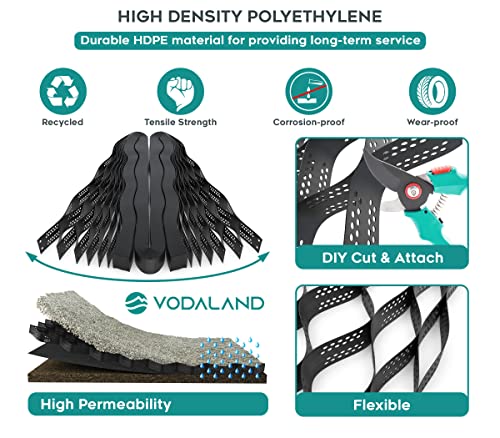
- •Perfect for driveways and parking lots.
- •Polyethylene Recycled and supersonic welded.
- •160 SQ ft - works on slopes & can be cut and attached to each other
- •Dimensions - 9 X 17 FT each unit
- •Use with grass, soil, or gravel
Vodaland - 4" GeoCell - 100% Permeable for Parking Pads, Retaining Walls and Erosion Control, Size 9 ft x 17 ft
List Price: $130.94$117.85DEALYou Save: $13.09 (10%)
Free shippingFree Returns – 30 daysFree Order CancellationSecure Payment2–3 Days DeliveryGet It October 25, 2026In Stock (30)No marketing spamNo account requiredFulfilment by FedEx / Amazon / UPS / ShipwirePayPal / Card Buyer Protection
Customer Reviews
Reviews sourced from verified Amazon purchasers4.3
out of 5
Based on 10 reviews
5★
90%
4★
10%
3★
0%
2★
0%
1★
0%
Great product - 3 year update!
SunnyNC✓ Verified Purchase•August 5, 2023
Dec 2019 update -
Came here to buy more and I happened to read my own review from 2017, lol and thought I will post an update. Read the original review that is below this update. The area I fixed using this grid is still solid, even more solid than when I installed. Not one bit of top soil eroded. All the plants took off great and recruited additional sediments during flood events. I have since then planted dogwoods (just inserted cuttings, so I don't have to cut through the grids. I also planted a red maple (had to cut out a few cells to fit the 2 gallon root ball). Everything took off and the entire area looks great, I have not done anything to maintain other then pull out pesky grape ivy weed every once on in a while.
Original early 2017 review:
I live on a river front property. The peninsula in my backyard where 2 rivers meet was eroded badly and the county did nothing to resolve this even though it was covered under an easement. So instead of watching my property get washed away, I tamped the area (the slope was literally shaking when I was tamping and I know it would have slided sooner than later), installed a geogrid (triax, earthlock brand) and then this product (which should be called geocell or geoweb to avoid confusing it with traditional geogrid) in conjunction. The triaxial geogrid somewhat acts like a compacted base (similar to like turf reinforcement grids). I filled the cells with the falling/eroded clay hanging off the cliff, sand, stone, silt, compost what ever I could find around. I topped it off with some fertile loamy silt from a recent flooding that was dumped around. I planted grasses (mondo, liriope, sedge whatever else I could find around the area), ground cover plants etc and mulched. There was a record rain fall event week after I installed and not one bit of soil washed off. (I had pinned the plants knowing I will lose them if it floods before the roots establish). Product is easy to use, I just wished it was a little cheaper as I need lot to cover the entire embankment.
Came here to buy more and I happened to read my own review from 2017, lol and thought I will post an update. Read the original review that is below this update. The area I fixed using this grid is still solid, even more solid than when I installed. Not one bit of top soil eroded. All the plants took off great and recruited additional sediments during flood events. I have since then planted dogwoods (just inserted cuttings, so I don't have to cut through the grids. I also planted a red maple (had to cut out a few cells to fit the 2 gallon root ball). Everything took off and the entire area looks great, I have not done anything to maintain other then pull out pesky grape ivy weed every once on in a while.
Original early 2017 review:
I live on a river front property. The peninsula in my backyard where 2 rivers meet was eroded badly and the county did nothing to resolve this even though it was covered under an easement. So instead of watching my property get washed away, I tamped the area (the slope was literally shaking when I was tamping and I know it would have slided sooner than later), installed a geogrid (triax, earthlock brand) and then this product (which should be called geocell or geoweb to avoid confusing it with traditional geogrid) in conjunction. The triaxial geogrid somewhat acts like a compacted base (similar to like turf reinforcement grids). I filled the cells with the falling/eroded clay hanging off the cliff, sand, stone, silt, compost what ever I could find around. I topped it off with some fertile loamy silt from a recent flooding that was dumped around. I planted grasses (mondo, liriope, sedge whatever else I could find around the area), ground cover plants etc and mulched. There was a record rain fall event week after I installed and not one bit of soil washed off. (I had pinned the plants knowing I will lose them if it floods before the roots establish). Product is easy to use, I just wished it was a little cheaper as I need lot to cover the entire embankment.
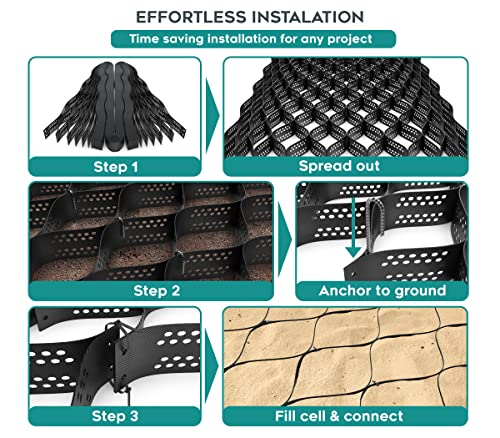
The dimensions shown are correct 17' x 9' but in the opposite direction shown in the photo
skoldpadda✓ Verified Purchase•July 16, 2023
I didn't see this addressed in the questions, so just wanted to mention that the "continuous" side stretches out to 17' and the sides/cells with the "points" span the 9' dimension. The diagram/thumbnail shows it the opposite way.
Work well
FinishLine✓ Verified Purchase•July 2, 2023
I would highly recommend having 2 people available to install this. I did the install solo and it's a bit challenging. Once I developed a system for using temporary stakes as an additional pair of hands, it went a lot easier.
In order to spread this out nice, tight and even, the grid requires 1 stake per cell around the perimeter with 2 stakes on each corner cell. That's 56 stakes per section, which is a lot more stakes than I expected. Maybe I'm just over-doing it, but this is the system what I felt worked best to stretch our the grid evenly and securely.
Working alone, it takes me about 90 minutes to stretch out, loosely stake, then fully drive the stakes for EACH section. Granted I'm driving 10" x 1/2" rebar pins into 6"+ of very well compacted road base. My finished dimensions came out at about 8' x 19'6" per section not 9' x 17'.
In order to spread this out nice, tight and even, the grid requires 1 stake per cell around the perimeter with 2 stakes on each corner cell. That's 56 stakes per section, which is a lot more stakes than I expected. Maybe I'm just over-doing it, but this is the system what I felt worked best to stretch our the grid evenly and securely.
Working alone, it takes me about 90 minutes to stretch out, loosely stake, then fully drive the stakes for EACH section. Granted I'm driving 10" x 1/2" rebar pins into 6"+ of very well compacted road base. My finished dimensions came out at about 8' x 19'6" per section not 9' x 17'.
Works on a berm
Marshall C. Miller, Jr.✓ Verified Purchase•June 25, 2023
Using this to hold rubber landscaping nuggets on a berm. It seems to work, only complaint is it isn't as long as they say closer to 11.
Great for DIY erosion control on slopes.
Amazon Customer✓ Verified Purchase•June 18, 2023
Researched everything...this is the way to go. Trickier to put down because of slope. We notched out a 4" lip on top of slope and pinned from there. Avoid distortion of grid by pinning top cells closer together so there's plenty of slack.
TIP: install with the curved part of the cells up and down, keeping the pointed, welded parts of cells going side to side. Pin all the tabs together when joining one section to another. We used tent stakes, but sandy or loose soil might require something sturdier.
We ordered three, but found that cutting was easy and there was no need to waste any by keeping it unextended to accommodate our shorter slope. Never had to open the last box. Goes around a curving slope beautifully. Can't recommend this product enough. In fact, we purchased more of it at the 2" depth to go on top of compacted base for our patio paver project. Filled with sand, these cells will never shift.
Including cutting, experimenting with eliminating distortion of grid due to too much tension, laying out and pinning, this took two 60ish old people five hours to complete install of two full grids. This did not include filling cells with soil for planting no-mow micro-clover.
TIP: install with the curved part of the cells up and down, keeping the pointed, welded parts of cells going side to side. Pin all the tabs together when joining one section to another. We used tent stakes, but sandy or loose soil might require something sturdier.
We ordered three, but found that cutting was easy and there was no need to waste any by keeping it unextended to accommodate our shorter slope. Never had to open the last box. Goes around a curving slope beautifully. Can't recommend this product enough. In fact, we purchased more of it at the 2" depth to go on top of compacted base for our patio paver project. Filled with sand, these cells will never shift.
Including cutting, experimenting with eliminating distortion of grid due to too much tension, laying out and pinning, this took two 60ish old people five hours to complete install of two full grids. This did not include filling cells with soil for planting no-mow micro-clover.
Page 1 of 2