LAPOND High Performance Single Phase to 3 Phase Converter, 1.5KW 2HP VFD 220V 7A Output Variable Frequency Drive Vector Control Inverter for Spindle Motor CNC Speed Control,K100 Series


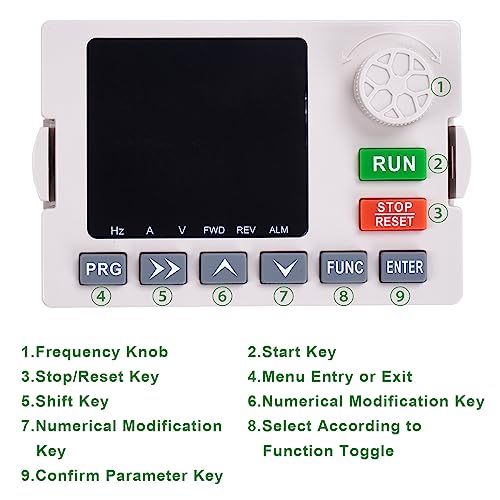

Key features
- •This is single phase VFD with single phase 220V INPUT and three phase 220V OUTPUT,only work with three phase asynchronous motor,If your motor is heavy load, pls choose a higher Horsepower vfd than your motor's or contact sales for model selection suggestion.
- •High performance Vector controlled and stability to enable motor to achieve high torque in low speed rotation to increase motor working efficiency; work well with CNC controller, say Mach3 controller, support fast accelerate/deccelerate with external optional braking resistor and external potentiometer.
- •Rich of digital and analogy control terminals for versitile control , optional MODBUS (RS485) extension, well controlled fans produce low acoustics noise.
- •Application : spindle motor,lathe,milling,pumps,treadmills,conveyors,winding machine, mixer, extruder, slitter, compressor, ventilator,elevator,centrifuger and other speed control machines.
- •We are the original factory,any technical issues do not hesitate to contact us;Warranty: 1 year!
LAPOND High Performance Single Phase to 3 Phase Converter, 1.5KW 2HP VFD 220V 7A Output Variable Frequency Drive Vector Control Inverter for Spindle Motor CNC Speed Control,K100 Series
List Price: $168.77$151.89DEALYou Save: $16.88 (10%)
Free shippingFree Returns – 30 daysFree Order CancellationSecure Payment2–3 Days DeliveryGet It October 26, 2026In Stock (1)No marketing spamNo account requiredFulfilment by FedEx / Amazon / UPS / ShipwirePayPal / Card Buyer Protection
Customer Reviews
Reviews sourced from verified Amazon purchasers4.3
out of 5
Based on 10 reviews
5★
80%
4★
20%
3★
0%
2★
0%
1★
0%
Works well
Amazon Customer✓ Verified Purchase•September 14, 2023
It was fairly easy for me (a non electrician but familiar with basic electrical) to install. Customer support was great. I did have a couple questions that were answered within 24 hours.
Manual is too small to read without a microscope, but customer support sent a pdf version that was word searchable. Ask for one, it makes life much easier.
Customer support can also provide some simple setup instruction to control the on/off and speed from a CNC controller. It's all in the manual, but their instructions were easier to follow.
The VFD on my previous VFD was on all the time. The fan on this vfd comes on as needed. This may seem minor and it certainly doesn't matter when the CNC is running, but it is nice to not listen to a fan between runs.
Manual is too small to read without a microscope, but customer support sent a pdf version that was word searchable. Ask for one, it makes life much easier.
Customer support can also provide some simple setup instruction to control the on/off and speed from a CNC controller. It's all in the manual, but their instructions were easier to follow.
The VFD on my previous VFD was on all the time. The fan on this vfd comes on as needed. This may seem minor and it certainly doesn't matter when the CNC is running, but it is nice to not listen to a fan between runs.
Lapond VFD is easy to install, program, and use.
Leon Lapointe✓ Verified Purchase•September 11, 2023
I wanted to incorporate a variable speed capability onto my Laguna 14 SUV bandsaw so that it could be used to cut steel, brass, aluminum, and plastics in addition to wood. Originally, the saw was equipped with a single speed 3hp 220V single phase motor providing blade speed suitable for woods only.
I retrofitted the saw with a 3hp three phase 2 pole motor and installed the Lapond SVD-PS2.2GB 2.2kw 220V 3hp Variable Frequency Vector Drive that I purchased through Amazon to provide the variable blade speed capability I wanted. I also purchased an external potentiometer and case to provide higher speed setting resolution than the pot installed on the VFD could provide.
The total number of VFD parameters required to be modified for this installation is relatively few as the attached image shows. These modifications include those which provide direct display of motor rpm on the VFD. It should be noted that the value in parameter P7.06 needs to be 0.6 for a 2 pole 3ph motor (3600 rpm at 60Hz), and 0.3 for a 4 pole 3ph motor (1800 rpm at 60Hz). I verified motor rpm versus the displayed value using a hand held tachometer on the motor shaft.
Research suggested that a typical 3phase motor can be oversped by about 25% which corresponds to 4500 rpm at a frequency of 75Hz. I opted for some margin and so I set maximum frequency to 72Hz which corresponds to 4320 motor rpm.
I did not attach an external start/stop capability as the controls on the VFD are easily accessible and the saw is equipped with a brake/kill switch pedal that controls power being supplied to the VFD in the event of an "emergency". Otherwise, the RUN/STOP buttons on the Lapond VFD panel are friendly to use.
With some simple calculations, I generated a plot of blade speed vs motor rpm for my bandsaw which is shown in the attached image. Recommended blade speeds for various materials is shown in the last attached image. Setting the motor rpm, and hence the blade speed, is very simple and precise employing the external high resolution potentiometer.
As of now, I am very pleased with the Lapond VFD. The cooling fan is on only when the motor is being driven and even then the fan is very quiet and can't be heard above the noise being generated by the motor and saw/blade system. The VFD brings the blade to a complete stop in about 3 seconds from 4320 motor rpm even though parameter P0.17 is set to 2 seconds. I don't know if the inertia of the 14 inch cast iron wheels and 125 inch long by 1 inch wide Laguna Resaw King blade overwhelms the internal braking system of the VFD, but it definitely takes longer than 2 seconds for the blade to come to a complete stop when the motor rpm is set to 4320 rpm.
I did not require technical assistance from Lapond and hence cannot comment on their customer service.
I do not know the longevity/reliability of the Lapond VFD yet because I haven't used the saw very much since installing this system. If any issues arise I will update this review.
Update: February 20, 2019
I installed a braking resistor (https://www.amazon.com/gp/product/B07GXHMJF8/ref=ppx_yo_dt_b_asin_title_o01__o00_s00?ie=UTF8&psc=1), purchased through Amazon, which significantly improves braking performance. The bandsaw with its heavy 14 inch cast iron wheels and substantial blade now stop within the time set by Parameter P0-18. Prior to the installation of the braking resistor it would require upwards of six seconds for the system to come to a stop from 3600 motor RPM. Now it will stop within one second from that speed. With repeated stops from 3600 motor RPM the resistor does become quite warm to the touch.
I had not specified in my original review the high resolution potentiometer that I had installed. The potentiometer I purchased from Amazon provides 0 to 5K ohm in about 300 degree rotation of the dial. The pot can be found at https://www.amazon.com/gp/product/B074KCK7X9/ref=ppx_yo_dt_b_asin_title_o05__o00_s00?ie=UTF8&psc=1. The pins on the potentiometer are labeled 1, 2, and 3. I connected Pin 1 of the pot to GND, Pin 2 to AI1, and Pin 3 to +10V lugs of the Lapond VFD. This provides near 0 frequency at pot position 0 and whatever maximum frequency is specified in P0-08, P0-10, and P0-12 at pot position 100.
I installed the potentiometer into a case, also purchased from Amazon, that can be found at https://www.amazon.com/gp/product/B07BPQHCH7/ref=ppx_yo_dt_b_asin_title_o05__o00_s00?ie=UTF8&psc=1. It was necessary to drill the case to accommodate the potentiometer. The case is made from plastic. The cover is transparent and the base of the case is a tan color. I used brad point drill bits with the drill press set to a very slow speed (~200 rpm) and backing blocks of wood to prevent cracking.
Update: August 21, 2020
I have used this Lapond VFD on my Laguna 14SUV Bandsaw for over a year and half (about 40 hours of actual operation ... this is for a hobby, after all!) with excellent results. The VFD continues to perform flawlessly. I am very pleased with it.
I retrofitted the saw with a 3hp three phase 2 pole motor and installed the Lapond SVD-PS2.2GB 2.2kw 220V 3hp Variable Frequency Vector Drive that I purchased through Amazon to provide the variable blade speed capability I wanted. I also purchased an external potentiometer and case to provide higher speed setting resolution than the pot installed on the VFD could provide.
The total number of VFD parameters required to be modified for this installation is relatively few as the attached image shows. These modifications include those which provide direct display of motor rpm on the VFD. It should be noted that the value in parameter P7.06 needs to be 0.6 for a 2 pole 3ph motor (3600 rpm at 60Hz), and 0.3 for a 4 pole 3ph motor (1800 rpm at 60Hz). I verified motor rpm versus the displayed value using a hand held tachometer on the motor shaft.
Research suggested that a typical 3phase motor can be oversped by about 25% which corresponds to 4500 rpm at a frequency of 75Hz. I opted for some margin and so I set maximum frequency to 72Hz which corresponds to 4320 motor rpm.
I did not attach an external start/stop capability as the controls on the VFD are easily accessible and the saw is equipped with a brake/kill switch pedal that controls power being supplied to the VFD in the event of an "emergency". Otherwise, the RUN/STOP buttons on the Lapond VFD panel are friendly to use.
With some simple calculations, I generated a plot of blade speed vs motor rpm for my bandsaw which is shown in the attached image. Recommended blade speeds for various materials is shown in the last attached image. Setting the motor rpm, and hence the blade speed, is very simple and precise employing the external high resolution potentiometer.
As of now, I am very pleased with the Lapond VFD. The cooling fan is on only when the motor is being driven and even then the fan is very quiet and can't be heard above the noise being generated by the motor and saw/blade system. The VFD brings the blade to a complete stop in about 3 seconds from 4320 motor rpm even though parameter P0.17 is set to 2 seconds. I don't know if the inertia of the 14 inch cast iron wheels and 125 inch long by 1 inch wide Laguna Resaw King blade overwhelms the internal braking system of the VFD, but it definitely takes longer than 2 seconds for the blade to come to a complete stop when the motor rpm is set to 4320 rpm.
I did not require technical assistance from Lapond and hence cannot comment on their customer service.
I do not know the longevity/reliability of the Lapond VFD yet because I haven't used the saw very much since installing this system. If any issues arise I will update this review.
Update: February 20, 2019
I installed a braking resistor (https://www.amazon.com/gp/product/B07GXHMJF8/ref=ppx_yo_dt_b_asin_title_o01__o00_s00?ie=UTF8&psc=1), purchased through Amazon, which significantly improves braking performance. The bandsaw with its heavy 14 inch cast iron wheels and substantial blade now stop within the time set by Parameter P0-18. Prior to the installation of the braking resistor it would require upwards of six seconds for the system to come to a stop from 3600 motor RPM. Now it will stop within one second from that speed. With repeated stops from 3600 motor RPM the resistor does become quite warm to the touch.
I had not specified in my original review the high resolution potentiometer that I had installed. The potentiometer I purchased from Amazon provides 0 to 5K ohm in about 300 degree rotation of the dial. The pot can be found at https://www.amazon.com/gp/product/B074KCK7X9/ref=ppx_yo_dt_b_asin_title_o05__o00_s00?ie=UTF8&psc=1. The pins on the potentiometer are labeled 1, 2, and 3. I connected Pin 1 of the pot to GND, Pin 2 to AI1, and Pin 3 to +10V lugs of the Lapond VFD. This provides near 0 frequency at pot position 0 and whatever maximum frequency is specified in P0-08, P0-10, and P0-12 at pot position 100.
I installed the potentiometer into a case, also purchased from Amazon, that can be found at https://www.amazon.com/gp/product/B07BPQHCH7/ref=ppx_yo_dt_b_asin_title_o05__o00_s00?ie=UTF8&psc=1. It was necessary to drill the case to accommodate the potentiometer. The case is made from plastic. The cover is transparent and the base of the case is a tan color. I used brad point drill bits with the drill press set to a very slow speed (~200 rpm) and backing blocks of wood to prevent cracking.
Update: August 21, 2020
I have used this Lapond VFD on my Laguna 14SUV Bandsaw for over a year and half (about 40 hours of actual operation ... this is for a hobby, after all!) with excellent results. The VFD continues to perform flawlessly. I am very pleased with it.
Works well
Amazon Customer✓ Verified Purchase•August 24, 2023
First time I've ever needed, bought or installed a VFD. I bought this to power a 3 phase surface grinder in my home shop. Will only ever be set for standard speed so didn't need lots of features, but did want it hooked to original start/stop switch on grinder.
Looked around awhile before ordering and solicited lots of opinions on machine shop boards. I had actually settled on an automation direct GS2 that about 2x the cost, but they were out of stock and not being fulfilled for another month. Almost bought the Teco, but didn't like the open sides on that or that the wiring stuck out the front (rather then the bottom like the Lapond). Bought this one after reading the reviews, seeing the attached files on changing the frequency from 50-60 hz and wiring in the original start/stop switch, and obtaining the manual from the website and reading it.
Wiring the VFD was very simple. A bit of a struggle to get 2 ground wires under the short screw, but found a longer one at the hardware store. Wiring inside the grinder a little bit of a puzzle since you are bypassing the original start/stop switch, but figured it out on first attempt. Also identified 2 terminals from the drum switch with a multimeter that could be used for the new wire to the VFD, so ran that.
Never have programmed one before; reading the manual it was a bit intimidating at first. Like others said, read the manual a couple of times on how to program it till it sinks in. The little manual that comes with it (about 3 x 4 inches) has text way to small for these eyes to read, so the pdf version from the website is the only way to go. I wrote all of the parameters I thought I needed to change to set on a piece of paper, and quickly set them as required in about 15 minutes. The start-up did auto find the remaining motor parameters.
Ran well from the beginning (originally not hooked to start/stop switch). Variable frequency knob worked good to change the speed. I settled on 15 sec ramp up and down settings. Then added the start/stop switch wiring and reset 4 parameters. Works great off the original switch. The fan only runs when the start/stop switch on the grinder is on. Shuts off a few seconds after I turn the grinder off, even though the VFD is still plugged into the wall. I can't hear the fan over the grinder motor anyway.
I installed it directly to back of the machine, then bent up a metal shield above it to keep dirt/dust out/off it. Bought 2 conduit clamps to clamp the (2) 220 cables to the back of the grinder so can't be ripped out of the VFD. Is not mounted inside of any other enclosure, and no external disconnect switch. When I am done using it I unplug the cord from the wall (like my other 220 single phase tools).
Have used it about a month for ~ 10 hrs so far. Working well. Have to see how long it lasts. if it keeps going I would not hesitate to buy again for future machine. Ended up being far simpler than I thought from reading other reviews.
Looked around awhile before ordering and solicited lots of opinions on machine shop boards. I had actually settled on an automation direct GS2 that about 2x the cost, but they were out of stock and not being fulfilled for another month. Almost bought the Teco, but didn't like the open sides on that or that the wiring stuck out the front (rather then the bottom like the Lapond). Bought this one after reading the reviews, seeing the attached files on changing the frequency from 50-60 hz and wiring in the original start/stop switch, and obtaining the manual from the website and reading it.
Wiring the VFD was very simple. A bit of a struggle to get 2 ground wires under the short screw, but found a longer one at the hardware store. Wiring inside the grinder a little bit of a puzzle since you are bypassing the original start/stop switch, but figured it out on first attempt. Also identified 2 terminals from the drum switch with a multimeter that could be used for the new wire to the VFD, so ran that.
Never have programmed one before; reading the manual it was a bit intimidating at first. Like others said, read the manual a couple of times on how to program it till it sinks in. The little manual that comes with it (about 3 x 4 inches) has text way to small for these eyes to read, so the pdf version from the website is the only way to go. I wrote all of the parameters I thought I needed to change to set on a piece of paper, and quickly set them as required in about 15 minutes. The start-up did auto find the remaining motor parameters.
Ran well from the beginning (originally not hooked to start/stop switch). Variable frequency knob worked good to change the speed. I settled on 15 sec ramp up and down settings. Then added the start/stop switch wiring and reset 4 parameters. Works great off the original switch. The fan only runs when the start/stop switch on the grinder is on. Shuts off a few seconds after I turn the grinder off, even though the VFD is still plugged into the wall. I can't hear the fan over the grinder motor anyway.
I installed it directly to back of the machine, then bent up a metal shield above it to keep dirt/dust out/off it. Bought 2 conduit clamps to clamp the (2) 220 cables to the back of the grinder so can't be ripped out of the VFD. Is not mounted inside of any other enclosure, and no external disconnect switch. When I am done using it I unplug the cord from the wall (like my other 220 single phase tools).
Have used it about a month for ~ 10 hrs so far. Working well. Have to see how long it lasts. if it keeps going I would not hesitate to buy again for future machine. Ended up being far simpler than I thought from reading other reviews.
Could not have been easier
Homer Simpson✓ Verified Purchase•August 8, 2023
I needed to power an old 5hp, 3 phase radial arm saw. Connect the two 120V hot lines and ground coming in from the panel, then connect the 3 single phase lines on the output side, just as it shows in the picture, and your done. I still need to optimize speed and acceleration but need to get a tachometer to do this first. Setting parameters in the firmware is easy and the instructions are simple to follow.
Very Impressed so far!
Pete. C✓ Verified Purchase•August 6, 2023
I ordered the 1.5kw VFD for my Boxford metal lathe. I downloaded the Pdf manual "SVD-p-User-Manual.pdf" (if you copy and paste that file name you will find it) which made things much easier, as the paper one that come with the unit is quite small and not the easiest to read (old age probably). I had already pre wired my lathe and motor for the vfd including the Emergency stop buttons and door safety switches. The VFD install went as expected and I had the lathe up and running in about an hour. After running the lathe and adjusting a few settings, which is quite easy using the Pdf manual and the keypad on the device, I built a remote pendant so I didnt' have to touch the VFD during machining. This has worked very well and again it was quite straight forward to adjust the settings to accommodate the pendant. I have done several machining job on the lathe since the install and so far I am very happy with its performance. I will be buying another one for my second lathe in the near future and also one for my bandsaw.
The attached pic was taken during the setting up, the VFD is now in its own vented enclosure with a clear front.
The attached pic was taken during the setting up, the VFD is now in its own vented enclosure with a clear front.
Page 1 of 2


