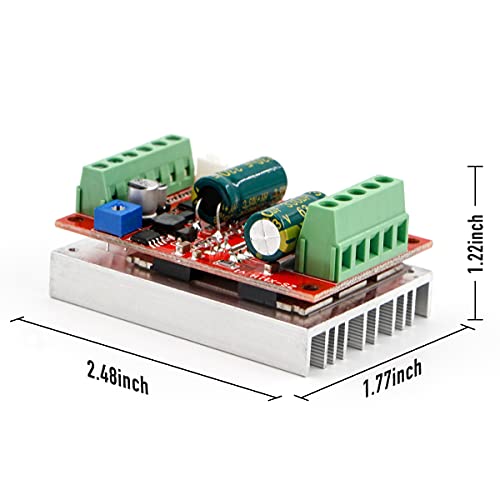
RioRand 350W 6-60V PWM DC Brushless Electric Motor Speed Controller with Hall


Key features
- •1.Humanized design,the interface adopts binding posts,standard heat sink,integrated speed regulating potentiometer on the board,it can be used when the power is on,save time and effort.
- •2.Full patch technology,stable performance,with forward and reverse, brake function.Electric Motor Speed Controller Brushless Controller with Hall.
- •3.Wide voltage 6-60V high power 400W DC three-phase brushless with Hall controller.
- •4.High-power 400W DC three-phase brushless with Hall controller, support PLC 0-5V analog control, support PWM control, amplitude 2.5-5V
- •5.There are three relatively thick phase wires on the motor, and there are also three phase wire interfaces on the driver board. They are marked with the characters of MA, MB, MC and other similar characters, and they are also connected respectively.
RioRand 350W 6-60V PWM DC Brushless Electric Motor Speed Controller with Hall
List Price: $34.90$31.41DEALYou Save: $3.49 (10%)
Free shippingFree Returns – 30 daysFree Order CancellationSecure Payment2–3 Days DeliveryGet It October 24, 2026In Stock (30)No marketing spamNo account requiredFulfilment by FedEx / Amazon / UPS / ShipwirePayPal / Card Buyer Protection
Customer Reviews
Reviews sourced from verified Amazon purchasers4.1
out of 5
Based on 10 reviews
5★
50%
4★
50%
3★
0%
2★
0%
1★
0%
Arrived damaged
Jackie speece✓ Verified Purchase•March 2, 2024
Edit: I got a replacement and it arrived in 2 days and on a Sunday, so I was able to fully test the board and it works as expected, satisfied with this order and will likely order again however the first package was damaged that they send and wasn't soldered very well so make sure to inspect after purchase, but they will make good on it if it is damaged.
Works Great!
Chris✓ Verified Purchase•February 11, 2024
Works great for my project controlling a BLDC motor!
What am I doing wrong?
SamPid71✓ Verified Purchase•January 30, 2024
I keep hearing about a jumper. I get it to him but motor won't go. I also left a question. But you. Can post pics in question but you can't reply to reviews.. Ah Amazon.. Got to love it.
Good controller, with a few gotchas
John✓ Verified Purchase•January 27, 2024
This controller ran great out of the box for me. It drove a 24V 6A motor with ease. No heat issues and high torque. If you're going to use the PWM mode to control the speed, make sure you remove the jumper next to the speed pot on the controller board. If it weren't for a couple of gotchas, I would have given it 5 stars.
Gotchas:
The controllers power down in PWM mode after a few seconds connected to +5V power, and then they don't re-enable. It seems that the PWM channel is very sensitive to noise and so something causes the controller to shut down. I could "wake" it back up by wiggling the wire connected to the +5V power to the controller. If you are using an Arduino, instead of connecting the 5V terminals on the controller to a +5V power source, connect it to one of the Arduino's digital pins instead. These pins are at TTL logic levels (+5V) and they provide enough power to supply the logic on the controller. You can then toggle the pin on and off to enable and disable the controller. When the motor is stopped or you want to stop the motor, set the pin to LOW so it clears the controller of any internal shutdown mechanism. When the motor needs to move, set the pin to HIGH and the controller logic will power up and resume.
The brake isn't really a brake. It just cuts the power to the motor and has no holding torque. There's no power that goes to stop any momentum from the motor, so the motor stops itself through friction.
This is way cheaper than a lot of controllers out there and I think it's a great value for prototyping mechanical setups without having to spend much money!
Gotchas:
The controllers power down in PWM mode after a few seconds connected to +5V power, and then they don't re-enable. It seems that the PWM channel is very sensitive to noise and so something causes the controller to shut down. I could "wake" it back up by wiggling the wire connected to the +5V power to the controller. If you are using an Arduino, instead of connecting the 5V terminals on the controller to a +5V power source, connect it to one of the Arduino's digital pins instead. These pins are at TTL logic levels (+5V) and they provide enough power to supply the logic on the controller. You can then toggle the pin on and off to enable and disable the controller. When the motor is stopped or you want to stop the motor, set the pin to LOW so it clears the controller of any internal shutdown mechanism. When the motor needs to move, set the pin to HIGH and the controller logic will power up and resume.
The brake isn't really a brake. It just cuts the power to the motor and has no holding torque. There's no power that goes to stop any momentum from the motor, so the motor stops itself through friction.
This is way cheaper than a lot of controllers out there and I think it's a great value for prototyping mechanical setups without having to spend much money!
Worked great for me, but WATCH OUT - many questions/answers are for another product
Bob Baust✓ Verified Purchase•December 20, 2023
The media could not be loaded. Note - many of the questions/answers displayed for this item are actually for the Hall Sensor version so please be careful and don't assume all those answers apply to this module. This listing is for the "Hall-less" version, meaning it's for controlling a 3-phase DC motor that only has 3 wires and does NOT use hall sensor monitoring.
Some errors I noted in the Q/A section:
- some Q/A indicate the module has "soft-start" - it does not, but see my easy hack to add it below*
- some say to "remove the jumper" to use the external analog speed control - there is no jumper on this module, just be sure to set the on-board speed pot to zero (full ccw)
- some say this module will not work with a Hall-less motor - that is WRONG, it is specifically designed to work with hall-less motors.
- there are several different wiring diagrams shown in the listing, but the one that has pictures of the motor and power supply is what I used and seems to be correct.
I used this controller to operate the fan motor from an EGO leaf blower that was trashed because the internal controller died. My fan motor has 3 leads - red, blue, and yellow, which connect to the controller terminals red to red, blue to blue, and yellow to green. I'll use this fan blower with some 18v cordless tool batteries as a sweeper in my shop and patio, and 18v yields plenty of air flow for that purpose.
* I made a simple modification to perform a soft-start function, using a 470uf capacitor and a 1k resistor (see photo and video). Some experimenting proved that the external potentiometer speed control reaches maximum motor speed at about 4.6v, which can be achieved by placing a 1k resistor from the 5v terminal to the analog speed input. By adding the capacitor, the voltage on the speed input slowly rises when power is applied, so that the motor speed ramps up from zero to full speed in about a second, greatly reducing the strain on the power supply, controller, and the motor. If you want a slower start-up you can increase the size of the capacitor, but leave the resistor at 1k. If you increase the resistance above 1000Ω the motor will never reach full speed.
Some errors I noted in the Q/A section:
- some Q/A indicate the module has "soft-start" - it does not, but see my easy hack to add it below*
- some say to "remove the jumper" to use the external analog speed control - there is no jumper on this module, just be sure to set the on-board speed pot to zero (full ccw)
- some say this module will not work with a Hall-less motor - that is WRONG, it is specifically designed to work with hall-less motors.
- there are several different wiring diagrams shown in the listing, but the one that has pictures of the motor and power supply is what I used and seems to be correct.
I used this controller to operate the fan motor from an EGO leaf blower that was trashed because the internal controller died. My fan motor has 3 leads - red, blue, and yellow, which connect to the controller terminals red to red, blue to blue, and yellow to green. I'll use this fan blower with some 18v cordless tool batteries as a sweeper in my shop and patio, and 18v yields plenty of air flow for that purpose.
* I made a simple modification to perform a soft-start function, using a 470uf capacitor and a 1k resistor (see photo and video). Some experimenting proved that the external potentiometer speed control reaches maximum motor speed at about 4.6v, which can be achieved by placing a 1k resistor from the 5v terminal to the analog speed input. By adding the capacitor, the voltage on the speed input slowly rises when power is applied, so that the motor speed ramps up from zero to full speed in about a second, greatly reducing the strain on the power supply, controller, and the motor. If you want a slower start-up you can increase the size of the capacitor, but leave the resistor at 1k. If you increase the resistance above 1000Ω the motor will never reach full speed.
Page 1 of 2


