12V 24V 36V 48V 60V 72V Battery Monitor Meter, Waterproof LED Battery Capacity Voltage Indicator Acid&Lithium Battery Gauge Meter for Golf Cart EZGO Club CAR and Most Cars



Key features
- •🚟Battery Level Meter: The battery indicator is used to measure the remaining charge of the devices, equipments and battery-powered vehicles.
- •🚟Wide Applications: Compatible with 12V, 24V, 36V, 48V, 60V, 72V (freely selectable) various Battery-powered devices, suitable for electric vehicles, golf carts, club cars, sightseeing cars, tour buses, boats, marines, scooter, forklifts, and more.
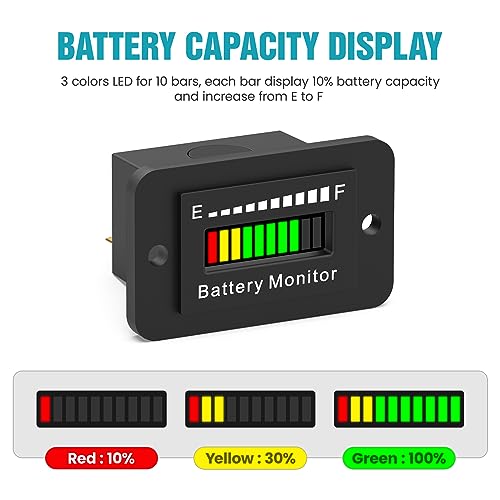
- •🚟Clear and Easy-to-Read Display: The battery meter designed for battery powered device to state the remain battery capacity; 10 segment LED Bar Graph display, 10% per segment(1 red, 2 yellow,7 green).
- •🚟How To Install: You can drill a precise panel cutout size 37x25 mm (1.5x 1 inch) in the proper location of the car for installation or install directly into the slot (if your car happens to have this slot). The battery capacity gauge has 2 connection methods (key switch, keyless switch). Just connect the battery, no external power supply, plug and play.
- •🚟Safety To Use: Comes with installation accessory, easy to install.Reverse protection design, won't burn if connect reversely. IP65 waterproof protection and overvoltage protection, help to extend the life of the battery.
- •🚟High-Quality Construction: Life Waterproof IP65, Heat Resistance, Low Power Consumption (Automatic Sleep), High Test Accuracy, PVC screen protector with bright back-light, which makes you can read the results on the clear LCG display from different angles.
12V 24V 36V 48V 60V 72V Battery Monitor Meter, Waterproof LED Battery Capacity Voltage Indicator Acid&Lithium Battery Gauge Meter for Golf Cart EZGO Club CAR and Most Cars
List Price: $38.78$34.90DEALYou Save: $3.88 (10%)
Free shippingFree Returns – 30 daysFree Order CancellationSecure Payment2–3 Days DeliveryGet It June 25, 2026In Stock (30)No marketing spamNo account requiredFulfilment by FedEx / Amazon / UPS / ShipwirePayPal / Card Buyer Protection
Customer Reviews
Reviews sourced from verified Amazon purchasers4.4
out of 5
Based on 10 reviews
5★
50%
4★
50%
3★
0%
2★
0%
1★
0%
Works as expected.
jami platz✓ Verified Purchase•October 9, 2023
Installed on pre-2000 Electric Club Car DS. Works as it should.
Battery charger meter
Michael✓ Verified Purchase•August 24, 2023
These Things Are great. Buy a big old set of them or just one or two you can pretty much throw them in anything and they work great. Just about anything that runs on 12 volts you can pretty much add a battery meter to and keep an eye on how much juice you got. Throw these in a yakbox, on the go box, camping box, ham radio box, you can add one to your car, to any of your outdoor machinery like gators, dirt bikes, quads, or anything else that runs on 12 volts and keep an eye on them. This meter came package really well and undamaged and arrived really quick in the mail. Overall these are 100% worth the asking price and work just fine
Colorful battery gauge
RMag✓ Verified Purchase•August 21, 2023
Installed this in my 2008 EZGO golf cart in less than 15 minutes. Looks sharp and clean compared to the original gauge which was just an orange color with fewer steps in the gauge. Hopefully this last a long time. Accuracy seems to be fairly good but I've not driven the batter down past 50% yet. Nice update for an older cart.
A great way to monitor your power system status...
Robert C. (Sanjisdad)✓ Verified Purchase•August 4, 2023
We live off grid and rely on our solar setup for our power needs. There is a 5kw battery bank that has a fluctuating state of charge depending on solar input and power drains we put on the battery bank. As it is, we have to manually read the state of charge before we run heavy draw devices like our washing machine. Now with this power monitor mounted in a easily read location we can see at a glance the power remaining in our battery bank. Based on the reading we can choose to turn off the refrigerator and freezers before using a heavy power drain.
The unit is not large and is deeper than expected. Length of front plate is about two inches and depth of unit is a bit over an inch or so. It comes with a small bag of mounting bolts with nuts as well as female spade connectors to attach wires to the male connectors on the back. Once mounted it gives a "gas gauge" type reading that any family member can understand. It can be adjusted for most system voltages.
This is a great economical aid to monitoring our system status. You can use it how best meets your needs. I like it!
The unit is not large and is deeper than expected. Length of front plate is about two inches and depth of unit is a bit over an inch or so. It comes with a small bag of mounting bolts with nuts as well as female spade connectors to attach wires to the male connectors on the back. Once mounted it gives a "gas gauge" type reading that any family member can understand. It can be adjusted for most system voltages.
This is a great economical aid to monitoring our system status. You can use it how best meets your needs. I like it!
Simple compact solution for monitoring battery voltage
RaceNJason✓ Verified Purchase•July 24, 2023
Overall the monitor does what it's supposed to. But, I feel the voltage chart is a little confusing. Basically the voltage that the chart shows under a particular LED count appears to be 1 LED count off. I used a highly precise power supply to do my measurements which you can see in the pictures. In the chart provided in the manual, it shows for 6 LEDs at a voltage of 11.43V - what I observed was at 11.42V I would get 4 LEDs and at 11.43V I would get 5 (not the 6 I thought I should get). Although quite accurate in the voltage level transition point on the chart, the LED count as I said appears minus 1 off.
Being 1 off on the LED count could be of concern for some since what I also found was to get all 10 LEDs to light up I needed ~12.68V and not the >12.30V that the chart implied. I think all 12V batteries can be safely charged up to 12.70V so this probably isn't of concern, but showing on the chart that it should have all 10 LEDs on at >12.30V is slightly misleading (at that voltage only 9 LEDs are on). I didn't test the higher voltage settings (i.e. 24V, 36V, 48V) but I would assume that the ratio of difference is probably identical. Because of this I would recommend you test the higher voltage systems to get an idea of exactly the voltage all 10 LEDs light up. In my quick test I just used a wire shunt between the V+ terminal and the control terminal.
One of my pictures shows that at 12.68V the LED count can fluctuate between 9 and 10. At 12.70V it was stable at the 10 LEDs. It does take around 10 seconds for updates to occur. When all 10 LEDs are on, the device consumes around 11mA. This could've been slightly less if the manufacturer was willing to dim the LEDs some. They did set it up such that the installation of a switch between the V+ and the control terminal will make the device consume 0mA of power. If you have this on a car battery rated at say 40Ah it would take around 200 days of constantly running to eventually ruin your battery (if you didn't charge it at all). If you have a 100Ah deep cycle battery you are looking at a year. So I don't think the 11mA load is sufficient to be of concern, but having a switch on it would eliminate that entirely.
The price is a little high considering you just have LEDs lighting up and not actual values like some monitors do. But, on the other hand some of those digital display monitors consume far more than 11mA to run and therefore your use of the device and how often you keep your system charged will need to be part of that decision.
I subtracted a star on value for money since a slightly lower price would make this more economical considering this is just an LED bar display. And I also subtracted a star on Accuracy because the values in the chart did not seem to align with the number of LEDs that should've been on. Since the voltage values did match spot on for the transition points, just not the LED count...the device is still quite useable as long as you know this minus 1 LED count offset.
Overall I think it could be useful to many people who need a simple battery monitor and if hooked up with a switch it won't impact the batteries at all when turned off. If you need something more complex like actual voltage values or maybe some type of Bluetooth/Wi-Fi capability and you are NOT concerned with the additional power draw these devices have, then maybe one of those types would be better suited for you.
Being 1 off on the LED count could be of concern for some since what I also found was to get all 10 LEDs to light up I needed ~12.68V and not the >12.30V that the chart implied. I think all 12V batteries can be safely charged up to 12.70V so this probably isn't of concern, but showing on the chart that it should have all 10 LEDs on at >12.30V is slightly misleading (at that voltage only 9 LEDs are on). I didn't test the higher voltage settings (i.e. 24V, 36V, 48V) but I would assume that the ratio of difference is probably identical. Because of this I would recommend you test the higher voltage systems to get an idea of exactly the voltage all 10 LEDs light up. In my quick test I just used a wire shunt between the V+ terminal and the control terminal.
One of my pictures shows that at 12.68V the LED count can fluctuate between 9 and 10. At 12.70V it was stable at the 10 LEDs. It does take around 10 seconds for updates to occur. When all 10 LEDs are on, the device consumes around 11mA. This could've been slightly less if the manufacturer was willing to dim the LEDs some. They did set it up such that the installation of a switch between the V+ and the control terminal will make the device consume 0mA of power. If you have this on a car battery rated at say 40Ah it would take around 200 days of constantly running to eventually ruin your battery (if you didn't charge it at all). If you have a 100Ah deep cycle battery you are looking at a year. So I don't think the 11mA load is sufficient to be of concern, but having a switch on it would eliminate that entirely.
The price is a little high considering you just have LEDs lighting up and not actual values like some monitors do. But, on the other hand some of those digital display monitors consume far more than 11mA to run and therefore your use of the device and how often you keep your system charged will need to be part of that decision.
I subtracted a star on value for money since a slightly lower price would make this more economical considering this is just an LED bar display. And I also subtracted a star on Accuracy because the values in the chart did not seem to align with the number of LEDs that should've been on. Since the voltage values did match spot on for the transition points, just not the LED count...the device is still quite useable as long as you know this minus 1 LED count offset.
Overall I think it could be useful to many people who need a simple battery monitor and if hooked up with a switch it won't impact the batteries at all when turned off. If you need something more complex like actual voltage values or maybe some type of Bluetooth/Wi-Fi capability and you are NOT concerned with the additional power draw these devices have, then maybe one of those types would be better suited for you.
Page 1 of 2


