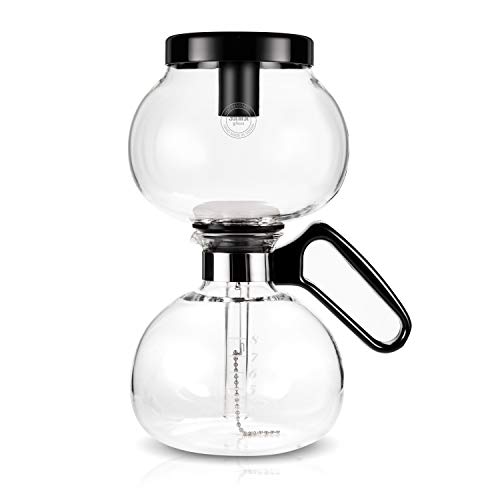
Yama Glass 8-Cup Stovetop Siphon Coffee Maker, 24 Oz Vacuum Brew, Heat-Resistant Borosilicate Glass


Key features
- •YAMA Siphon brewed coffee produces cleaner, richer, and smoother cup of coffee by maximizing the essential oils from the brew
- •Large 8 cup capacity is perfect for serving the whole family
- •Vacuum technology seals in the aroma and flavors delivering on the true profile of your coffee
- •Works on gas and electric rangetops; comes with wire diffuser for use on electric Coil burners (included)
- •Premium hand crafted, hand blown Borosilicate Glass is non-porous and does not absorb odors or chemicals ensuring each brew is as fresh and pure as intended
- •Includes reusable, washable cloth filters. Lid doubles as a siphon stand for post brew
BrandYama Glass
CategoryCoffee Machines
Size32oz (8 cup)
ColorClear
WarrantyIf received broken will replace
Yama Glass 8-Cup Stovetop Siphon Coffee Maker, 24 Oz Vacuum Brew, Heat-Resistant Borosilicate Glass
List Price: $102.90$92.61DEALYou Save: $10.29 (10%)
Free shippingFree Returns – 30 daysFree Order CancellationSecure Payment2–3 Days DeliveryGet It October 26, 2026In Stock (1)No marketing spamNo account requiredFulfilment by FedEx / Amazon / UPS / ShipwirePayPal / Card Buyer Protection
Customer Reviews
Reviews sourced from verified Amazon purchasers4.4
out of 5
Based on 10 reviews
5★
60%
4★
40%
3★
0%
2★
0%
1★
0%
Don't fear the hassle.
Sailorman✓ Verified Purchase•November 16, 2016
This is an excellent way to make coffee. There isn't any paper waste, the finer cloth filter means you can grind finer than a French press (smaller particles mean more surface area contact with the grounds and therefore more efficient flavor transfer to the water), and the design means that coffee brews at the ideal temperature, which is just slightly off the boil. When the water boils, steam pressure forces the water up the tube into the top chamber - during this journey and in the upper chamber it loses just the right amount of heat, reaching what is pretty reliably the ideal brew temperature up top.
Also, once the coffee is brewed, it is drawn from the bottom of the top chamber. The advantage to this is that the bitter tan foam (crema for those in the know) which in a French Press you need to scoop off the top before pressing with spoons (or at least you SHOULD be scooping it off the top! :) ) rests on the top of the grounds as the chamber drains and doesn't get drawn down into the coffee that you'll be drinking from the lower chamber. Win.
The "difficulty" of using this unit is way overstated, in my opinion. The first time you use it you'll be uncomfortable, because you're inexperienced. After I'd say the 5th brew, or even the 3rd, you'll know what you're doing, and then you'll tweak your method over time to get even more skilled. Once you know what you're doing, using this unit is something that comes automatically. It doesn't feel like a chore to me, more like a very pleasant ritual - a part of the "break" in "coffee break." When I'm away from home I miss making coffee this way - although most of my friends are converts now, so a lot of the places I go I still get to use Yamas :) The point is don't be discouraged that this unit is hard to use or a pain in the rear - if you use it for a week you'll get over that no problem and you'll soon find the process to be part of the fun.
Yama's unit is the best in my opinion because it works on any type of stove top. I don't like bunsen burner or other flame type units because it's environmentally irresponsible, without making the coffee any better - the heating efficiency of raw flame (how much heat actually gets into the water vs spills out around the unit and into the room) is pathetic compared to modern electric and induction units. Also, I don't use gas. Why? Because fracking, that's why. But we won't go any further down that rabbit hole in this review.
The flat base of this unit makes it easy to handle and leave on a counter after you've brewed. I'd hate to have to manage a unit with a spherical bottom.
So why 4 instead of 5 stars? I've owned these for a few years now (I've had 2 or 3), and the seals eventually develop small vacuum leaks. You can still use them with this, but the units get less efficient over time. You have to replace the seal, which is easy because it slides off no problem, but they are kind of hard to find. It would be nice if either the seal material could be made more durable, or replacement seals were easily available from Amazon. I'm not trying to scare anyone away from this unit - these low level leaks have generally not started until 3 yrs or so of heavy use. I just want to point it out as something that might eventually happen to you. It's also not specific to Yama's units - EVERY siphon system eventually develops a vacuum leak.
I'd also like as an included accessory a cap for the bottom chamber for after the coffee is brewed - I usually make myself two small cups, and it would be nice to have a lid to put on the bottom chamber to help it hold the heat in longer while I drink the first.
Final analysis - buy this! If you love coffee, you'll never go back!
Also, once the coffee is brewed, it is drawn from the bottom of the top chamber. The advantage to this is that the bitter tan foam (crema for those in the know) which in a French Press you need to scoop off the top before pressing with spoons (or at least you SHOULD be scooping it off the top! :) ) rests on the top of the grounds as the chamber drains and doesn't get drawn down into the coffee that you'll be drinking from the lower chamber. Win.
The "difficulty" of using this unit is way overstated, in my opinion. The first time you use it you'll be uncomfortable, because you're inexperienced. After I'd say the 5th brew, or even the 3rd, you'll know what you're doing, and then you'll tweak your method over time to get even more skilled. Once you know what you're doing, using this unit is something that comes automatically. It doesn't feel like a chore to me, more like a very pleasant ritual - a part of the "break" in "coffee break." When I'm away from home I miss making coffee this way - although most of my friends are converts now, so a lot of the places I go I still get to use Yamas :) The point is don't be discouraged that this unit is hard to use or a pain in the rear - if you use it for a week you'll get over that no problem and you'll soon find the process to be part of the fun.
Yama's unit is the best in my opinion because it works on any type of stove top. I don't like bunsen burner or other flame type units because it's environmentally irresponsible, without making the coffee any better - the heating efficiency of raw flame (how much heat actually gets into the water vs spills out around the unit and into the room) is pathetic compared to modern electric and induction units. Also, I don't use gas. Why? Because fracking, that's why. But we won't go any further down that rabbit hole in this review.
The flat base of this unit makes it easy to handle and leave on a counter after you've brewed. I'd hate to have to manage a unit with a spherical bottom.
So why 4 instead of 5 stars? I've owned these for a few years now (I've had 2 or 3), and the seals eventually develop small vacuum leaks. You can still use them with this, but the units get less efficient over time. You have to replace the seal, which is easy because it slides off no problem, but they are kind of hard to find. It would be nice if either the seal material could be made more durable, or replacement seals were easily available from Amazon. I'm not trying to scare anyone away from this unit - these low level leaks have generally not started until 3 yrs or so of heavy use. I just want to point it out as something that might eventually happen to you. It's also not specific to Yama's units - EVERY siphon system eventually develops a vacuum leak.
I'd also like as an included accessory a cap for the bottom chamber for after the coffee is brewed - I usually make myself two small cups, and it would be nice to have a lid to put on the bottom chamber to help it hold the heat in longer while I drink the first.
Final analysis - buy this! If you love coffee, you'll never go back!
Coffee is important, who do you trust to brew it, you, or that $19.99 Mr. Coffee from WalMart?
Pseudonym✓ Verified Purchase•May 26, 2016
Since March of 2015 this has been my regular coffee maker, between two to seven days a week. Almost immediately I discarded the included filter with its crappy cloth filter, and fiddly spring and hook. I replaced it with an elegant Cory glass filter off Ebay. I couldn't be happier.
Honestly, and I should feel a little silly about this, a large part of what I like about it has nothing to do with the coffee I make with it. The upper and lower carafes with a Cory glass rod make for some beautiful glassware. After (a ridiculously simple) cleanup, I often leave them out on my counter long after they're dry simply because of how esoterically elegant they look. Even before cleanup, with the lower carafe is on my glass stove top, and the upper carafe perched precariously on its stem in the round black base, I have what looks like a chemistry lab's implements, soliciting guests' questions as to what kind of strange, hidden knowledge I use to make coffee.
And I'm only too happy to show them, because the coffee it can make is most likely better than any they've had before. Mind you, there is more art to this than the mundane, rote science of a drip coffee maker. The net is full of "one true" methods of siphon coffee brewing. Should you add your ground coffee at the start, or only upon boil (aka "rattle")? One minute brew time, or two, three, or four? More? Stir throughout the brew time, or only at the start? Heat, then reduce temp to bare minimum until drawdown, or not? Fine or coarse grounds?
It all produces coffee. The fun is finding the method produces the coffee you like best.
For instance, with the coffee bean I currently favor, I use a fine grind (14 on a Baratza Virtuoso - Conical Burr Coffee Grinder) poured in only after the top carafe starts to rattle. I then lower the burner temp to the lowest it takes to keep the water in the top carafe, set the timer to one minute brew time and stir throughout the minute. After the minute elapses, I remove the pot from heat and watch the drawdown, which can take between a minute and half to two minutes.
You control the process from start to finish. Try that with a $19.99 WalMart drip coffee maker.
Speaking of the price, you can get this for around $50.00, less than almost any other siphon coffee maker on the net, and it's probably of higher quality than the other more expensive models on Amazon. I would attest to how its lasted over a year without problem, but, regretfully, I've had to replace the upper carafe because I have kids and can't nice things... but that leads me to my final point about how awesome this coffee pot is, I was able to replace the upper carafe on Amazon for a very acceptable $25.00.
This coffee maker is the coffee aficionado's true tool of choice. If you're serious about making coffee the way /you/ want it, coffee that you can't make with a mundane retail drip coffee maker, this is the coffee maker you want.
Honestly, and I should feel a little silly about this, a large part of what I like about it has nothing to do with the coffee I make with it. The upper and lower carafes with a Cory glass rod make for some beautiful glassware. After (a ridiculously simple) cleanup, I often leave them out on my counter long after they're dry simply because of how esoterically elegant they look. Even before cleanup, with the lower carafe is on my glass stove top, and the upper carafe perched precariously on its stem in the round black base, I have what looks like a chemistry lab's implements, soliciting guests' questions as to what kind of strange, hidden knowledge I use to make coffee.
And I'm only too happy to show them, because the coffee it can make is most likely better than any they've had before. Mind you, there is more art to this than the mundane, rote science of a drip coffee maker. The net is full of "one true" methods of siphon coffee brewing. Should you add your ground coffee at the start, or only upon boil (aka "rattle")? One minute brew time, or two, three, or four? More? Stir throughout the brew time, or only at the start? Heat, then reduce temp to bare minimum until drawdown, or not? Fine or coarse grounds?
It all produces coffee. The fun is finding the method produces the coffee you like best.
For instance, with the coffee bean I currently favor, I use a fine grind (14 on a Baratza Virtuoso - Conical Burr Coffee Grinder) poured in only after the top carafe starts to rattle. I then lower the burner temp to the lowest it takes to keep the water in the top carafe, set the timer to one minute brew time and stir throughout the minute. After the minute elapses, I remove the pot from heat and watch the drawdown, which can take between a minute and half to two minutes.
You control the process from start to finish. Try that with a $19.99 WalMart drip coffee maker.
Speaking of the price, you can get this for around $50.00, less than almost any other siphon coffee maker on the net, and it's probably of higher quality than the other more expensive models on Amazon. I would attest to how its lasted over a year without problem, but, regretfully, I've had to replace the upper carafe because I have kids and can't nice things... but that leads me to my final point about how awesome this coffee pot is, I was able to replace the upper carafe on Amazon for a very acceptable $25.00.
This coffee maker is the coffee aficionado's true tool of choice. If you're serious about making coffee the way /you/ want it, coffee that you can't make with a mundane retail drip coffee maker, this is the coffee maker you want.
Siphon Brew for a Good Smooth Cup
Halljp✓ Verified Purchase•December 3, 2015
I own both the 5 and 8 cup version. These are obviously a little more effort both in brewing and clean up, but I think the view is worth the climb. You get a very smooth and rich cup of coffee. I started with the 5 cup and it works great for just two of us (5 "cups" is about right for two "mugs"). I bought the 8 because I ended up working away from home and bought another one for my apartment. You can make 5 or 6 in the 8 cup quite well, so knowing what I know now, if I was just buying one it would be the 8 cup. Note that the top of the 5 cup is a much tighter fit in the bottom than the 8. It is not good or bad with regards to the unit working properly. It does make me a bit more concerned I will eventually break the top piece on the 5 cup - another reason I would buy the 8.
I have used these on both gas and electric (element) stove tops with good success.
I have used these on both gas and electric (element) stove tops with good success.
Great Coffee-fussy filter
Mary✓ Verified Purchase•October 22, 2015
I bought this to replace a Bodum Pebo when I broke the top of that. Turned out that the replacement part was more than this whole coffee maker and Yama has replacement parts more reasonably priced and readily available. The Pebo makes a minimum of 6 - 5 ounce cups and this can make up to 5 - 4.5 ounce cups which was another good thing as far as I was concerned. The Yama was well packed and arrived in perfect condition. The wider bottom of the carafe means the handle stays cool and the water warms before the air pressure pushes water up to the coffee; so you can just fill the carafe with tap water, assemble the unit, add coffee and put it on the gas stove at medium low heat. Turn off when the water has risen and air has bubbled through to the top. It makes excellent coffee. 5 star coffee.
I thought the cloth filter was fussy-directions said to wash with a toothbrush and then leave in a jar of water in the refrigerator between uses. ?! I had read that there was a stainless steel filter available and I got that. I found that let grit into my cup when made as I had made great coffee using the cloth. Also found the stainless filter had to be disassembled to clean each time as coffee lodged in between the layers of it. Had an idea and tried the Bodum Pebo 'filter' (which is a grooved plastic one). It fits! With it the coffee is clean of particulate matter and washing up is much easier than with either of the Yama filters. Other reviewers have said that glass filter rods fit this-I don't know about that.
Great coffee with either the cloth or the grooved filter.
I thought the cloth filter was fussy-directions said to wash with a toothbrush and then leave in a jar of water in the refrigerator between uses. ?! I had read that there was a stainless steel filter available and I got that. I found that let grit into my cup when made as I had made great coffee using the cloth. Also found the stainless filter had to be disassembled to clean each time as coffee lodged in between the layers of it. Had an idea and tried the Bodum Pebo 'filter' (which is a grooved plastic one). It fits! With it the coffee is clean of particulate matter and washing up is much easier than with either of the Yama filters. Other reviewers have said that glass filter rods fit this-I don't know about that.
Great coffee with either the cloth or the grooved filter.
It makes good coffee...
David Karoly✓ Verified Purchase•August 7, 2015
First, it worked just as advertised. I had none of the problems others had. The coffee it makes is pretty good, better than my stainless steel percolator. It took about 12 minutes to boil 40 oz. of water. The rest of the process took a couple of minutes. It will work with less than boiling water, it just needs steam. Clean-up is simple...I just scooped the grounds (they are nicely dried out), rinsed everything and washed it. I cleaned the filter and put it in water in the refrigerator as recommended. You can't get your hand into the lower pot, the opening is small. If it's a big deal you would need a long skinny brush to get in there. The coffee it makes is very clean, no sediment or grounds get past the filter. I just shook the lower vessel with soapy water in it which seems sufficient.
A couple of reservations: the glass seems a bit thin and delicate. I think it wouldn't take much to break it. I don't think it would last long in a household with small children, especially the glass tube on the upper vessel. When it breaks you have glass shards all over plus the general mess of coffee, etc. The plastic stand could be wider but it's made to be stored as a lid on the upper vessel. I cringe when I remove the upper vessel and the tube clinks against the lower pot. It would be nice to have some way to release the vacuum but that would add complexity to a simple design.
Overall, I recommend this pot...it actually works very well. It takes a light touch, be careful. I bought the bamboo stick that Amazon recommended; I don't think it's necessary...just use the plastic spoon the pot comes with. I am tempted by the permanent metal screen filter they offer, though.
Someone suggested boiling the water in a tea kettle then pouring into the room temperature carafe. I would not do that. Although the glass can handle it, I would think over time the stress will cause it to shatter someday. Likewise I let it cool off before rinsing it, I don't put cold water in the hot glass.
Edit 08/29/2015: I have settled on 2 minutes brew time which results in strong coffee without acid or bitterness. I have decided the bamboo stick suggested by Amazon is useful as a stir stick and loosening the grounds and dumping in the green waste. One time I absent-mindedly had the burner flame too high, don't go above medium heat, if the heat is too high the water will rise very rapidly like a volcano, and splatter. Also water too hot will scald the coffee grounds. I use 6 on my LG gas range then lower it to 4 when the water is boiling. A person in a YouTube video demonstrating the smaller Hario suggested stirring counter-clockwise 10 times just as it starts to siphon downwards. I started doing that and it seems to help it siphon better because it stirs up the fines off of the filter. My process:
1. Put cold, filtered water in the carafe.
2. Put the carafe on medium heat.
3. While waiting for the water to boil run the hot side of the kitchen faucet into your watering can (2 gallons saved from waste). I use this to water my flowers.
4. Install the filter in the upper vessel and put it in its stand.
5. Put a number of scoops which equals cups of water of coarse ground coffee in the upper vessel (I don't put it in after the water rises as some suggest.
6. When the water starts to boil install the upper vessel into the carafe firmly seating it and twist it a little.
7. After the water rises start the timer from 1 to 2 minutes per your preference and stir getting all the grounds wet and off the sides.
8. When the timer goes off turn off burner and using an oven mit on your left hand gently press down on the top vessel while moving the pot to a cold burner with your right hand using the handle.
9. Be patient, it may take a minute to cool enough to start siphoning. Don't be a coffee geek, no need to blow on it or use a wet towel, etc.
10. Stir 10 to 12 times counter-clockwise as it begins to siphon.
11. Be patient, it will take a 1 to 5 minutes to siphon depending on how many fines got into the grind. If the bottom appears to start boiling it's done but this doesn't always happen. If it appears to be stopped at 7 cups I assume it's done I gently rock the upper vessel to release it. About another half cup drains down when the vacuum is released.
12. Decant the coffee into a 42oz. Thermos brand vacuum bottle.
13. The coffee can be loosened with the wooden paddle and dumped.
14. Wash and dry all parts and put the filter in a container of cold water in the refrigerator.
A couple of reservations: the glass seems a bit thin and delicate. I think it wouldn't take much to break it. I don't think it would last long in a household with small children, especially the glass tube on the upper vessel. When it breaks you have glass shards all over plus the general mess of coffee, etc. The plastic stand could be wider but it's made to be stored as a lid on the upper vessel. I cringe when I remove the upper vessel and the tube clinks against the lower pot. It would be nice to have some way to release the vacuum but that would add complexity to a simple design.
Overall, I recommend this pot...it actually works very well. It takes a light touch, be careful. I bought the bamboo stick that Amazon recommended; I don't think it's necessary...just use the plastic spoon the pot comes with. I am tempted by the permanent metal screen filter they offer, though.
Someone suggested boiling the water in a tea kettle then pouring into the room temperature carafe. I would not do that. Although the glass can handle it, I would think over time the stress will cause it to shatter someday. Likewise I let it cool off before rinsing it, I don't put cold water in the hot glass.
Edit 08/29/2015: I have settled on 2 minutes brew time which results in strong coffee without acid or bitterness. I have decided the bamboo stick suggested by Amazon is useful as a stir stick and loosening the grounds and dumping in the green waste. One time I absent-mindedly had the burner flame too high, don't go above medium heat, if the heat is too high the water will rise very rapidly like a volcano, and splatter. Also water too hot will scald the coffee grounds. I use 6 on my LG gas range then lower it to 4 when the water is boiling. A person in a YouTube video demonstrating the smaller Hario suggested stirring counter-clockwise 10 times just as it starts to siphon downwards. I started doing that and it seems to help it siphon better because it stirs up the fines off of the filter. My process:
1. Put cold, filtered water in the carafe.
2. Put the carafe on medium heat.
3. While waiting for the water to boil run the hot side of the kitchen faucet into your watering can (2 gallons saved from waste). I use this to water my flowers.
4. Install the filter in the upper vessel and put it in its stand.
5. Put a number of scoops which equals cups of water of coarse ground coffee in the upper vessel (I don't put it in after the water rises as some suggest.
6. When the water starts to boil install the upper vessel into the carafe firmly seating it and twist it a little.
7. After the water rises start the timer from 1 to 2 minutes per your preference and stir getting all the grounds wet and off the sides.
8. When the timer goes off turn off burner and using an oven mit on your left hand gently press down on the top vessel while moving the pot to a cold burner with your right hand using the handle.
9. Be patient, it may take a minute to cool enough to start siphoning. Don't be a coffee geek, no need to blow on it or use a wet towel, etc.
10. Stir 10 to 12 times counter-clockwise as it begins to siphon.
11. Be patient, it will take a 1 to 5 minutes to siphon depending on how many fines got into the grind. If the bottom appears to start boiling it's done but this doesn't always happen. If it appears to be stopped at 7 cups I assume it's done I gently rock the upper vessel to release it. About another half cup drains down when the vacuum is released.
12. Decant the coffee into a 42oz. Thermos brand vacuum bottle.
13. The coffee can be loosened with the wooden paddle and dumped.
14. Wash and dry all parts and put the filter in a container of cold water in the refrigerator.
Page 1 of 2