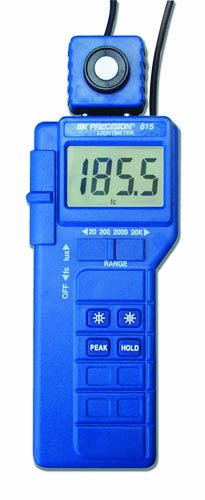
B&K Precision 615 Compact Digital Light Meter, 2 Measuring Ranges
Key features
- •Portable easy to use, 3-1/2 digit, compact sized digital light meter
- •Designed for simple one hand operation
- •It provides Measurement in lux and fc units
- •The meter has a backlit LCD display, peak hold (50mS pulse light) and data-hold feature
- •1 Year warranty
BrandB&K Precision
CategoryLight Measurement
B&K Precision 615 Compact Digital Light Meter, 2 Measuring Ranges
List Price: $217.94$196.15DEALYou Save: $21.79 (10%)
Free shippingFree Returns – 30 daysFree Order CancellationSecure Payment2–3 Days DeliveryGet It October 25, 2026In Stock (3)No marketing spamNo account requiredFulfilment by FedEx / Amazon / UPS / ShipwirePayPal / Card Buyer Protection
Customer Reviews
Reviews sourced from verified Amazon purchasers3.0
out of 5
Based on 1 reviews
5★
0%
4★
0%
3★
100%
2★
0%
1★
0%
Accurate and sensitive, but slow in low light levels
D. Etchells•May 12, 2016
I bought one of these because I needed a meter that would read down to very low light levels in our camera test lab. There are cheaper products available (we have a couple), but for a critical measurement, I trusted the B&K Precision name. As far as I can tell, the meter is accurate, and will indeed read down to very low light levels, but it's *very* slow when the light is dim. (I'm talking about levels less than 1 lux.) The spec for the meter says it updates 2x/second, and that's true as far as it goes: The digital reading updates twice a second. What's not mentioned is that there must be a huge capacitor across the sensor to reduce noise in dim lighting, so the value that's being measured by the digital part changes **very** slowly when the light level is low. At the lowest light levels we're measuring (~0.16 lux or so), it can take a good 15 seconds for the reading to stabilize.
This won't be an issue if you can afford to wait to make a reading after a lighting change (and obviously if your light source is quite constant), but if you need a faster response in very dim conditions, this probably isn't the meter for you. (It's pretty fast at higher light levels, I think it's just that in very dim lighting, the current through the photodiode is very small, so it takes a long time to charge or discharge the filter capacitor.)
(FWIW, I suspect this would be the case with other cheap light meters - or else if they have a much smaller filter capacitor, you'll get a lot of noise on the readings.)
This won't be an issue if you can afford to wait to make a reading after a lighting change (and obviously if your light source is quite constant), but if you need a faster response in very dim conditions, this probably isn't the meter for you. (It's pretty fast at higher light levels, I think it's just that in very dim lighting, the current through the photodiode is very small, so it takes a long time to charge or discharge the filter capacitor.)
(FWIW, I suspect this would be the case with other cheap light meters - or else if they have a much smaller filter capacitor, you'll get a lot of noise on the readings.)


