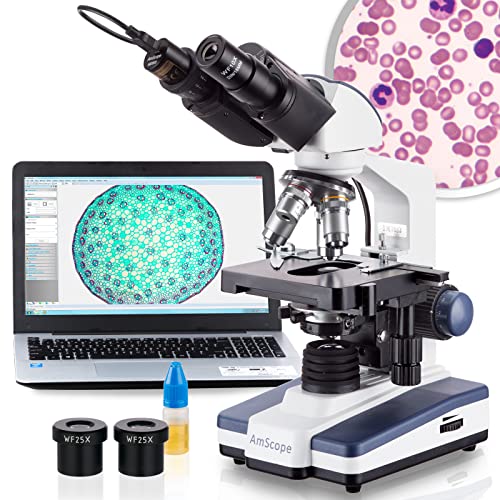
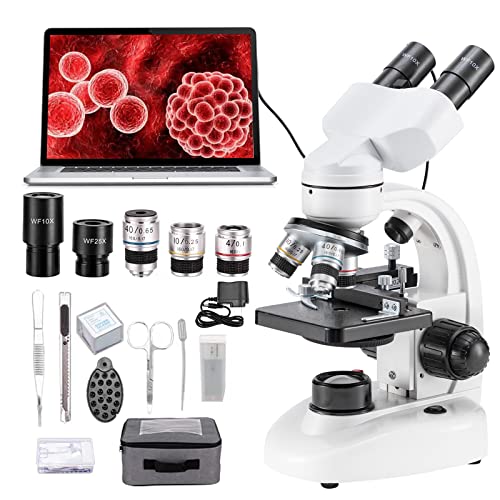
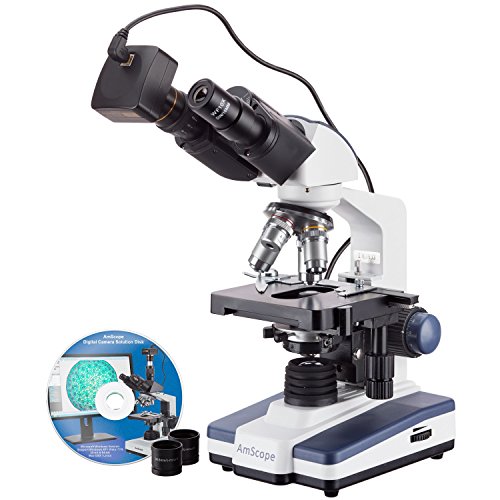
OMAX M82E Series LED Binocular Compound Lab Microscope - 40X-2000X Magnification - Microscope Kit with 100 Blank Slides & Cover Slips



Key features
- •Total magnification: 40X-80X-100X-200X-400X-800X-1000X-2000X; Eyepieces: wide field WF10X and WF20X; Objectives: achromatic DIN 4X, 10X, 40X(S), 100X(S, Oil); Viewing head: 45 degrees inclined 360 degrees swiveling binocular; Sliding adjustable interpupillary distance: 2-3/16inch ~ 2-15/16inch(55~75mm); Ocular diopter adjustable on both eyetubes
- •Nosepiece: revolving quadruple; Stage: double layer X-Y mechanical stage with scales, size: 4-1/2inchx 4-15/16inch (115mm x 125mm), translation range: 2-13/16inch x 1-3/16inch (70mm x 30mm); Stage upward moving lock protects objectives and slides
- •Condenser: NA1.25 Abbe condenser with iris diaphragm; Illumination: transmitted (lower) LED light, intensity adjustable; Focus: Coaxial coarse and fine knobs on both sides
- •Full solid metal frame construction with stain resistant enamel finish; Power supply: AC/DC adapter, 7.5V/7.5W (UL approved) - Input: 100-240V; 100-piece blank glass slides with 100-piece cover slips and 50-sheet lens cleaning paper included
- •5-year warranty against manufacturing defects
OMAX M82E Series LED Binocular Compound Lab Microscope - 40X-2000X Magnification - Microscope Kit with 100 Blank Slides & Cover Slips
List Price: $394.29$354.86DEALYou Save: $39.43 (10%)
Free shippingFree Returns – 30 daysFree Order CancellationSecure Payment2–3 Days DeliveryGet It October 25, 2026In Stock (2)No marketing spamNo account requiredFulfilment by FedEx / Amazon / UPS / ShipwirePayPal / Card Buyer Protection
Customer Reviews
Reviews sourced from verified Amazon purchasers4.4
out of 5
Based on 10 reviews
5★
70%
4★
0%
3★
30%
2★
0%
1★
0%
Good when working properly. Expensive hassle to fix.
Courtney S.•August 26, 2017
I purchased this microscope a year ago and have used it probably a total of 5 hrs. It worked well except that the fine focus control loses traction and therefore isn't very effective. Recently the LED light started intermittently turning off and on and then has now completely stopped working. The company is taking it back for repair but I have to pay the shipping costs.
Smoke and fumes emitting from the microscope
Amazon Customer•May 5, 2017
I was really excited to use this microscope. Since I bought it around the end of 2016 until now it had been giving me no trouble whatsoever and it was very fun and easy to use, especially since it came with so many slides and a filter. I had not used a filter before and as I was trying to install it, I seemed to have unscrewed the actual lighting mechanism. I was not at all worried about it because I did not rip or break anything and simply screwed it back and successfully put in the green filter that came with it. As I used it, I noticed it smelled a little funny, and even after I used it for so long, I thought I just hadn't noticed it before. Just to be safe, I turned it off and put it away until today when I decided I wanted to use it again. Today it had been on even shorter than yesterday and the smell was a lot stronger, and then I noticed that the underside of my microscope was smoking. Alarmed, I unplugged it and it is currently sitting on my desk with a slide still in it. I don't know if I'll be able to use it again or if I even should. I'm hoping to unscrew and rewire it so that it stops smoking, but I might just forget about it altogether, which is really disappointing seeing as I was given it as a gift.
Awesome! I can't believe that you get all this ...
11B40PX2S•March 22, 2017
Awesome! I can't believe that you get all this for such a reasonable price. Product works great. OMAX provides detailed user guide/operational manual via web-link and all hardware required to start examining the micro world around you!
We wanted to get something that would be high-quality and be useful even for someone with college level interest
James•January 12, 2016
This is our first microscope that we got for our kids. We wanted to get something that would be high-quality and be useful even for someone with college level interest.
Excellent quality and great magnification. Aside from some prepared slides that we bought, we also looked at a few things of our own including algae from our fish tank, where we could easily see the various parts of the cells.
Excellent quality and great magnification. Aside from some prepared slides that we bought, we also looked at a few things of our own including algae from our fish tank, where we could easily see the various parts of the cells.
Top microscope in its price range.
Laurentiu Cristofor•December 10, 2015
I recently developed an interest in microscopes, so I did some research and I ended up going for this OMAX M82ES microscope, which you may see offered in several different bundles. I want to share in this review some of the things I learned in my research, so as to help you make your own purchasing decisions.
First, let's start by talking magnification. The instinctive reaction of a first time user is to prefer microscope kits that offer higher magnification. But this is misleading because beyond 1000X-1500X magnifications, you don't really gain any resolution (check: www.microscope.com/education-center/articles/false-magnification/ as well as comments to this review and below). And, as we will see below, most microscope kits don't offer any intermediate magnifications between 1000X and the maximum magnification they offer (2000X or 2500X), so that maximum magnification doesn't really give you any extra resolution over a 1000X microscope.
Compound microscopes obtain their magnifications by combining the eyepiece magnification with the objective magnification. The objective magnifications usually are: 4X, 10X, 40X, and 100X. The most used eyepiece magnifications are: 10X, 20X, 25X. The 100X objective cannot be used as is, it requires a special immersion oil (see: en.wikipedia.org/wiki/Oil_immersion for explanation); so in inexpensive microscopes, this objective is usually missing, Regarding eyepieces, you usually get 10X or pairs of 10x+20X or 10X+25X. Now let's look at what these combinations provide as magnification:
10X: 40X (with 4X objective), 100X (with 10X), 400X (with 40X), 1000X (with 100X).
20X: 80X (with 4X), 200X (with 10X), 800X (with 40X), 2000X (with 100X)
25X: 100X (with 4X), 250X (with 10X), 1000X (with 40X), 2500X (with 100X)
[EDIT: I rewrote this analysis based on comment feedback - see comments section] When I first wrote this review, I didn't know exactly how to figure out the theoretical resolution limit for each objective. I still don't have an exact formula, as it depends on several factors including the wavelength of the illumination light, but a comment to this review pointed me to a rule of thumb that I also found mentioned in a Zeiss article on microscopy - that rule says that the maximum magnification that can be expected to be achieved with an objective would be 1000 times the numerical aperture value of the objective - see zeiss-campus.magnet.fsu.edu/articles/basics/resolution.html). The numerical apertures and maximum magnifications for the OMAX objectives are the following: 4X (0.10/100X), 10X (0.25/250X), 40X (0.65/650X), 100X (1.25/1250X).
So, if we exclude the false magnifications, these are the magnifications that we can expect from each combination of objective and eyepiece (note that even this is optimistic, because we evaluated the maximum magnification, which we will probably not reach in practice):
10X: 40X (with 4X objective), 100X (with 10X), 400X (with 40X), 1000X (with 100X).
20X: 80X (with 4X), 200X (with 10X)
25X: 100X (with 4X), 250X (with 10X) - these are probably not going to be achieved because they're the maximal values for each objective.
False magnification may still help your naked eye make out details even if it doesn't bring up more details. But if you would record images, then you could also probably blow out the 1000X image to 2000X and see similar detail as when using the 20X or 25X eyepiece instead of the 10X one. With this in mind, there is not much reason to prefer a model that comes with 25X eyepieces over one that comes with 20X and in fact, personally, I would have been happy to just get the 10X eyepieces.
So this is why I picked a 40X-2000X microscope over a 40X-2500X one. But there are a few more reasons why I settled for this OMAX model:
1. Stage operation. The slide holding system and the adjustment of the stage are one of the main differences from less expensive models. The stage has X/Y scales so you can mark coordinates of an observation point, so you can easily find it later.
2. Condenser operation. The position of the condenser can be adjusted vertically and it has an iris diaphragm (vs disc on less expensive models); the condenser can also be easily removed and replaced with a darkfield condenser, for example, if you want to do so. There is also a filter holder that can slide out from under the condenser - just look for a tiny knob that you can pull out.
3. Coarse/fine coaxial focusing knobs. Less expensive models lack fine knobs or don't have them positioned coaxially. The coaxial positioning is nice because you don't have to move your hand much when focusing the microscope.
I would have also settled for a monocular microscope, but these are generally less featured than binocular microscopes and are lacking one or more of the above mentioned features.
The main competitor of the OMAX M82ES is the AmScope B120 model, which has a Siedentopf head - that head is an advantage for the AmScope as it offers an easier configuration process and is easier to reconfigure if more than one person uses the microscope. To counter that, the OMAX uses less plastic in its build, which I prefer. The OMAX also seems to have simpler adjustments.
A few more things you should know about this OMAX microscope:
The objectives come pre-installed, but not everything is configured for optimal operation. There is a focusing rack stop screw that is supposed to help prevent the slides from being pushed into the larger magnification objectives (40X and 100X) - that screw will need to be adjusted as it does not come pre-set and on my sample it allowed the slides to be pushed into the high magnification objectives (40X and 100X - those objectives are spring loaded to prevent damage, but it is better to avoid it by also limiting the movement of the stage using this screw).
Make sure to download and read the manual, to acquaint yourself with the parts of this microscope. And before you fully unpack the microscope, I also suggest watching the OMAX introductory video on youtube, which will walk you through the main functionality of the microscope.
This is a full featured microscope that can be further enhanced through additional OMAX or AmScope accessories.
A few accessories suggested:
OMAX A Pair of Rubber Eyecups for Microscopes with 23.2mm Eyepieces
OMAX 60X Achromatic Objective Lens (spring) for Compound Microscopes
Some quick comments on these items:
- The rubber cups are very nice and I wish they were included even if they had to bump the price of the package - they really make it more comfortable to use the eyepieces.
- The 60X objective has a numerical aperture of 0.85, so it can theoretically achieve up to 850X magnification. I replaced my 1000X (oil) objective with this one and I primarily use the 10X eyepieces. The reason I don't use the 1000X is simply because I don't need that magnification and I don't want to bother with the application and cleaning of the immersion oil. Even this 60X objective gives me more magnification that I often need for most of the slides I explore.
If you have an interchangeable lens camera (mirrorless or DSLR), you may also want to check for adapters on ebay: you can get adapters from 23mm microscope tubes to T2 mount (a simple universal mount that is also used by some telescopes) and then you can get an adapter from the T2 mount to the specific mount of your camera. An update on this aspect: I found this solution not very satisfying - the illumination of the microscope will produce a halo of light as it goes through the slide and that will get recorded in the photograph. I don't know if a specialized camera will have the same issue - if anyone knows, I'd appreciate feedback in the comments. It might be that the lack of a final optical element in this combination is what causes these issues (since I remove and eyepiece and replace it with an open path to the camera's sensor).
If you're looking for something less expensive and do not need all the features of this OMAX model, then here is one interesting option that I came across in my search:
Levenhuk 50L NG Microscope monocular 40-1280x case with experiment kit
First, let's start by talking magnification. The instinctive reaction of a first time user is to prefer microscope kits that offer higher magnification. But this is misleading because beyond 1000X-1500X magnifications, you don't really gain any resolution (check: www.microscope.com/education-center/articles/false-magnification/ as well as comments to this review and below). And, as we will see below, most microscope kits don't offer any intermediate magnifications between 1000X and the maximum magnification they offer (2000X or 2500X), so that maximum magnification doesn't really give you any extra resolution over a 1000X microscope.
Compound microscopes obtain their magnifications by combining the eyepiece magnification with the objective magnification. The objective magnifications usually are: 4X, 10X, 40X, and 100X. The most used eyepiece magnifications are: 10X, 20X, 25X. The 100X objective cannot be used as is, it requires a special immersion oil (see: en.wikipedia.org/wiki/Oil_immersion for explanation); so in inexpensive microscopes, this objective is usually missing, Regarding eyepieces, you usually get 10X or pairs of 10x+20X or 10X+25X. Now let's look at what these combinations provide as magnification:
10X: 40X (with 4X objective), 100X (with 10X), 400X (with 40X), 1000X (with 100X).
20X: 80X (with 4X), 200X (with 10X), 800X (with 40X), 2000X (with 100X)
25X: 100X (with 4X), 250X (with 10X), 1000X (with 40X), 2500X (with 100X)
[EDIT: I rewrote this analysis based on comment feedback - see comments section] When I first wrote this review, I didn't know exactly how to figure out the theoretical resolution limit for each objective. I still don't have an exact formula, as it depends on several factors including the wavelength of the illumination light, but a comment to this review pointed me to a rule of thumb that I also found mentioned in a Zeiss article on microscopy - that rule says that the maximum magnification that can be expected to be achieved with an objective would be 1000 times the numerical aperture value of the objective - see zeiss-campus.magnet.fsu.edu/articles/basics/resolution.html). The numerical apertures and maximum magnifications for the OMAX objectives are the following: 4X (0.10/100X), 10X (0.25/250X), 40X (0.65/650X), 100X (1.25/1250X).
So, if we exclude the false magnifications, these are the magnifications that we can expect from each combination of objective and eyepiece (note that even this is optimistic, because we evaluated the maximum magnification, which we will probably not reach in practice):
10X: 40X (with 4X objective), 100X (with 10X), 400X (with 40X), 1000X (with 100X).
20X: 80X (with 4X), 200X (with 10X)
25X: 100X (with 4X), 250X (with 10X) - these are probably not going to be achieved because they're the maximal values for each objective.
False magnification may still help your naked eye make out details even if it doesn't bring up more details. But if you would record images, then you could also probably blow out the 1000X image to 2000X and see similar detail as when using the 20X or 25X eyepiece instead of the 10X one. With this in mind, there is not much reason to prefer a model that comes with 25X eyepieces over one that comes with 20X and in fact, personally, I would have been happy to just get the 10X eyepieces.
So this is why I picked a 40X-2000X microscope over a 40X-2500X one. But there are a few more reasons why I settled for this OMAX model:
1. Stage operation. The slide holding system and the adjustment of the stage are one of the main differences from less expensive models. The stage has X/Y scales so you can mark coordinates of an observation point, so you can easily find it later.
2. Condenser operation. The position of the condenser can be adjusted vertically and it has an iris diaphragm (vs disc on less expensive models); the condenser can also be easily removed and replaced with a darkfield condenser, for example, if you want to do so. There is also a filter holder that can slide out from under the condenser - just look for a tiny knob that you can pull out.
3. Coarse/fine coaxial focusing knobs. Less expensive models lack fine knobs or don't have them positioned coaxially. The coaxial positioning is nice because you don't have to move your hand much when focusing the microscope.
I would have also settled for a monocular microscope, but these are generally less featured than binocular microscopes and are lacking one or more of the above mentioned features.
The main competitor of the OMAX M82ES is the AmScope B120 model, which has a Siedentopf head - that head is an advantage for the AmScope as it offers an easier configuration process and is easier to reconfigure if more than one person uses the microscope. To counter that, the OMAX uses less plastic in its build, which I prefer. The OMAX also seems to have simpler adjustments.
A few more things you should know about this OMAX microscope:
The objectives come pre-installed, but not everything is configured for optimal operation. There is a focusing rack stop screw that is supposed to help prevent the slides from being pushed into the larger magnification objectives (40X and 100X) - that screw will need to be adjusted as it does not come pre-set and on my sample it allowed the slides to be pushed into the high magnification objectives (40X and 100X - those objectives are spring loaded to prevent damage, but it is better to avoid it by also limiting the movement of the stage using this screw).
Make sure to download and read the manual, to acquaint yourself with the parts of this microscope. And before you fully unpack the microscope, I also suggest watching the OMAX introductory video on youtube, which will walk you through the main functionality of the microscope.
This is a full featured microscope that can be further enhanced through additional OMAX or AmScope accessories.
A few accessories suggested:
OMAX A Pair of Rubber Eyecups for Microscopes with 23.2mm Eyepieces
OMAX 60X Achromatic Objective Lens (spring) for Compound Microscopes
Some quick comments on these items:
- The rubber cups are very nice and I wish they were included even if they had to bump the price of the package - they really make it more comfortable to use the eyepieces.
- The 60X objective has a numerical aperture of 0.85, so it can theoretically achieve up to 850X magnification. I replaced my 1000X (oil) objective with this one and I primarily use the 10X eyepieces. The reason I don't use the 1000X is simply because I don't need that magnification and I don't want to bother with the application and cleaning of the immersion oil. Even this 60X objective gives me more magnification that I often need for most of the slides I explore.
If you have an interchangeable lens camera (mirrorless or DSLR), you may also want to check for adapters on ebay: you can get adapters from 23mm microscope tubes to T2 mount (a simple universal mount that is also used by some telescopes) and then you can get an adapter from the T2 mount to the specific mount of your camera. An update on this aspect: I found this solution not very satisfying - the illumination of the microscope will produce a halo of light as it goes through the slide and that will get recorded in the photograph. I don't know if a specialized camera will have the same issue - if anyone knows, I'd appreciate feedback in the comments. It might be that the lack of a final optical element in this combination is what causes these issues (since I remove and eyepiece and replace it with an open path to the camera's sensor).
If you're looking for something less expensive and do not need all the features of this OMAX model, then here is one interesting option that I came across in my search:
Levenhuk 50L NG Microscope monocular 40-1280x case with experiment kit
Page 1 of 2