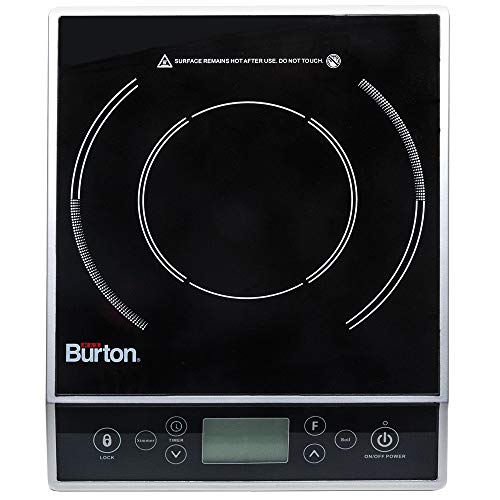
Max Burton 6400 Digital Choice Induction Cooktop 1800 Watts LCD Control




Key features
- •COOKTOP: The Max Burton 6400 Digital Induction Cooktop is portable, easy to use and energy efficient
- •INDUCTION: With induction cooking, your cookware is being heated by a magnetic field inside of the cooktop
- •SAFE: There is no open flame or exposed heating element to burn people or surrounding items, making this ideal for young and old
- •CONVENIENT: The Max Burton 6400 Induction Cooktop is lightweight, plugs into any standard household outlet and has an easy to use LCD screen and touch controls
- •IDEAL: This cooktop can be used for a primary or secondary burner in the home, dorm, office, boat, RV or gourmet kitchen
Max Burton 6400 Digital Choice Induction Cooktop 1800 Watts LCD Control
List Price: $111.98$100.78DEALYou Save: $11.20 (10%)
Free shippingFree Returns – 30 daysFree Order CancellationSecure Payment2–3 Days DeliveryGet It October 26, 2026In Stock (2)No marketing spamNo account requiredFulfilment by FedEx / Amazon / UPS / ShipwirePayPal / Card Buyer Protection
Customer Reviews
Reviews sourced from verified Amazon purchasers3.9
out of 5
Based on 10 reviews
5★
70%
4★
20%
3★
0%
2★
10%
1★
0%
Great cooktop, highly recommend!
Salinwa•May 23, 2018
I had bought a cheap and very lousy induction burner (one of those tv brands, thought I'd save a little money) to use while we were living in our shop (I didn't have a kitchen to speak of) and I hated it. Then I bought this Max Burton burner but we ended up just eating out most of the time, didn't use it much. Now we're in our new house and I use it almost daily! I like it a LOT!! I do NOT like the glass cooktop stove that came with the house (though I AM trying to make friends with it) but I really like this Max Burton burner. I might buy another one if our new stove and I don't learn to get along but even so this will remain my go to burner for cooking. I love to use it on our kitchen island where I have lots of room to spread out for prep or whatever while cooking. But also, clean up is WAY easier than that glass top stove. I HATE cleaning that thing. I can store this burner in a drawer or under the counter. If you're thinking of getting one of these, don't skimp, this is a good one, I highly recommend it!
Powerful and fast - Regular outlet
DL•February 3, 2018
I purchased this cook-top before the holidays in 2014. It is still going strong and has been extremely helpful along the way. I had been intrigued by induction cooking and wanted to try a smaller unit before considering a full range upgrade. This unit was perfect to make me a believer in induction. I can cook and simmer foods like cheese fondue at the lowest level for extended periods without fear of burning. You can boil water almost as fast as as a neighbors extremely expensive gas range. It reacts to changes in temperature almost instantly. You get the benefits of induction right away without the need for a major upgrade. Just make sure that a magnet will stick to the pot or pan that you intend to use or induction won't work.
We still use our primary range on a regular basis but have found this to be an excellent option for quick cooking, cooking specific foods with high temperature sensitivity, and boiling water quickly. There is almost no extra heat other than what is given off by the pot so it doesn't heat up your kitchen like a gas stove on a hot day. It is also very easy to clean and move when finished. I've found the cook-top to be extremely handy around Thanksgiving when we need an extra burner. I've even used it as a pancake station to be away from the heat of the stove while other food was cooking.
Some thoughts on use: I typically use the number settings rather than relying on the temperature selection. It took a bit longer to learn the right settings but I find the numbers to be more consistent. The unit will not operate unless you have a pan sitting on the cook-top. If you lift your pan you will hear an annoying beeping sound until you either put the pan back or turn the unit off. There is a fan that runs while the unit is in use and for a short period after you turn it off until it cools down. It is fairly quiet but the unit is not silent by any means. I also hear a high pitch sound on occasion from the pot or pan when cooking on high heat. It isn't enough to bother me and it seems to be something I hear on induction cook-tops in general and not specific to this unit.
I've since upgraded my primary range to induction and am unlikely to go back. If you need some extra cooking space, are used to the responsiveness of gas but only have electric, or just want to try induction out this was a great option.
We still use our primary range on a regular basis but have found this to be an excellent option for quick cooking, cooking specific foods with high temperature sensitivity, and boiling water quickly. There is almost no extra heat other than what is given off by the pot so it doesn't heat up your kitchen like a gas stove on a hot day. It is also very easy to clean and move when finished. I've found the cook-top to be extremely handy around Thanksgiving when we need an extra burner. I've even used it as a pancake station to be away from the heat of the stove while other food was cooking.
Some thoughts on use: I typically use the number settings rather than relying on the temperature selection. It took a bit longer to learn the right settings but I find the numbers to be more consistent. The unit will not operate unless you have a pan sitting on the cook-top. If you lift your pan you will hear an annoying beeping sound until you either put the pan back or turn the unit off. There is a fan that runs while the unit is in use and for a short period after you turn it off until it cools down. It is fairly quiet but the unit is not silent by any means. I also hear a high pitch sound on occasion from the pot or pan when cooking on high heat. It isn't enough to bother me and it seems to be something I hear on induction cook-tops in general and not specific to this unit.
I've since upgraded my primary range to induction and am unlikely to go back. If you need some extra cooking space, are used to the responsiveness of gas but only have electric, or just want to try induction out this was a great option.
Good induction cooktop
Larry•September 3, 2016
Induction is great!
Background: for about a year, I was using one of those electric stoves with the coils; most of the cooking I do is very simple, such as scrambled eggs, or fish, or just reheating food; one day, one of the coils on the stove exploded in spectacular fashion, thus rendering it useless; so I began my search for something to replace it, and eventually settled on a portable induction cooktop.
I initially didn't want to spend more than $100 and read many reviews and considered the Duxtop, Secura, and Nuwave induction cooktops. I eventually settled on this one because the interface is at an angle (not flat/flush) with the cooking area, and the buttons are digital touch buttons, even though it was more than what I wanted to spend.
Some points:
- since the interface is at an angle with the cooking area, it is easier to see the screen when I am a few feet away; also, this seems safer compared to the completely flat surface cooktops where one could accidentally put a hot pot on the buttons/screen.
- the buttons are touch sensitive; meaning you just need to lightly touch it with your finger to use it; this seems like it would last longer than those cooktops with buttons that you actually have to press down on; maybe someone with eletrical engineering background can confirm this.
- when you press any of the buttons, it makes a loud *beep* sound; it is not terribly loud, but maybe you wouldn't want it use it in the middle of the night if you live in a small apartment with roomates.
- glass top, easy to wipe clean; however, the glass does not extend all the way to the edges; might be bad if you spilled a lot of water on it.
- two-prong power cord
- I've used t-fal stainless steel cookware with this, from 5 inch pots to 10 inch pans. Heats up in half the time of my old electric stove; reheat about 2.5 pounds of food in about 5 minutes at power level 3. Gets a small 5 inch pot of water to a rolling boil in about 5 minutes at power level 5.
- noticed no significant difference in my electric bill.
- there is a fan inside that cools it down and spins for a minute or two after you turn it off; it is fairly quiet, about as loud as a computer fan.
- small enough where I can just put it in my kitchen drawer when I am done.
- I actually want to give this 4.5 stars because it is more expensive than the competitors; the Duxtop 1800 Touch Sensitive is half the price at 70dollars
I have used it everyday for about a year. So far so good.
Background: for about a year, I was using one of those electric stoves with the coils; most of the cooking I do is very simple, such as scrambled eggs, or fish, or just reheating food; one day, one of the coils on the stove exploded in spectacular fashion, thus rendering it useless; so I began my search for something to replace it, and eventually settled on a portable induction cooktop.
I initially didn't want to spend more than $100 and read many reviews and considered the Duxtop, Secura, and Nuwave induction cooktops. I eventually settled on this one because the interface is at an angle (not flat/flush) with the cooking area, and the buttons are digital touch buttons, even though it was more than what I wanted to spend.
Some points:
- since the interface is at an angle with the cooking area, it is easier to see the screen when I am a few feet away; also, this seems safer compared to the completely flat surface cooktops where one could accidentally put a hot pot on the buttons/screen.
- the buttons are touch sensitive; meaning you just need to lightly touch it with your finger to use it; this seems like it would last longer than those cooktops with buttons that you actually have to press down on; maybe someone with eletrical engineering background can confirm this.
- when you press any of the buttons, it makes a loud *beep* sound; it is not terribly loud, but maybe you wouldn't want it use it in the middle of the night if you live in a small apartment with roomates.
- glass top, easy to wipe clean; however, the glass does not extend all the way to the edges; might be bad if you spilled a lot of water on it.
- two-prong power cord
- I've used t-fal stainless steel cookware with this, from 5 inch pots to 10 inch pans. Heats up in half the time of my old electric stove; reheat about 2.5 pounds of food in about 5 minutes at power level 3. Gets a small 5 inch pot of water to a rolling boil in about 5 minutes at power level 5.
- noticed no significant difference in my electric bill.
- there is a fan inside that cools it down and spins for a minute or two after you turn it off; it is fairly quiet, about as loud as a computer fan.
- small enough where I can just put it in my kitchen drawer when I am done.
- I actually want to give this 4.5 stars because it is more expensive than the competitors; the Duxtop 1800 Touch Sensitive is half the price at 70dollars
I have used it everyday for about a year. So far so good.
Again, a picture is worth 1000 words!
Linda S.•January 23, 2015
I purchased the 6400 to replace the Duxtop I had just returned. As you can see from the photo, more of the pan's bottom was bubbling - not just the dreaded middle hot spot. I made a chicken recipe in a Fagor 8 quart pressure cooker. The picture shows the garlic browning.
The reviewer who also used an induction for a pressure cooker said that the heat changed quickly (which is why I wanted to purchase one in the first place! It did reduce the power very quickly as I could hear it in the amount of pressure being released. I will say that the Max Burton 6400 runs "hot" in that the second level of heat; kept everything boiling. The first level sets the temperature at 100 degrees and not 140 degrees as the Duxtop and most other brands. I will update this review when I make the spaghetti gravy again...for a more fair comparison. That said, I am keeping this one!
The reviewer who also used an induction for a pressure cooker said that the heat changed quickly (which is why I wanted to purchase one in the first place! It did reduce the power very quickly as I could hear it in the amount of pressure being released. I will say that the Max Burton 6400 runs "hot" in that the second level of heat; kept everything boiling. The first level sets the temperature at 100 degrees and not 140 degrees as the Duxtop and most other brands. I will update this review when I make the spaghetti gravy again...for a more fair comparison. That said, I am keeping this one!
Not happy about setting my bedside alarm for 3
Amazon Customer•January 11, 2015
{Updates in brackets 1/15/2015} [update in these brackets 1/24/2015]
Thought I did my research on this model, but I guess I missed a couple of things. I bought this portable unit primarily to do low-slow simmers outside (Bone Broth.....48-72 hour simmer).
Not so successful on the long simmers:
1. The unit turns off after 3 hours for safety reasons. It is not clear from the literature....as it seems that the timer function is selectable.....but three hours is the limit, and always in force. Not happy about setting my bedside alarm for 3:00am two days in a row to restart this thing.
{update----the default safety shutdown is only two hours. You can extend this auto-shutdown to a maximum of three hours if you set up the timer function. Terrible for long simmers}
2. This unit "seems" to have many power and temperature settings....
{
update----
Could not make slow simmers work properly on with either Power or Temperature control. For temperature, setting at 175deg was a fast boil, setting at 150 stopped boiling altogether. For Power setting, P-2 was a fast boil, and P-1 stopped boiling. Depending on a number of factors, like size and type of pot, amount of liquid, and ambient temperature, you may get lucky and hit a simmer close to one of the settings (so with right combo, it may work for you).
I used a power meter (Kill-A-Watt) to see what this thing was doing on the Power Settings (P-1 thru P-10). I was shocked.
The pan I tested on was an Induction pan 12" base Vollrath Tribute. The maximum wattage that the Burton will put out is dependent on the pan bottom material itself. This particular pan maxes out at 1380 Watts (not 1800 watts). Other pans I have do better for a maximum (like Dutch Oven cast iron...about 1600 watts).
In short, the lowest power setting ( P-1) is 25% of maximum power for this pan I am using (335 watts). Only at this lowest setting, the unit cycles on and off every four seconds with 800 watts for 3 secs, then 0 watts for about 4 secs (avg 335 watts).
Here is the killer: the next power level, P-2 Jumps up nearly 500 watts from 335 watts to 800 watts...about 60% of full power. WHAT???? This level, and all power levels above this run continuously (no on-off cycling). Here is the actual data:
OFF....0% -- 6 Watts
P-1: 25% -- 335 Watts
P-2: 58% -- 800 Watts
P-3: 72% -- 988 Watts
P-4: 76% -- 1045 Watts
P-5: 79% -- 1090 Watts
P-6: 85% -- 1178 Watts
P-7: 87% -- 1200 Watts
P-8: 92% -- 1268 Watts
P-9: 96% -- 1320 Watts
P-10: 100% -- 1380 Watts
No wonder I could not get this thing to simmer properly. Power Level P-1 jumps from 0% to 25%. P-2 Jumps from 25% to 58% HUGE jumps. Then P-3 thru P-10 are all tiny steps of power output. What were these guys thinking? 300 watts is about all you need to keep 16 quarts (big pot) simmering, and there is NO adjustment in that power range. Temperature control for simmering is problematic (with low-thermal mass systems like induction) with even good continuous-variable temperature control and is impossible with the discrete 25 degF steps on this unit.
I would say that it is barely usable for simmering. I finally used setting P-1, and wrapped insulation around/top of my 16 quart stockpot to change the operating point to get a low simmer. Yuk.
\update}
To a lesser degree, there was a bit of disappointment that the burner ring is only 6" in diameter with a doughnut hole in the middle. Most my pans/pots are 8-12" diameter. Even with an expensive try-ply bottom, you will be challenged for even heat in this situation.
On a positive note, I did cook some chicken schnitzel in a fry pan (Vollrath Trinity), used temperature control set at 350, and it came out brilliant.
Also, you cannot beat this burner to boil water. Our 1600 watt electric kettle is the reference standard. Our high-output gas stove takes 60% longer to boil the same quantity of water as this kettle. The Max Burton MATCHED the famous electric kettle in the boil ring. Pretty amazing.
I will definitely consider a high-end induction cooktop with large rings, and "continuous-variable" thermal control for our next kitchen installation.
However, for this portable cooktop, I will send it back and get an electric hotplate with larger burner ring, 1300 watts, and continuous-variable power control independent of type of pot used.
{update.... ordered from Amazon and received the Waring SB30 electric and tried it out side-by side with my ongoing bone-broth simmer (next to Burton). I was able to get better control of power applied to get a nice low simmer with the Waring. The disadvantage is that it takes a long time to heat up the pan, and, the heat is retained for a long time when you turn it down. I am not happy with the power control though. It works well because of my 14 quart simmer. But serious control issues here too. Apparently, the only portable countertop induction that promises continuous-variable control is the $450 Vollrath Mirage Pro. Just seems that the Max Burton was so close to perfect......what were they thinking?}
***********************************************
*************************************************
[update 1/25] Purchased the NuWave Pic2 Pro (now renamed "Titanium") from Amazon as replacement for the Max Burton 6400 Induction and the Waring SB30 Electric. Although not perfect, it is definitely a keeper. Here are the advantages over the Max Burton 6400:
> Size. It is small and round, yet handles my big 12" 16 qt stock pot and massive Le Creuset 13.25qt Dutch oven (14") nicely. It just looks nicer, and is easier to handle and stow.
> Instead of a hard maximum three hour operating limit, you can set the timer for up to 99 hours (4 days!). Hello long bone broth simmers (72 hrs), and not setting alarm at 3:00am to restart unit!!!!
> The heating on the Max Burton seems to be almost elliptical 5.5" x 4.5". The NuWave is a distinct 6.5" perfect round.....that is a big difference in heating area.
> The power transmitted into pots is dependent on the pot bottom material. I get between 150 to 200 watt higher power (NuWave vs Max Burton) into each of the cookwares I tested: Vollrath Tribute (Induction) Stock 16qt stock and fry, and Le Creuset 13.25 cast iron.
> The power control on the NuWave allows me to produce a simmer, fine enough control to go just under a simmer, and even vary the simmer intensity. It has temperature control in steps of 5 degF, unlike the Max Burton at 25 degF steps.
At first, I was dismayed that the NuWave ONLY offers Temp Control Mode, and does not have a Power Control Mode like the Max Burton. However, as the Max Burton's first two Power Mode levels have ridiculous steps "0 to 335 watts" and "335 to 800 watts" (0%- 25%- 60% power levels), rendering that control mode almost useless, I gave this thing a whirl.
By the end of my testing and cooking, I now see the brilliance in having only a temperature control mode. It does have its limitations, mostly due to the physics of the problem. I'll try to do a layman's explanation. All of my testing was performed with a logging oscilloscope and current transformer to monitor instantaneous power, average power, current and view modulating duty cycles of the controller. Temperature measured with TypeK thermoouple into a Fluke 325 Voltmeter.
The problem with temperature control is that all of the these cooktops (NuWave, Max Burton, etc.) are "guessing" at what the temperature of the actual cookware bottom is. The temperature sensor is NOT on your pan's bottom, it is under the glass top of the burner. Through software magic, they guess at transient timing, power levels, etc. The downside is that with big variations of the pan's bottom material, rate of heat lost out of top of pan, ingredients in the pan, ambient temperature, the "guess" for temperature can vary a lot. Inside home (70degF), 5 cups of water in my big dutch oven, temperatures tracked within 10-15 degrees (actual temp higher than the NuWave setting). Outside cooking (6 hr Pork Shoulder Braise) at 41 degF, I had to set the Nuwave at 250 degF to get a bare simmer (actual at pot surface about 210 degF). However, despite the difference in the actual temperature vs. the Unit's setpoint temp, it does a great job of holding that temperature.
So, don't trust the absolute temperature setting. Use a thermometer, or, use judgement, or both to get the proper "setting." The neat thing is that once you set a temperature level, it seems to do a great job of varying Power output to maintain that temperature. So as your pot ingredients heat up, the power level automatically reduces to keep the surface temp constant. With 5 degF steps in temperature control, you do have great flexibility.
There was one situation that the NuWave did not handle well, and it may be a very rare situation. Theoretically, when doing temperature control, the software should be able to apply anywhere between 0 and maximum unit power to achieve that temperature level setpoint. I believe that NuWave has set up software for reasons of safety and possible limiting of overshoot of temperatures, power limits for ranges of temperature setpoint:
100-270 degF settings: Max 600 watts
275-370 degF settings: Max 990 watts
375-420 degF settings: Max 1287 watts
425-560 degF settings: Max 1566 watts
SEAR: ---------------------1702 watts
So in a rare case of trying to low boil small quantity of water in a big, big pot outside in cold temperature, you need about 750 watts of power to reach a boil. If you set "215 degF" on the Nuwave, it maxes at 600 watts, and the temperature never gets above about 200 degrees. If you step up temperature setpoint nothing happens until you get to "275," where the max power available is now 990 watts, and you will end up with a very hard boil. Definitely a rare case, and I can live with it.
Thought I did my research on this model, but I guess I missed a couple of things. I bought this portable unit primarily to do low-slow simmers outside (Bone Broth.....48-72 hour simmer).
Not so successful on the long simmers:
1. The unit turns off after 3 hours for safety reasons. It is not clear from the literature....as it seems that the timer function is selectable.....but three hours is the limit, and always in force. Not happy about setting my bedside alarm for 3:00am two days in a row to restart this thing.
{update----the default safety shutdown is only two hours. You can extend this auto-shutdown to a maximum of three hours if you set up the timer function. Terrible for long simmers}
2. This unit "seems" to have many power and temperature settings....
{
update----
Could not make slow simmers work properly on with either Power or Temperature control. For temperature, setting at 175deg was a fast boil, setting at 150 stopped boiling altogether. For Power setting, P-2 was a fast boil, and P-1 stopped boiling. Depending on a number of factors, like size and type of pot, amount of liquid, and ambient temperature, you may get lucky and hit a simmer close to one of the settings (so with right combo, it may work for you).
I used a power meter (Kill-A-Watt) to see what this thing was doing on the Power Settings (P-1 thru P-10). I was shocked.
The pan I tested on was an Induction pan 12" base Vollrath Tribute. The maximum wattage that the Burton will put out is dependent on the pan bottom material itself. This particular pan maxes out at 1380 Watts (not 1800 watts). Other pans I have do better for a maximum (like Dutch Oven cast iron...about 1600 watts).
In short, the lowest power setting ( P-1) is 25% of maximum power for this pan I am using (335 watts). Only at this lowest setting, the unit cycles on and off every four seconds with 800 watts for 3 secs, then 0 watts for about 4 secs (avg 335 watts).
Here is the killer: the next power level, P-2 Jumps up nearly 500 watts from 335 watts to 800 watts...about 60% of full power. WHAT???? This level, and all power levels above this run continuously (no on-off cycling). Here is the actual data:
OFF....0% -- 6 Watts
P-1: 25% -- 335 Watts
P-2: 58% -- 800 Watts
P-3: 72% -- 988 Watts
P-4: 76% -- 1045 Watts
P-5: 79% -- 1090 Watts
P-6: 85% -- 1178 Watts
P-7: 87% -- 1200 Watts
P-8: 92% -- 1268 Watts
P-9: 96% -- 1320 Watts
P-10: 100% -- 1380 Watts
No wonder I could not get this thing to simmer properly. Power Level P-1 jumps from 0% to 25%. P-2 Jumps from 25% to 58% HUGE jumps. Then P-3 thru P-10 are all tiny steps of power output. What were these guys thinking? 300 watts is about all you need to keep 16 quarts (big pot) simmering, and there is NO adjustment in that power range. Temperature control for simmering is problematic (with low-thermal mass systems like induction) with even good continuous-variable temperature control and is impossible with the discrete 25 degF steps on this unit.
I would say that it is barely usable for simmering. I finally used setting P-1, and wrapped insulation around/top of my 16 quart stockpot to change the operating point to get a low simmer. Yuk.
\update}
To a lesser degree, there was a bit of disappointment that the burner ring is only 6" in diameter with a doughnut hole in the middle. Most my pans/pots are 8-12" diameter. Even with an expensive try-ply bottom, you will be challenged for even heat in this situation.
On a positive note, I did cook some chicken schnitzel in a fry pan (Vollrath Trinity), used temperature control set at 350, and it came out brilliant.
Also, you cannot beat this burner to boil water. Our 1600 watt electric kettle is the reference standard. Our high-output gas stove takes 60% longer to boil the same quantity of water as this kettle. The Max Burton MATCHED the famous electric kettle in the boil ring. Pretty amazing.
I will definitely consider a high-end induction cooktop with large rings, and "continuous-variable" thermal control for our next kitchen installation.
However, for this portable cooktop, I will send it back and get an electric hotplate with larger burner ring, 1300 watts, and continuous-variable power control independent of type of pot used.
{update.... ordered from Amazon and received the Waring SB30 electric and tried it out side-by side with my ongoing bone-broth simmer (next to Burton). I was able to get better control of power applied to get a nice low simmer with the Waring. The disadvantage is that it takes a long time to heat up the pan, and, the heat is retained for a long time when you turn it down. I am not happy with the power control though. It works well because of my 14 quart simmer. But serious control issues here too. Apparently, the only portable countertop induction that promises continuous-variable control is the $450 Vollrath Mirage Pro. Just seems that the Max Burton was so close to perfect......what were they thinking?}
***********************************************
*************************************************
[update 1/25] Purchased the NuWave Pic2 Pro (now renamed "Titanium") from Amazon as replacement for the Max Burton 6400 Induction and the Waring SB30 Electric. Although not perfect, it is definitely a keeper. Here are the advantages over the Max Burton 6400:
> Size. It is small and round, yet handles my big 12" 16 qt stock pot and massive Le Creuset 13.25qt Dutch oven (14") nicely. It just looks nicer, and is easier to handle and stow.
> Instead of a hard maximum three hour operating limit, you can set the timer for up to 99 hours (4 days!). Hello long bone broth simmers (72 hrs), and not setting alarm at 3:00am to restart unit!!!!
> The heating on the Max Burton seems to be almost elliptical 5.5" x 4.5". The NuWave is a distinct 6.5" perfect round.....that is a big difference in heating area.
> The power transmitted into pots is dependent on the pot bottom material. I get between 150 to 200 watt higher power (NuWave vs Max Burton) into each of the cookwares I tested: Vollrath Tribute (Induction) Stock 16qt stock and fry, and Le Creuset 13.25 cast iron.
> The power control on the NuWave allows me to produce a simmer, fine enough control to go just under a simmer, and even vary the simmer intensity. It has temperature control in steps of 5 degF, unlike the Max Burton at 25 degF steps.
At first, I was dismayed that the NuWave ONLY offers Temp Control Mode, and does not have a Power Control Mode like the Max Burton. However, as the Max Burton's first two Power Mode levels have ridiculous steps "0 to 335 watts" and "335 to 800 watts" (0%- 25%- 60% power levels), rendering that control mode almost useless, I gave this thing a whirl.
By the end of my testing and cooking, I now see the brilliance in having only a temperature control mode. It does have its limitations, mostly due to the physics of the problem. I'll try to do a layman's explanation. All of my testing was performed with a logging oscilloscope and current transformer to monitor instantaneous power, average power, current and view modulating duty cycles of the controller. Temperature measured with TypeK thermoouple into a Fluke 325 Voltmeter.
The problem with temperature control is that all of the these cooktops (NuWave, Max Burton, etc.) are "guessing" at what the temperature of the actual cookware bottom is. The temperature sensor is NOT on your pan's bottom, it is under the glass top of the burner. Through software magic, they guess at transient timing, power levels, etc. The downside is that with big variations of the pan's bottom material, rate of heat lost out of top of pan, ingredients in the pan, ambient temperature, the "guess" for temperature can vary a lot. Inside home (70degF), 5 cups of water in my big dutch oven, temperatures tracked within 10-15 degrees (actual temp higher than the NuWave setting). Outside cooking (6 hr Pork Shoulder Braise) at 41 degF, I had to set the Nuwave at 250 degF to get a bare simmer (actual at pot surface about 210 degF). However, despite the difference in the actual temperature vs. the Unit's setpoint temp, it does a great job of holding that temperature.
So, don't trust the absolute temperature setting. Use a thermometer, or, use judgement, or both to get the proper "setting." The neat thing is that once you set a temperature level, it seems to do a great job of varying Power output to maintain that temperature. So as your pot ingredients heat up, the power level automatically reduces to keep the surface temp constant. With 5 degF steps in temperature control, you do have great flexibility.
There was one situation that the NuWave did not handle well, and it may be a very rare situation. Theoretically, when doing temperature control, the software should be able to apply anywhere between 0 and maximum unit power to achieve that temperature level setpoint. I believe that NuWave has set up software for reasons of safety and possible limiting of overshoot of temperatures, power limits for ranges of temperature setpoint:
100-270 degF settings: Max 600 watts
275-370 degF settings: Max 990 watts
375-420 degF settings: Max 1287 watts
425-560 degF settings: Max 1566 watts
SEAR: ---------------------1702 watts
So in a rare case of trying to low boil small quantity of water in a big, big pot outside in cold temperature, you need about 750 watts of power to reach a boil. If you set "215 degF" on the Nuwave, it maxes at 600 watts, and the temperature never gets above about 200 degrees. If you step up temperature setpoint nothing happens until you get to "275," where the max power available is now 990 watts, and you will end up with a very hard boil. Definitely a rare case, and I can live with it.
Page 1 of 2