Safbrew BE-256 Dry Brewing Yeast 11.5 grams

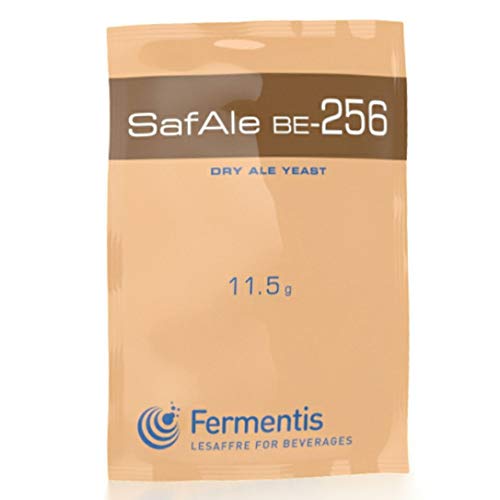
Key features
- •Belgian yeast strain for reproducing Abbey-style beers
- •Has complex flavor, estery aroma and high alcohol tolerance
- •Ferments quickly with high attenuation rate
Safbrew BE-256 Dry Brewing Yeast 11.5 grams
List Price: $17.36$15.62DEALYou Save: $1.74 (10%)
Free shippingFree Returns – 30 daysFree Order CancellationSecure Payment2–3 Days DeliveryGet It October 25, 2026In Stock (3)No marketing spamNo account requiredFulfilment by FedEx / Amazon / UPS / ShipwirePayPal / Card Buyer Protection
Customer Reviews
Reviews sourced from verified Amazon purchasers4.6
out of 5
Based on 6 reviews
5★
83%
4★
0%
3★
17%
2★
0%
1★
0%
Great product.
L. A. Rodriguez•July 11, 2017
works as intended. Great product.
Works well for Imperial stouts.
Mbrown•July 10, 2017
I use this yeast in my Russian Imperial Stout. I've made three batches so far with no problems. This yeast is designed for high gravity beers. My Starting OG is usually in the 1.090's and normally ends up in the mid to upper teens, 1.015 - 1.018.
Five Stars
rocco1972•March 4, 2017
Excellent excellent yeast strong and crazy love it
Strange flavor profile, and unimpressive results.
Brewmedic•October 4, 2016
This was an unimpressive, vaguely Belgish yeast. It had a bizarre, appley dominated profile, and a tartness that was unpleasant. I had high hopes for the yeast, but it did not deliver. There's just not many good options for dry Belgian yeasts, and really you need to get liquid to achieve high quality results. I have tried a number of the offerings from White Labs and Wyeast, but always like having the dry yeast as an option for ease of use and storage. I won't be trying it again.
One of my go-to brewing yeasts
M. Salsbury•May 24, 2016
There are many varieties of liquid and dry yeast. The advantage of liquid varieties is that they're more numerous and can produce beers that are more to a particular style. The disadvantage is that liquid yeast has a relatively short shelf life. If you buy it and don't use it for a while, many of the cells will die off and you may not have enough viable yeast cells to ferment your beer property (or at all). Dry yeast doesn't offer as many varieties, but lasts much longer and generally provides more viable cells per packet.
I brew beer on average 1-2 times per month. Often I can plan this out in advance and have a suitable liquid yeast on hand. Sometimes, plans will change and I find myself with time to do a new batch unexpectedly. That's when these dry yeast packets are great. I can whip up the wort and grab a packet of dry yeast to ferment it with.
I've done several styles with Safbrew Abbaye yeast. I've done a dubbel, a couple of tripels, a quad, a table ale, and one or two other Belgian styles. While I think I've gotten a little more of the signature Belgian flavors with some of the dry yeasts I've used, I've never gotten a bad beer from Safbrew Abbaye... so I never hesitate to use it. It works.
I've used it both as a "sprinkle on the wort while dry" yeast and rehydrated. I can't say that I see a significant difference in the beer with either approach. Both seem to work fine.
It's not necessary to do this, but I often add yeast nutrient and pure oxygen (through diffuser stone) into my wort before pitching. I feel that I get a lot better fermentation and results from this in general. Your experience may vary.
Some recommendations based on reading and experience (there is a great book on the subject from Stan Heironymous called "Brew Like a Monk" available from Amazon). First, many Belgian brewers do not control the temperature at which their beer ferments. This lets the yeast do what it will, and seems to generate more of the signature Belgian yeast flavors. Fermenting at the upper end of the yeast's temperature range (if you're going to control temperature) will do that too. Slightly underpitching the yeast (adding less than a full dose, so that it's mildly stressed as it ferments) can increase flavor production, too... just don't underpitch too much or it may not ferment completely (or could pick up a wild yeast infection or bacterial infection that sours the beer).
Bottom line: This is one of my favorite go-to yeasts for Belgian brewing. It works well, generates good beer, and lasts a long time on the shelf.
I brew beer on average 1-2 times per month. Often I can plan this out in advance and have a suitable liquid yeast on hand. Sometimes, plans will change and I find myself with time to do a new batch unexpectedly. That's when these dry yeast packets are great. I can whip up the wort and grab a packet of dry yeast to ferment it with.
I've done several styles with Safbrew Abbaye yeast. I've done a dubbel, a couple of tripels, a quad, a table ale, and one or two other Belgian styles. While I think I've gotten a little more of the signature Belgian flavors with some of the dry yeasts I've used, I've never gotten a bad beer from Safbrew Abbaye... so I never hesitate to use it. It works.
I've used it both as a "sprinkle on the wort while dry" yeast and rehydrated. I can't say that I see a significant difference in the beer with either approach. Both seem to work fine.
It's not necessary to do this, but I often add yeast nutrient and pure oxygen (through diffuser stone) into my wort before pitching. I feel that I get a lot better fermentation and results from this in general. Your experience may vary.
Some recommendations based on reading and experience (there is a great book on the subject from Stan Heironymous called "Brew Like a Monk" available from Amazon). First, many Belgian brewers do not control the temperature at which their beer ferments. This lets the yeast do what it will, and seems to generate more of the signature Belgian yeast flavors. Fermenting at the upper end of the yeast's temperature range (if you're going to control temperature) will do that too. Slightly underpitching the yeast (adding less than a full dose, so that it's mildly stressed as it ferments) can increase flavor production, too... just don't underpitch too much or it may not ferment completely (or could pick up a wild yeast infection or bacterial infection that sours the beer).
Bottom line: This is one of my favorite go-to yeasts for Belgian brewing. It works well, generates good beer, and lasts a long time on the shelf.
Page 1 of 2


