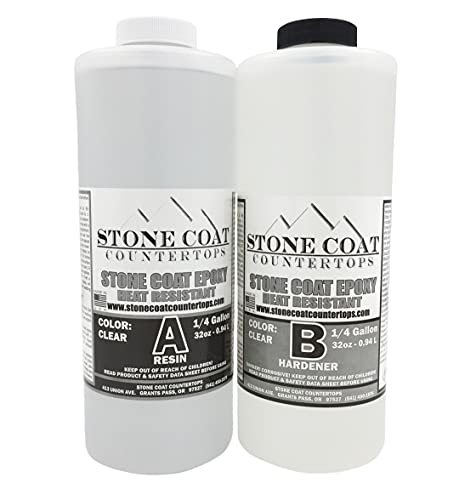
Promise Epoxy Resin Kit 1 Gallon - Crystal Clear, Self Leveling, Food Safe for Table Top, Arts, Wood Casting, Jewelry Making, Use with Mica Powder, Silicone Molds, & Alcohol Ink


Key features
- •Designed for Table Tops, Bars, Wood finishes, See-Through Encapsulations, Art work, and other applications
- •Self Leveling and High Gloss U.V. Resistant Formula
- •Produces a Tough, High Gloss, Water Resistant Coating
- •Eliminates Craters, Crawling and Fish Eyes
- •Blush Resistant
Promise Epoxy Resin Kit 1 Gallon - Crystal Clear, Self Leveling, Food Safe for Table Top, Arts, Wood Casting, Jewelry Making, Use with Mica Powder, Silicone Molds, & Alcohol Ink
List Price: $79.91$71.92DEALYou Save: $7.99 (10%)
Free shippingFree Returns – 30 daysFree Order CancellationSecure Payment2–3 Days DeliveryGet It October 29, 2026In Stock (30)No marketing spamNo account requiredFulfilment by FedEx / Amazon / UPS / ShipwirePayPal / Card Buyer Protection
Customer Reviews
Reviews sourced from verified Amazon purchasers4.4
out of 5
Based on 10 reviews
5★
60%
4★
40%
3★
0%
2★
0%
1★
0%
Easy to mix epoxy
ebchar✓ Verified Purchase•September 21, 2023
I used this epoxy for my first ever project finishing a stove top cutting board for a galley gimballed stove on my sailboar. After watching a variety of you tube tutorials, I applied 2 coats over a granite stone spray paint finish. Results were better than I expected. After a satin topcoat(different product) I repeated the same process on my galley counter top and I intend to refinish both head counters as well.
Great Value
artv4nd3l4y✓ Verified Purchase•September 6, 2023
I did a lot of pours with this gallon and only one of them had any issues. I can only speculate what happened. I noticed on the bad pour the measuring was slightly over for the epoxy so I tried to match how much off it was with hardener. The other mention is I did not use a second container to mix it a second time, instead I mixed it the full 6 minutes in the same one. I had success 5/6 times doing this, but I do recommend you use two containers and mix it 3 minutes in the first, transfer it then mix 3 for minutes in the second.
I have not had an issue since I started using a second container each time, and made sure the levels never go over. If they do you should just mix slightly more, trust me the bad batch still has not cured and the rest of it usually cures overnight. Also be careful not to mix too vigorously since that will add bubbles, and you do not want to pull the paint stick in and out since that will add bubbles.
I have not had an issue since I started using a second container each time, and made sure the levels never go over. If they do you should just mix slightly more, trust me the bad batch still has not cured and the rest of it usually cures overnight. Also be careful not to mix too vigorously since that will add bubbles, and you do not want to pull the paint stick in and out since that will add bubbles.
It CAN produce amazing results, but it has many nuances that you need to understand
Jake✓ Verified Purchase•August 13, 2023
For first time users, I would highly recommend mixing small amounts and trying little jobs. The product can produce amazing results BUT has many nuances. This is my 2nd kit (and was substantially better than the first from a different manufacturer).
I used the product in a cool garage - 55-60f so realize my comments relate to THIS TEMPERATURE. This is a big deal as the viscosity changes dramatically based on temp. If you're using this in the summer in Phoenix in your garage with the door open, this will flow like water!
Viscosity will dictate 1) how this flows and if not properly contained completely, how quickly it drips out 2) how it traps bubbles and how thick you can/should pour it 3) if it will level itself out or not. There is NO optimal temperature as you need to figure out how to use it and then decide what works best for your application.
I needed a build up to about 1" in certain areas of my project. I took 4-5 applications to get it there based on temp and bubble trap. To that, adding epoxy in layers is super easy, takes no prep other than keeping to clean and then pouring again within 24-36hrs. In fact, I routinely needed to sand edges off based on my forming method (packaging tape which worked pretty well but did allow for some dripping at times) AND POURING FRESH EPOXY OVER MATTE SANDED AREAS RENEWED it to CLEAR AGAIN. This was fantastic when I first tried this and realized I didn't need to sand down with 400-600 grit before repouring. This made reworking an area so easy.
Using wax paper or parchment paper under your project works great. It peels off easily after cured
Using a heat gun can help a lot. It eliminated a lot of bubbles that came to the surface. It also quickly warms up the epoxy which increases flow which again, can be good or bad depending on your application. When it thins out, more bubbles can also come to the surface and burst. Heat guns can be used to shape the epoxy for up to 2 hours or more after initial pour. I used it to level out the product when it won't cover an area 100%. Once I set it outside after it'd been sitting for a few hours in my garage to cure in the sun.
It actually started to move in direct sunshine at 70F after 6 hrs!!! This does not set quickly at 60f.
Curing - it is noted in the instructions and is true that it takes a LONG time to fully cure (up to 3 days I believe). If you want to sand an area, it is gummy for the first 12-24 hours making sanding difficult if you want to keep working. Heating it up will cure it more quickly as it'll move the reaction forward faster, but it's not going to happen in minutes or even a few hours.
Overall, I think this is a great product. I will use it again for sure. Just really think about how it works both chemically and it's physical traits to help you figure out how to manipulate it. Try small first and don't get in a hurry. It's taken me 2 weeks of working on my project every day to finally get it right mixing 6-10 oz at a time for several sq feet of uneven surface (root ball I'm encasing)
I used the product in a cool garage - 55-60f so realize my comments relate to THIS TEMPERATURE. This is a big deal as the viscosity changes dramatically based on temp. If you're using this in the summer in Phoenix in your garage with the door open, this will flow like water!
Viscosity will dictate 1) how this flows and if not properly contained completely, how quickly it drips out 2) how it traps bubbles and how thick you can/should pour it 3) if it will level itself out or not. There is NO optimal temperature as you need to figure out how to use it and then decide what works best for your application.
I needed a build up to about 1" in certain areas of my project. I took 4-5 applications to get it there based on temp and bubble trap. To that, adding epoxy in layers is super easy, takes no prep other than keeping to clean and then pouring again within 24-36hrs. In fact, I routinely needed to sand edges off based on my forming method (packaging tape which worked pretty well but did allow for some dripping at times) AND POURING FRESH EPOXY OVER MATTE SANDED AREAS RENEWED it to CLEAR AGAIN. This was fantastic when I first tried this and realized I didn't need to sand down with 400-600 grit before repouring. This made reworking an area so easy.
Using wax paper or parchment paper under your project works great. It peels off easily after cured
Using a heat gun can help a lot. It eliminated a lot of bubbles that came to the surface. It also quickly warms up the epoxy which increases flow which again, can be good or bad depending on your application. When it thins out, more bubbles can also come to the surface and burst. Heat guns can be used to shape the epoxy for up to 2 hours or more after initial pour. I used it to level out the product when it won't cover an area 100%. Once I set it outside after it'd been sitting for a few hours in my garage to cure in the sun.
It actually started to move in direct sunshine at 70F after 6 hrs!!! This does not set quickly at 60f.
Curing - it is noted in the instructions and is true that it takes a LONG time to fully cure (up to 3 days I believe). If you want to sand an area, it is gummy for the first 12-24 hours making sanding difficult if you want to keep working. Heating it up will cure it more quickly as it'll move the reaction forward faster, but it's not going to happen in minutes or even a few hours.
Overall, I think this is a great product. I will use it again for sure. Just really think about how it works both chemically and it's physical traits to help you figure out how to manipulate it. Try small first and don't get in a hurry. It's taken me 2 weeks of working on my project every day to finally get it right mixing 6-10 oz at a time for several sq feet of uneven surface (root ball I'm encasing)
Great stuff but understand what you are doing.
BuddhaShaolin✓ Verified Purchase•July 1, 2023
This epoxy worked pretty good for my project. I liked it but it can be difficult to use. Read on if you're bored.
I used this stuff to cover my concrete countertop that I made. It was "L" shaped with a cut out for a small bar sink and I used black pigment to get a midnight colored countertop. I used a mold for the front edge to give it a chiseled look. Poured the countertop and then I prepped it for epoxy. Using a wet grinder I polished it as best I could and then set to pour the epoxy. I made a small batch per the recommendations to put a starter coat on. I then followed up with a heavy "flow" coat. I ringed the countertop with tape to hold the flow coat in, in order to let it "set up" and then removed the tape and used a torch to heat up and "flow" the epoxy over the edge using a throw away brush. Overall it worked pretty good and my friends thought it looked awesome. Some things to note and things I would do differently. I should have polished the top first and then did an infill coat. I knocked out some very small aggregate in the concrete that left very small holes that created bubble problems for me. Not the end of the world. I plan on sanding and putting a new coat on in the future to fix my ignorance. I would also use a heated blanket to warm the concrete up. This is important. I would also use some buckets to pre warm the separate compounds up to a warm temperature for better flow. The instructions will tell you to use between a 65 to 80 degree temperature but I think getting that higher 80 would have been better. It was stiff at 65 when mixing and then the concrete "stole" the heat from the compounds and slowed the "flowing" material making it more difficult for me. Hence the heated blanket. By heating the compounds and the concrete I think I can get a better top coat. Eliminating bubbles because the epoxy will be in a longer and more fluid state at a warmer temperature. And there you have it. I hope this helps you achieve a nice finished project.
I used this stuff to cover my concrete countertop that I made. It was "L" shaped with a cut out for a small bar sink and I used black pigment to get a midnight colored countertop. I used a mold for the front edge to give it a chiseled look. Poured the countertop and then I prepped it for epoxy. Using a wet grinder I polished it as best I could and then set to pour the epoxy. I made a small batch per the recommendations to put a starter coat on. I then followed up with a heavy "flow" coat. I ringed the countertop with tape to hold the flow coat in, in order to let it "set up" and then removed the tape and used a torch to heat up and "flow" the epoxy over the edge using a throw away brush. Overall it worked pretty good and my friends thought it looked awesome. Some things to note and things I would do differently. I should have polished the top first and then did an infill coat. I knocked out some very small aggregate in the concrete that left very small holes that created bubble problems for me. Not the end of the world. I plan on sanding and putting a new coat on in the future to fix my ignorance. I would also use a heated blanket to warm the concrete up. This is important. I would also use some buckets to pre warm the separate compounds up to a warm temperature for better flow. The instructions will tell you to use between a 65 to 80 degree temperature but I think getting that higher 80 would have been better. It was stiff at 65 when mixing and then the concrete "stole" the heat from the compounds and slowed the "flowing" material making it more difficult for me. Hence the heated blanket. By heating the compounds and the concrete I think I can get a better top coat. Eliminating bubbles because the epoxy will be in a longer and more fluid state at a warmer temperature. And there you have it. I hope this helps you achieve a nice finished project.
First time user, worked well
Locoz31✓ Verified Purchase•June 25, 2023
The media could not be loaded. I've never used an epoxy pour before, this was my first time using anything like this. The wife wanted me to sand down and seal our kitchen table, it had a heavy wood grain, food and crumbs would get stuck in the crevices of the grain making it difficult to keep clean, so I figured I would sand it down, re-stain it and seal it with a nice thick epoxy coat.
I figured I was going to spend some money on this project, might as well spruce it up a bit and try to make it more special but keeping it simple. I love film photography so I got the idea to print out some Fuji instant prints and encase them in the epoxy. I sprayed them with an aerosol can of acrylic sealer to prevent yellowing and hot glued them to the table, also a bit of glitter and a few fake leaves. I had a pack of Christmas led lights and drilled holes the same diameter and hot glued them in from the bottom.
The product worked well, I followed the instructions and everything went smoothly, you just have to remember to have the surface level. It spread easily. I layed one coat, waited 6 hours then a second coat while the surface was still tacky. The results are great, I got two small bubbles but they are not noticable. Finished it off by using a handheld router and rounding over the edges.
Tip: the stirring process introduces tons of tiny bubbles, right after applying the epoxy, I used a heat gun on the surface and it makes the bubbles disappear, you can also use a hair dryer or small kitchen torch, the smaller bubbles the heat can't get will disappear as it cures.
Overall I'm very pleased with the ease of use, and the results. This is also half the price of similar stuff you can get a the hardware store.
I figured I was going to spend some money on this project, might as well spruce it up a bit and try to make it more special but keeping it simple. I love film photography so I got the idea to print out some Fuji instant prints and encase them in the epoxy. I sprayed them with an aerosol can of acrylic sealer to prevent yellowing and hot glued them to the table, also a bit of glitter and a few fake leaves. I had a pack of Christmas led lights and drilled holes the same diameter and hot glued them in from the bottom.
The product worked well, I followed the instructions and everything went smoothly, you just have to remember to have the surface level. It spread easily. I layed one coat, waited 6 hours then a second coat while the surface was still tacky. The results are great, I got two small bubbles but they are not noticable. Finished it off by using a handheld router and rounding over the edges.
Tip: the stirring process introduces tons of tiny bubbles, right after applying the epoxy, I used a heat gun on the surface and it makes the bubbles disappear, you can also use a hair dryer or small kitchen torch, the smaller bubbles the heat can't get will disappear as it cures.
Overall I'm very pleased with the ease of use, and the results. This is also half the price of similar stuff you can get a the hardware store.
Page 1 of 2