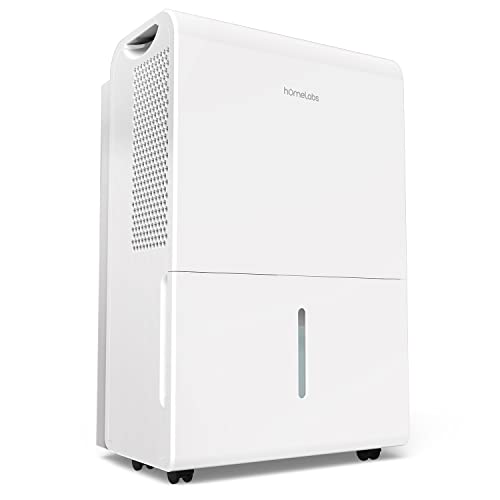
hOmeLabs 3000 Sq. ft. Energy Star Dehumidifier - Ideal for Medium to Large Rooms, Bedrooms and Home Basements - Powerful Moisture Removal and Humidity Control - 35 Pint (Previously 50 Pint)


Key features
- •3,000 SQ FT LARGE DEHUMIDIFIER - Our dehumidifier removes up to 35 pints (50 Pint 2012 DOE Standard) of water from the air per day. This moisture-removing beast is fit for any basement, cellar or large room, and it's Energy Star certified, so it quickly and effectively absorbs moisture without racking up your energy bill.
- •DESIGNED FOR THE MODERN HOME - That most dehumidifiers are clunky eyesores is news to nobody. We designed with the modern consumer in mind: a sleek clean look, convenient built-in wheels and handles, and a quiet fan that won't drown out your current binge-watching obsession. Durability is key, too, which is why we offer a 2-year warranty, plus an extra 6 months if you register on our website.
- •SUPER EASY TO USE - Dehumidifiers don't need to be complicated, so ours isn't. Adjust to your ideal moisture setting, then let it run its continuous 24-hour cycle until the tank is full, at which point it will automatically shut-off. Don't got time for that? There's also a drain hose outlet for continuous draining. The hose is not included; we recommend a ⅝" diameter garden hose with an internal threaded end, and optionally Teflon tape for extra security.
- •ELIMINATES MOISTNESS, ODOR & OTHER THINGS YOU HATE - Moist is a bad word. Our portable dehumidifier reduces odors and allergens by removing bacteria from humid air through its built-in pump compressor. It also features a Turbo mode that increases fan speed from Normal Air CFM 165 (cubic feet per minute) to High Air CFM 188 for maximum moisture removal and odor reduction.
- •IMPORTANT THINGS TO KNOW - Dehumidifiers emit heat when in use (that's how they absorb the moisture). This product won't work in the same room as an evaporative cooler, and is intended for spaces between 1,500 and 3,000 SQ FT. It measures 15.4 x 11 x 24.3 inches, has a 1.8 gallon water tank capacity, and removes up to 35 pints of moisture from the air per day.
- •Size: 15.4 x 11 x 24.3 in
- •Weight: 40 lbs
- •Rated Current: 4.7 Amps
- •Moisture Removal: 35 pints per day Air CFM Range (cubic feet per minute): 165 (Normal) to 188 (Turbo)
- •Removable Water Tank Capacity: 1.6 gallons
- •Certifications: UL & Energy Star rated
- •Includes: Washable Filter, Built-in Handles and Wheels, Drain Hose Outlet
- •Features: Touch Control Panel; Auto Restart, Shut Off, Defrost; Turbo Mode; Continuous Dehumidifying; 24-hour Timer; Custom Humidity Level from 35% to 85%
- •Best For: Spaces between 1,500 and 3,000 square feet, with room temp from 41°F to 95°F
hOmeLabs 3000 Sq. ft. Energy Star Dehumidifier - Ideal for Medium to Large Rooms, Bedrooms and Home Basements - Powerful Moisture Removal and Humidity Control - 35 Pint (Previously 50 Pint)
List Price: $301.17$271.05DEALYou Save: $30.12 (10%)
Free shippingFree Returns – 30 daysFree Order CancellationSecure Payment2–3 Days DeliveryGet It October 29, 2026In Stock (1)No marketing spamNo account requiredFulfilment by FedEx / Amazon / UPS / ShipwirePayPal / Card Buyer Protection
Customer Reviews
Reviews sourced from verified Amazon purchasers4.7
out of 5
Based on 10 reviews
5★
80%
4★
20%
3★
0%
2★
0%
1★
0%
Go Bigger
PQ✓ Verified Purchase•January 9, 2018
I bought the 30 pint first, then bought a 50 pint too. The 30 seems to run and and run. It shuts of for less than 30 seconds, then starts running again. The 50 pint does not do this. Not sure why...normal...defective....if considering a purchase I would recommend the 50 pint. I have the 30 in my small bedroom and the 50 my living area. I live in humid FL and decided this would help me sleep better, I would say it is helping. It isnt real quiet but I like the white noise for sleeping so it works for me. It does put out warm air part of the time, so I turned it facing out bedroom door because I dont need to heat up my bedroom, this seems to be working too.
I'm very happy with this dehumidifier and recommend it for anything more than a small closet
sgrams✓ Verified Purchase•January 6, 2018
I bought this to use in my small cabin (about 300 square feet floor space) heated by a LP gas wall furnace. Its been well below zero so the furnace runs much of the time creating a lot of water on the windows, so much water it was running off the windows onto the flooring. Upon receiving this unit I stayed overnight that same day and by morning there was around two gallons of water in the tank, a total of around 16 hours of use and only a very slight amount of moisture on the bottoms of a few of the windows, even though it's a small cabin it has eight windows and two doors. I have no trouble sleeping from the sound of the dehumidifier which I leave on "constant", in fact its not loud at all even on "turbo" mode. The humidity led fluctuates between 30-45 but without a sling psychrometer or another precise instrument its difficult to measure humidity. The unit can be set to automatically turn on/off when a set humidity level is reached but for my current use I haven't used that function. I bought this 6 gallon unit over the 4 gallon because it was less money at the time, I think that was just luck on my part, I would assume the 4 gallon works just as good. The dehumidifier is built to take up little floor space, using the built-in handles the unit rolls easily on hard flooring and indoor/outdoor carpeting, and the water drawer extracts and re-inserts easily.
Great choice
Mladen Bajic✓ Verified Purchase•January 4, 2018
I've had this dehumidifier for about a week now and I have to say I'm very satisfied. It's a quality product and does it's job really well. For the price range, it is a much larger and more powerful device than other options I've seen or tried. I use it in a one bedroom apartment and it does the job very quickly.
Two things I would like to see in a future model:
- Smarter humidistat; Right now there is almost no 'down time'. For example, if I set the desired relative humidity to 50, it will work until it achieves that level, and then as soon as it goes up by a bit it will start again. This means that after it automatically shuts down, it starts back within a minute. A bigger trigger threshold would be nice.
- Quiet mode; It has a turbo mode, but I'd actually prefer a quiet mode. I use it in the living room, and it does the job in 30ish minutes, but it is a bit loud even when not in turbo mode. I'd much more prefer to have it run in "quiet mode" and do the same job in an hour or two.
Two things I would like to see in a future model:
- Smarter humidistat; Right now there is almost no 'down time'. For example, if I set the desired relative humidity to 50, it will work until it achieves that level, and then as soon as it goes up by a bit it will start again. This means that after it automatically shuts down, it starts back within a minute. A bigger trigger threshold would be nice.
- Quiet mode; It has a turbo mode, but I'd actually prefer a quiet mode. I use it in the living room, and it does the job in 30ish minutes, but it is a bit loud even when not in turbo mode. I'd much more prefer to have it run in "quiet mode" and do the same job in an hour or two.
No more mold issues - it's worth it to get the more powerful unit
TechMo✓ Verified Purchase•January 2, 2018
We had been having big issues with mold in the back room of our apartment where the sun doesn't quite reach during winter days. Mold was growing on just about any porous surface - clothes, mattress, curtains, you name it - costing us a lot of money, time, and energy trying to keep up (had to throw away a lot of expensive clothes). Everything was just constantly damp and cold in that room and our landlord didn't want to do anything about it.
Well, this seems to have solved the problem. When I first plugged it in, the humidity reading was over 80%, and now it's maintaining it around 40% - removing almost 6 gallons of water every 12 hours. I'll still have to convince my landlord to check for the source of the humidity (it's an old building), but thankfully this should help prevent any more mold growth inside our apartment.
I'm really glad I went with this over one of the smaller and less powerful versions, and I would recommend anyone else on the fence to just go with the bigger one if you have the space. Since that room was always cold, the heat produced actually worked out great by saving us the cost of buying a space heater too.
Well, this seems to have solved the problem. When I first plugged it in, the humidity reading was over 80%, and now it's maintaining it around 40% - removing almost 6 gallons of water every 12 hours. I'll still have to convince my landlord to check for the source of the humidity (it's an old building), but thankfully this should help prevent any more mold growth inside our apartment.
I'm really glad I went with this over one of the smaller and less powerful versions, and I would recommend anyone else on the fence to just go with the bigger one if you have the space. Since that room was always cold, the heat produced actually worked out great by saving us the cost of buying a space heater too.
hOmeLabs vs Frigidaire 70-pint models
NS✓ Verified Purchase•November 19, 2017
70-pint Frigidaire 70-Pint Dehumidifier vs hOmeLabs dehumidifier point-by-point comparison.
Foreword: These are two of the most highly rated and popular dehumidifiers on Amazon. So I thought it may be a good idea to compare them side by side since I happen to own both. I've owned Frigidaire for about 9 month and hOmeLabs for about a week.
EPA recommends indoor relative humidity levels 30-60%. Both of these units are well capable of maintaining that. Another note is that both of these units are appliances that do electrical work, therefore, they do generate heat. If you live in a climate where you don't mind a certain amount of heating (Pacific NW, Midwest or New England), these are perfect. If you live in the South (TX, FL, etc), regular A/C unit should generally do an OK job of controlling humidity, but if you want an additional de-humidification capacity, you're much better off investing in a portable A/C unit. Most of them have a de-humidification mode and typically draw out comparable amount of moisture. The other great benefit there is that they pump the heat outside (through the window exhaust) resulting in cool dry air inside.
Back to comparison. In general, both of these units are really good and will get your humidity down. I would recommend both of them heartily, but they do differ in finer points, which is what detailed below:
QUALITY OF THE BUILD: Both of these units are solid. However, Frigidaire is physically smaller and much more polished. Somehow the plastic enclosure of hOmeLabs unit feels flimsier.
Winner: Frigidaire
EASE OF MANEUVERABILITY: Both of these units come with casters attached and are breeze to roll around. Frigidaire has a handle on top and hOmeLabs has 2 handles on the sides.
Winner: Tie
EASE OF OPERATION: It is super easy to operate both of these units. No manual needed at all. The buttons and lights are practically identical too. One difference is that Frigidaire hydrometer goes in increments of 5% whereas hOmeLabs specifies the humidity in 1% intervals.
Winner: Tie
MAINTAINING HUMIDITY LEVEL (AUTO ON/OFF): This is where both units fail in my opinion. The idea here is that you can set a humidity level to maintain and the unit will automatically turn off when it reaches it and turn back on when the humidity rises again. Nice idea. The reality is that these units collect and store water, as such the humidity around them tends to increase quite rapidly once the airflow ceases. Frigidaire deals better with this problem by extending the window for off/on. For example, if you set the desired level at 50%, it'll run until it hits 45%, and it won't turn on again until humidity rises to 55%. It usually keeps off for about 10 mins, with the overall humidity variation during this time 1-3%. hOmeLabs unit is just a fail when it comes to this feature. It turns off as soon as it goes 1% below the set level (49% in my example) and turns back on 5% over. For some reason this takes about 1-2 mins, with no measureable variation of humidity elsewhere in the area.
Winner: Frigidaire (but still fail)
COLLECTION BUCKET: Both of these units come with ~1.6gal buckets that collect water. This is where you get to practically experience quality of the build as this is the part of the dehumidifier you will interact with the most. Aside of build and plastic quality here, one big practical difference is that Frigidaire includes a splash guard so you don't have to worry about the water splashing all around while you carry it to the sink or tub. No such luck with hOmeLabs unit.
Winner: Frigidaire
WATER LEVEL INDICATOR: If you're using the bucket for water collection, this is the part of the dehumidifier you will most likely to look at the most to try to figure out whether you need to empty the bucket now or wait till later. This is where hOmeLabs stands out. It has a bright green bar that floats on top of the water to indicate its level. It also feature a much more of vertical opening for the level to show. In contract, it's practically impossible to see the level of the water in Frigidaire. There's nothing floating on top and contrary to the pictures of the product, it does not come with light blue backlight illumination.
Winner: hOmeLabs
HOSE DRAINING: I haven't used it on either unit, but both units have it. hOmeLabs has it at the back, and Frigidaire has it on the side.
Winner: Tie
TEMPERATURE: Both of these unit generate heat, as I mentioned above. This is a basic part of the refrigeration cycle. Unlike with AC or a fridge, the resulting heat is mixed with exhaust air and is pumped back into the room. Both of these units generate a comparable amount of heat based upon my totally nonscientific method of sticking my hand into the exhaust.
Winner: Tie
DIRECTION OF EXHAUST: Both of these units draw air from the back and pump it out through the side. One notable difference is that Frigidaire throws it up at about 45 degree angle, resulting in a much better air circulation and, thus, much more uniform humidity level throughout the area. hOmeLabs, shoots the air straight out, which results in the much more intense air circulation around the floor. It also ends up not mixing the air as well in the overall area: after about 1.5 hr of operation, the humidity at knee level was ~40% (down from 65%), whereas near the ceiling was 50-55% (also, down from 65%), as measure by a network on AccuRite hydrometers. Eventually it does all mix however, but be ready for this disparity. Depending on what you want, this is could be a good or bad.
Winner: Tie
SPEED OF EXHAUST: Frigidaire has 3 speeds: Hi, Med, Lo. hOmeLabs has 2: Normal and Turbo. One thing to note here is Normal for hOmeLabs is roughly equal to Lo for Frigidaire, and Turbo is roughly equal to Medium. There's no equivalent to Hi in hOmeLabs unit.
Winner: Frigidaire
NOISE LEVEL: Both of these units are very comparable. My purely subjective perception is that Frigidaire is slightly louder. Measuring with sound meter and operating at Medium speed (Frigidaire) and Turbo (hOmeLabs), Frigidaire produces ~59dB at about a foot away from the front and hOmeLabs produces ~57dB. Frigidaire is quite noticeably louder at Hi speed (~65dB).
Winner: hOmeLabs
POWER CONSUMPTION: This is where there's a big difference. All draws are measured with P3 P4400 Kill A Watt appliance. hOmeLabs draws about 1W at idle (non-operating) and 560W operating at Turbo mode. Furthermore, every time it turns on there's a momentarily spike in current such that the lights momentarily flicker on the whole circuit. In comparison Frigidaire draws 0.4W at idle and 470W operating at Medium and 485W operating at Hi. It does not have any problems with momentary spikes at unit power on.
Winner: Frigidaire
CONCLUSION: While both of this units are very good and will get the job done, considering all of the above I'm giving Frigidaire 5 stars (but really A-) and hOmeLabs 4 stars (but really B+). Hopefully you'll find this useful as you make your decision.
Foreword: These are two of the most highly rated and popular dehumidifiers on Amazon. So I thought it may be a good idea to compare them side by side since I happen to own both. I've owned Frigidaire for about 9 month and hOmeLabs for about a week.
EPA recommends indoor relative humidity levels 30-60%. Both of these units are well capable of maintaining that. Another note is that both of these units are appliances that do electrical work, therefore, they do generate heat. If you live in a climate where you don't mind a certain amount of heating (Pacific NW, Midwest or New England), these are perfect. If you live in the South (TX, FL, etc), regular A/C unit should generally do an OK job of controlling humidity, but if you want an additional de-humidification capacity, you're much better off investing in a portable A/C unit. Most of them have a de-humidification mode and typically draw out comparable amount of moisture. The other great benefit there is that they pump the heat outside (through the window exhaust) resulting in cool dry air inside.
Back to comparison. In general, both of these units are really good and will get your humidity down. I would recommend both of them heartily, but they do differ in finer points, which is what detailed below:
QUALITY OF THE BUILD: Both of these units are solid. However, Frigidaire is physically smaller and much more polished. Somehow the plastic enclosure of hOmeLabs unit feels flimsier.
Winner: Frigidaire
EASE OF MANEUVERABILITY: Both of these units come with casters attached and are breeze to roll around. Frigidaire has a handle on top and hOmeLabs has 2 handles on the sides.
Winner: Tie
EASE OF OPERATION: It is super easy to operate both of these units. No manual needed at all. The buttons and lights are practically identical too. One difference is that Frigidaire hydrometer goes in increments of 5% whereas hOmeLabs specifies the humidity in 1% intervals.
Winner: Tie
MAINTAINING HUMIDITY LEVEL (AUTO ON/OFF): This is where both units fail in my opinion. The idea here is that you can set a humidity level to maintain and the unit will automatically turn off when it reaches it and turn back on when the humidity rises again. Nice idea. The reality is that these units collect and store water, as such the humidity around them tends to increase quite rapidly once the airflow ceases. Frigidaire deals better with this problem by extending the window for off/on. For example, if you set the desired level at 50%, it'll run until it hits 45%, and it won't turn on again until humidity rises to 55%. It usually keeps off for about 10 mins, with the overall humidity variation during this time 1-3%. hOmeLabs unit is just a fail when it comes to this feature. It turns off as soon as it goes 1% below the set level (49% in my example) and turns back on 5% over. For some reason this takes about 1-2 mins, with no measureable variation of humidity elsewhere in the area.
Winner: Frigidaire (but still fail)
COLLECTION BUCKET: Both of these units come with ~1.6gal buckets that collect water. This is where you get to practically experience quality of the build as this is the part of the dehumidifier you will interact with the most. Aside of build and plastic quality here, one big practical difference is that Frigidaire includes a splash guard so you don't have to worry about the water splashing all around while you carry it to the sink or tub. No such luck with hOmeLabs unit.
Winner: Frigidaire
WATER LEVEL INDICATOR: If you're using the bucket for water collection, this is the part of the dehumidifier you will most likely to look at the most to try to figure out whether you need to empty the bucket now or wait till later. This is where hOmeLabs stands out. It has a bright green bar that floats on top of the water to indicate its level. It also feature a much more of vertical opening for the level to show. In contract, it's practically impossible to see the level of the water in Frigidaire. There's nothing floating on top and contrary to the pictures of the product, it does not come with light blue backlight illumination.
Winner: hOmeLabs
HOSE DRAINING: I haven't used it on either unit, but both units have it. hOmeLabs has it at the back, and Frigidaire has it on the side.
Winner: Tie
TEMPERATURE: Both of these unit generate heat, as I mentioned above. This is a basic part of the refrigeration cycle. Unlike with AC or a fridge, the resulting heat is mixed with exhaust air and is pumped back into the room. Both of these units generate a comparable amount of heat based upon my totally nonscientific method of sticking my hand into the exhaust.
Winner: Tie
DIRECTION OF EXHAUST: Both of these units draw air from the back and pump it out through the side. One notable difference is that Frigidaire throws it up at about 45 degree angle, resulting in a much better air circulation and, thus, much more uniform humidity level throughout the area. hOmeLabs, shoots the air straight out, which results in the much more intense air circulation around the floor. It also ends up not mixing the air as well in the overall area: after about 1.5 hr of operation, the humidity at knee level was ~40% (down from 65%), whereas near the ceiling was 50-55% (also, down from 65%), as measure by a network on AccuRite hydrometers. Eventually it does all mix however, but be ready for this disparity. Depending on what you want, this is could be a good or bad.
Winner: Tie
SPEED OF EXHAUST: Frigidaire has 3 speeds: Hi, Med, Lo. hOmeLabs has 2: Normal and Turbo. One thing to note here is Normal for hOmeLabs is roughly equal to Lo for Frigidaire, and Turbo is roughly equal to Medium. There's no equivalent to Hi in hOmeLabs unit.
Winner: Frigidaire
NOISE LEVEL: Both of these units are very comparable. My purely subjective perception is that Frigidaire is slightly louder. Measuring with sound meter and operating at Medium speed (Frigidaire) and Turbo (hOmeLabs), Frigidaire produces ~59dB at about a foot away from the front and hOmeLabs produces ~57dB. Frigidaire is quite noticeably louder at Hi speed (~65dB).
Winner: hOmeLabs
POWER CONSUMPTION: This is where there's a big difference. All draws are measured with P3 P4400 Kill A Watt appliance. hOmeLabs draws about 1W at idle (non-operating) and 560W operating at Turbo mode. Furthermore, every time it turns on there's a momentarily spike in current such that the lights momentarily flicker on the whole circuit. In comparison Frigidaire draws 0.4W at idle and 470W operating at Medium and 485W operating at Hi. It does not have any problems with momentary spikes at unit power on.
Winner: Frigidaire
CONCLUSION: While both of this units are very good and will get the job done, considering all of the above I'm giving Frigidaire 5 stars (but really A-) and hOmeLabs 4 stars (but really B+). Hopefully you'll find this useful as you make your decision.
Page 1 of 2