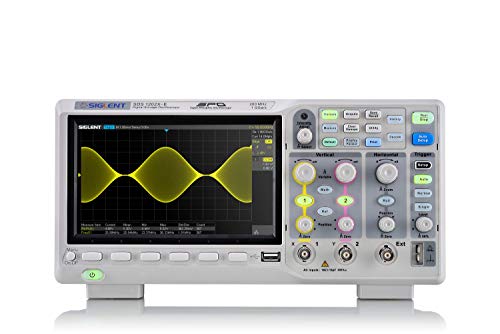
Siglent Technologies SDS1202X-E 200 mhz Digital Oscilloscope 2 Channels, Grey



Key features
- •200 mhz bandwidth
- •Real-time sampling rate up to 1 gsa/use
- •IRecord length up to 14 Mpts
- •Standard serial bus triggering and decode, supports iic, spi, uart, Rs232, can, and lin
- •1M points fft
Siglent Technologies SDS1202X-E 200 mhz Digital Oscilloscope 2 Channels, Grey
List Price: $551.45$496.31DEALYou Save: $55.14 (10%)
Free shippingFree Returns – 30 daysFree Order CancellationSecure Payment2–3 Days DeliveryGet It October 25, 2026In Stock (7)No marketing spamNo account requiredFulfilment by FedEx / Amazon / UPS / ShipwirePayPal / Card Buyer Protection
Customer Reviews
Reviews sourced from verified Amazon purchasers4.7
out of 5
Based on 10 reviews
5★
70%
4★
30%
3★
0%
2★
0%
1★
0%
A big step up from analog scopes - update after 9 months
Kitchen Panda✓ Verified Purchase•July 28, 2023
My order arrived on time and in good condition. ( Nine months later, still working fine!)
This is only my 4th oscilloscope purchase and replaces my Tektronix 2215. Maybe it's because I watched so many review videos first, but I picked up the user interface pretty quickly and have been trying out the 'scope for the last two weeks.
The main points I like are the deep memory depth (up to 14 million samples, split between two channels) and the serial decode function (handy for Arduino and Raspberry Pi and other microcontroller peripherals).
Other great features I enjoy are one-button screen captures to a USB stick, and the novelty of operating the scope remotely over the Ethernet LAN port built in. I was a little disappointed that this 2-channel model doesn't include the Web server remote display option like the 4-channel edition; you have to install a special software package to drive it over the network. Be aware of network security concerns discussed on the Web, though it's never going to trouble me on my household network.
A blunder I made when ordering was to order from .com, not .ca, so I was charged significant extra import duty even though this scope shipped from Mississauga. (Edit: Shortly after posting this, I was credited back with the difference.)
Serial decode was the main reason I chose this over other makes; I'm still trying it out and find it a little difficult to set up. You can' t use "trigger in" as a clock signal, so you can pick only one direction of an SPI bus to monitor, for example. I can't see how to invert logic levels to directly monitor RS 232 with the UART protocol; it seems hard-wired to expect logic 1 is the higher of two voltages, though you can change the threshold (if I'm just monitoring one channel I can invert probe and ground, if the source is isolated from ground). Works fine on 5 V UART signals, though.
Tried it on "oscilloscope music" but found it was easier to get a good picture on an analog scope; this is not a great limitation.
I find the screen resolution to be pleasantly high and I am glad I didn't purchase other models with fewer screen pixels.
All scopes are microphonic to some degree; I tried this one and found I had to tap it pretty hard with a pencil, especially right around the BNC connectors, to get it to false trigger. Now I that I know that, I won't do that any more.
When I was in university, getting all these features would have cost as much as a small house and taken a wall full of equipment - it's amazing what technology you can get for so little money.
After nine months on my bench I'm still very happy with this instrument.
This is only my 4th oscilloscope purchase and replaces my Tektronix 2215. Maybe it's because I watched so many review videos first, but I picked up the user interface pretty quickly and have been trying out the 'scope for the last two weeks.
The main points I like are the deep memory depth (up to 14 million samples, split between two channels) and the serial decode function (handy for Arduino and Raspberry Pi and other microcontroller peripherals).
Other great features I enjoy are one-button screen captures to a USB stick, and the novelty of operating the scope remotely over the Ethernet LAN port built in. I was a little disappointed that this 2-channel model doesn't include the Web server remote display option like the 4-channel edition; you have to install a special software package to drive it over the network. Be aware of network security concerns discussed on the Web, though it's never going to trouble me on my household network.
A blunder I made when ordering was to order from .com, not .ca, so I was charged significant extra import duty even though this scope shipped from Mississauga. (Edit: Shortly after posting this, I was credited back with the difference.)
Serial decode was the main reason I chose this over other makes; I'm still trying it out and find it a little difficult to set up. You can' t use "trigger in" as a clock signal, so you can pick only one direction of an SPI bus to monitor, for example. I can't see how to invert logic levels to directly monitor RS 232 with the UART protocol; it seems hard-wired to expect logic 1 is the higher of two voltages, though you can change the threshold (if I'm just monitoring one channel I can invert probe and ground, if the source is isolated from ground). Works fine on 5 V UART signals, though.
Tried it on "oscilloscope music" but found it was easier to get a good picture on an analog scope; this is not a great limitation.
I find the screen resolution to be pleasantly high and I am glad I didn't purchase other models with fewer screen pixels.
All scopes are microphonic to some degree; I tried this one and found I had to tap it pretty hard with a pencil, especially right around the BNC connectors, to get it to false trigger. Now I that I know that, I won't do that any more.
When I was in university, getting all these features would have cost as much as a small house and taken a wall full of equipment - it's amazing what technology you can get for so little money.
After nine months on my bench I'm still very happy with this instrument.
Nice system
James Black✓ Verified Purchase•July 20, 2023
I'm not skilled yet but it is well built and appears to be a nice unit.
Gran Producto
Greivin González Porras✓ Verified Purchase•July 17, 2023
Probado y funciona muy bien.
Good hobby scope
eric triani✓ Verified Purchase•July 13, 2023
Yes this is a Chinese scope. Every scope I've used at work is made in China.... sucks, but that's the way it is. All of my benchtop equipment are foreign made tools other than fluke. As for this scope it performs well and I use the same slightly updated version at work made by Teledyne Lecroy. It is the same scope different sticker. Certificate of calibration is even the same. So if you want a more than half priced Lecroy this will fit your needs.
Probing questions
Milburn Stone✓ Verified Purchase•June 3, 2023
Item was received on time, well boxed, functioned without problems. It will indeed display 200+ MHz signals. I have a "hobby repair shop" and got the scope about a year ago, during which time I have used it for a wide array of audio, digital, and radio testing. For troubleshooting, a digital scope is great, because on the "measure" function it will tell you more about a point in a circuit than any other tool I can name. After a year, everything still seems functional, and it is certainly a lot of scope for the money.
Of course, after (ahem) quite a few years of using oscilloscopes, I am still somewhat used to the old analog variety. People in my position might want to be aware that there are differences, a learning curve, and a few shortcomings to a digital scope. They have many buttons, menus, and options to deal with and it sometimes seems excessive for what you are trying to do. One of my pet peeves is that you can't "fine tune" the horizontal frequency as you did on the old scopes, it goes in steps that always seem a little too high or low. That's not a defect, just a feature of digital. But, coupled with the sort of...meh...triggering, some analog signals can be hard to lock in and you often have to settle for a jumpy display. This can even happen on a simple sine wave, not just complex signals. I don't expect perfection for under $400, but the fact is that it doesn't trigger as well as the old Tek 453 I paid $50 for, made in the early 70s. Otherwise, of course, it outperforms the heck out of it. So, overall I'm pretty happy with the performance, and it's a good bang for the buck.
The supplied probes, however, I'm not happy with at all. They will pass 200 MHz but are cheap junk, and mine arrived without the "clip hooks" that allow you to leave them attached to a circuit. If they were left out by mistake, it's bad QC. If they were left out to save money, they are cheapskates. I probably should have complained about it early on. My advice is, plan to get a pair of decent probes with all the accessories to get maximum benefit from this scope.
Of course, after (ahem) quite a few years of using oscilloscopes, I am still somewhat used to the old analog variety. People in my position might want to be aware that there are differences, a learning curve, and a few shortcomings to a digital scope. They have many buttons, menus, and options to deal with and it sometimes seems excessive for what you are trying to do. One of my pet peeves is that you can't "fine tune" the horizontal frequency as you did on the old scopes, it goes in steps that always seem a little too high or low. That's not a defect, just a feature of digital. But, coupled with the sort of...meh...triggering, some analog signals can be hard to lock in and you often have to settle for a jumpy display. This can even happen on a simple sine wave, not just complex signals. I don't expect perfection for under $400, but the fact is that it doesn't trigger as well as the old Tek 453 I paid $50 for, made in the early 70s. Otherwise, of course, it outperforms the heck out of it. So, overall I'm pretty happy with the performance, and it's a good bang for the buck.
The supplied probes, however, I'm not happy with at all. They will pass 200 MHz but are cheap junk, and mine arrived without the "clip hooks" that allow you to leave them attached to a circuit. If they were left out by mistake, it's bad QC. If they were left out to save money, they are cheapskates. I probably should have complained about it early on. My advice is, plan to get a pair of decent probes with all the accessories to get maximum benefit from this scope.
Page 1 of 2