Celestron Signature Series Moon by Robert Reeves Features A Superb Moon Astronomical Telescope, Black (22016)



Key features
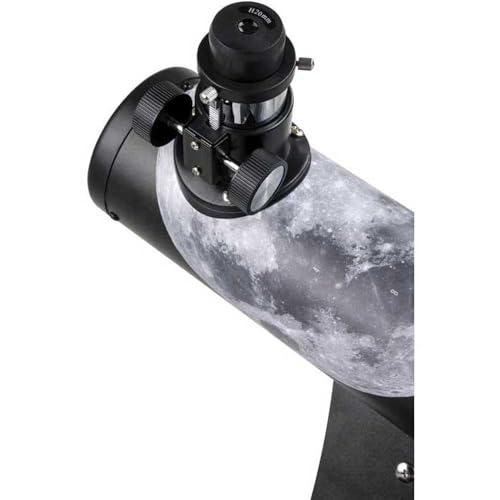
- •Celestron's beloved entry-level telescope gets a stunning new look! The Signature Series FirstScope features a superb Moon image by astroimager and Team Celestron member Robert Reeves
- •High-quality tabletop Dobsonian with a 76mm reflector optical tube
- •FirstScope artwork highlights key features on the lunar surface like craters and maria that you can explore for yourself with the telescope
- •Simple, portable design that's easy to use for astronomers of all levels-a great choice for kids and families
- •Also includes a free PDF download of the Lunar Landscapes ebook by Robert Reeves
BrandCelestron
CategoryRefractors
SizeSignature Series - Moon FirstScope Telescope
ColorBlack
Warranty2 year limited warranty
Celestron Signature Series Moon by Robert Reeves Features A Superb Moon Astronomical Telescope, Black (22016)
List Price: $113.41$102.07DEALYou Save: $11.34 (10%)
Free shippingFree Returns – 30 daysFree Order CancellationSecure Payment2–3 Days DeliveryGet It October 24, 2026In Stock (30)No marketing spamNo account requiredFulfilment by FedEx / Amazon / UPS / ShipwirePayPal / Card Buyer Protection
Customer Reviews
Reviews sourced from verified Amazon purchasers4.3
out of 5
Based on 10 reviews
5★
60%
4★
40%
3★
0%
2★
0%
1★
0%
Excellent! Secondary mirror issues.
Gabor K.✓ Verified Purchase•August 11, 2023
I ordered two Celestron 76mm FirstScope Telescopes (item # 21024) from Amazon (used, like new). Both had the secondary mirror (diagonal) glued on askew. You can fix this by simply prying the secondary mirror off its 45 degree holder. First, remove the front cap and the eyepiece. Do the following with the telescope tube tightened and its front end pointing slightly downward. This way, if you drop the secondary mirror assembly, it will not fall into the tube and onto the primary mirror. Don't touch the aluminized mirror surface as you proceed. Remove the secondary mirror assembly by removing the single Phillips screw holding its stem in place. This screw is located at the front base of the focuser. The secondary mirror itself is held in place by a piece of two sided foam tape. Gently insert and twist a non serrated butter knife blade (or such) between the secondary mirror and the 45 degree slanted holder surface. Slowly advance until the mirror is free. This maneuver should lift only the mirror off the two sided tape, and leave the tape itself attached to the holder surface. Now you can re-attach the ellipse shaped secondary mirror correctly centered, a bit offset towards the primary mirror, long axis front to back, short axis side-to-side. The beveled edge closest to the front end faces upward, while the beveled edge closest to the primary mirror faces downward. You can use a black permanent marker (Sharpie) to paint the secondary mirror edges, to reduce light reflection. Keep a fine line between the painted edge and the aluminized mirror surface. If you end up with permanent marker stain or a fingerprint on the mirror surface, use rubbing alcohol on a clean, soft cotton rag (free of oil, lint and abrasive) to gently wipe it off, moving only towards the edge. Then use your own breath to fog the mirror before gently wiping off the alcohol residue. Less is more, you don't want to put scratches on the aluminized surface, as they degrade the optical performance. Re-install the diagonal assembly. Roughly collimate it indoors with ambient light around (never point the telescope towards the sun!), buy turning the stem (before completely tightening its screw) and by using the three Phillips screws on the diagonal base to fine tune the up-down and side-to-side position of the secondary mirror. No adjustment of the primary mirror is readily available on this model. The contest is to have a perfectly centered and round secondary mirror reflection with your eye's reflected image in the center, inside the larger, perfectly centered and round primary mirror reflection, as you look down the empty focuser (eyepiece removed, focuser pushed in as far as it goes), holding your eye close (don't scratch your eye!). At night you can center a moderately bright star (Polaris is ideal since it won't move out of the field) using the 4mm eyepiece. Adjust the focuser first to be inside, then outside of focus. If the telescope is properly collimated, you should see a perfectly centered, round set of diffraction rings with the small, round secondary mirror shadow in the center (ignore the secondary mirror assembly stem shadow). For more details look up: "collimation of newtonian telescopes", and "offsetting the secondary mirror".
Wonderful telescope for a beginner
Crystal Hunter✓ Verified Purchase•July 6, 2023
I purchased this telescope for my 10 year old son for Christmas this year based SOLELY on customer reviews. This was the fourth telescope I had purchased for him after all three previous Celestron telescopes broke within a day. Let me make one thing clear, I have no idea what to look for in a telescope, so I had to trust the customers on this one.
I was not going to go with Celestron again after our previous failures. The first three I purchased came from very prominent retail chains, and I did not order them online. I thought that if I was purchasing a telescope, I would need to go to the stores and check them out first. That is NOT how that really works.
With that being said, all three previous versions of the Celestron failed miserably. The legs broke off of the scope and when my son tried to look into the scope, the entire thing just fell on the ground. For a while I told my son that we were not going to buy anymore telescopes. I told him if he wanted to look at the stars, he would just have to use his eyeballs.
That sounds like a terrible mom. Therefore I began looking this year and saw the Celestron FirstScope. My first thought was "not another Celestron". I noted that it had very HIGH customer feedback, but even still my disgust for Celestron kept me from buying until two weeks before Christmas.
Finally it came and I couldn't wait to take it out and see if it was going to fall apart in my hands too. After all, it is FREE SUPER SAVER SHIPPING and if it broke... well... it would just go in the trash! So I went out that night after my children were in the bed and searched for the moon. Wow... I could actually see the craters of the moon without having the lens (or whatever that is) fall off in my hand. I felt like I had found a needle in a haystack!
So, my son got the FirstScope for Christmas and it has not broken yet. Thank Heaven because no matter how much I love my children, I was tired of weeding through telescopes to find a deceint beginner scope for my son.
With all that said, if you want a beginner scope buy this one. It is not made for anything more than that. Maybe one day when my son works for NASA we will have the task of searching for a scope where we can view Pluto with our eyes closed. Until then, this one WORKS!
I was not going to go with Celestron again after our previous failures. The first three I purchased came from very prominent retail chains, and I did not order them online. I thought that if I was purchasing a telescope, I would need to go to the stores and check them out first. That is NOT how that really works.
With that being said, all three previous versions of the Celestron failed miserably. The legs broke off of the scope and when my son tried to look into the scope, the entire thing just fell on the ground. For a while I told my son that we were not going to buy anymore telescopes. I told him if he wanted to look at the stars, he would just have to use his eyeballs.
That sounds like a terrible mom. Therefore I began looking this year and saw the Celestron FirstScope. My first thought was "not another Celestron". I noted that it had very HIGH customer feedback, but even still my disgust for Celestron kept me from buying until two weeks before Christmas.
Finally it came and I couldn't wait to take it out and see if it was going to fall apart in my hands too. After all, it is FREE SUPER SAVER SHIPPING and if it broke... well... it would just go in the trash! So I went out that night after my children were in the bed and searched for the moon. Wow... I could actually see the craters of the moon without having the lens (or whatever that is) fall off in my hand. I felt like I had found a needle in a haystack!
So, my son got the FirstScope for Christmas and it has not broken yet. Thank Heaven because no matter how much I love my children, I was tired of weeding through telescopes to find a deceint beginner scope for my son.
With all that said, if you want a beginner scope buy this one. It is not made for anything more than that. Maybe one day when my son works for NASA we will have the task of searching for a scope where we can view Pluto with our eyes closed. Until then, this one WORKS!
A fantastic first scope to intrigue young minds!
Christopher Anderson✓ Verified Purchase•June 27, 2023
OK. First off. This is not a Takahashi Sky 90. It isn't an Obsession UC22" Dobsonian. I own both of the aforementioned scopes. Plus a Tak FSQ106EDXIII. I am an amateur astronomer. Heck, I even have my own domed observatory in the back yard. So I didn't expect this little scope to afford views like I was accustomed to.
I bought the scope for my neighbors 8 year old son. But before I passed it along to him, I decided to try it out on the Heavens. Out of the box I was far from impressed. Sure, it is only a 3" reflector. But the optic problems it was plagued by were enormous. The eyepieces are crap, sad to say. But worst of all, the optic train is even worse, at least my model.
Most reflectors have the ability to collimate the optics. That is, align everything with respect to the eyepiece. This scope does not. No way to move the primary mirror, and only "fake" alignment screws on the secondary mirror. On top of all this, the secondary mirror (the mirror that reflects the image from the primary to the eyepiece) was installed crooked. This definitely didn't help any.
First thing I did was remove the secondary (small) mirror from the focuser and re-glue it so that it was lined up better. This was done by "eyeballing" but it made a vast difference in the view. Easy to do with some contact cement. This is about all you can do to help the optics in this little scope. This may have just been my scope, but I didn't have time to send it back.
Once I made this change, I was impressed. Remember, you're not going to get Hubble views out of this scope. Even after the fix there was a lot of astigmatism and coma in the eyepiece. Stars showed lots of pincushion artifacts just outside of the center field. But when I trained the scope on the Orion Nebula, there it was! With a bit of averted vision (not looking directly at the object, but sort of off to one side) I was treated with the classic nebulosity. The Pleiades were brilliant, and I was easily able to make out the shape of the Andromeda Galaxy. Jupiter's four big moons were obvious, though the cloud bands took some imagination (but there was light thin clouds disturbing my view from Earth). The Moon was very impressive. Even when I changed to the 4mm ocular, the Moon showed lots of detail that should make any kid bubble with joy. The craters were very impressive. Though I did not see myself, I am sure the rings of Saturn would be easily visible.
I remember, as a ten year old, looking at Saturn with my brothers 60mm Sears refractor. I was enthralled and it set the stage for a life long desire to explore the Heavens. Since then I've owned an Edmund Astroscan and 6" reflector, two Celestron C8's, a C11, a home made 13.1" Dobsonian reflector, and my current Takahashi refractors, and my new 22" Obsession scope. All of this because of my first back yard views with a Sears piece of junk. This scope is far better in my opinion. Remember, you're not necessarily getting a top notch telescope. The build overall is impressive however. A finderscope would be nice, but I had pretty good luck just sighting down the tube and hunting. But a scope like this might just be the one thing to spark curiosity in a young mind. And there just isn't much of that going around these days.
If you have a youngster that you think might like an introduction to the night sky, this is the perfect little gem. Sure, far from perfect, and might even need a bit of tweaking if you are brave enough. But even out of the box it gives descent views of the brighter celestial objects, plus the Moon and bigger planets. And it is easy to carry and a breeze to set up. Go for it!
I bought the scope for my neighbors 8 year old son. But before I passed it along to him, I decided to try it out on the Heavens. Out of the box I was far from impressed. Sure, it is only a 3" reflector. But the optic problems it was plagued by were enormous. The eyepieces are crap, sad to say. But worst of all, the optic train is even worse, at least my model.
Most reflectors have the ability to collimate the optics. That is, align everything with respect to the eyepiece. This scope does not. No way to move the primary mirror, and only "fake" alignment screws on the secondary mirror. On top of all this, the secondary mirror (the mirror that reflects the image from the primary to the eyepiece) was installed crooked. This definitely didn't help any.
First thing I did was remove the secondary (small) mirror from the focuser and re-glue it so that it was lined up better. This was done by "eyeballing" but it made a vast difference in the view. Easy to do with some contact cement. This is about all you can do to help the optics in this little scope. This may have just been my scope, but I didn't have time to send it back.
Once I made this change, I was impressed. Remember, you're not going to get Hubble views out of this scope. Even after the fix there was a lot of astigmatism and coma in the eyepiece. Stars showed lots of pincushion artifacts just outside of the center field. But when I trained the scope on the Orion Nebula, there it was! With a bit of averted vision (not looking directly at the object, but sort of off to one side) I was treated with the classic nebulosity. The Pleiades were brilliant, and I was easily able to make out the shape of the Andromeda Galaxy. Jupiter's four big moons were obvious, though the cloud bands took some imagination (but there was light thin clouds disturbing my view from Earth). The Moon was very impressive. Even when I changed to the 4mm ocular, the Moon showed lots of detail that should make any kid bubble with joy. The craters were very impressive. Though I did not see myself, I am sure the rings of Saturn would be easily visible.
I remember, as a ten year old, looking at Saturn with my brothers 60mm Sears refractor. I was enthralled and it set the stage for a life long desire to explore the Heavens. Since then I've owned an Edmund Astroscan and 6" reflector, two Celestron C8's, a C11, a home made 13.1" Dobsonian reflector, and my current Takahashi refractors, and my new 22" Obsession scope. All of this because of my first back yard views with a Sears piece of junk. This scope is far better in my opinion. Remember, you're not necessarily getting a top notch telescope. The build overall is impressive however. A finderscope would be nice, but I had pretty good luck just sighting down the tube and hunting. But a scope like this might just be the one thing to spark curiosity in a young mind. And there just isn't much of that going around these days.
If you have a youngster that you think might like an introduction to the night sky, this is the perfect little gem. Sure, far from perfect, and might even need a bit of tweaking if you are brave enough. But even out of the box it gives descent views of the brighter celestial objects, plus the Moon and bigger planets. And it is easy to carry and a breeze to set up. Go for it!
Great way to get your foot in the door of astronomy!
Lisa Bee✓ Verified Purchase•June 27, 2023
I am an absolute beginner at using a telescope. Previously I could name a few constellations by sight but have never had or used a telescope of any kind. I knew I would like looking at the night sky in more detail, but wasn't sure if I would like it enough to justify spending hundreds of dollars on equipment. This was a great way to get in and try it for very little money! This telescope is very inexpensive, but because there are absolutely no frills here they put all the money into constructing the basics as well as they could at this price point. I actually like the fact that I have to do everything manually, because I am learning how everything works. Something else that I really like here is that the eyepieces are a standard size (1.25"), and any additional eyepieces I buy can move up with me when I am ready to upgrade.
On my first time out, with only the included eyepieces, I was able to see the Orion Nebula (M42), Jupiter with three of the four Galilean moons, and The Pleiades (M45)! By my second time out I had acquired a 2x Barlow lens (Celestron), and enjoyed views of the crescent moon and Jupiter with all four of the Galilean Moons! I have also ordered some additional eyepieces and will update when those come in. I have read in other reviews that better quality eyepieces can improve the view quite a bit, and I will post whether or not that is true for me once I have a little more experience with the telescope.
I think the FirstScope is a great buy for someone to get started in astronomy, as long as you understand up front what you are getting. You're not going to see images like the Hubble photographs! Jupiter's moons are teeny tiny pindots, but when you realize what they are it will take your breath away! Jupiter is just a larger bright dot, although the first time out I was able to make out some faint color bands. Nebulae are just stars with a little blur of fog around them, but if you've never seen that "fog" before it is a wonder to behold.
The FirstScope is so small it's very easy to take it out to the back yard for 10 minutes before bed. This greatly increases the chances of it actually being used on a regular basis, and that is something I will keep in mind as I upgrade in the future. A bigger telescope is great, but one so big that it stays in the closet is worthless. I am thoroughly enjoying this telescope, and I will have fun looking for everything it will possibly let me see while I save up for a bigger one. I'm hooked!
On my first time out, with only the included eyepieces, I was able to see the Orion Nebula (M42), Jupiter with three of the four Galilean moons, and The Pleiades (M45)! By my second time out I had acquired a 2x Barlow lens (Celestron), and enjoyed views of the crescent moon and Jupiter with all four of the Galilean Moons! I have also ordered some additional eyepieces and will update when those come in. I have read in other reviews that better quality eyepieces can improve the view quite a bit, and I will post whether or not that is true for me once I have a little more experience with the telescope.
I think the FirstScope is a great buy for someone to get started in astronomy, as long as you understand up front what you are getting. You're not going to see images like the Hubble photographs! Jupiter's moons are teeny tiny pindots, but when you realize what they are it will take your breath away! Jupiter is just a larger bright dot, although the first time out I was able to make out some faint color bands. Nebulae are just stars with a little blur of fog around them, but if you've never seen that "fog" before it is a wonder to behold.
The FirstScope is so small it's very easy to take it out to the back yard for 10 minutes before bed. This greatly increases the chances of it actually being used on a regular basis, and that is something I will keep in mind as I upgrade in the future. A bigger telescope is great, but one so big that it stays in the closet is worthless. I am thoroughly enjoying this telescope, and I will have fun looking for everything it will possibly let me see while I save up for a bigger one. I'm hooked!
Really small, but a fun scope
TooMuchStuff✓ Verified Purchase•June 11, 2023
Just to be clear, this is pretty much for kids. It's small and not very technical. Know that, and the price is reasonable and it's a great little telescope. It's easily transported & used on a tabletop, tailgate - and cheap enough not to worry about it getting broken or stolen.
Page 1 of 2