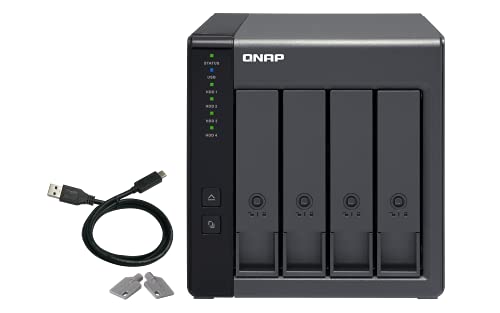
QNAP TR-004 4 Bay USB Type-C Direct Attached Storage (DAS) with hardware RAID (Diskless)


Key features
- •High-speed direct-attached storage Device via USB Type-C for Windows, macOS and Linux
- •Use the TR-004 As external storage for NAS backup
- •Expand the capacity of your QNAP NAS
- •Supports up to 4 2. 5/3. 5 inch SATA drives at Gbps
- •Hardware RAID supports RAID 0, 1, 5, JBOD, and individual disks
- •Lockable drive Bays
QNAP TR-004 4 Bay USB Type-C Direct Attached Storage (DAS) with hardware RAID (Diskless)
List Price: $318.65$286.79DEALYou Save: $31.86 (10%)
Free shippingFree Returns – 30 daysFree Order CancellationSecure Payment2–3 Days DeliveryGet It October 24, 2026In Stock (21)No marketing spamNo account requiredFulfilment by FedEx / Amazon / UPS / ShipwirePayPal / Card Buyer Protection
Customer Reviews
Reviews sourced from verified Amazon purchasers4.4
out of 5
Based on 10 reviews
5★
60%
4★
40%
3★
0%
2★
0%
1★
0%
The Best 4 bay Raid Unit at this price point...
Bukko✓ Verified Purchase•December 9, 2023
Works as advertised. Qnap raid management software is excellent and easy to use. Unit worked perfectly. Unit is a little large compared to others and the plastic case makes if feel a little cheap but hey.... it's a low cost home solution and the best one at this price point IMO. I was getting good transfer rates (USB 3) as well but decided to upgrade my entire system to a thunderbolt rig so I returned this and will be purchasing a thunderbolt enclosure in the near future (which is pretty much double the cost.) I work with music and video as a hobby and want to have a much faster raid enclosure. If you need a good easy to use raid back up for home use this IMO is the best one out there.
Great affordable RAID enclosure!
Sean✓ Verified Purchase•November 29, 2023
Bottom line: I recommend the TR-004 with drives I mention below (or others on its list of supported drives) in one of the 3 modes: Individual, RAID 1/0, or RAID 5. Please keep in mind that RAID is not a substitute for a good backup. You should always keep a backup copy of anything important on a separate device! If you want to know more details, read on.
As an IT professional, I appreciate the benefits of using RAID. It provides faster performance than any one of the drives in the array. How much so depends on the type of array you configure. Configured properly (more on that later*), it provides safety against data loss when a drive fails, and that's always a matter of when, not if. My only complaint with the TR-004 is that the trays that the drives go in are a little flimsy.
The down side of RAID is often cost - it's not terribly cheap. Building a home network storage server using it can be expensive because motherboards that support it cost more that those that don't. Using a dedicated controller card is often even more so. I could never convince my better half to let me build a file server with enough storage to meet our needs using RAID because of this - until I found the QNAP TR-004.
The TR-004 is a great price when you consider that it has the RAID controller built in. It's an even better value because it supports many of the various popular levels of RAID (more on that later*). Add the fact that you don't have to fill every drive slot to use it, and it's a high value for the money. I put it on a tiny PC also available here on Amazon.com for under $200, and **boom** - instant dedicated file server for home!
You need to populate the TR-004 with drives, it comes without any. Get good NAS or other server grade drives. I recommend WD RED, WD PURPLE, or WD GOLD from Western Digital, or Seagate's IronWolf or SkyHawk lines. These drives are specifically designed for use in RAID arrays for Network-Attached Storage, also called NAS (WD RED & IronWolf), security camera systems (WD PURPLE & SkyHawk) or other servers (WD GOLD & IronWolf). They are made for very high reliability. At the very least, use either the Western Digital WD BLACK or high-end Seagate Barracuda drives. Anything cheaper, and you'll end up having problems with your RAID array loosing sync.
"What's that mean?" you ask? In simple terms, all the drives in a RAID array look, to the computer, like a single giant drive. Data gets spread across the drives in chunks. This is how you get the speed performance increase from RAID. While one drive is busy handling one thing, others are frequently able to handle other things. It's also how you get protection against data loss if a drive fails, when you are using a level of RAID that provides this.
* Here's the "more on that later" I promised above. RAID comes in different "levels", referred to as RAID x, where x is a number. All RAID arrays are made up of multiple drives. The TR-004 supports 6 different modes, though I only recommend 4 of them. These modes are:
Individual - Every drive in the TR-004 is visible to the computer as a separate drive letter (ie: e:, f:, etc). The drives can all be different models, brands, and sizes. I can recommend this mode, but know that data on each drive will be lost if that drive fails and the data on it isn't backed up elsewhere. If you are going to use this mode, you can use any drive the TR-004 will support, not just the ones I mentioned above.
JOBD - This stands for Just One Big Drive. All the space of all the drives is available to the computer as one giant drive. It requires at least 2 drives, but supports as many as the controller can handle, 4 in the case of this enclosure. This mode allows the use of different, models, brands, and even sizes of drives. It works by spreading the data within files across all the drives in the array (as do all the RAID levels in one way or another). DANGER: If any drive fails, all data on all drives in this mode is lost, unless it's backed up elsewhere. I do not recommend this mode.
RAID 0 - This is technically the first RAID mode. It's the same as JOBD, with the notable exception that all the drives in the array should be identical, the same exact model number, the same brand, the same size. The only difference their should be is the drives' serial numbers. This requirement is continued to all the rest of the RAID levels. RAID 0 is fast, however it has the same danger as JOBD, so I do not recommend this mode, either.
RAID 1/0 - This mode is also know as RAID 10. It requires an even number of identical drives, and a minimum of 4 (all bays filled in the TR-004). It copies 2 RAID 0 arrays between each other. In larger arrays, an even number of identical drives is required for RAID 1/0. This is the fastest of the RAID levels, but it has the drawback of only making half the total space of all the drives combined to the computer (ie: 4 drives of 3 TB each would look like 6 TB to the computer [4 drives * 3 TB = 12 TB, 12 TB / 2 = 6 TB]). Although I do not recommend RAID 0, the fact that there are 2 identical copies of a RAID 0 array, any single drive can fail without loosing data. Therefore, I do recommend RAID 1/0 for speed and data redundancy.
RAID 5 - This mode is a good compromise between between the speed of RAID 1/0 and the desire to get more storage space from the drives in the array. RAID 5 also requires at identical drives. It needs a minimum of 3, but can go up from there to however many drives the controller can support, in single drive increments. It achieves redundancy, by spreading data across "stripes" that are duplicated on the multiple drives. At it's absolute simplest, it places 2 copies of each stripe in the array. For example, lets say there are 3 stripes stored in a 3-drive array. We'll call the stripes A, B, & C. We'll call the drives 1, 2, & 3. RAID 5 stores a copy of A on 1 & 2, a copy of B on 2 & 3, and a copy of C on 3 & 1. By doing this, any 1 drive can fail but there is still at least 1 usable copy of all stripes in the array. Replace the failed drive, and the controller will copy the necessary stripes to the new drive. The amount of storage available to the computer is the combined total of the storage on all but one of drives in the array (ie 4 drives of 3 TB each would look like 9 TB to the computer [4 drives -1 = 3 drives, 3 drives * 3 TB = 9 TB]). RAID 5 is not as fast as RAID1/0, but it gives more storage from the same drives, so I do recommend it in particular for home servers, where cost is a bigger consideration that many businesses.
SFOTWARE CONTROL: When the TR-004 is in this mode, special software must be downloaded and installed on the computer it is attached to. The mode it will run in will then be controlled by the user from within this software. I do not recommend this mode because if you are going to move the TR-004 from one computer to another, you may accidentally loose everything stored on it. You never know when you may have to move it to another computer - say if the one it's on dies?
As an IT professional, I appreciate the benefits of using RAID. It provides faster performance than any one of the drives in the array. How much so depends on the type of array you configure. Configured properly (more on that later*), it provides safety against data loss when a drive fails, and that's always a matter of when, not if. My only complaint with the TR-004 is that the trays that the drives go in are a little flimsy.
The down side of RAID is often cost - it's not terribly cheap. Building a home network storage server using it can be expensive because motherboards that support it cost more that those that don't. Using a dedicated controller card is often even more so. I could never convince my better half to let me build a file server with enough storage to meet our needs using RAID because of this - until I found the QNAP TR-004.
The TR-004 is a great price when you consider that it has the RAID controller built in. It's an even better value because it supports many of the various popular levels of RAID (more on that later*). Add the fact that you don't have to fill every drive slot to use it, and it's a high value for the money. I put it on a tiny PC also available here on Amazon.com for under $200, and **boom** - instant dedicated file server for home!
You need to populate the TR-004 with drives, it comes without any. Get good NAS or other server grade drives. I recommend WD RED, WD PURPLE, or WD GOLD from Western Digital, or Seagate's IronWolf or SkyHawk lines. These drives are specifically designed for use in RAID arrays for Network-Attached Storage, also called NAS (WD RED & IronWolf), security camera systems (WD PURPLE & SkyHawk) or other servers (WD GOLD & IronWolf). They are made for very high reliability. At the very least, use either the Western Digital WD BLACK or high-end Seagate Barracuda drives. Anything cheaper, and you'll end up having problems with your RAID array loosing sync.
"What's that mean?" you ask? In simple terms, all the drives in a RAID array look, to the computer, like a single giant drive. Data gets spread across the drives in chunks. This is how you get the speed performance increase from RAID. While one drive is busy handling one thing, others are frequently able to handle other things. It's also how you get protection against data loss if a drive fails, when you are using a level of RAID that provides this.
* Here's the "more on that later" I promised above. RAID comes in different "levels", referred to as RAID x, where x is a number. All RAID arrays are made up of multiple drives. The TR-004 supports 6 different modes, though I only recommend 4 of them. These modes are:
Individual - Every drive in the TR-004 is visible to the computer as a separate drive letter (ie: e:, f:, etc). The drives can all be different models, brands, and sizes. I can recommend this mode, but know that data on each drive will be lost if that drive fails and the data on it isn't backed up elsewhere. If you are going to use this mode, you can use any drive the TR-004 will support, not just the ones I mentioned above.
JOBD - This stands for Just One Big Drive. All the space of all the drives is available to the computer as one giant drive. It requires at least 2 drives, but supports as many as the controller can handle, 4 in the case of this enclosure. This mode allows the use of different, models, brands, and even sizes of drives. It works by spreading the data within files across all the drives in the array (as do all the RAID levels in one way or another). DANGER: If any drive fails, all data on all drives in this mode is lost, unless it's backed up elsewhere. I do not recommend this mode.
RAID 0 - This is technically the first RAID mode. It's the same as JOBD, with the notable exception that all the drives in the array should be identical, the same exact model number, the same brand, the same size. The only difference their should be is the drives' serial numbers. This requirement is continued to all the rest of the RAID levels. RAID 0 is fast, however it has the same danger as JOBD, so I do not recommend this mode, either.
RAID 1/0 - This mode is also know as RAID 10. It requires an even number of identical drives, and a minimum of 4 (all bays filled in the TR-004). It copies 2 RAID 0 arrays between each other. In larger arrays, an even number of identical drives is required for RAID 1/0. This is the fastest of the RAID levels, but it has the drawback of only making half the total space of all the drives combined to the computer (ie: 4 drives of 3 TB each would look like 6 TB to the computer [4 drives * 3 TB = 12 TB, 12 TB / 2 = 6 TB]). Although I do not recommend RAID 0, the fact that there are 2 identical copies of a RAID 0 array, any single drive can fail without loosing data. Therefore, I do recommend RAID 1/0 for speed and data redundancy.
RAID 5 - This mode is a good compromise between between the speed of RAID 1/0 and the desire to get more storage space from the drives in the array. RAID 5 also requires at identical drives. It needs a minimum of 3, but can go up from there to however many drives the controller can support, in single drive increments. It achieves redundancy, by spreading data across "stripes" that are duplicated on the multiple drives. At it's absolute simplest, it places 2 copies of each stripe in the array. For example, lets say there are 3 stripes stored in a 3-drive array. We'll call the stripes A, B, & C. We'll call the drives 1, 2, & 3. RAID 5 stores a copy of A on 1 & 2, a copy of B on 2 & 3, and a copy of C on 3 & 1. By doing this, any 1 drive can fail but there is still at least 1 usable copy of all stripes in the array. Replace the failed drive, and the controller will copy the necessary stripes to the new drive. The amount of storage available to the computer is the combined total of the storage on all but one of drives in the array (ie 4 drives of 3 TB each would look like 9 TB to the computer [4 drives -1 = 3 drives, 3 drives * 3 TB = 9 TB]). RAID 5 is not as fast as RAID1/0, but it gives more storage from the same drives, so I do recommend it in particular for home servers, where cost is a bigger consideration that many businesses.
SFOTWARE CONTROL: When the TR-004 is in this mode, special software must be downloaded and installed on the computer it is attached to. The mode it will run in will then be controlled by the user from within this software. I do not recommend this mode because if you are going to move the TR-004 from one computer to another, you may accidentally loose everything stored on it. You never know when you may have to move it to another computer - say if the one it's on dies?
future exspansion project
Brianna W.✓ Verified Purchase•October 24, 2023
While I have not put any drives into this unit YET, I did go ahead and set it up in my server case. I have had experience with QNAP products in the past, this is going to be an extension of my current server.
I did have a small issue in the past (not mechanical or operational) and I did contact customer service. my experience with them on the phone was great. Very friendly and professional. Will be doing business with them in the future.
I did have a small issue in the past (not mechanical or operational) and I did contact customer service. my experience with them on the phone was great. Very friendly and professional. Will be doing business with them in the future.
Excellent DAS
Edwin Combs✓ Verified Purchase•September 22, 2023
This works as described. I like my unit. I would recommend it to anyone looking for a multi bay direct access server (DAS). Basically it's an external hard disk enclosure with raid hardware. Works great.
Everything but speed
ROBERT QUARG✓ Verified Purchase•September 20, 2023
Hmmmm, on the one hand the unit is very nice, interface is functional, capabilities are what I was looking for (at least on paper), and the build quality is what I expected (bit on the cheap side but functional). From a build perspective, if you are planning to keep moving drives in and out of the box, I would say this is not for you. However, if you expect to replace drives a half dozen, a dozen times over the lifetime of the box the build is more than adequate but just don't try to "force" the drive doors. With 3 1/2 inch drive insertion into the carriers does not required tools, but does required you remove a piece from either side of the carrier that snaps into place...first time I inserted a drive into the carrier I thought I broke the carrier, but the carrier is designed to work this way, still was a bit unnerving.
When it comes to speed, does not even come close to expectations. I first tried some WD red drives I had been using knowing I could get more than 1000MBs write out of an 8 drive array. I was not expecting half that speed (only 4 drives in this array) but even if I got 100MBs out of it I would be satisfied (vs happy). However, at peek I only got 15/20MBs out of the drives! Wow! I did not stop there, next I tried some Seagate drives I had lying around, ended up getting about 55MBs out of the array. Both arrays were RAID 0, so was trying to get max speed for the first test(s). Having build some of my own machines I even tried doing a full format (vs a fast format) knowing that I've had experience that the array does its own formatting (underneath the OS formatting) trying to force the RAID array to do the base level formatting. It took 1 3/4 days for 4 2GB Seagate drives in RAID 0 to format. Result...the same. Speed did not improve.
My bottom line, the box is not fast enough for my purposes. And, based on my tests between the two drives types (both sets I had taken out of another RAID array recently that I built using a more conventional RAID controller) my drives performing almost 10x better, so I know it is not the drives.
With that said, I know a number of people reported much greater speeds in the reviews. Because I saw such a big difference between the two drive sets (mine are older, at least 7/8 years old) I can only speculate that more recent drives might perform much better using this array for some reason. Also, my box came with older firmware (that I updated), I wondering if some problems were sorted out (newer hardware, perhaps) if you get a more recent hardware build of the box. So, I can't discount both slowness speed claims and the faster ones in reviews.
I'm going to return the box because it just does not match what I need, at most 1/4th what is indicated on the Amazon web page. If it were not for the speed issue I believe the box is basic, but has potential to be very useful being a great idea but seems (based on my experience and reviews) that it depends what drives you use and perhaps getting more recent hardware. Wish it worked out for me as it took a great deal of time (and yes, I did more than I'm describing, moving the box around on different USB ports making sure at least USB 3.0 ports were being used, different machines, ...) having great hopes that did not work out.
When it comes to speed, does not even come close to expectations. I first tried some WD red drives I had been using knowing I could get more than 1000MBs write out of an 8 drive array. I was not expecting half that speed (only 4 drives in this array) but even if I got 100MBs out of it I would be satisfied (vs happy). However, at peek I only got 15/20MBs out of the drives! Wow! I did not stop there, next I tried some Seagate drives I had lying around, ended up getting about 55MBs out of the array. Both arrays were RAID 0, so was trying to get max speed for the first test(s). Having build some of my own machines I even tried doing a full format (vs a fast format) knowing that I've had experience that the array does its own formatting (underneath the OS formatting) trying to force the RAID array to do the base level formatting. It took 1 3/4 days for 4 2GB Seagate drives in RAID 0 to format. Result...the same. Speed did not improve.
My bottom line, the box is not fast enough for my purposes. And, based on my tests between the two drives types (both sets I had taken out of another RAID array recently that I built using a more conventional RAID controller) my drives performing almost 10x better, so I know it is not the drives.
With that said, I know a number of people reported much greater speeds in the reviews. Because I saw such a big difference between the two drive sets (mine are older, at least 7/8 years old) I can only speculate that more recent drives might perform much better using this array for some reason. Also, my box came with older firmware (that I updated), I wondering if some problems were sorted out (newer hardware, perhaps) if you get a more recent hardware build of the box. So, I can't discount both slowness speed claims and the faster ones in reviews.
I'm going to return the box because it just does not match what I need, at most 1/4th what is indicated on the Amazon web page. If it were not for the speed issue I believe the box is basic, but has potential to be very useful being a great idea but seems (based on my experience and reviews) that it depends what drives you use and perhaps getting more recent hardware. Wish it worked out for me as it took a great deal of time (and yes, I did more than I'm describing, moving the box around on different USB ports making sure at least USB 3.0 ports were being used, different machines, ...) having great hopes that did not work out.
Page 1 of 2