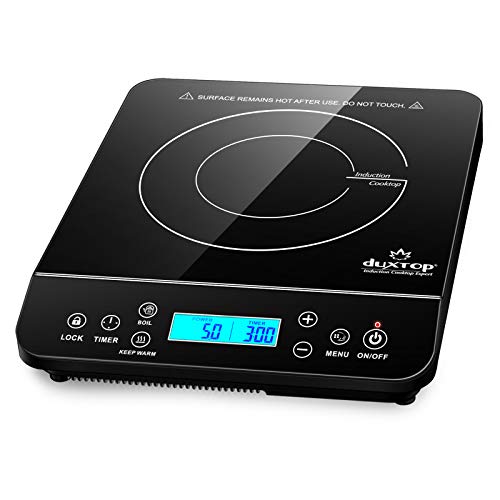
Duxtop Portable Induction Cooktop, Countertop Burner Induction Hot Plate with LCD Sensor Touch 1800 Watts, Black 9610LS BT-200DZ




Key features
- •Digital LCD sensor-touch control panel; child safety lock system (press and hold the safety lock key for 3 sec to activate), fast boil button & keep Warm button.
- •Duxtop induction cooktop uses 120 Volts, 15 amp of electricity – standard in all homes; lightweight and compact for easy handling and storage.
- •Built-in Count-down digital timer with 1 minute increments up to 10 hours; 20 temperature ranges from 100 °F to 460 °F; 20 power levels from 100-1800 Watts; 5 ft cord.
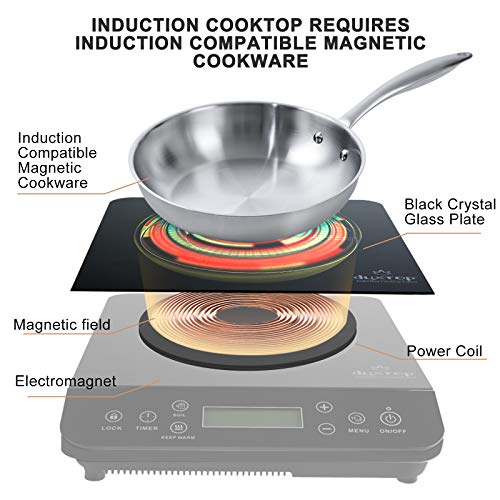
- •Requires induction compatible magnetic cookware. Compatible with Duxtop and other induction ready cookware such as cast aluminum enameled iron and Steel, stainless steel with a magnetic bottom, or cast iron. The auto-pan detection will shut the unit off automatically after 60 seconds if no cookware, or the incorrect cookware is detected; equipped with diagnostic error message system, low and high voltage warning system; ETL approved and built to North American standards.
- •Note: in order to use this and any other induction cooktop, you need to have the right kind of cookware. The "rule of thumb" to determine if your cookware is induction ready is; if a magnet sticks to the bottom of the cooking vessel, It is induction ready. Induction itself is a noiseless process; however there may be high pitched sounds from Clad cookware, The base of which has multiple layers of metals sandwiched together. 2-Year manufacturer's.
Duxtop Portable Induction Cooktop, Countertop Burner Induction Hot Plate with LCD Sensor Touch 1800 Watts, Black 9610LS BT-200DZ
List Price: $168.77$151.89DEALYou Save: $16.88 (10%)
Free shippingFree Returns – 30 daysFree Order CancellationSecure Payment2–3 Days DeliveryGet It October 25, 2026In Stock (1)No marketing spamNo account requiredFulfilment by FedEx / Amazon / UPS / ShipwirePayPal / Card Buyer Protection
Customer Reviews
Reviews sourced from verified Amazon purchasers4.4
out of 5
Based on 10 reviews
5★
70%
4★
30%
3★
0%
2★
0%
1★
0%
Much greater granularity at the low end where it’s needed
FelixMendeldog✓ Verified Purchase•September 26, 2023
This is a worthy successor to my prior Duxtop (which lasted 15 years and is still available new for $58.99), and is the first portable induction plate I've used with sufficient granularity at the low end of the heating range"”yay!
I don't see the power levels for this new Duxtop listed, but many other portable induction plates use the same system-on-a-chip controller. You'll most often see nine power settings as follows: 200, 400, 600, 800, 1000, 1200, 1400, 1600, and 1800 watts. These are accomplished by turning the magnet on and off"”i.e.: at 200 watts the magnet is on full power 1/9th of the time; at 1800 watts the magnet is on full power all the time. Below is how that plays out for real life cooking:
200 (The lowest power level on many portable induction plates)
400 (100.00% increase from power 1 to power 2)
600 (50.00% increase from power 2 to power 3)
800 (33.33% increase from power 3 to power 4)
1000 (25.00% increase from power 4 to power 5)
1200 (20.00% increase from power 5 to power 6)
1400 (16.67% increase from power 6 to power 7)
1600 (14.29% increase from power 7 to power 8)
1800 (12.50% increase from power 8 to power 9)
I'm delighted that this new Duxtop is NOT programed like this, because the above is *asinine.* Any cooking appliance that employs the above modulation series has the greatest granularity at the high end of the heating range where it's wasted (who cares about 12.50% when boiling a pot of water?!), and huge step increases at the low end where the difference between step 1 and step 2 is "” 1: barely simmering and 2: burning whatever you're cooking as you apply twice the heat of power 1 "” a 100% increase between the first two power levels is a totally unacceptable for cooking, but that's how many induction hobs are programed. Firmware engineers"”especially those who code cheap systems-on-chips"”rarely consider such things as natural logarithms. Anyway"¦
The good news is /this new Duxtop/ one has twenty power steps, with more granularity at the low and middle than others I've used. I've been cooking on it for a few days: it's far better in actual use.
Additional small, welcome upgrades: its beeps are more subtle than my last one; there's no buzzing from the magnet; the fan is louder (or perhaps that's my perceptual error because the magnetic buzzing is gone, compared to my last one?). It also produces a more pleasing sound and moves more cooling air though the unit. I'd prefer knobs (obviously, we all would), but its haptic buttons are more responsive than the older model. (The only units with knobs listed the idiotic nine steps I criticize above, so I won't buy one, and neither should you, until they replace their controllers with ones that makes sense for cooking.)
It's nearly twice as expensive as the older Duxtop model, but it's still less than $120, and well worth it for the better heat control alone.
I don't see the power levels for this new Duxtop listed, but many other portable induction plates use the same system-on-a-chip controller. You'll most often see nine power settings as follows: 200, 400, 600, 800, 1000, 1200, 1400, 1600, and 1800 watts. These are accomplished by turning the magnet on and off"”i.e.: at 200 watts the magnet is on full power 1/9th of the time; at 1800 watts the magnet is on full power all the time. Below is how that plays out for real life cooking:
200 (The lowest power level on many portable induction plates)
400 (100.00% increase from power 1 to power 2)
600 (50.00% increase from power 2 to power 3)
800 (33.33% increase from power 3 to power 4)
1000 (25.00% increase from power 4 to power 5)
1200 (20.00% increase from power 5 to power 6)
1400 (16.67% increase from power 6 to power 7)
1600 (14.29% increase from power 7 to power 8)
1800 (12.50% increase from power 8 to power 9)
I'm delighted that this new Duxtop is NOT programed like this, because the above is *asinine.* Any cooking appliance that employs the above modulation series has the greatest granularity at the high end of the heating range where it's wasted (who cares about 12.50% when boiling a pot of water?!), and huge step increases at the low end where the difference between step 1 and step 2 is "” 1: barely simmering and 2: burning whatever you're cooking as you apply twice the heat of power 1 "” a 100% increase between the first two power levels is a totally unacceptable for cooking, but that's how many induction hobs are programed. Firmware engineers"”especially those who code cheap systems-on-chips"”rarely consider such things as natural logarithms. Anyway"¦
The good news is /this new Duxtop/ one has twenty power steps, with more granularity at the low and middle than others I've used. I've been cooking on it for a few days: it's far better in actual use.
Additional small, welcome upgrades: its beeps are more subtle than my last one; there's no buzzing from the magnet; the fan is louder (or perhaps that's my perceptual error because the magnetic buzzing is gone, compared to my last one?). It also produces a more pleasing sound and moves more cooling air though the unit. I'd prefer knobs (obviously, we all would), but its haptic buttons are more responsive than the older model. (The only units with knobs listed the idiotic nine steps I criticize above, so I won't buy one, and neither should you, until they replace their controllers with ones that makes sense for cooking.)
It's nearly twice as expensive as the older Duxtop model, but it's still less than $120, and well worth it for the better heat control alone.
Vast improvement over many other similar induction hotplates. A Best Buy!!!
Creig✓ Verified Purchase•September 21, 2023
I owned a Tramontina induction hot plate for several years before it recently stopped working. It was excellent for searing meat especially steaks, and good for only a few other tasks because the temperature control was crude. This DUX unit, by comparison, is fantastic. What a great improvement! It seems all these less expensive induction hot plates, including this one, control cooking temperature by cycling the power on and off as opposed to controlling the induction coil current. Most of them offer a pan surface that alternates between too hot and too cold . This DUX unit has somehow overcome this problem by using much finer control of the duty cycle. The result is vastly improved temperature control and an induction hot plate that is useful for more than just boiling water or searing meat. The Dux is well designed and very nice looking. This is without any question a best buy. I got a "used" one in a box that had been opened at a nice discount. Could not tell it from a brand new one. Unless you need a 220V unit for use with much larger pots and pans, get this one. Remarkably it will control well all the way from blazing hot to warm at approx. 125 deg F. It has a useful timer that goes up to 10 hours and shuts the unit off when the time is up. This DUX unit is far more useful than competing induction hot plates because of its good temperature control, very wide range of settings and timer. It could be the heat source for a fine crockpot substitute. Of course, as with all of these less expensive induction hot plates, you will want to learn to control the temperature indirectly using the numeric settings that control the duty cycle. This one goes from 0.5 to 10 in 0.5 increments giving you a total of twenty settings. The Dux can be made to read out temperature directly but the reading will only be approximate, and may be quite inaccurate in some situations. This in no way affects the usefulness of the Dux however. If temperature is critical, use an "instant" read thermometer. One of the big surprises is that you can make Hollandaise sauce directly without a double boiler if you have the right utensil.. For example, the 12 cm Barrizonni belly shaped milk pot with heavy wire handle is perfect for this purpose. Its base is only 9 cm which is wide enough to let the DUX top know there is a pot on it, so it won't shut itself off, but small enough to fit mostly within the central circle of the Dux. To make a one egg yolk Hollandaise, for example -- something not easy to do directly on a gas or electric range without using a double boiler-- put one cold yolk and 4-5 Tbs of cold butter in chunks into the pot all at the same time! The butter can even be frozen! Put the pot dead center on the Duxtop and set it to a low setting "1". You can tinker with the heat a little by moving the pot slightly off center and then back to center as needed, or lifting it, something you can't do with most competing units without having to reset the controls. Whisk until the butter is incorporated and then season the sauce in the usual way. This goes very fast, about a minute or two. This is the easiest anyone is ever going to make a perfect hollandaise sauce.
Since reviewing this duxtop, I had a chance to use the beautifully sleek induction cooktop sold by IKEA. The IKEA unit is about half the price, however it lacks fine control of cooking temperature (10 settings versus 20 available on the Duxtop Model 96xx) resulting in significantly more coarse temperature control and a very noticeable cycling between on and off. Furthermore the IKEA unit, as do most other brands, shuts of quickly if the cooking utensil is lifted from the surface and stays off until manually reset, whereas the Duxtop, while it also shuts off to protect the unit, will restart without changing its settings when the cookware is placed back in contact with the surface within a minute or less. Quite often one needs to lift a pan to flip its contents, or for even finer heat control. Having used this Duxtop for a while now, I can't say enough good things about it, it is truly a remarkably well designed and extremely functional induction hot plate for home use..
I noticed another review mentioned that they like another brand of induction hotplate better because it boiled water, by their test, 20 seconds faster than the Duxtop. I need not point out how absurd this is. Twenty seconds difference over 4 minutes will result from small differences in the amount of water or the precise positioning of the pan. There is no statistical difference between the time to boil water between these two hot plates. You'd have to repeat this test many times under careful control to have any chance of detecting any real difference in the time to boil water. Incidentally, none of these 1800 watt induction hot plates will boil substantial amounts of water significantly faster than many conventional, natural gas stoves. That's not where an induction cooktop has an edge over a good gas range. The Duxtop is better at controlling both time and temperature than a gas stove and it both heats and cools the surface of a pan far more rapidly. All induction cooktops, even the lousy ones, will get a pan surface blazing hot very fast on their top setting and are superior for searing meat, but do this outdoors unless you have efficient kitchen stove ventilation, because there is going to be smoke, and lots of it. The only place where the top setting should ever be needed is in bringing water to a boil quickly. The high heat of vaporization of water gives some protection to the cooking unit. If you want to shorten the life of the induction hotplate, use it at the top setting (10) on a dry pan for extended periods! In searing meat a setting above 8 is not needed. This is undoubtedly why when one selects the boil function on the Duxtop it automatically sets the power level to 10 and automatically sets the timer to 10 minutes; yet another wise protective feature of the Duxtop that competing units do not have.
Another big advantage induction cooktops have over any range with an open flame is that a paper towel can safely substitute as a pan lid to trap splatters of moisture and fat while letting steam escape. This arrangement can be used in combination with a lid, which will trap both splatters and steam. Many meats nowadays come pumped full of salt solutions,e.g., most bacon brands. These meats, when fried in an open pan, will create a mess of fat spatters. If a lid is used, steamed rather than browned meat results. Induction cooking solves these problems. Bacon, for example, is as easily prepared, and without creating a mess, on the Duxtop as it is in a microwave by substituting a paper towel for a pan lid. Nothing browns meat faster or more conveniently than an induction cooktop, and there is no mess to clean up!.
All in all this is a remarkably good induction hot plate, and is perhaps the first inexpensive induction hot plate for home use to give highly satisfactory temperature control over a very wide range. It brings an inexpensive, portable home unit very close to the control one previously had to pay far more to achieve. In this sense, this appears to be an appliance that breaks new ground that all other home-use induction hotplates will be forced to emulate. We can think of the Duxtop as bringing to the serious home cook what was previously available only in professional or high-end home kitchens. Like the iconic Kitchenaid Mixer that brought professional orbital mixing action to home cooks, this 96xx series of Duxtops appears to me to be the first inexpensive induction cooktop to give professional quality induction temperature control. The only difference you are likely to experience between this unit and one costing far more is the size of the pans and the volume of liquids that it can handle. In most cases this duxtop unit will be sufficient for cooking four to six servings using most standard sized pots and pans. You can successfully use somewhat larger pans up to the width of the unit if you use a lower power setting and allow more time for conduction to even out the pan surface temperature. The only possible improvement I would like to see would be one still lower power setting of say 0.25. That could be even more useful for fermentations such as making of creme fraiche in a bain marie. The present model goes down to a still amazing and very useful 0.5. Yes, you can melt chocolate at the 0.5 lowest setting, but keep your eye on it and stir. After using this thing almost daily for a few months, I am still amazed at what it can do and how well it does it!
edit 2020: After daily use for 9 months haven't changed my mind. A beautifully engineered product. Will be the standard against which all competitors must compete. And the price remains amazingly low for this kind of quality and function. One of the best products for the money I have ever purchased.
edit sept. 2020: Oh my goodness, is this thing ever great! Now I hardly ever use my otherwise great Bosch range's gas cook top. For those in the Southern part of the U.S. that make gumbo regularly, this duxtop is a fantastic roux maker because of its great temperature control. It will make it possible for even an amateur chef to achieve an almost black roux without burning it. Look up Chef Paul Prudhomme's method in his cookbook. Use an enameled, cast iron, dutch oven.
Edit: After 19 Months of daily use, still perfect in every way.
Edit: I continue to be impressed with the spectacular engineering that went into this product. I use it daily, seldom using my Bosch gas stove top. Beware of imposters that look similar but do not offer the all-important 20 levels of heat control, a 10-hour timer and also permit a pan to be lifted from the surface with the unit operating without having to reset the controls (very useful feature!). I have learned that the Duxtop has a number of circuit and heat protection features that are only evident after much use. What a great induction cooktop this is!
Edit Mar 2023: Approaching four years now of daily use. Still functions like brand new and looks almost brand new.
Since reviewing this duxtop, I had a chance to use the beautifully sleek induction cooktop sold by IKEA. The IKEA unit is about half the price, however it lacks fine control of cooking temperature (10 settings versus 20 available on the Duxtop Model 96xx) resulting in significantly more coarse temperature control and a very noticeable cycling between on and off. Furthermore the IKEA unit, as do most other brands, shuts of quickly if the cooking utensil is lifted from the surface and stays off until manually reset, whereas the Duxtop, while it also shuts off to protect the unit, will restart without changing its settings when the cookware is placed back in contact with the surface within a minute or less. Quite often one needs to lift a pan to flip its contents, or for even finer heat control. Having used this Duxtop for a while now, I can't say enough good things about it, it is truly a remarkably well designed and extremely functional induction hot plate for home use..
I noticed another review mentioned that they like another brand of induction hotplate better because it boiled water, by their test, 20 seconds faster than the Duxtop. I need not point out how absurd this is. Twenty seconds difference over 4 minutes will result from small differences in the amount of water or the precise positioning of the pan. There is no statistical difference between the time to boil water between these two hot plates. You'd have to repeat this test many times under careful control to have any chance of detecting any real difference in the time to boil water. Incidentally, none of these 1800 watt induction hot plates will boil substantial amounts of water significantly faster than many conventional, natural gas stoves. That's not where an induction cooktop has an edge over a good gas range. The Duxtop is better at controlling both time and temperature than a gas stove and it both heats and cools the surface of a pan far more rapidly. All induction cooktops, even the lousy ones, will get a pan surface blazing hot very fast on their top setting and are superior for searing meat, but do this outdoors unless you have efficient kitchen stove ventilation, because there is going to be smoke, and lots of it. The only place where the top setting should ever be needed is in bringing water to a boil quickly. The high heat of vaporization of water gives some protection to the cooking unit. If you want to shorten the life of the induction hotplate, use it at the top setting (10) on a dry pan for extended periods! In searing meat a setting above 8 is not needed. This is undoubtedly why when one selects the boil function on the Duxtop it automatically sets the power level to 10 and automatically sets the timer to 10 minutes; yet another wise protective feature of the Duxtop that competing units do not have.
Another big advantage induction cooktops have over any range with an open flame is that a paper towel can safely substitute as a pan lid to trap splatters of moisture and fat while letting steam escape. This arrangement can be used in combination with a lid, which will trap both splatters and steam. Many meats nowadays come pumped full of salt solutions,e.g., most bacon brands. These meats, when fried in an open pan, will create a mess of fat spatters. If a lid is used, steamed rather than browned meat results. Induction cooking solves these problems. Bacon, for example, is as easily prepared, and without creating a mess, on the Duxtop as it is in a microwave by substituting a paper towel for a pan lid. Nothing browns meat faster or more conveniently than an induction cooktop, and there is no mess to clean up!.
All in all this is a remarkably good induction hot plate, and is perhaps the first inexpensive induction hot plate for home use to give highly satisfactory temperature control over a very wide range. It brings an inexpensive, portable home unit very close to the control one previously had to pay far more to achieve. In this sense, this appears to be an appliance that breaks new ground that all other home-use induction hotplates will be forced to emulate. We can think of the Duxtop as bringing to the serious home cook what was previously available only in professional or high-end home kitchens. Like the iconic Kitchenaid Mixer that brought professional orbital mixing action to home cooks, this 96xx series of Duxtops appears to me to be the first inexpensive induction cooktop to give professional quality induction temperature control. The only difference you are likely to experience between this unit and one costing far more is the size of the pans and the volume of liquids that it can handle. In most cases this duxtop unit will be sufficient for cooking four to six servings using most standard sized pots and pans. You can successfully use somewhat larger pans up to the width of the unit if you use a lower power setting and allow more time for conduction to even out the pan surface temperature. The only possible improvement I would like to see would be one still lower power setting of say 0.25. That could be even more useful for fermentations such as making of creme fraiche in a bain marie. The present model goes down to a still amazing and very useful 0.5. Yes, you can melt chocolate at the 0.5 lowest setting, but keep your eye on it and stir. After using this thing almost daily for a few months, I am still amazed at what it can do and how well it does it!
edit 2020: After daily use for 9 months haven't changed my mind. A beautifully engineered product. Will be the standard against which all competitors must compete. And the price remains amazingly low for this kind of quality and function. One of the best products for the money I have ever purchased.
edit sept. 2020: Oh my goodness, is this thing ever great! Now I hardly ever use my otherwise great Bosch range's gas cook top. For those in the Southern part of the U.S. that make gumbo regularly, this duxtop is a fantastic roux maker because of its great temperature control. It will make it possible for even an amateur chef to achieve an almost black roux without burning it. Look up Chef Paul Prudhomme's method in his cookbook. Use an enameled, cast iron, dutch oven.
Edit: After 19 Months of daily use, still perfect in every way.
Edit: I continue to be impressed with the spectacular engineering that went into this product. I use it daily, seldom using my Bosch gas stove top. Beware of imposters that look similar but do not offer the all-important 20 levels of heat control, a 10-hour timer and also permit a pan to be lifted from the surface with the unit operating without having to reset the controls (very useful feature!). I have learned that the Duxtop has a number of circuit and heat protection features that are only evident after much use. What a great induction cooktop this is!
Edit Mar 2023: Approaching four years now of daily use. Still functions like brand new and looks almost brand new.
Finally, a way to keep my gas cooktop clean. Stop using it and use this instead!
D. Booth✓ Verified Purchase•September 21, 2023
I'll admit I'm a sucker for kitchen gadgets and small appliances. But it must have been a well-placed ad that got to me late one evening, when, within the space of half an hour, I went from never having heard of a standalone induction hub to having one in my cart to be delivered the next morning.
That order went in a week ago today. In that time, I have used my gas cook top only for conducting comparison tests to see how much time, if any, the induction would save me over the gas. My kitchen is not a certified laboratory, but the results were pretty much as expected, with one surprise.
I used 5 different pans for testing. All All-Clad and Tramontina vessels are tri-ply. For the first test I boiled 2 cups of water in the following pans with these results:
5" All-Clad saucepan: Induction (I): 3 minutes; Gas (G): 6.75 minutes
NOTE: Part of the difference is no doubt due to having to use the smallest burner on the gas stove for this small pan.
All-Clad saucepan: I: 3 minutes; G: 5.25 minutes
All-Clad Dutch oven size: I: 3 minutes; G: 4 minutes
Le Creuset 2-1/4 quart saucier pan: I: 3.2 minutes; G 4.5 minutes
For the second test, I boiled 5 quarts of water in one pot:
Tramontina pasta pot: I: 22 minutes; G: 22.5 minutes
WHOA. That last one was a surprise and disappointing one at that. I repeated it somewhat in the All-Clad Dutch oven with 4 quarts of water, and the results were similarly similar. Is the hob working right? Has anybody else had the same results? Still, if it is working right, it's not a deal killer. I'm used to planning for water to take this long to boil, and I'd much rather be doing it on a heating source that is not polluting my household with deadly gasses for that much time.
In addition to the boiling-water tests, I cooked vegetarian chili in the Dutch oven (see photo), made oat-milk chocolate pudding in the Le Creuset, fried eggs in a black steel /carbon steel frying pan, warmed up left overs, heated soup for lunches; and I was happy with all results.
As to usability, I was concerned that the interface might be tricky, but I picked it up quickly. Not bad for a seriously senior senior citizen.
The pan does have a tendency to slide if you're stirring vigorously. My handles and lids did not get hot; however, so can can quickly keep a pot from getting too far away without burning myself to stop it.
I like its look and the design with a controls at a slant. As a shorty, every little detail like that is helpful. It is lightweight, but a bit bulky. I definitely read the size specs before buying it but was probably hoping it wouldn't really be that big.
As a compulsive wiper-upper I found myself accidentally changing settings whenever I automatically swiped whatever I had managed to splatter on it. At least things it cleans up easily, unlike that gas monster.
My biggest concern is that when I plug it in, the electricity arcs. What does that mean? Something wrong with my wiring, the unit, nothing to worry about it?
I'd like to store it on its side but haven't found any documentation about that yet.
And, finally, regarding the noise it makes. The fan seems a bit loud for such a small device, but it is waaaay less noisy than the exhaust fan above my cooktop that seems to just send the stinky gas fumes to a vent above the microwave and shoot it back into the room. I have only heard the other noise, kind of a hissing noise, a few times. It hasn't been very loud. If I move the pan a little bit, sometimes it goes away. I consider myself pretty sensitive to sounds, and it hasn't bothered me. Fortunately, my floor plan is pretty open. If I was in a closed off kitchen where noise had no place to go, it might be more of a problem.
I have a modest-sized kitchen that has no vacant countertop space begging to be filled. If I add something, it most likely means, something else has got to be relocated. For that to happen I have must have a great need or desire for the new product. This is undoubtedly worth it. It saves time in most cases, doesn't harm the atmosphere, and it takes the pressure off replacing the old gas beast and paying for new wiring to get a new stove. If I had a tad-bit more space, I'd probably get the double-burner version. As it is, I'll keep using this and add another single burner if I want to later.
That order went in a week ago today. In that time, I have used my gas cook top only for conducting comparison tests to see how much time, if any, the induction would save me over the gas. My kitchen is not a certified laboratory, but the results were pretty much as expected, with one surprise.
I used 5 different pans for testing. All All-Clad and Tramontina vessels are tri-ply. For the first test I boiled 2 cups of water in the following pans with these results:
5" All-Clad saucepan: Induction (I): 3 minutes; Gas (G): 6.75 minutes
NOTE: Part of the difference is no doubt due to having to use the smallest burner on the gas stove for this small pan.
All-Clad saucepan: I: 3 minutes; G: 5.25 minutes
All-Clad Dutch oven size: I: 3 minutes; G: 4 minutes
Le Creuset 2-1/4 quart saucier pan: I: 3.2 minutes; G 4.5 minutes
For the second test, I boiled 5 quarts of water in one pot:
Tramontina pasta pot: I: 22 minutes; G: 22.5 minutes
WHOA. That last one was a surprise and disappointing one at that. I repeated it somewhat in the All-Clad Dutch oven with 4 quarts of water, and the results were similarly similar. Is the hob working right? Has anybody else had the same results? Still, if it is working right, it's not a deal killer. I'm used to planning for water to take this long to boil, and I'd much rather be doing it on a heating source that is not polluting my household with deadly gasses for that much time.
In addition to the boiling-water tests, I cooked vegetarian chili in the Dutch oven (see photo), made oat-milk chocolate pudding in the Le Creuset, fried eggs in a black steel /carbon steel frying pan, warmed up left overs, heated soup for lunches; and I was happy with all results.
As to usability, I was concerned that the interface might be tricky, but I picked it up quickly. Not bad for a seriously senior senior citizen.
The pan does have a tendency to slide if you're stirring vigorously. My handles and lids did not get hot; however, so can can quickly keep a pot from getting too far away without burning myself to stop it.
I like its look and the design with a controls at a slant. As a shorty, every little detail like that is helpful. It is lightweight, but a bit bulky. I definitely read the size specs before buying it but was probably hoping it wouldn't really be that big.
As a compulsive wiper-upper I found myself accidentally changing settings whenever I automatically swiped whatever I had managed to splatter on it. At least things it cleans up easily, unlike that gas monster.
My biggest concern is that when I plug it in, the electricity arcs. What does that mean? Something wrong with my wiring, the unit, nothing to worry about it?
I'd like to store it on its side but haven't found any documentation about that yet.
And, finally, regarding the noise it makes. The fan seems a bit loud for such a small device, but it is waaaay less noisy than the exhaust fan above my cooktop that seems to just send the stinky gas fumes to a vent above the microwave and shoot it back into the room. I have only heard the other noise, kind of a hissing noise, a few times. It hasn't been very loud. If I move the pan a little bit, sometimes it goes away. I consider myself pretty sensitive to sounds, and it hasn't bothered me. Fortunately, my floor plan is pretty open. If I was in a closed off kitchen where noise had no place to go, it might be more of a problem.
I have a modest-sized kitchen that has no vacant countertop space begging to be filled. If I add something, it most likely means, something else has got to be relocated. For that to happen I have must have a great need or desire for the new product. This is undoubtedly worth it. It saves time in most cases, doesn't harm the atmosphere, and it takes the pressure off replacing the old gas beast and paying for new wiring to get a new stove. If I had a tad-bit more space, I'd probably get the double-burner version. As it is, I'll keep using this and add another single burner if I want to later.
95% perfect
TM✓ Verified Purchase•September 17, 2023
This does everything I hoped it would do.
I fry in a cast iron fry pan. Eggs in butter do excellently started at 260 (due to butter's low smoke point) and then finished at 220. The default starting temperature of 300 is perfect for oil-browned meat. After washing the fry pan, refreshing the seasoning can be done at high heat for 5 minutes without any risk of my forgetting to come back and turn it off before it starts smoking.
Similarly - bringing water to a boil while I assemble the ingredients for oatmeal or soup is automatic & I can simmer at level 1 until it's ready. The keep warm setting is helpful for dealing with stragglers to the dinner table.
Clean up is a damp rag.
The problem which may be specific to me is the cooling fan. I really don't like fan noises - vacuum cleaner, swamp cooler, computer fan, or most room fans just get on my nerves. This fan is quite noisy and runs at full speed for about a full minute after turning off the unit. Even if the power is turned on & immediately turned back off without cooking anything, it runs for a full minute at full power. The exiting air is room temperature. This personal annoyance levies a 5% reduction from 100% perfect.
I fry in a cast iron fry pan. Eggs in butter do excellently started at 260 (due to butter's low smoke point) and then finished at 220. The default starting temperature of 300 is perfect for oil-browned meat. After washing the fry pan, refreshing the seasoning can be done at high heat for 5 minutes without any risk of my forgetting to come back and turn it off before it starts smoking.
Similarly - bringing water to a boil while I assemble the ingredients for oatmeal or soup is automatic & I can simmer at level 1 until it's ready. The keep warm setting is helpful for dealing with stragglers to the dinner table.
Clean up is a damp rag.
The problem which may be specific to me is the cooling fan. I really don't like fan noises - vacuum cleaner, swamp cooler, computer fan, or most room fans just get on my nerves. This fan is quite noisy and runs at full speed for about a full minute after turning off the unit. Even if the power is turned on & immediately turned back off without cooking anything, it runs for a full minute at full power. The exiting air is room temperature. This personal annoyance levies a 5% reduction from 100% perfect.
Hot spot is real but manageable
Checkursix✓ Verified Purchase•September 7, 2023
The product is sleek, very stable, appears to be well designed and made and simple to use. Fan noise is minimal and not annoying at all. In fact, I like that it is there and turns off indicating when it is cool. Haven't cooked with it yet but tested using bottom-covering of water in a 10" skillet. Clearly, it only heats within that inner ring and it's the pan's convection which carries heat beyond that. Not much different than a small gas burner and a large pan. But because it heats so quickly, and cycles on and off to maintain the heat you want, be aware of hot spot in the center. Not a problem for soups etc., but I bet it would be if you were trying to griddle some pancakes. I believe this is the same for all "low priced" portable induction products. My non-scientific method to test the "accuracy" of the "temperature setting" seemed to say that feature is useless. It took a setting of 280 degrees to boil water with my infrared thermometer reading 213 on the surface. I'll update if anything particularly positive or negative shows up after I try some cooking.
Page 1 of 2