Stud Finder Wall Scanner - 5 in 1 Electronic Stud Sensor Wall Detector Joist Finders Edge Center Finding with LCD Display for Wood Beams AC Wires Metal Detection (Silver)


Key features
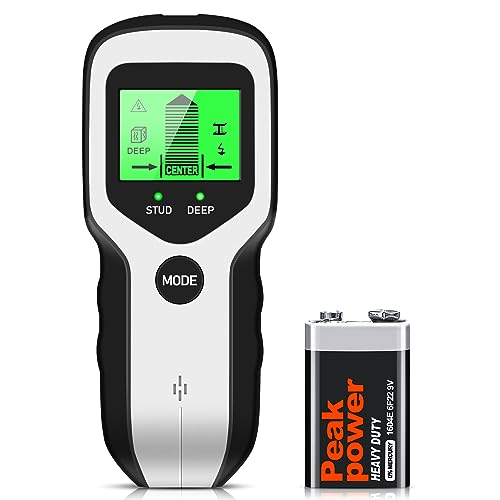
- •GREAT ACCURACY AND CONSISTENCY - Tavool stud finder is professionally designed! Tavool stud finders uses the UPGRADE INTERNAL SENSORS. It senses a change in density in the space behind the wall and locates the stud center with GREAT ACCURACY. In additions. The shape of this wall scanner also shows the edges of the stud. The center of a stud is the most secure location when mounting anything heavy. The edges help you to recheck the locations. Take it home, makes your DIY homework easier!
- •WIRE WSRNNING INDICATOR, NO FEAR OF DRILLING INTO A LIVE WIRE - WireWarning Detection is up to 2 in.(51mm) deep. The added bonus is that the wire warning is ALWAYS ON while you are scanning in StudScan/DeepScan/MetalScan Modes, to alert you to the presence of live, unshielded electrical AC wires up to 2 in. (50 mm) deep, which helps you avoid drilling or hammering into a water pipe or electrical wire.Whether you are a professional, homeowner or a DIY enthusiast, you can find great use in it
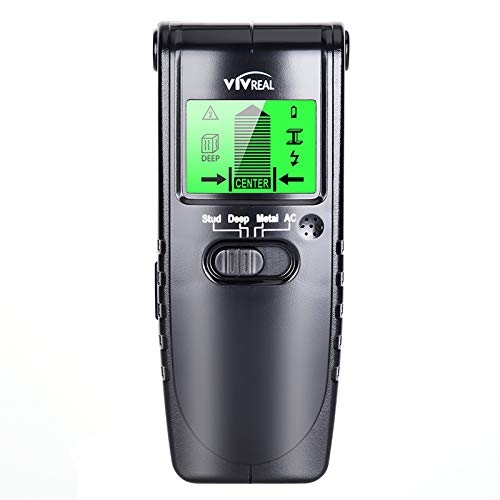
- •5 SCANNING MODES UP TO 60MM DEPTH - Tavool stud locator has mufti-fuctions and can quickly and easily locates wood metal studs joists beams metal pipe rebar and live AC wire behind walls, floors, and ceilings. StudScan Mode scans through one layer of drywall up to 0.5 in.(12mm) and 1 in . (25mm) thick. DeepScan Mode scans through 2 layers of drywall up to 1.5 in. (38 mm) deep. Deep Stud Scan Mode is a higher sensitivity scanning mode that should be used when there are extra layers of wallboard
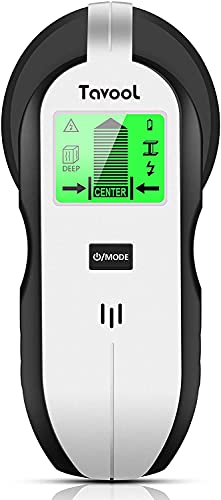
- •EASY TO READLCD DISPLAY +SOULD WARNING HELPS FIND STUD CENTER AND STUD DEGES EASILY - Displaying the Desired Stud Center As Well As the Precise Position of the Stud - The Tavool digital stud detector features large LCD display together with the big sound warning to detect the accurate location of the objects. When find the material, the LCD display will indicate the direction and the intensity of beeping tells whether you are more close to the target. The fast detection saves users time greatly
- •WHY RECOMMEND TAVOOL STUD FINDER TO YOU: Tavool has been dedicated to Research and develop stud finders for many years, and we have a professional team and mature productions process. Tavool stud finder not only gives you top quality and great accuracy, but also provide muti-functions to meet your practical needs on drywall, lathe wall, ceiling, plasterboard wall, wallboard etc.
Stud Finder Wall Scanner - 5 in 1 Electronic Stud Sensor Wall Detector Joist Finders Edge Center Finding with LCD Display for Wood Beams AC Wires Metal Detection (Silver)
List Price: $41.89$37.70DEALYou Save: $4.19 (10%)
Free shippingFree Returns – 30 daysFree Order CancellationSecure Payment2–3 Days DeliveryGet It October 24, 2026In Stock (1)No marketing spamNo account requiredFulfilment by FedEx / Amazon / UPS / ShipwirePayPal / Card Buyer Protection
Customer Reviews
Reviews sourced from verified Amazon purchasers4.2
out of 5
Based on 10 reviews
5★
60%
4★
40%
3★
0%
2★
0%
1★
0%
Really great, affordable stud finder, and easy to use!
Lily B.✓ Verified Purchase•August 29, 2023
I highly recommend purchasing this stud finder, even if you don't have various projects around the house. My father used to be the person who would accurately install my house accessories. He always did things by the book and I was "that" DIY person that randomly nailed things into my wall without having a stud finder. Yep, totally guilty! After my father passed away, he wasn't there to make sure my wall ornaments or accessories were leveled, strongly held/properly supported and safely nailed and drilled into walls. After fighting my walls (haha) for not letting me install my heavy as heck curtain rod without falling, I said, "Okay dad, you win! I'll finally give in and get a stud finder and make you stop rolling over in your grave." I searched Amazon for quite sometime in hopes of finding something that was affordable, good quality, and accurate and stumbled upon this little gem after going through various stud finders and reviews. It came quickly, brand new, and worked perfectly. It took a few seconds to recognize where the studs and wires were and were not. And um....as you can see in the photo, I finally hung up my curtains correctly and they are holding up strong. What are those big dots within the record circle you ask? My many failed attempts of drilling into the wall only to hit God knows what and fail at my project. Now I can lay under my curtains without worrying that they are going to collapse on my head and send me straight to the afterlife, ha, ha! The adjustable depth and various options for inquiring about what exists behind the wall is great and the arrows easily point you in the direction of where you can safely drill. As I said, it's an easy and efficient drill that does its job without complicating life or frustrating you in the process. Even if youre just planning on hanging up something as simple as picture frames, trust me, this will save you time and ensure that you actually hung them properly and that they are secure. Hope this review helped anyone who needs it!
Better than average "Stud Sensor" but.....
Stampboy of ND✓ Verified Purchase•August 25, 2023
This "Stud Sensor" is as good as any other Stud Sensor and better than most. It "is" able to find studs behind drywall and it does warn of electrical lines. (What I cannot judge the is metal stud setting because I do not have metal studs.) What it simply cannot do well is: find studs behind plaster walls. Be it the half inch setting, the 1 inch setting, or the 1.5 inch setting, the sensor does not give confidence to use a fastener in a given spot. I was most certainly hoping this stud sensor could do exactly that. It cannot. I suspect the technology is just not available for my particular needs such as plaster walls, a very precise task. (My 35 year old Craftsman stud senor cannot handle plaster walls either.) Instead I get these ghost images telling me that I have studs every 6 inches or so. For me, stud sensor are getting better, but they just aren't there yet. It is a very nice stud sensor. It just doesn't solve my needs any better than my old Craftsman. For me it would be a 3.5 star but I will give it a 4 star because they did so well on drywall.
Very Accurate!!!
Amazon Customer✓ Verified Purchase•August 8, 2023
Once you get used to how to use it, it works very well & is spot on with metal, wood, etc.
An improvement over my old stud finders
Michael Cavataio✓ Verified Purchase•July 10, 2023
I have gone through a lot of cheap, stud finders over the years only to be disappointed in the results and features. I was looking for something better. Now, I saw this for a good price and decided to give this a try. What I like about the product is that it is pretty easy to use. Just hold it on to the wall and calibrate, then slide it across the wall. I like that it has settings to find wood and metal along with wires behind the wall. This will be good for sure. It seems to work well and I especially like that it can find the edges and center. You might need to use some of the different depth setting depending on your wall and what kind it is. It seems to work well on my walls with and without wall paper. I haven't used it on any type of big textured coverings but again you might need to adjust the depth settings and play around with it. Overall it is definitely and upgrade over the old cheap stud finders and I should get a lot of long term use from it
Works well. Happy with my purchase.
Greg✓ Verified Purchase•June 28, 2023
I needed to secure a TV mount to the wall and therefore needed a stud finder. My old stud finder, which is a completely different brand, was not working so I thought I would give this one a try. It worked well and I was able to get my task completed.
The stud finder was simple to use. There is a mode button on the front which cycles thru the different objects for it to detect. The first three modes were for wood studs of various thickness, followed by metal stud, and AC. There is also a button on the side for calibration. There is a short bit of instructions that came with it and worth reading. I only tried the 1 1/2 wood stud option over drywall so my review is in regards to it.
Before looking for wood studs I used the calibration button to calibrate the unit (per the instructions). You need to hold it up to the wall for the calibration to work. There are multiple bars on the lcd which count down to let you know when calibration is complete. I didn't time how long calibration took but it was just a few seconds. You need to be aware that when you calibrate you don't want to have it over a wood stud. So if after you calibrate you are getting odd results try to calibrate on a different part of the wall. This is very similar to the other stud finder that I had.
I then slid it across the wall with the unit pointed up to the ceiling. I moved it at a slow pace and before too long it found a wood stud. There are arrows on the lcd screen to point which direction is center and also it tells you when you hit the edge and when you hit center. Once you find the stud you cannot depend on these readings to be 100% accurate. This is also similar to the other unit I had and I think you will have the same result with any stud finder. What you want to do once you find the wood stud is to use a very small drill bit (I used a 1/16) and drill a series of holes to find the edge of the wood stud. This is the only way to know for sure where center is. When you drill a hole past the edge of the wood stud you will be able to push the drill bit into the wall after you have drilled thru the dry wall. If you are drilling into a wood stud you will not be able to push it into the wood of course so you should be able to feel the difference.
I did have a few false positives where it detected a wood stud where there wasn't one. When that happened I recalibrated and tried again with success. The reason that I knew that there wasn't a stud is because I didn't expect one to be so close to the other wood stud. I have had this same experience with my other stud finder as well so I don't expect this to be too uncommon.
Like I said above I was able to secure my TV mount to the wall with the help of this stud finder so I am happy with it and have added it to my tool chest for future projects.
The stud finder was simple to use. There is a mode button on the front which cycles thru the different objects for it to detect. The first three modes were for wood studs of various thickness, followed by metal stud, and AC. There is also a button on the side for calibration. There is a short bit of instructions that came with it and worth reading. I only tried the 1 1/2 wood stud option over drywall so my review is in regards to it.
Before looking for wood studs I used the calibration button to calibrate the unit (per the instructions). You need to hold it up to the wall for the calibration to work. There are multiple bars on the lcd which count down to let you know when calibration is complete. I didn't time how long calibration took but it was just a few seconds. You need to be aware that when you calibrate you don't want to have it over a wood stud. So if after you calibrate you are getting odd results try to calibrate on a different part of the wall. This is very similar to the other stud finder that I had.
I then slid it across the wall with the unit pointed up to the ceiling. I moved it at a slow pace and before too long it found a wood stud. There are arrows on the lcd screen to point which direction is center and also it tells you when you hit the edge and when you hit center. Once you find the stud you cannot depend on these readings to be 100% accurate. This is also similar to the other unit I had and I think you will have the same result with any stud finder. What you want to do once you find the wood stud is to use a very small drill bit (I used a 1/16) and drill a series of holes to find the edge of the wood stud. This is the only way to know for sure where center is. When you drill a hole past the edge of the wood stud you will be able to push the drill bit into the wall after you have drilled thru the dry wall. If you are drilling into a wood stud you will not be able to push it into the wood of course so you should be able to feel the difference.
I did have a few false positives where it detected a wood stud where there wasn't one. When that happened I recalibrated and tried again with success. The reason that I knew that there wasn't a stud is because I didn't expect one to be so close to the other wood stud. I have had this same experience with my other stud finder as well so I don't expect this to be too uncommon.
Like I said above I was able to secure my TV mount to the wall with the help of this stud finder so I am happy with it and have added it to my tool chest for future projects.
Page 1 of 2