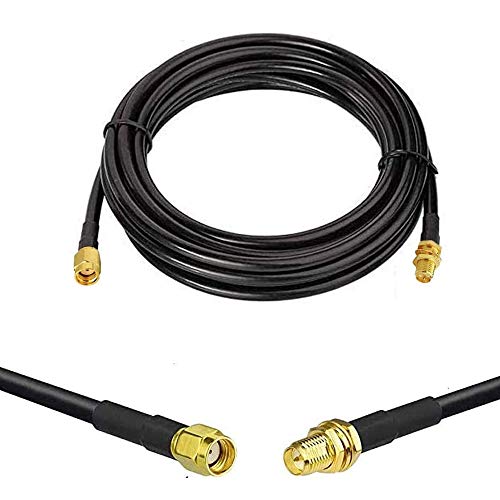
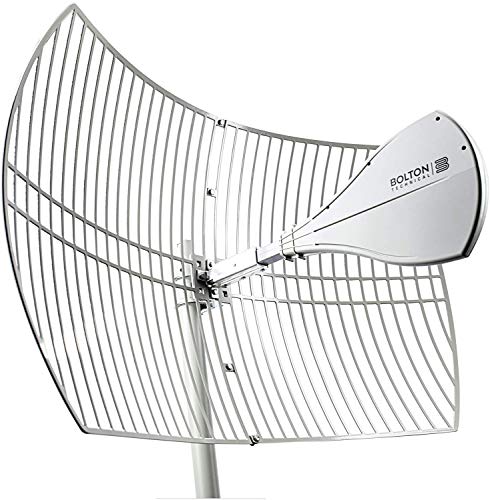
Bolton Technical Long Ranger Antenna | New Parabolic - Over 20 Miles Range | All Cell Bands: 5G, 4G, LTE | WiFi 2.4/5 GHz WiFi 6 | High Gain Cellular/WiFi Antenna up to +28 dB | All Carriers



Key features
- •HOME ON THE RANGE, OR ANYWHERE – Reach cell towers or WiFi sources over 10 miles away. Bring the signal you need inside your home (or wherever you need it), and get your stuff working better than ever. This thing is big, but powerful!
- •WHERE THE DEER AND THE ANTELOPE GAIN – Up to +28 dB of gain, more than any other directional RF antenna. Continuous gain and radiation frequencies between the 600 MHz and 6500MHz frequencies makes the Long Ranger the true successor to the Ultra Gain legacy.
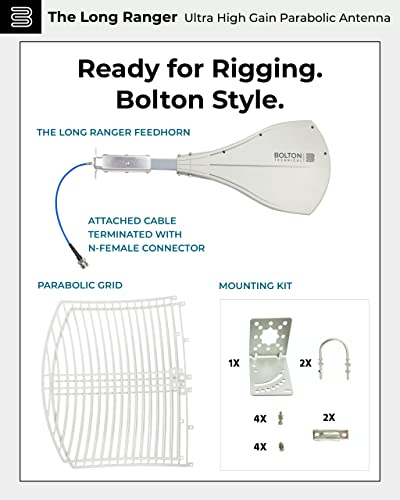
- •HEAR NO DISCOURAGING WORD – Improved N-Female connection ports and clamps make installation easier. Don't allow bad signal to rule your life. Bring it indoors with a Long Ranger!
- •WORKS EVEN WHEN THE SKIES ARE CLOUDY – The Long Ranger is weatherproof, with a single setting feedhorn and 10-degree directional signal beam. Or: your stuff will still work no matter the weather outside.
- •TOTAL SIGNAL COVERAGE – Get complete coverage on all types of radio frequency signal, including 5G, WiFi, 4G, LTE, all cellular, Wi-Max, GPS, GOV, MIL, and SDR bands. No matter your band, the Long Ranger's got you covered.
BrandBolton Technical
CategoryNetwork Antennas
Bolton Technical Long Ranger Antenna | New Parabolic - Over 20 Miles Range | All Cell Bands: 5G, 4G, LTE | WiFi 2.4/5 GHz WiFi 6 | High Gain Cellular/WiFi Antenna up to +28 dB | All Carriers
List Price: $290.99$261.89DEALYou Save: $29.10 (10%)
Free shippingFree Returns – 30 daysFree Order CancellationSecure Payment2–3 Days DeliveryGet It October 29, 2026In Stock (2)No marketing spamNo account requiredFulfilment by FedEx / Amazon / UPS / ShipwirePayPal / Card Buyer Protection
Customer Reviews
Reviews sourced from verified Amazon purchasers4.0
out of 5
Based on 10 reviews
5★
70%
4★
30%
3★
0%
2★
0%
1★
0%
Do you have a forest between antenna and tower?
PATRICK LATIN✓ Verified Purchase•August 15, 2023
This is a great antenna made sturdy and packaged with care in the box but there is one problem I had that I believe that no antenna can overcome unless it is mounted higher than a forest and that is trees and distance from tower. My tower is 10 to 12 miles away so this antenna did not work for me because of forest. Other than that a great antenna.
Perfect for hitting a specific tower at long distance.
C. Wright✓ Verified Purchase•August 14, 2023
I have been using this dish for about 8 months now for my primary internet connection.
Some details about my situation: I live in a remote area where the nearest cell tower is about 5 miles away. My booster is a cell fi go X. My carrier is Verizon. I have mounted the dish on the side of my house high up near the roof line.
Note: parabolic antenna is really suited to the application I mention above, you have one particular tower you are trying to hit at great distance. This antenna will pretty much not pick up any other towers in the area. If you want general directionality at a lesser distance a yagi style antenna is better. If you want to pick up all signals in an area of pretty good coverage (maybe a metal roof scenario) you will want an Omni directional antenna.
Ok, so how does it work: to put in perspective, without any booster I get just about 1 bar, and almost no internet data and frequent dropped calls.
With the yagi that my booster came with I was getting up to 2-3 bars but crucially data remained at a max of 10 mb down and only 1 up.
With this parabolic antenna I now get a pretty solid 30 mega down and up to 6 up. Calls are much clearer with only the occasional drop.
The thing I am most impressed with is that it has been pretty stable, you can expect some variability in cell signal and with weather. But this was much more stable than the yagi.
Tips for installation. You will need to hit the tower pretty dead on and have it just about perfectly level. Being off just a few degrees will dramatically effect performance. In my case just between some trees I can actually see the tower so I know I am right on target. If you have really dense tree cover this antenna may not boost as much.
One tip about the booster, this may be specific to cel fi go. It sweeps a bunch of different bands and frequencies, you can specify up front which band and frequencies to disable, if you look up what your tower uses it can save you a lot of time trying to figure out if you are connecting. Trust me you are going to be moving it slightly scanning, moving it scanning again.
Another pro tip. I'll often switch airplane mode on and off when I get home to make sure I'm tuned in to my booster perfectly. When you are out and about your phone may jump to some other frequencies and toggling that forces it to sweep for the strong signal again.
At the end of the day I was able to get this combo of booster and antenna configured such that I have a usable internet connection through my cell hotspot of around 30mb down and 6mb up, contrasted to my max through dsl of 10/1 (wonderful American internet). It also makes phone calls easier to hear and rarely drops.
Some details about my situation: I live in a remote area where the nearest cell tower is about 5 miles away. My booster is a cell fi go X. My carrier is Verizon. I have mounted the dish on the side of my house high up near the roof line.
Note: parabolic antenna is really suited to the application I mention above, you have one particular tower you are trying to hit at great distance. This antenna will pretty much not pick up any other towers in the area. If you want general directionality at a lesser distance a yagi style antenna is better. If you want to pick up all signals in an area of pretty good coverage (maybe a metal roof scenario) you will want an Omni directional antenna.
Ok, so how does it work: to put in perspective, without any booster I get just about 1 bar, and almost no internet data and frequent dropped calls.
With the yagi that my booster came with I was getting up to 2-3 bars but crucially data remained at a max of 10 mb down and only 1 up.
With this parabolic antenna I now get a pretty solid 30 mega down and up to 6 up. Calls are much clearer with only the occasional drop.
The thing I am most impressed with is that it has been pretty stable, you can expect some variability in cell signal and with weather. But this was much more stable than the yagi.
Tips for installation. You will need to hit the tower pretty dead on and have it just about perfectly level. Being off just a few degrees will dramatically effect performance. In my case just between some trees I can actually see the tower so I know I am right on target. If you have really dense tree cover this antenna may not boost as much.
One tip about the booster, this may be specific to cel fi go. It sweeps a bunch of different bands and frequencies, you can specify up front which band and frequencies to disable, if you look up what your tower uses it can save you a lot of time trying to figure out if you are connecting. Trust me you are going to be moving it slightly scanning, moving it scanning again.
Another pro tip. I'll often switch airplane mode on and off when I get home to make sure I'm tuned in to my booster perfectly. When you are out and about your phone may jump to some other frequencies and toggling that forces it to sweep for the strong signal again.
At the end of the day I was able to get this combo of booster and antenna configured such that I have a usable internet connection through my cell hotspot of around 30mb down and 6mb up, contrasted to my max through dsl of 10/1 (wonderful American internet). It also makes phone calls easier to hear and rarely drops.
Works great with T-Mobile Home Internet gateway
Cody✓ Verified Purchase•July 27, 2023
We have T-Mobile Home Internet and actually live in an area where it is not officially supported but can still technically hit the towers.
We have the Nokia 5G21 model gateway and did the external antenna mod, running U.FL pigtails out through the bottom and adapting to SMA and then to N type cables. We have only installed two of these so far, utilizing a 2x2 setup from the first two U.FL spots in the gateway. I plan to purchase two more of these for a full 4x4 MIMO setup.
We live about 5 miles (in straight line) from the nearest T-Mobile tower, in a dense forest and so far with two antennas, we get pretty good reception but it could definitely be better utilizing all 4 antenna ports. We're probably seeing 70Mbps on average for download and 10Mbps upload. This is an improvement over the just 10Mbps down and 3Mbps up that we see with just the gateway's internal antennas. Ping is about 43ms. On signal, primary signal is -107dbm. Secondary signal is -106dbm.
With proper tuning and the addition of 2 more of these, I expect to see speeds upward of around 100Mbps down when it'd all said and done. We just have a makeshift setup.. a galvanized fence post in a patio umbrella base with both antennas bolted to that.
I'll be doing a more permanent setup soon, adding a second string of pipe to the pipe already being used so that the antennas can go higher. We'll also turn the antennas at an angle for cross polarization, as to improve signal quality a little more.
We have the Nokia 5G21 model gateway and did the external antenna mod, running U.FL pigtails out through the bottom and adapting to SMA and then to N type cables. We have only installed two of these so far, utilizing a 2x2 setup from the first two U.FL spots in the gateway. I plan to purchase two more of these for a full 4x4 MIMO setup.
We live about 5 miles (in straight line) from the nearest T-Mobile tower, in a dense forest and so far with two antennas, we get pretty good reception but it could definitely be better utilizing all 4 antenna ports. We're probably seeing 70Mbps on average for download and 10Mbps upload. This is an improvement over the just 10Mbps down and 3Mbps up that we see with just the gateway's internal antennas. Ping is about 43ms. On signal, primary signal is -107dbm. Secondary signal is -106dbm.
With proper tuning and the addition of 2 more of these, I expect to see speeds upward of around 100Mbps down when it'd all said and done. We just have a makeshift setup.. a galvanized fence post in a patio umbrella base with both antennas bolted to that.
I'll be doing a more permanent setup soon, adding a second string of pipe to the pipe already being used so that the antennas can go higher. We'll also turn the antennas at an angle for cross polarization, as to improve signal quality a little more.
Does what it says
Mac✓ Verified Purchase•July 22, 2023
Boosted my cell service on ATT (4G LTE) network like a champ, I use a weboost cell booster so it works well with that brand as well. I had to get it dialed in with the direction. It is definitely sensitive to the direction of the nearest cell tower so take your time and get it right and it will be worth it once you do. Went from 1 bar to 4 bars cell signal.
Great Antenna- But Do Your Homework
Noah Kercheval✓ Verified Purchase•July 18, 2023
Pros:
Narrow beam increases signal stability
Well constructed
Higher gain then yagi on high frequencies
New design set apart from last gen copycats
Cons:
Expensive
Much heavier than yagi
Catches more wind than yagi
Required extensive testing to see if it would be useful
My personal findings:
My pole is only 20 feet tall just peaking over my hill, no direct line of sight since I live in the woods surrounded by 60 foot trees on the back side of a hill. I had to do extensive testing and research to feel confident this setup would work with my weboost.
I only have att and there are 3 towers within about 7 miles of me that cellmapper.net showed overlapped my area. But only 1 really ever comes through with a decent signal and speed on bands 5 or 66. My problem with my yagi was that even though my decibels were in the mid to high 80s my RSSNR was almost always in the negative or just pop into 1-3 range and my RSRQ was 12-15 most of the time. Bad signal quality, so sometimes my speed would be 10 to 15 mps and then I would have next to nothing.
I got this antenna because the yagi is only about 10db across the board. I figured if this can get closer to 15db gain on band 5 or even 20db on band 66, the least that could happen is better stability. After install my signal strength is about the same but my RSSNR IS 6-12 and my RSRQ is 6-8 even in bad weather. My speed is consistently 20 to 25 mps now too. I can only chalk that up to the narrow beam of this antenna. My uploads are much more stable now too at 3mps.
I can only advise you to do your homework, test, research, and test again especially since this cost almost as much as my booster kit. Network Cell Info Lite on the play store is a super helpful tool for free. Also make sure your setup will support the 5-6 lb antenna, it catches a bunch of wind and before I clamped it into the desired direction, the wind blew it off point and my speed plummeted until I realized what happened.
Hope this helps!
Narrow beam increases signal stability
Well constructed
Higher gain then yagi on high frequencies
New design set apart from last gen copycats
Cons:
Expensive
Much heavier than yagi
Catches more wind than yagi
Required extensive testing to see if it would be useful
My personal findings:
My pole is only 20 feet tall just peaking over my hill, no direct line of sight since I live in the woods surrounded by 60 foot trees on the back side of a hill. I had to do extensive testing and research to feel confident this setup would work with my weboost.
I only have att and there are 3 towers within about 7 miles of me that cellmapper.net showed overlapped my area. But only 1 really ever comes through with a decent signal and speed on bands 5 or 66. My problem with my yagi was that even though my decibels were in the mid to high 80s my RSSNR was almost always in the negative or just pop into 1-3 range and my RSRQ was 12-15 most of the time. Bad signal quality, so sometimes my speed would be 10 to 15 mps and then I would have next to nothing.
I got this antenna because the yagi is only about 10db across the board. I figured if this can get closer to 15db gain on band 5 or even 20db on band 66, the least that could happen is better stability. After install my signal strength is about the same but my RSSNR IS 6-12 and my RSRQ is 6-8 even in bad weather. My speed is consistently 20 to 25 mps now too. I can only chalk that up to the narrow beam of this antenna. My uploads are much more stable now too at 3mps.
I can only advise you to do your homework, test, research, and test again especially since this cost almost as much as my booster kit. Network Cell Info Lite on the play store is a super helpful tool for free. Also make sure your setup will support the 5-6 lb antenna, it catches a bunch of wind and before I clamped it into the desired direction, the wind blew it off point and my speed plummeted until I realized what happened.
Hope this helps!
Page 1 of 2