Cambridge Audio DacMagic 200M - MQA HiFi DAC and Headphone Amplifier with Bluetooth - PC/MAC Support with USB Connection - Handle Digital Files up to 24/768 or DSD512 - Lunar Grey


Key features
- •✓ AMAZING SOUND CONVERSION. DacMagic 200M performs the digital-to-analogue conversion perfectly every time, letting all kinds of digital audio systems sound better than ever when it reaches your ears.
- •✓ ARTIST APPROVED AUDIO. DacMagic 200M is Cambridge Audio's first product to support MQA. MQA is an award-winning British technology that delivers studio-quality sound in a file small enough to stream.
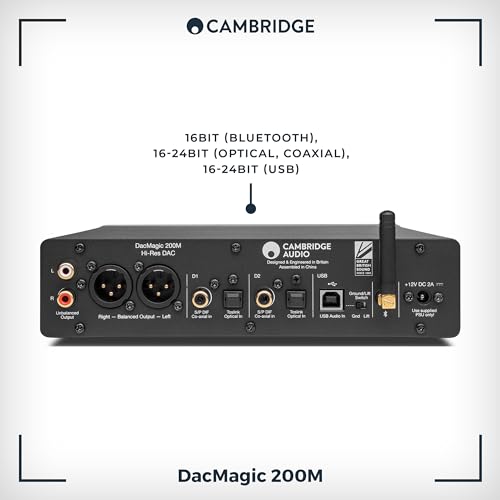
- •✓ POWERFUL PROCESSING. Inside is a pair of extremely high-quality ESS Sabre DAC converters. They handle digital audio files up to 32bit/768kHz or DSD512, handling digital music of any kind stored on CDs, smartphones, computers - or anywhere else.
- •✓ EASY CONNECTING. Digital optical, digital coaxial and USB inputs mean CD players, games consoles, laptops or any other digital equipment can be easily hooked up. Bluetooth aptX also lets you wirelessly deliver files from your smartphone or tablet.
- •✓ TECH SPECS - Dual ESS ES9028Q2M DACs, Frequency Response 10Hz to 50kHz (±1dB), Max Power Consumption 12W, Signal to Noise Ratio >115dB (A-Weighted), Digital Filter: Selectable (Fast - Slow - Short Delay), Dimensions 2.0" x 8.6" x 7.6", WEIGHT 2.6lbs.
Cambridge Audio DacMagic 200M - MQA HiFi DAC and Headphone Amplifier with Bluetooth - PC/MAC Support with USB Connection - Handle Digital Files up to 24/768 or DSD512 - Lunar Grey
List Price: $580.55$522.50DEALYou Save: $58.05 (10%)
Free shippingFree Returns – 30 daysFree Order CancellationSecure Payment2–3 Days DeliveryGet It October 25, 2026In Stock (1)No marketing spamNo account requiredFulfilment by FedEx / Amazon / UPS / ShipwirePayPal / Card Buyer Protection
Customer Reviews
Reviews sourced from verified Amazon purchasers4.5
out of 5
Based on 10 reviews
5★
60%
4★
40%
3★
0%
2★
0%
1★
0%
Saved by the sound
Kloid✓ Verified Purchase•October 20, 2023
The MQA would not work properly when playing my MQA CDs from a transport. It would stutter trying to maintain a lock. This made my MQA encoded CDs unlistenable (OK, I only have two MQA CDs). I corresponded with Audio Advice and they said it should work. I tried three CD players using both optical and coax outputs (Pioneer, Denon, Teac) without success. I cannot recommend this DAC for MQA decoding. It may or may not work. I didn't try MQA through the USB input so who knows? To be honest I didn't buy this DAC for MQA. Another disappointment is this PRE/DAC does not have remote volume control. Adjusting the volume manually is questionable. By now you are probably wondering why-da-hek did I give the M200 4 Stars! Yep, you guessed it, the dual ESS Sabre DACs saved the day. The sound is exceptional! I drive a pair of powered studio monitors with the M200. I already have an Emotiva Stealth PRE/DAC that is also outstanding. I ordered the M200 as a backup. After listening to both with different monitors I have determined the M200 is slightly more lush with enhanced presence. The Emotiva makes me feel as if I am listening to the playback in the recording studio. The Emotiva does not use oversampling believe it or not. Now I have two superior sounding DACs that I switch between frequently. I would prefer the M200 without MQA and the inclusion of a remote volume. If Cambridge Audio ever offers an ESS Sabre PRE/DAC configured in this way for under $500, I will likely purchase it. For now, the M200 provides for an enjoyable and pleasant listening experience for those who still appreciate CDs.
Update: The Teac CD player I was using as a transport for the 200M(!) started to have difficulties playing some of my CDs. I decided to pull my 20+ year old Pioneer PD-59 out of mothballs. Still in great condition, the PD-59 worked well with the 200M. In fact CD playback seemed more revealing now. Without thinking about it I put on one of my MQA encoded CDs that failed to play with other transports I mentioned earlier (the previous Pioneer unit that did not work with MQA is a DV-45 DVD player). With the PD-59 surprisingly I got a lock. Yep, the MQA light came on solid! Evidently the PD-59 provides a digital signal pristine enough to activate MQA. Thinking about it I remembered the PD-59 uses a Stable Platter Mechanism transport. The CD sits upside down and is fully supported by the platter (just like a record player!). Most CD players are grasped in the center and are subject to wobble, possibly contributing extra digital grunge. In fact, as I recall, the PD-59 played every CD perfectly, even those that failed on every other CD player I owned. Hmmm, looks like the quality of the digital signal is very important. Too bad Pioneer and other manufacturers didn't make Stable Platter Mechanism a standard. In my case SPM proved its worth! So how does MQA sound? Wider sound stage, superior channel separation, clear, improved tonal accuracy, and less grunge. You do trade off some warmth for improved bass articulation. Unfortunately MQA will suffer the fate of SACD. Limited media availability and non-standardization. Very few MQA CDs available from Amazon. MQA seems to be purposed for streaming. In any case, with the right transport, MQA CDs sound pleasingly improved on the 200M.
Update: The Teac CD player I was using as a transport for the 200M(!) started to have difficulties playing some of my CDs. I decided to pull my 20+ year old Pioneer PD-59 out of mothballs. Still in great condition, the PD-59 worked well with the 200M. In fact CD playback seemed more revealing now. Without thinking about it I put on one of my MQA encoded CDs that failed to play with other transports I mentioned earlier (the previous Pioneer unit that did not work with MQA is a DV-45 DVD player). With the PD-59 surprisingly I got a lock. Yep, the MQA light came on solid! Evidently the PD-59 provides a digital signal pristine enough to activate MQA. Thinking about it I remembered the PD-59 uses a Stable Platter Mechanism transport. The CD sits upside down and is fully supported by the platter (just like a record player!). Most CD players are grasped in the center and are subject to wobble, possibly contributing extra digital grunge. In fact, as I recall, the PD-59 played every CD perfectly, even those that failed on every other CD player I owned. Hmmm, looks like the quality of the digital signal is very important. Too bad Pioneer and other manufacturers didn't make Stable Platter Mechanism a standard. In my case SPM proved its worth! So how does MQA sound? Wider sound stage, superior channel separation, clear, improved tonal accuracy, and less grunge. You do trade off some warmth for improved bass articulation. Unfortunately MQA will suffer the fate of SACD. Limited media availability and non-standardization. Very few MQA CDs available from Amazon. MQA seems to be purposed for streaming. In any case, with the right transport, MQA CDs sound pleasingly improved on the 200M.
Made old and new speakers have a 2nd life of quality
Art Gremlin✓ Verified Purchase•October 18, 2023
probably one of the best purchases I ever made. I was skeptical about DACs and Headphone amps, I tested many. And this one I got mainly for 2 reasons, I needed the XLR output to use with some hi-def studio monitor speakers on my PC. And second reason was my analog headphones never sounded good, even mid to high tier headphones, and I heard this would make miracles with them.
On speakers via USB: I first plugged this into old and fairly cheap pair of bookshelf speakers using a default 44 Hz output, then I set my PC to output 384 Hz, which is the maximum from my machine and this DAC support it, and I immediately had an OMG moment, suddenly this pair of old speakers where playing clear details I never heard from them, and on higher volumes it was not distorting anymore.
New high-end speakers via USB: I audibly cursed for a while on plugging it in, mad about why in the world I did not got this years ago? Why?! It's such a monstrous sound quality difference. it has no buzz or electric noises at all, even on very high volume without playing a song. Records with acoustic guitars, ambient voice and drum kits recorded with mic, gained a new life on my listening experience.
With analog over the ear Headphones: Same OMG moment, suddenly my headphone was crystal clear, no distortions on high volume and each instrument channel was noticeable and defined on music I heard 1000x before.
Don't get me wrong, I have tried similar DACs and headphone amps before, but nothing came close to this in quality and in bringing a new life to old equipment.
Cons: Sometimes when you're listening to songs via USB connection to a PC, if you change songs the audio disappears. Turning it on and off seems the only solution at the moment. It's worth mention is not always and I'm using Windows 11, which drivers for audio devices have been reposted to behave weirdly.
So, 9.5/10 stars, one of my best electronic equipment purchases ever.
On speakers via USB: I first plugged this into old and fairly cheap pair of bookshelf speakers using a default 44 Hz output, then I set my PC to output 384 Hz, which is the maximum from my machine and this DAC support it, and I immediately had an OMG moment, suddenly this pair of old speakers where playing clear details I never heard from them, and on higher volumes it was not distorting anymore.
New high-end speakers via USB: I audibly cursed for a while on plugging it in, mad about why in the world I did not got this years ago? Why?! It's such a monstrous sound quality difference. it has no buzz or electric noises at all, even on very high volume without playing a song. Records with acoustic guitars, ambient voice and drum kits recorded with mic, gained a new life on my listening experience.
With analog over the ear Headphones: Same OMG moment, suddenly my headphone was crystal clear, no distortions on high volume and each instrument channel was noticeable and defined on music I heard 1000x before.
Don't get me wrong, I have tried similar DACs and headphone amps before, but nothing came close to this in quality and in bringing a new life to old equipment.
Cons: Sometimes when you're listening to songs via USB connection to a PC, if you change songs the audio disappears. Turning it on and off seems the only solution at the moment. It's worth mention is not always and I'm using Windows 11, which drivers for audio devices have been reposted to behave weirdly.
So, 9.5/10 stars, one of my best electronic equipment purchases ever.
great dac
Miller time✓ Verified Purchase•August 20, 2023
Not sure if this a great value compared to other competing products at $550. But it works great! I bought it to hardware decode MQA format files, which according to the hype is the purest sound available. After getting it, I downloaded Tidal to check it out. On a Mac, the setup was relatively painless. You have to tell Tidal to send the music data to the CA DAC Magic for processing (the CA DAC Magic 200M is in the choices). There is additional set up to tell Tidal that you want the CA DAC Magic to hardware process the MQA. From what I can tell, all this setup circumvents the Mac MIDI set up (which is what I had to use to have a FIIO DAC work properly). I initially messed with MIDI setup and it honked the interaction of Tidal with the CA DAC Magic.. it worked just wasn't hardware processing the MQA files (based upon the CA DAC Magic LED lights). Anyways, I rebooted a couple times and restarted Tidal each time and it worked itself out to lock out the Mac MIDI. Had it a few days and it is working flawlessly now. Sometimes have to wait a several seconds for Tidal/CA DAC Magic to start streaming if the computer goes to sleep and/or CA DAC Magic goes to sleep. Anyways my system sounded great already, I would love to say it is hugely noticeable to have the CA DAC Magic in the system with the best processing and best file formats available. All I can say is it is working as advertised, it is hardware processing the MQA files (based upon the indicator lights on the DAC Magic) and my music still sounds great!!!
Have now owned the DAC Magic for a week. Have tried listening with and without MQA turned on. It is quite a noticeable improvement to the sound quality with MQA. The best way I can describe it is a visual image. You can have a good image and then you process it to get more contrast and details in the image pop. That's what the sound is like, the instruments/vocals etc become more distinct more defined. Anyway, very happy with the DAC magic and the sound quality I'm listening to!
Have now owned the DAC Magic for a week. Have tried listening with and without MQA turned on. It is quite a noticeable improvement to the sound quality with MQA. The best way I can describe it is a visual image. You can have a good image and then you process it to get more contrast and details in the image pop. That's what the sound is like, the instruments/vocals etc become more distinct more defined. Anyway, very happy with the DAC magic and the sound quality I'm listening to!
Great sound, full MQA hardware decoding, full featured DAC/Amp.
sjc✓ Verified Purchase•August 12, 2023
I have had the Cambridge Audio DAC Magic 200M for just about a year now and it has performed without issue. It replaced my aging Parasound ZDAC v.2. The 200M is a MQA DAC, Preamp, and Headphone amp but I bought it primarily because of it's ability to hardware decode (unfold) MQA files and for its balanced XLR outputs so I can use balanced or unbalanced headphone amplifiers with the 200M.
I have auditioned the Monoprice THX AAA 887, Schitt Magnius, and the Monolith Liquid Spark designed by Alex Cavalli headphone amps with the 200M. The AAA 887 and Magnius have balanced inputs so
I had those connected to the 200M with Mogami XLR cables, the Liquid Spark is unbalanced and I have it connected with a short pair of AudioQuest King Cobra RCA cables. I currently have the Philips X3 open back and Beyerdynamic DT 770 PRO closed back headphones being powered by the Liquid Spark amp. I'm currently running Roon on a 2023 Mac Mini with the M2 PRO chip. Tidal and uncompressed FLAC files on a NAS drive are my music sources (will eventually get a Roon Nucleus dedicated core device).
The 200M decodes pretty much anything and everything I throw at it. I have to admit that is is fun to see the MQA and DSD sampling rate LED's light up on the front of the 200M! You can set the XLR and RCA outputs to a fixed volume setting for when you are using an external headphone amp or any other device that has a volume control. There are also filter settings to choose from, descriptions of what the different filters do is explained in the included documentation. I noticed that when an MQA file is being played the filter defaults to the Short Delay setting and cannot be manually changed using the Filter button. I honestly couldn't hear a big difference between the Fast and Slow settings. If you are using the pre-outputs in variable volume mode or if you are using the internal headphone amp the volume control on the 200M is really nice, it is the type that rotates continuously and it is smooth with just the right amount of resistance, it feels like a quality volume control. The DAC is very quiet and from what I can tell doesn't really impart any coloration of its own on the audio. It passes a very clean detailed signal to the external headphone amplifiers which is all you really need and want it to do. It basically just disappears.
During my research of standalone headphone amps to use with the 200M I learned that there is a category of headphone amp called a "measurement chaser" meaning they are all about specs - ultra low noise floor, S/N Ratio, high dynamic range, and high output power especially from balanced outputs. The THX AAA 887 and the Schitt Magnius are two examples in that category. Both have a very detailed imaging and open sound staging and they are both very quiet, no background noise whatsoever. If you are hearing hiss or other audio anomalies then those sounds are on the recording. With both of these amps I felt like they revealed too much detail in the recording, meaning you can hear all the flaws of a bad recording. On the other hand, with excellent recordings the imaging and depth of the soundstage is amazing. I also felt that, as other professional reviewers have pointed out that these measurement chasing amps almost have to much power on their balanced outputs, I found that with most recordings I couldn't get past 11 o'clock on the volume controls before it was to loud which doesn't give you a lot of volume range to play with. This was especially true on the Schitt Magnius.
Ultimately, I just didn't like the sound of the Magnius, to unforgiving and sterile sounding, and the Monoprice THX AAA 887's volume control developed a clicking distortion and this happened on the replacement unit they sent me as well so the AAA 887 got returned for store credit and I got the Monolith Liquid Spark. It has plenty of power to drive my two pairs of headphones mentioned above, it is also quiet - no background noise, it presents great imaging and the soundstage is decent, but it doesn't present audio with an attention to hyper detail, it's warmer, slightly more rounded overall which again makes it great for listening to a lot of different genres of music and for listening to recordings of varying quality. It's more fun to listen to with the 200M providing the level of detail you would expect from hi-res FLAC or MQA music files, and it has plenty of power with two gain settings to drive my Philips X3's and the 250 ohm Beyerdynamic's with a good range on the volume control. The volume control has a quality feel to it, rotates smoothly.
Overall, if you are in the market for a DAC that does full hardware decoding of MQA files (and DSD) they you can't go wrong with the DAC Magic 200M and with it's pre amp outputs you can drive a pair of desktop powered speakers as well. Definitely recommended.
I have auditioned the Monoprice THX AAA 887, Schitt Magnius, and the Monolith Liquid Spark designed by Alex Cavalli headphone amps with the 200M. The AAA 887 and Magnius have balanced inputs so
I had those connected to the 200M with Mogami XLR cables, the Liquid Spark is unbalanced and I have it connected with a short pair of AudioQuest King Cobra RCA cables. I currently have the Philips X3 open back and Beyerdynamic DT 770 PRO closed back headphones being powered by the Liquid Spark amp. I'm currently running Roon on a 2023 Mac Mini with the M2 PRO chip. Tidal and uncompressed FLAC files on a NAS drive are my music sources (will eventually get a Roon Nucleus dedicated core device).
The 200M decodes pretty much anything and everything I throw at it. I have to admit that is is fun to see the MQA and DSD sampling rate LED's light up on the front of the 200M! You can set the XLR and RCA outputs to a fixed volume setting for when you are using an external headphone amp or any other device that has a volume control. There are also filter settings to choose from, descriptions of what the different filters do is explained in the included documentation. I noticed that when an MQA file is being played the filter defaults to the Short Delay setting and cannot be manually changed using the Filter button. I honestly couldn't hear a big difference between the Fast and Slow settings. If you are using the pre-outputs in variable volume mode or if you are using the internal headphone amp the volume control on the 200M is really nice, it is the type that rotates continuously and it is smooth with just the right amount of resistance, it feels like a quality volume control. The DAC is very quiet and from what I can tell doesn't really impart any coloration of its own on the audio. It passes a very clean detailed signal to the external headphone amplifiers which is all you really need and want it to do. It basically just disappears.
During my research of standalone headphone amps to use with the 200M I learned that there is a category of headphone amp called a "measurement chaser" meaning they are all about specs - ultra low noise floor, S/N Ratio, high dynamic range, and high output power especially from balanced outputs. The THX AAA 887 and the Schitt Magnius are two examples in that category. Both have a very detailed imaging and open sound staging and they are both very quiet, no background noise whatsoever. If you are hearing hiss or other audio anomalies then those sounds are on the recording. With both of these amps I felt like they revealed too much detail in the recording, meaning you can hear all the flaws of a bad recording. On the other hand, with excellent recordings the imaging and depth of the soundstage is amazing. I also felt that, as other professional reviewers have pointed out that these measurement chasing amps almost have to much power on their balanced outputs, I found that with most recordings I couldn't get past 11 o'clock on the volume controls before it was to loud which doesn't give you a lot of volume range to play with. This was especially true on the Schitt Magnius.
Ultimately, I just didn't like the sound of the Magnius, to unforgiving and sterile sounding, and the Monoprice THX AAA 887's volume control developed a clicking distortion and this happened on the replacement unit they sent me as well so the AAA 887 got returned for store credit and I got the Monolith Liquid Spark. It has plenty of power to drive my two pairs of headphones mentioned above, it is also quiet - no background noise, it presents great imaging and the soundstage is decent, but it doesn't present audio with an attention to hyper detail, it's warmer, slightly more rounded overall which again makes it great for listening to a lot of different genres of music and for listening to recordings of varying quality. It's more fun to listen to with the 200M providing the level of detail you would expect from hi-res FLAC or MQA music files, and it has plenty of power with two gain settings to drive my Philips X3's and the 250 ohm Beyerdynamic's with a good range on the volume control. The volume control has a quality feel to it, rotates smoothly.
Overall, if you are in the market for a DAC that does full hardware decoding of MQA files (and DSD) they you can't go wrong with the DAC Magic 200M and with it's pre amp outputs you can drive a pair of desktop powered speakers as well. Definitely recommended.
Incredible Sound when listening at Hi Resolution
Robert Williams✓ Verified Purchase•August 4, 2023
I have a decent stereo system, but it's basically an analog system, with the exception of the CD player. My stereo system did have a NAIM Data Streamer, but I hardly used it and traded it in for a REGA Planar 10 turntable. So I listen to vinyls most of the time.
I'm an Apple Music subscriber, so at times I would hook my iPhone to my stereo amplifier via a Lightning to stereo RCA connector. The audio quality wasn't the greatest, but back then Apple Music was only streaming at CD quality resolution, 16-bit/44.1 kHz. Apple Music added two additional data resolution options in 2022. Lossless for a maximum resolution of 24-bit/48 kHz and Hi-Res Lossless for a maximum resolution of 24-bit/192 kHz. So it was a no brainer that I needed a DAC to fully utilize the higher resolutions with my Apple Mac and iPhone. Also, to listen music at Hi-Res Lossless, it's required to connect to a DAC.
So after doing some research, I purchased the Cambridge Audio DACMagic 200M and a Lightning OTG MIDI to USB Type-B cord.
The sound quality was substantially much better listening to music through the DACMagic. Actually, the sound quality was incredible!
Some of the lessons I learned;
1. Connecting my CD player to a DAC via the optical digital jack connector, the DAC data resolution input was only 16 bit, 44.1 kHz PCM. Limitations of CD Players. No fault of the DACMagic.
2. To see the incoming data rate on the Cambridge Audio DACMagic 200M from my Apple MAC computer, you need to utilize the Audio Midi Setup App. When the computer is connected to the DAC the DACMagic 200M will be displayed on the computer, to be selected. Then from the MIDI Setup select the data resolution format you want to use. Such as 24-bit/192 kHz. This is not necessary when using an iPhone, and the incoming data rate is displayed on the DAC for what ever data resolution you are outputting from the iPhone.
3. The DAC size is smaller than what I envisioned, but it's built very well.
4. The Blue Tooth connection works good, but you will not get the sound quality of high resolution that you would if using the MIDI connector.
I recently downloaded TIDAL to compare the audio quality with Apple Music. When streaming at high resolution, the audio quality sounded about the same with both. When streaming TIDAL Master Quality Authenticated Albums (MQA), the quality sounded better. The DacMagic does a good job with MQA streaming.
June 11, 2023
I just recently upgraded my IPhone 7 Plus to an iPhone 14 Pro Max. Apparently, the lightning to USB 2.0 interface doesn't connect to the DacMagic 200M with the newer iPhone. I reached out for technical support and Cambridge Audio states they don't guarantee compatibility with mobile devices and most likely this issue is related to the audio driver for the audio playback.
September 23, 2023
I just purchased the IPhone 15 Pro which one of its upgrades was replacing the lightning connector with an USB-C connector. That fixed my compatibility interface issue that I had with the IPhone 14. The DacMagic 200M works great!!!
I'm an Apple Music subscriber, so at times I would hook my iPhone to my stereo amplifier via a Lightning to stereo RCA connector. The audio quality wasn't the greatest, but back then Apple Music was only streaming at CD quality resolution, 16-bit/44.1 kHz. Apple Music added two additional data resolution options in 2022. Lossless for a maximum resolution of 24-bit/48 kHz and Hi-Res Lossless for a maximum resolution of 24-bit/192 kHz. So it was a no brainer that I needed a DAC to fully utilize the higher resolutions with my Apple Mac and iPhone. Also, to listen music at Hi-Res Lossless, it's required to connect to a DAC.
So after doing some research, I purchased the Cambridge Audio DACMagic 200M and a Lightning OTG MIDI to USB Type-B cord.
The sound quality was substantially much better listening to music through the DACMagic. Actually, the sound quality was incredible!
Some of the lessons I learned;
1. Connecting my CD player to a DAC via the optical digital jack connector, the DAC data resolution input was only 16 bit, 44.1 kHz PCM. Limitations of CD Players. No fault of the DACMagic.
2. To see the incoming data rate on the Cambridge Audio DACMagic 200M from my Apple MAC computer, you need to utilize the Audio Midi Setup App. When the computer is connected to the DAC the DACMagic 200M will be displayed on the computer, to be selected. Then from the MIDI Setup select the data resolution format you want to use. Such as 24-bit/192 kHz. This is not necessary when using an iPhone, and the incoming data rate is displayed on the DAC for what ever data resolution you are outputting from the iPhone.
3. The DAC size is smaller than what I envisioned, but it's built very well.
4. The Blue Tooth connection works good, but you will not get the sound quality of high resolution that you would if using the MIDI connector.
I recently downloaded TIDAL to compare the audio quality with Apple Music. When streaming at high resolution, the audio quality sounded about the same with both. When streaming TIDAL Master Quality Authenticated Albums (MQA), the quality sounded better. The DacMagic does a good job with MQA streaming.
June 11, 2023
I just recently upgraded my IPhone 7 Plus to an iPhone 14 Pro Max. Apparently, the lightning to USB 2.0 interface doesn't connect to the DacMagic 200M with the newer iPhone. I reached out for technical support and Cambridge Audio states they don't guarantee compatibility with mobile devices and most likely this issue is related to the audio driver for the audio playback.
September 23, 2023
I just purchased the IPhone 15 Pro which one of its upgrades was replacing the lightning connector with an USB-C connector. That fixed my compatibility interface issue that I had with the IPhone 14. The DacMagic 200M works great!!!
Page 1 of 2