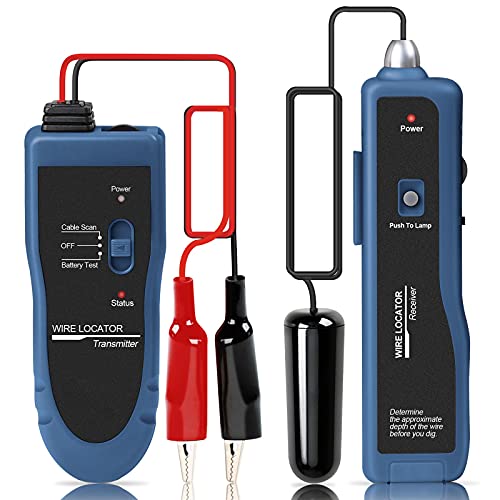
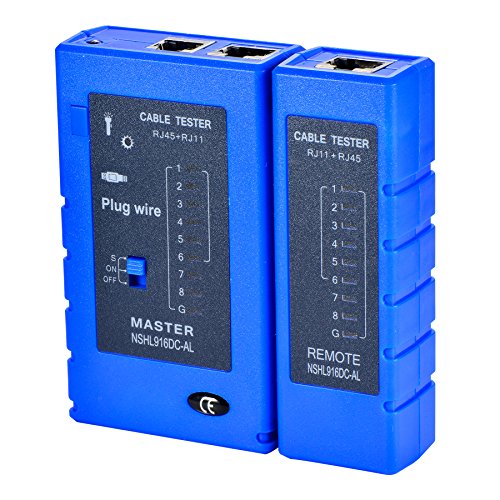
Underground Wire Tracer, TUIREL Underground Wire Locator with Earphone, Cable Tester for Locate Control Wires Cables Pet Fence Wires Locating Irrigation, Tone Generator Kit & Probe




Key features
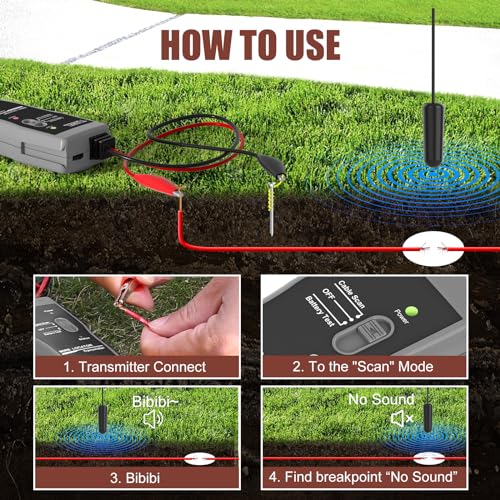
- •[Time-saving] Locating underground cables and pipes manually can be a time-consuming and labor-intensive process. With an underground cable locator, which can quickly and accurately locate the break-point and direction of underground and wall-through cables.
- •[Professional cable locator] The battery of underground wire locator can last for 3 hours under normal conditions. When the battery is in its optimal state, the wire tracking range can reach 2 feet deep and a length of 1000 feet. As the battery runs out of charge, the detection distance will become shorter.
- •[Places you can locate] Tone generator and probe kit can be used to bury sprinkler valves, wire trackers, dog fence disconnection locators, pipelines, invisible fence disconnection locators, wall buried wire trackers, wire trackers, network cable testers, electric fence testers, etc.
- •[Where it can be used] Do not use on live circuits as this may damage the tester! The cable locator is only used to locate non-energised cables. Supplied with a 9V battery for easy replacement if you need to use your device continuously without any interruptions. The Underground Cable Locator is only suitable for single or double core wires, not for multi-core wires and bundled and stranded wires.
- •[Hassle free service] If you encounter problems during the use of the wire tracer, please read the important instructions carefully, or if you have any questions about our products, please feel free to contact us, we have professional technicians at any time to answer your questions.
BrandTUIREL
CategoryNetwork & Cable Testers
Underground Wire Tracer, TUIREL Underground Wire Locator with Earphone, Cable Tester for Locate Control Wires Cables Pet Fence Wires Locating Irrigation, Tone Generator Kit & Probe
List Price: $66.77$60.09DEALYou Save: $6.68 (10%)
Free shippingFree Returns – 30 daysFree Order CancellationSecure Payment2–3 Days DeliveryGet It October 26, 2026In Stock (1)No marketing spamNo account requiredFulfilment by FedEx / Amazon / UPS / ShipwirePayPal / Card Buyer Protection
Customer Reviews
Reviews sourced from verified Amazon purchasers4.1
out of 5
Based on 10 reviews
5★
40%
4★
60%
3★
0%
2★
0%
1★
0%
Works great!!!!!
Amazon Customer✓ Verified Purchase•July 28, 2023
I used this product to locate a break for my underground dog fence and i was skeptical that it would work and it did perfectly. It saved me so much time. I would recommend this product to anyone who is considering buying it.
It was easier to use than I expected
Doug Wright✓ Verified Purchase•July 19, 2023
I purchased this to find where my invisible fence line was broken because I had lost continuity. I was Leary reading some of the reviews but it was very straightforward. The instructions were very clear and within an hour I had located and repaired the break. Hope I never have to use it again but it earned it's price in this one application.
It really worked!
JustMe✓ Verified Purchase•July 14, 2023
I took a chance on buying a relatively cheap unit, knowing that I might regret it. But it worked great for tracing my 24 VAC underground sprinkler electrical cables and finding the control valves. (Some of the valve box covers were completely overgrown with grass and I misplaced my sprinkler system map from about 20 years ago.)
This was the first time I've ever used a line detector, so I had to actually break down and read the directions, which weren't the best (or worst) I've encountered. Buried in the instruction manual is a warning to turn off any higher voltage (over 48 VAC) circuits that you might encounter in your search area (to keep from frying the detector). I missed one (120 VAC), but it didn't cause a problem - I just moved the unit away quickly, flipped the offending breaker off, and continued on with no problems. I had some questions as I read the manual, but the answers became obvious once I got started. I was able to trace the entire length of the cable, which was approx. 950 feet long. So overall, a good buy; paid for itself on the first use!
This was the first time I've ever used a line detector, so I had to actually break down and read the directions, which weren't the best (or worst) I've encountered. Buried in the instruction manual is a warning to turn off any higher voltage (over 48 VAC) circuits that you might encounter in your search area (to keep from frying the detector). I missed one (120 VAC), but it didn't cause a problem - I just moved the unit away quickly, flipped the offending breaker off, and continued on with no problems. I had some questions as I read the manual, but the answers became obvious once I got started. I was able to trace the entire length of the cable, which was approx. 950 feet long. So overall, a good buy; paid for itself on the first use!
Works With Some Trial and Error
Ken✓ Verified Purchase•June 17, 2023
This tracer comes with its own bag. The plastic on the housings is low quality, which leads to some difficulty closing the battery compartment. The instructions are not great so it may take some trial and error. Hopefully you have some known wire that you can test on. I had a break in my landscaping line and this did the trick with some frustration and effort. Overall if you are a DIYer that wants to save money compared to paying a landscaping company to fix an issue this is a reasonable deal. It is okay for the occasional user.
Helpful Tool - Takes a bit of Practice to Use - Poorly Written Manual
Amazonian✓ Verified Purchase•May 30, 2023
I'm an avid DYI'er, have a background in electronics, and often tackle my own household repairs & renovations. I ordered this signal tracer to be able to locate wires, copper pipe, or to pinpoint locations for drilling. It's billed as an underground wire locator, but also functions nicely in interior environments.
Test 1) I disconnected a breaker from my electrical panel box (Since this tester is for un-energized circuits), clipped the red wire of the signal generator to the outgoing wire, and tested for the signal along a run of standard "Romex" type house wiring. I knew ahead of time where the wire went (since this was just for testing purposes) and was able to easily trace it from the box to about 25 feet away where it entered a junction box and split, headed in two different directions to multiple light fixtures. The signal was easy to trace to the junction box but past the box, one lighting branch was easy to follow, the other had virtually no signal. I traced this wire with the red attached to the "hot" side wire and the black attached to the ground bus in the panel box, as well as testing with only the red wire connected to the "hot" wire and the black wire attached to nothing, and couldn't tell the difference.
Test 2) I traced a cable TV wire (RJ 6) that had been run underneath carpet across a room (a run of about 15 feet), by attaching the red signal generator wire to the outside, shield, portion of the cable and detecting the direction & position of the wire similar to the way one would trace the signal of an underground cable. (See the video that's available on the Amazon page where the man finds the wire running across the ground). It was easy to pinpoint the wire to within a half inch or so.
Test 3) I traced a speaker wire that runs through about 40 feet of PVC conduit by connecting the red signal generator wire to one of the leads. It was easy to trace the signal even when the conduit was 4 to 6 inches away underneath drop-type ceiling panels.
Test 4) I clipped the red signal lead to a 1/4 inch copper gas line and traced the gas line about 60 feet around the perimeter of my house. The signal was strong within 4 inches.
Test 5) I wrapped the black and red signal wires around the signal generator and hooked them to each other, then placed the signal generator on one side of a wall (standard thickness wall, with plywood on each side) and used the signal detector to pinpoint the location of the transmitter. I then checked the results by measuring from a known point, on each side of the wall and found that the detector was accurate within an inch or so. In the manual this is described as pinpointing a drill site.
Conclusion: As it states in the manual, I found it true that using a signal generator/detector is 80% skill & patience, and 20% science & theory. All my testing was on objects that I could easily verify, with transmission ranges one would expect to find in an average sized house; some objects were easy to detect, others not so easy (even when I knew basically where they were). All in all, this is a great little tool for DYI'ers, especially patient ones who are willing to get familiar with the equipment and experiment BEFORE they really need to use it to find something. I can see how this relatively inexpensive tool could easily save someone a lot of time and money if they're willing to play and get familiar with it. The kit comes with a carrying case, batteries, ear buds (for use in noisy environments), and a manual. I subtracted a star because the manual is not particularly well written or illustrated, and can easily leave one guessing whether they are using the test kit properly in different situations.
Test 1) I disconnected a breaker from my electrical panel box (Since this tester is for un-energized circuits), clipped the red wire of the signal generator to the outgoing wire, and tested for the signal along a run of standard "Romex" type house wiring. I knew ahead of time where the wire went (since this was just for testing purposes) and was able to easily trace it from the box to about 25 feet away where it entered a junction box and split, headed in two different directions to multiple light fixtures. The signal was easy to trace to the junction box but past the box, one lighting branch was easy to follow, the other had virtually no signal. I traced this wire with the red attached to the "hot" side wire and the black attached to the ground bus in the panel box, as well as testing with only the red wire connected to the "hot" wire and the black wire attached to nothing, and couldn't tell the difference.
Test 2) I traced a cable TV wire (RJ 6) that had been run underneath carpet across a room (a run of about 15 feet), by attaching the red signal generator wire to the outside, shield, portion of the cable and detecting the direction & position of the wire similar to the way one would trace the signal of an underground cable. (See the video that's available on the Amazon page where the man finds the wire running across the ground). It was easy to pinpoint the wire to within a half inch or so.
Test 3) I traced a speaker wire that runs through about 40 feet of PVC conduit by connecting the red signal generator wire to one of the leads. It was easy to trace the signal even when the conduit was 4 to 6 inches away underneath drop-type ceiling panels.
Test 4) I clipped the red signal lead to a 1/4 inch copper gas line and traced the gas line about 60 feet around the perimeter of my house. The signal was strong within 4 inches.
Test 5) I wrapped the black and red signal wires around the signal generator and hooked them to each other, then placed the signal generator on one side of a wall (standard thickness wall, with plywood on each side) and used the signal detector to pinpoint the location of the transmitter. I then checked the results by measuring from a known point, on each side of the wall and found that the detector was accurate within an inch or so. In the manual this is described as pinpointing a drill site.
Conclusion: As it states in the manual, I found it true that using a signal generator/detector is 80% skill & patience, and 20% science & theory. All my testing was on objects that I could easily verify, with transmission ranges one would expect to find in an average sized house; some objects were easy to detect, others not so easy (even when I knew basically where they were). All in all, this is a great little tool for DYI'ers, especially patient ones who are willing to get familiar with the equipment and experiment BEFORE they really need to use it to find something. I can see how this relatively inexpensive tool could easily save someone a lot of time and money if they're willing to play and get familiar with it. The kit comes with a carrying case, batteries, ear buds (for use in noisy environments), and a manual. I subtracted a star because the manual is not particularly well written or illustrated, and can easily leave one guessing whether they are using the test kit properly in different situations.
Page 1 of 2