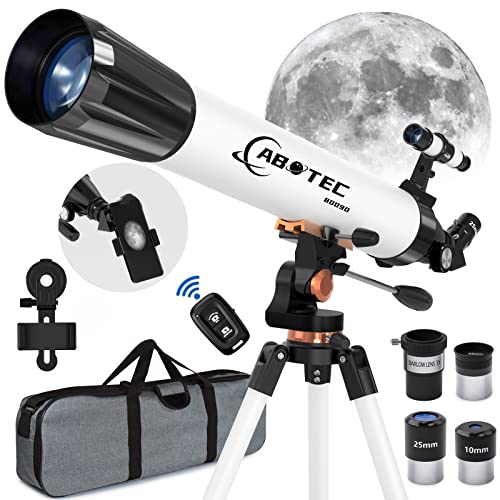
Telescope with Digital Eyepiece - Astronomy Refracting Telescope 90mm Aperture 900mm.For Beginners,Kids and Professionals, Vertisteel Altazimuth Mount, Powerful and Compact.Perfect for Observing Black




Key features
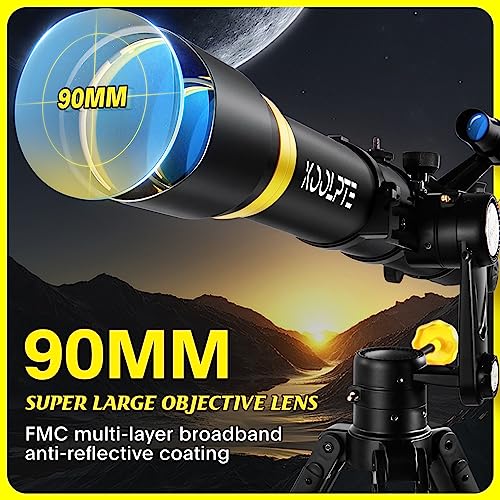
- •Powerful Optical Performance: This telescope features a 90mm aperture and 900mm focal length refracting design, providing exceptional optical performance that allows you to easily observe deep space objects in the universe.
- •Digital Eyepiece: Equipped with a digital eyepiece, you can easily capture and share astronomical images that enhance your viewing experience. This feature is not only convenient but also enhances your observation experience.
- •Sturdy and Durable Mount: The sub-black Vertisteel Altazimuth Mount provides stable support. The Free-Stop non-polar shaft - Follow-up and stop design, allowing the lens to move smoothly with high precision and maintain accurate positioning.
- •Phone Adapter & Wireless Remote: This telescope not only includes an Digital eyepiece, but also a phone adapter and wireless remote. You can easily capture and share images and videos of your observations on your phone without physically touching the telescope. This allows for a steady and stable observation experience, while also making it convenient to share your discoveries with others.
- •Suitable for Beginners and Professionals: This telescope is suitable for both beginners and professionals. Its user-friendly design and excellent optical performance make it an ideal choice for learning and researching astronomy..
Telescope with Digital Eyepiece - Astronomy Refracting Telescope 90mm Aperture 900mm.For Beginners,Kids and Professionals, Vertisteel Altazimuth Mount, Powerful and Compact.Perfect for Observing Black
List Price: $378.29$340.46DEALYou Save: $37.83 (10%)
Free shippingFree Returns – 30 daysFree Order CancellationSecure Payment2–3 Days DeliveryGet It October 26, 2026In Stock (2)No marketing spamNo account requiredFulfilment by FedEx / Amazon / UPS / ShipwirePayPal / Card Buyer Protection
Customer Reviews
Reviews sourced from verified Amazon purchasers4.7
out of 5
Based on 10 reviews
5★
80%
4★
20%
3★
0%
2★
0%
1★
0%
Great for the whole family
Nicole A.✓ Verified Purchase•December 28, 2023
If you don't know much about telescopes, this is the perfect one to start with. The set up was easy to follow and it's not hard to adjust the focal lenses or change out. There are many features we have not tired yet, but staying with the basics works great. With the 90mm aperture and 900mm focal depth, the picture was clear to view the sky and stars. This is great for family fun; my kids enjoy looking at the stars and trying to find all the planets. The base is sturdy (had one before but the stability was not great), so really pleased with this one. I'm not worried about the kids trying to look and knocking it over. The ability to use from the phone is a great added feature.
This a good one to get....good value!
Robert H.✓ Verified Purchase•December 25, 2023
This was the 2nd telescope I bought, first was returned due to a shaky base and hard to adjust. I chose this one because of the sturdy looking base....and wasn't disappointed! Sets up easy and the turn knob adjustments are great. The spotting scope is useless, but they all are and I never use it anyway. Great variety in eye-pieces (3 vs normal 2 + doppler). We built a view house and I love being able to see accross the city and the sky......Jupiter's moons are clearly visible and fun to watch be in different places every night. The wireless eyepiece seems to work fine (read directions carefully in app setup...you won't realize the network to use..it isn't obvious), I just haven't used it enough to comment much more on it.....I am old and I usually just go to the eyepiece. I will use it for pictures eventually.....images will be cool.
Good beginner telescope
Hannah Earling✓ Verified Purchase•December 16, 2023
This is an exceptional entry level telescope that effortlessly leave blends user-friendliness with remarkable optic quality, making it a perfect choice for buddy and astronomers period its aperture captures clear and bright images of celestial objects, providing and on inspiring view of the home planets and stars period the setup is straightforward requiring no tools which in courage's immediate exploration of the night sky. It's lightweight and durable design make it conveniently portable. For out or adventures , it also includes a variety of accessories enhancing the viewing experienceexperience overall , it offers an excellent introduction to astronomy promising endless nights of discovery and enjoyment for beginners.
Good entry telescope, takes some getting used to
Amazon Customer✓ Verified Purchase•December 6, 2023
Pros: Lowest price for the fine adjustments stand, sturdy enough and intuitive to maneuver to find things. Easy enough to see some detail on planets like Jupiter (moons and stripes) and Saturn (rings)
Cons: Not a very high magnification even with smaller lenses and I have found issues trying to use the barrow lens... I may have a defective one. I did get an adjustable lens to use with it which makes viewing with kids easier. I have also found that it is easy to move accidentally which can be a problem with family viewing... Luckily the fine adjusters are easy enough to use to correct. I have also had issues with the focus adjuster squeaking when I focus and that it moves the scope a little because of how tight it is in the barrel.. I may need some sort of lubricant to fix this issue. I also have had no luck using the camera attachment for taking photos.. May need more practice, but it weighs down the end quite a bit and so you can't find the object with your eye before putting on the camera...
Overall, If you're new to astronomy and want to be able to see colors of different stars and some planetary details without breaking the bank, this telescope is pretty good for the price point. I will say that it does do a good job looking at the moon, though it does not come with a moon lens so you have to put the partial cover on and be ready for your eye to get blinded a bit.. or buy a moon lens.
If you're looking for the perfect to adjust, great magnification that can take amazing pictures... you're going to need to spend a lot more money.
Cons: Not a very high magnification even with smaller lenses and I have found issues trying to use the barrow lens... I may have a defective one. I did get an adjustable lens to use with it which makes viewing with kids easier. I have also found that it is easy to move accidentally which can be a problem with family viewing... Luckily the fine adjusters are easy enough to use to correct. I have also had issues with the focus adjuster squeaking when I focus and that it moves the scope a little because of how tight it is in the barrel.. I may need some sort of lubricant to fix this issue. I also have had no luck using the camera attachment for taking photos.. May need more practice, but it weighs down the end quite a bit and so you can't find the object with your eye before putting on the camera...
Overall, If you're new to astronomy and want to be able to see colors of different stars and some planetary details without breaking the bank, this telescope is pretty good for the price point. I will say that it does do a good job looking at the moon, though it does not come with a moon lens so you have to put the partial cover on and be ready for your eye to get blinded a bit.. or buy a moon lens.
If you're looking for the perfect to adjust, great magnification that can take amazing pictures... you're going to need to spend a lot more money.
Sharp views of Jupiter and its moons, simple to use & sturdy.
Robert✓ Verified Purchase•December 2, 2023
Summary
Pros:
See the Moon in detail and see 5 planets, low price, nice contrast and brightness, sturdy mount with good controls that allow smooth tracking, lots of necessary accessories, digital eyepiece, long focal length allows larger images, light weight for portability, sharp stars that indicate good main objective lens, simple to use alt-azimuth mount which is a good choice for children and beginner adults.
Cons:
Budget finder scope and accessories are a bit hard to use and can be frustrating, manual tracking can get tiring over a long night, image quality and overall quality are not as good as the other ones I list below. This is a generic and new brand unlike well known ones like Orion or SkyWatcher. Of course it is not a professional one as those are in observatories.
Recommendation:
This is a decent beginner refractor telescope for the planets and the Moon with a variety of budget price accessories included that work, 3.5 stars overall. Do not go any smaller than 90mm objective size for a refractor. For the same price you can get better ones; either the Orion Observer 90mm refractor or the Orion Observer 134mm reflector, both of them come with a very good EQ3 mount. Orion has good quality beginner scopes that have been iterated and refined over many years. If you want something more capable for DSOs or better detail on the planets, consider larger ones like the Orion AstroView 6 reflector or Orion StarBlast 6 reflector or a 6" or 8" Dobsonian reflector (Orion, Apertura, Celestron, SkyWatcher brands) or a 90mm apochromatic refractor. All these cost just $200 or so more but they are going to give you much more quality, capability and satisfaction along with bigger objective lens or mirror. I highly recommend a 10x50 and a 20x80 set of binoculars from Orion to observe, enjoy and easily learn the night sky. For even more serious viewing, check out the Orion EON 130mm apochromatic refractor or Celestron C11 SCT along with a high quality EQ Mount with GoTo functionality along with quality eyepieces and filters.
Experienced backyard astronomers recommend an 8" Dobsonian as the best telescope to buy for most people as it can be for beginners and advanced users and is highly portable. A good example of this is the Orion SkyLine 8". Always remember, the best telescope for you is the one you use the most, not everyone uses the more advanced, big and heavy ones as often as the smaller ones, but some do. Part of the puzzle is realizing what you really want/need and how much time and money you are willing to spend.
Detailed review:
First impressions:
So far so good, after one night's observation. This is my first telescope to own and set up, but I have seen and viewed through large telescopes at observatories and local astronomy clubs. I am familiar with the night sky thanks to my binoculars and the clubs, so I know my way around stars, constellations and some DSOs.
I assembled this telescope in 90 minutes, taking my time. It was not hard, but you need to be patient and watch the short YouTube video on assembling along with the instructions, especially for attaching the tube to the mount. Using the 20 mm eye piece I was able to focus on Jupiter last night and was amazed at being able to see two bands in the middle and the 4 moons that are on the main axis. Stars are pretty well focused and appear pin point sharp with the 20mm eye piece. Using the iPhone SkyGuide app, I confirmed that I located Jupiter in the sky and then used the telescope to get it into view, but it took 15 minutes panning the scope up down, left right near the planet with the micro adjustments, which is what manually getting an object into the frame of a telescope feels like. Jupiter was bright and sharp with the 20 mm eyepiece, but with some expected chromatic aberration. It was of course magical seeing the planet and it's moons from my front porch. It just gives you a new appreciation and amazement being able to observe from your home. I am yet to try the digital eye piece. I will try to use the scope more over the next few weeks and update here.
First impressions are that this can be a good beginner telescope but manually finding objects can be hard for beginners. I wanted to see better quality and more detailed images and felt an intermediate or advanced telescope will better suit me. I set up the finder scope this one came with, which is a budget quality one as expected at this price. Children can use the finder scope once an adult sets it up. Another option to consider as a first telescope is the Orion StarBlast II 4.5 inch or the Orion Observer 134mm, in the same price range from a trusted brand name. Orion, Skywatcher and Celestron have some good beginner ones in this price range and also ones a step up for around 400 to 600 dollars.
Update 2
After a couple of more observation sessions I have noticed chromatic aberration getting in the way, which is expected as this is not an apochromatic lens (those cost much more and reduce the aberration to an extent). I could not use the finder scope well nor could I get it to align with the telescope easily and this is not uncommon with budget finder scopes, as it takes patience and trials. I also looked at Saturn, it was small with the 20 mm eye piece as expected and the rings were tough to see. I will try the digital eye piece as you need magnification to see the rings.
My needs are that I should be able to see a few of the observable brighter DSOs and the 5 easily observable solar system planets without much hassle. With a larger lens and an apochromatic refractor telescope, even in light pollution you will be able to get nice views of stars, a few star clusters, and a very few nebulae and galaxies. So far I have not been able to do that reliably with this beginner scope, if there is no progress on these, I may not use this telescope.
Update 3
Seeing what this scope does and the other reviews, I think this is a good beginner telescope. It falls just short for me, as it is not quite detailed enough for the planets and hard for the DSOs. After a couple of weeks of trying, I could finally align the finder scope with the telescope but it was tedious to use it to find the objects I wanted. To my disappointment, I could not find the Andromeda galaxy, which I can easily find with my Nikon 10X50 binoculars in a few seconds. I am not sure how the other reviewers found any brighter DSOs with this one. It appears like an ok choice for the Moon and the planets. This scope does deliver on a sturdy tripod, a light weight to be able to carry around the house or to a dark site, good manual controls over alt-azimuth movements for finding and manual tracking, comes with a bunch of low quality accessories like eye pieces including a digital one that works with your phone and a Barlow for magnification. Also, the 900 mm focal length is good to look at the Moon in detail. So you are getting a lot for under $300. Generally, a 90mm alt-azimuth refractor is a good choice for a beginner telescope as it is easy to use and easy to move around. Another telescope most often recommended is an 8" Dobsonian which is a reflector scope on a turntable base that works as an Alt Azimuth mount. The larger objective size of 8" has more light gathering capability for fainter objects. Also, I highly recommend a 10X50 pair of binoculars from Orion, Nikon or Celestron (get a bak-4 Porro prism with multi coatings). I also recommend a 20X80 or a 25X100 for DSOs. Orion makes an awesome 20x80 which I like a lot and even a 25x100 pair.
I will need to spend much more for what I am looking for. Orion said their StarBlast 4.5 won't do for me and recommended to check out their Observer 134mm($210) and AstroView 6 ($550), both are equatorial reflector telescopes. The price includes some accessories and you can get auto tracking functionality with these for 60 dollars more. Orion StarBlast 6 and Orion SkyLine 6 for around 400 dollars are other great choices. These telescopes are less tedious to use due to their quality and you will have more time to enjoy the viewing. Auto tracking functionality saves some time and effort (as the Earth rotates the object in the frame of your telescope goes out of it in a few seconds, auto tracking keeps objects in frame with tiny movements). The above mentioned scopes do not come with mounts with GoTo functionality, which will be more in the $1000 to $2000 range. Celestron currently sells a beginner one (Nextstar 130SLT GoTo reflector) and a StarSense line with partial GoTo feature. Full GoTo functionality drives the telescope automatically through its mount and software to find the object you choose from a list, but requires leveling and polar alignment set up every time you use the telescope. These are pretty easy to do in 10 minutes, once you learn. I have access to much larger telescopes with my local clubs and observatories (on observation days), it initially felt like I only needed an inexpensive one for home use, but soon realized that I am after more capable and higher quality scopes.
You can also borrow a telescope from your local club or library to get started but eventually you will want one for home use. You may end up seeing one you like a lot at an observation event, making it easier for you to choose. So far, choosing a telescope felt pretty complicated to me as I need a lighter one to move easily and have somewhat of a limited budget. The different types of scopes available along with technical details result in a longer learning curve. Also, once you are down that rabbit hole, you will want bigger aperture and different types of telescopes. The progression maybe like this: a basic refractor to start with, then a reflector on a Dobsonian mount, then a compound one like a Mak-Cass or Schmidt Cass, including a GoTo mount and 8'' or bigger aperture, then you may want to see colors in DSOs which requires an astro-photography setup that has an apochromatic triplet lens along with a field flattener, a GoTo pro mount and an astronomy camera, etc. It can get to be an expensive hobby both with your time and money, but the rewards are priceless.
You will need to use books with star charts like "Nightwatch", "The Backyard Astronomers Guide' or "˜Turn Left at Orion' along with astronomy apps like Sky Safari or Stellarium or the free version of SkyGuide. You can get advice from your local club on these. It is important to find dark sites near you, with your local club's help, to see the full capability of your telescope. You will want to learn some basics of Astronomy with books and/or YouTube or other online Astronomy crash courses. Keep up with news from JWST, Hubble and the major space agencies, every week something fascinating is reported.
Update 4:
So, I have ended up with the Orion EON 115mm apochromatic refractor with triplet lens on a good EQ Mount with Goto functionality (as the 130mm was backordered). This refractor is of high quality and highly portable in the hard shell case it comes with. The EON 130mm has been in stock since the last week of October and it is what I expected so far (sold the 115 on astromart). I also got a good 10" Dobsonian (Orion Skyline version with a nice focuser and a very good RACI finder scope). I set it up on a home made teak wood custom dolly with big wheels to avoid lifting the big telescope. I just wheel it around my yard for observation and into my garage when done. Both of these high quality scopes will be useful for many years before I need anything else.
Pros:
See the Moon in detail and see 5 planets, low price, nice contrast and brightness, sturdy mount with good controls that allow smooth tracking, lots of necessary accessories, digital eyepiece, long focal length allows larger images, light weight for portability, sharp stars that indicate good main objective lens, simple to use alt-azimuth mount which is a good choice for children and beginner adults.
Cons:
Budget finder scope and accessories are a bit hard to use and can be frustrating, manual tracking can get tiring over a long night, image quality and overall quality are not as good as the other ones I list below. This is a generic and new brand unlike well known ones like Orion or SkyWatcher. Of course it is not a professional one as those are in observatories.
Recommendation:
This is a decent beginner refractor telescope for the planets and the Moon with a variety of budget price accessories included that work, 3.5 stars overall. Do not go any smaller than 90mm objective size for a refractor. For the same price you can get better ones; either the Orion Observer 90mm refractor or the Orion Observer 134mm reflector, both of them come with a very good EQ3 mount. Orion has good quality beginner scopes that have been iterated and refined over many years. If you want something more capable for DSOs or better detail on the planets, consider larger ones like the Orion AstroView 6 reflector or Orion StarBlast 6 reflector or a 6" or 8" Dobsonian reflector (Orion, Apertura, Celestron, SkyWatcher brands) or a 90mm apochromatic refractor. All these cost just $200 or so more but they are going to give you much more quality, capability and satisfaction along with bigger objective lens or mirror. I highly recommend a 10x50 and a 20x80 set of binoculars from Orion to observe, enjoy and easily learn the night sky. For even more serious viewing, check out the Orion EON 130mm apochromatic refractor or Celestron C11 SCT along with a high quality EQ Mount with GoTo functionality along with quality eyepieces and filters.
Experienced backyard astronomers recommend an 8" Dobsonian as the best telescope to buy for most people as it can be for beginners and advanced users and is highly portable. A good example of this is the Orion SkyLine 8". Always remember, the best telescope for you is the one you use the most, not everyone uses the more advanced, big and heavy ones as often as the smaller ones, but some do. Part of the puzzle is realizing what you really want/need and how much time and money you are willing to spend.
Detailed review:
First impressions:
So far so good, after one night's observation. This is my first telescope to own and set up, but I have seen and viewed through large telescopes at observatories and local astronomy clubs. I am familiar with the night sky thanks to my binoculars and the clubs, so I know my way around stars, constellations and some DSOs.
I assembled this telescope in 90 minutes, taking my time. It was not hard, but you need to be patient and watch the short YouTube video on assembling along with the instructions, especially for attaching the tube to the mount. Using the 20 mm eye piece I was able to focus on Jupiter last night and was amazed at being able to see two bands in the middle and the 4 moons that are on the main axis. Stars are pretty well focused and appear pin point sharp with the 20mm eye piece. Using the iPhone SkyGuide app, I confirmed that I located Jupiter in the sky and then used the telescope to get it into view, but it took 15 minutes panning the scope up down, left right near the planet with the micro adjustments, which is what manually getting an object into the frame of a telescope feels like. Jupiter was bright and sharp with the 20 mm eyepiece, but with some expected chromatic aberration. It was of course magical seeing the planet and it's moons from my front porch. It just gives you a new appreciation and amazement being able to observe from your home. I am yet to try the digital eye piece. I will try to use the scope more over the next few weeks and update here.
First impressions are that this can be a good beginner telescope but manually finding objects can be hard for beginners. I wanted to see better quality and more detailed images and felt an intermediate or advanced telescope will better suit me. I set up the finder scope this one came with, which is a budget quality one as expected at this price. Children can use the finder scope once an adult sets it up. Another option to consider as a first telescope is the Orion StarBlast II 4.5 inch or the Orion Observer 134mm, in the same price range from a trusted brand name. Orion, Skywatcher and Celestron have some good beginner ones in this price range and also ones a step up for around 400 to 600 dollars.
Update 2
After a couple of more observation sessions I have noticed chromatic aberration getting in the way, which is expected as this is not an apochromatic lens (those cost much more and reduce the aberration to an extent). I could not use the finder scope well nor could I get it to align with the telescope easily and this is not uncommon with budget finder scopes, as it takes patience and trials. I also looked at Saturn, it was small with the 20 mm eye piece as expected and the rings were tough to see. I will try the digital eye piece as you need magnification to see the rings.
My needs are that I should be able to see a few of the observable brighter DSOs and the 5 easily observable solar system planets without much hassle. With a larger lens and an apochromatic refractor telescope, even in light pollution you will be able to get nice views of stars, a few star clusters, and a very few nebulae and galaxies. So far I have not been able to do that reliably with this beginner scope, if there is no progress on these, I may not use this telescope.
Update 3
Seeing what this scope does and the other reviews, I think this is a good beginner telescope. It falls just short for me, as it is not quite detailed enough for the planets and hard for the DSOs. After a couple of weeks of trying, I could finally align the finder scope with the telescope but it was tedious to use it to find the objects I wanted. To my disappointment, I could not find the Andromeda galaxy, which I can easily find with my Nikon 10X50 binoculars in a few seconds. I am not sure how the other reviewers found any brighter DSOs with this one. It appears like an ok choice for the Moon and the planets. This scope does deliver on a sturdy tripod, a light weight to be able to carry around the house or to a dark site, good manual controls over alt-azimuth movements for finding and manual tracking, comes with a bunch of low quality accessories like eye pieces including a digital one that works with your phone and a Barlow for magnification. Also, the 900 mm focal length is good to look at the Moon in detail. So you are getting a lot for under $300. Generally, a 90mm alt-azimuth refractor is a good choice for a beginner telescope as it is easy to use and easy to move around. Another telescope most often recommended is an 8" Dobsonian which is a reflector scope on a turntable base that works as an Alt Azimuth mount. The larger objective size of 8" has more light gathering capability for fainter objects. Also, I highly recommend a 10X50 pair of binoculars from Orion, Nikon or Celestron (get a bak-4 Porro prism with multi coatings). I also recommend a 20X80 or a 25X100 for DSOs. Orion makes an awesome 20x80 which I like a lot and even a 25x100 pair.
I will need to spend much more for what I am looking for. Orion said their StarBlast 4.5 won't do for me and recommended to check out their Observer 134mm($210) and AstroView 6 ($550), both are equatorial reflector telescopes. The price includes some accessories and you can get auto tracking functionality with these for 60 dollars more. Orion StarBlast 6 and Orion SkyLine 6 for around 400 dollars are other great choices. These telescopes are less tedious to use due to their quality and you will have more time to enjoy the viewing. Auto tracking functionality saves some time and effort (as the Earth rotates the object in the frame of your telescope goes out of it in a few seconds, auto tracking keeps objects in frame with tiny movements). The above mentioned scopes do not come with mounts with GoTo functionality, which will be more in the $1000 to $2000 range. Celestron currently sells a beginner one (Nextstar 130SLT GoTo reflector) and a StarSense line with partial GoTo feature. Full GoTo functionality drives the telescope automatically through its mount and software to find the object you choose from a list, but requires leveling and polar alignment set up every time you use the telescope. These are pretty easy to do in 10 minutes, once you learn. I have access to much larger telescopes with my local clubs and observatories (on observation days), it initially felt like I only needed an inexpensive one for home use, but soon realized that I am after more capable and higher quality scopes.
You can also borrow a telescope from your local club or library to get started but eventually you will want one for home use. You may end up seeing one you like a lot at an observation event, making it easier for you to choose. So far, choosing a telescope felt pretty complicated to me as I need a lighter one to move easily and have somewhat of a limited budget. The different types of scopes available along with technical details result in a longer learning curve. Also, once you are down that rabbit hole, you will want bigger aperture and different types of telescopes. The progression maybe like this: a basic refractor to start with, then a reflector on a Dobsonian mount, then a compound one like a Mak-Cass or Schmidt Cass, including a GoTo mount and 8'' or bigger aperture, then you may want to see colors in DSOs which requires an astro-photography setup that has an apochromatic triplet lens along with a field flattener, a GoTo pro mount and an astronomy camera, etc. It can get to be an expensive hobby both with your time and money, but the rewards are priceless.
You will need to use books with star charts like "Nightwatch", "The Backyard Astronomers Guide' or "˜Turn Left at Orion' along with astronomy apps like Sky Safari or Stellarium or the free version of SkyGuide. You can get advice from your local club on these. It is important to find dark sites near you, with your local club's help, to see the full capability of your telescope. You will want to learn some basics of Astronomy with books and/or YouTube or other online Astronomy crash courses. Keep up with news from JWST, Hubble and the major space agencies, every week something fascinating is reported.
Update 4:
So, I have ended up with the Orion EON 115mm apochromatic refractor with triplet lens on a good EQ Mount with Goto functionality (as the 130mm was backordered). This refractor is of high quality and highly portable in the hard shell case it comes with. The EON 130mm has been in stock since the last week of October and it is what I expected so far (sold the 115 on astromart). I also got a good 10" Dobsonian (Orion Skyline version with a nice focuser and a very good RACI finder scope). I set it up on a home made teak wood custom dolly with big wheels to avoid lifting the big telescope. I just wheel it around my yard for observation and into my garage when done. Both of these high quality scopes will be useful for many years before I need anything else.
Page 1 of 2