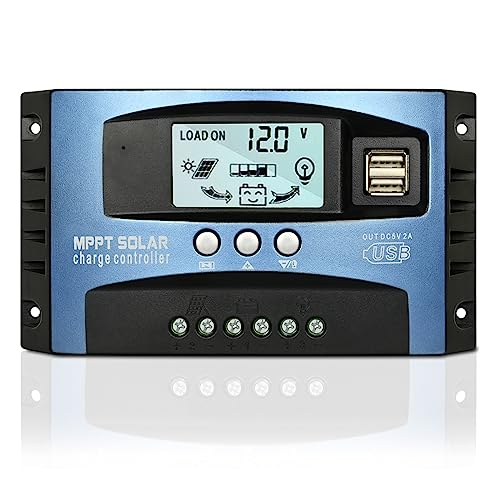
100A MPPT Solar Charge Controller, 12V 24V Dual USB Solar Panel Battery Intelligent Regulator with LCD Display, Auto Parameter Adjustable, Timer Setting, Multiple Load Control Modes



Key features
- •UPGRADED MPPT TECHNOLOGY: Detecting the maximum charging current by innovative MPPT technology highly tracking efficiency up to 99%. This MPPT solar charge controller could increase efficiency by 10%-30% compared with ordinary solar charge controller
- •WIDELY COMPATIBILITY IN BATTERY: The 100A solar charge controller is compatible with 12V or 24V systems automatically, suitable for lead-acid batteries and lithium batteries, but if you charge lithium batteries, you must set the charging parameters after connecting to the power. Dual USB 5V/3A output ports support mobiles, tablet PCs, or other devices which require 5V voltage. Please refer to the manual for more details
- •EASY TO READ AND ADJUSTABLE: Easy to read the status and data with an LCD display, which is also able to switch modes and parameter configuration, such as adjustment of battery float, reconnect, and stop discharge voltage, which can perfectly protect the lithium battery from over-discharge, suitable for home, industrial, commercial, etc
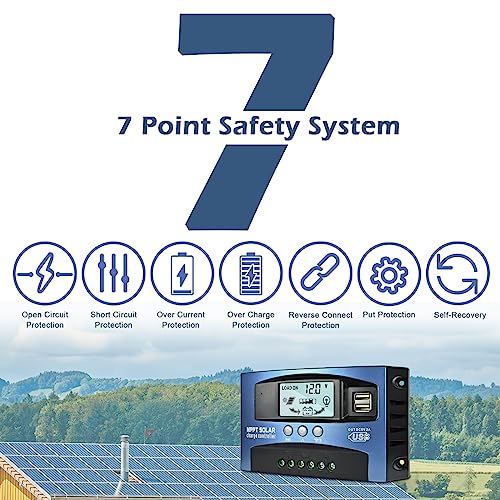
- •SAFE TO USE: Built-in overcurrent protection, short circuit protection, reverse connection protection, open circuit protection, all automatic recovery, no damage to the solar controller, but a reliable protector for your devices
- •EASY TO INSTALL AND OPERATE: The charge controller should connect the battery first, then the solar panel, and finally the load. The disassembly sequence is contrary to the wiring order. Please refer to the manual for details. We offer a 12-month warranty for quality-related issues and lifetime technique support, please contact us if any question
100A MPPT Solar Charge Controller, 12V 24V Dual USB Solar Panel Battery Intelligent Regulator with LCD Display, Auto Parameter Adjustable, Timer Setting, Multiple Load Control Modes
List Price: $50.62$45.56DEALYou Save: $5.06 (10%)
Free shippingFree Returns – 30 daysFree Order CancellationSecure Payment2–3 Days DeliveryGet It October 25, 2026In Stock (1)No marketing spamNo account requiredFulfilment by FedEx / Amazon / UPS / ShipwirePayPal / Card Buyer Protection
Customer Reviews
Reviews sourced from verified Amazon purchasers3.6
out of 5
Based on 10 reviews
5★
30%
4★
70%
3★
0%
2★
0%
1★
0%
Basic Charge Controller
WebLuke✓ Verified Purchase•December 29, 2023
It's a basic charge controller. The sticker on the back checks out with the listing, but it looks more like a PWM 50A. For basic 12V stuff, it seems ok, but I have no way of testing anything higher-powered.
May not have the MPPT features you think
Thomas H. Lawler✓ Verified Purchase•December 18, 2023
I got the 12/24V model (the manual shows one capable of 36, 48, and 60V systems is out there). For many controllers with the "MPPT" title they can accept power like 76V 5A input (created from 4 panels wired in series) and "transform" that power to something like ~14V 25A battery charge. They say in the manual for this "Max solar input 18V for 12V system, or 36V for 24V system" showing it can't do the above "transforming" that you may want in a controller. Seeing the price of this compared to others that can do such transforming it's not surprising to me that it can't do that. I even wonder if the "Max 18V for 12V system" means a panel with 22V open circuit power (which many panels will have) is unacceptable? They may mean ~18V (not that 18.5V is too high), but we need better details to know for sure. Otherwise it is a controller to prevent overcharging a battery (where many solar panel can go to 18V+, yet all 12V batteries should never go above ~14.5V).
Another item I'll bring up is the manual points out "Always connect the battery first and solar panels secondly, reversing that order when disconnecting" (which is common for most controllers). Many of the newer lithium batteries come with the built-in "Battery maintenance system" or BMS controllers that will block power when it sees the battery is full. That sudden disconnect of the battery by it's BMS controller has the potential to fry any controller from the disconnect due to that "incorrect order". I've tried to contact multiple battery OEMs asking about this concern, but they've ignored me (yet answered other Q&A). So beware that possible situation. I've thought myself "I can keep an older lead acid battery in parallel with the other to keep something connected if the BMS blocks it", yet many respond "You don't want a mix of batteries like that wired together". You can also set the max charge voltage well below where the BMS cuts out, but then you're only charging it 80% or such (taking away some of the battery capacity). So not sure what a good solution is to this dilemma (which isn't just about this product).
Another item I'll bring up is the manual points out "Always connect the battery first and solar panels secondly, reversing that order when disconnecting" (which is common for most controllers). Many of the newer lithium batteries come with the built-in "Battery maintenance system" or BMS controllers that will block power when it sees the battery is full. That sudden disconnect of the battery by it's BMS controller has the potential to fry any controller from the disconnect due to that "incorrect order". I've tried to contact multiple battery OEMs asking about this concern, but they've ignored me (yet answered other Q&A). So beware that possible situation. I've thought myself "I can keep an older lead acid battery in parallel with the other to keep something connected if the BMS blocks it", yet many respond "You don't want a mix of batteries like that wired together". You can also set the max charge voltage well below where the BMS cuts out, but then you're only charging it 80% or such (taking away some of the battery capacity). So not sure what a good solution is to this dilemma (which isn't just about this product).
Worked for my project
greenman✓ Verified Purchase•December 15, 2023
I got this to use in a battery box project. What really grabbed my attention, other than it's smaller size which was ideal for my intended use, was the fact that it has solar input through a DC connection. This is pretty rare in charge controllers, and I know you can cut and splice wires and do the same thing, both on this controller and others, but inside a box you want to keep things as simple and tidy as possible. Same thing on the load port.
I have used this with success on both actual solar power, and by using LiFePo4 chargers, even though that is discouraged, it does work.
I have used this with success on both actual solar power, and by using LiFePo4 chargers, even though that is discouraged, it does work.
very hard to set up , instructions in no better words then suck's.
Amazon Customer✓ Verified Purchase•November 28, 2023
instructions in no better words then suck's.
Works as it’s supposed to
Brian Jones✓ Verified Purchase•November 18, 2023
This little MPPT charge controller works fine as someone who is use these in the past I would recommend you read the instructions, so you know what to plug-in first. If this is not installed correctly, it will pop and be worthless. Once connected and working, it works great.
Page 1 of 2


