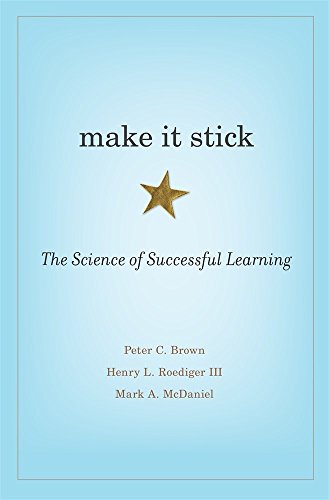
Make It Stick: The Science of Successful Learning

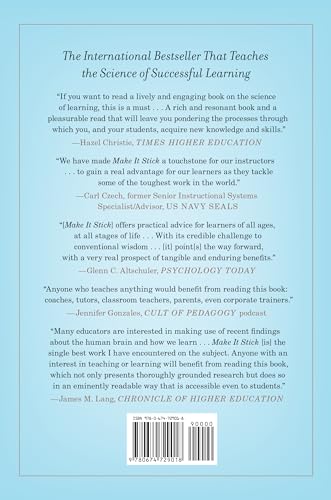


Key features
- •Belknap Press
Make It Stick: The Science of Successful Learning
List Price: $34.84$31.36DEALYou Save: $3.48 (10%)
Free shippingFree Returns – 30 daysFree Order CancellationSecure Payment2–3 Days DeliveryGet It October 25, 2026In Stock (30)No marketing spamNo account requiredFulfilment by FedEx / Amazon / UPS / ShipwirePayPal / Card Buyer Protection
Customer Reviews
Reviews sourced from verified Amazon purchasers4.6
out of 5
Based on 10 reviews
5★
40%
4★
50%
3★
10%
2★
0%
1★
0%
Everyone that is an educator should read this, along with anyone learning something new
Russell W Carey✓ Verified Purchase•September 2, 2017
The science of actual learning, backed up by evidence to support it. This book helped me understand why it felt like some new technologies I was learning felt like they weren't sticking. I'm extremely glad I read this book. I was very frustrated with how slow I felt like I was learning new concepts, but reading this helped me understand that it wasn't time to quit.
It also does a good job for laying out a case as to the deficiency of the current education system and just how broken it is, although they left that to lawmakers to figure out. After reading this book, I now realize just how broken teaching and learning really is.
It also does a good job for laying out a case as to the deficiency of the current education system and just how broken it is, although they left that to lawmakers to figure out. After reading this book, I now realize just how broken teaching and learning really is.
Very useful for both students and teachers who care about long-term learning
Barbara McElroy✓ Verified Purchase•June 3, 2017
A very readable book that reports research results about how to teach and learn for long-term retention. It bridges the gap between layperson and academic by moving references and citations to an appendix but being relatively easy to read. Recommended for teachers, professors, and those who want to retain the information they are learning, not just pass the next test.
Incorrect emphasis on effort as a way to increase learning
Booker T✓ Verified Purchase•November 16, 2016
I'm a practitioner in human learning and memory. I understand the field -- uh, well, it's too vast to grasp more than a little. But I have conducted untold thousands of up-close observations on learners of all ages, and I've had the privilege of testing theories and methods. I've also developed many of my own techniques for enhancing learning and memory. I really enjoyed all the different examples spelled out in this book. It's a tremendous, beautiful collection of findings that do matter. One persistent weakness is the authors' ongoing theme of the benefit of "effortful retrieval." They hammer on the claim that the harder you work at it, the better you learn. Since I have spent years showing the opposite, I can imagine that readers would feel like straining is equal to better learning. I thought the authors would clarify their understanding of this and say something that showed they don't mean what they seemed to be saying. But as the book draws closer to the end, the assertion gets stronger. It's an unnecessary one that wouldn't take much to tweak. My point is that at certain intervals there are ways to increase learning by reducing effort.
One more thing, a kind of funny one. Author Mark's father taught me a lot about testing and measurements and how powerful multiple-choice tests can be. They can be amazing and complex. So, I chuckled each time the authors compared good tests to mere multiple-choice tests.
One more thing, a kind of funny one. Author Mark's father taught me a lot about testing and measurements and how powerful multiple-choice tests can be. They can be amazing and complex. So, I chuckled each time the authors compared good tests to mere multiple-choice tests.
Novel ideas that are good for the individual, but I think orthodoxy will inhibit their use broadly.
Harlan Kanoa Sheppard✓ Verified Purchase•October 15, 2016
When I decided to continue my schooling, I wanted to make the best use of my time. Strange how it took me so long to wise up.
In 'Make It Stick' the author (Brown) makes a persuasive argument for changing the way that we impart information to others in order to render it effective. Granted, a lot of what he's talking about is difficult, but that's for social reasons. What I took away from this book was the notion of 'effortful learning'. The notion that learning should be hard, and that's not something we should shy away from.
There's only a few points that are eye-opening, but the author does a reasonably good job of hammering in those points with anecdotes from different angles that you're bound to pick up on one of them. I can say that I took something away from this book that has helped my learning elsewhere.
In 'Make It Stick' the author (Brown) makes a persuasive argument for changing the way that we impart information to others in order to render it effective. Granted, a lot of what he's talking about is difficult, but that's for social reasons. What I took away from this book was the notion of 'effortful learning'. The notion that learning should be hard, and that's not something we should shy away from.
There's only a few points that are eye-opening, but the author does a reasonably good job of hammering in those points with anecdotes from different angles that you're bound to pick up on one of them. I can say that I took something away from this book that has helped my learning elsewhere.
an important point of view
Michael George✓ Verified Purchase•May 26, 2016
The extent to which a person is able to learn, how learning can be effectively pursued, and then later retain the skills and knowledge gained from the learning activities involve critical questions for all of us, not just for teachers, like myself. It is also important to understand how and the extent to which we can improve on this learning. These are, from the perspective of science (and perhaps from the perspectives of most of us) not just involved with critical problems, but hard ones as well. This book, through stories and discussions, takes us into the heart of some of the important scientific findings, arrived at over many years of research in psychology, education and other fields. There are hugely subtle influences here associated with the individual trying to learn and retain what she learns, and her environment, and the feedback that occurs. Thus, it is not too surprising that science is uncovering what appear to be some fairly non-intuitive findings about this. Personally, I found the book filled with interesting ideas. We know that we often, as teachers, have forgotten the steep hills we had to climb to mastery. Therefore, I think a book like this that attends to many facets of the learning process is a valuable antidote to complacency. It is easy to lack empathy and appreciation for the struggles of a student, or of anyone trying to learn something important or useful, when you are already a master or expert. I feel this book places a lot of this struggle in some good perspective, and the "scientific" point of view expounded is helpful. I would, however, suggest that the summary dismissal of various strategies for learning, such as massed study and re-reading, and the emphasis on problems and tests, may not be as warranted as the current "science" suggests. It is sobering to be somewhat aware of the history of science, and how often science goes astray. That said, and that it is wise to bring a healthy dose of skepticism, this book presents a worthwhile point of view to be aware of, in a most subtle and difficult area of science.
Page 1 of 2


![Nero 11 Platinum [Old Version]](https://m.media-amazon.com/images/I/51FN826rLTL._SL500_.jpg)