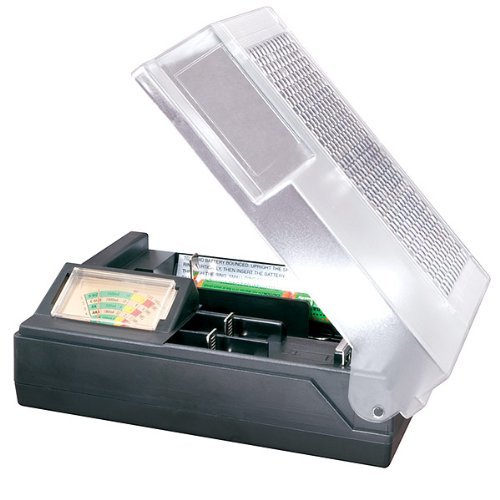
C.Crane 11-in-1 Solar Battery Charger
Key features
- •Solar battery charger. Recharge batteries with the sun!
- •Charges 11 different NiCd and NiMH battery sizes (AAA, AA, C, D, and 7 GUM sizes) Never be without power again!
- •Charges 2 pcs of NIMH or NiCad "D"/"C"/"AA"/"AAA" size rechargeable batteries
- •Adjustable top lid and bottom stand for optimal sunlight exposure
- •Blocking diode to prevent discharge
BrandC.CRANE
CategoryBatteries & Accessories
C.Crane 11-in-1 Solar Battery Charger
List Price: $43.63$39.27DEALYou Save: $4.36 (10%)
Free shippingFree Returns – 30 daysFree Order CancellationSecure Payment2–3 Days DeliveryGet It June 22, 2026In Stock (3)No marketing spamNo account requiredFulfilment by FedEx / Amazon / UPS / ShipwirePayPal / Card Buyer Protection
Customer Reviews
Reviews sourced from verified Amazon purchasers4.1
out of 5
Based on 10 reviews
5★
60%
4★
40%
3★
0%
2★
0%
1★
0%
Good product
soly✓ Verified Purchase•September 3, 2023
I got it for my sister in PR because a hurricane. Electric out for months. She let it out on the sun by the window that got all day light. She said it worked great. But if you can change it with a outlet first it charges better. But that was not the case with her. And it still changed all her rechargeable batteries. She keeps it in storage. And when the lights go off she takes it out and recharge her batteries. Loves the convinced of having one. She keeps extra batteries. So it gives her time to charge the rechargeable ones. It takes about 8 plus hrs depending on the sun for her batteries to recharge.
Easy to use. Takes a long time to charge, but it's free electricity. LOVE this thing!! Will update review as needed.
University Doc✓ Verified Purchase•August 21, 2023
8/22/17: I just received this today and I already placed two AA batteries in it and placed outside in the Hot Delta sun for charging. Very easy to figure out and use. Does accommodate all sizes of batteries except 9Volt. Charges two of the same size batteries at a time.
Information on box gives average charging times as such: AAA takes 6 to 12hours; AA takes 15 to 31hours; C takes 31 to 62 hours and D batteries take 69 to 138hours. Yes that is a long time, but if you are in a situation like a power outage, hopefully, you began with fully charged batteries and this is for when you need to recharge an extra set to use. Plus, you're not paying a cent to charge the batteries.
Will update when our batteries are charged. Reviews on manufacturer site warn to keep cover slightly open to avoid baking batteries. The meter does work and shows when batteries are not charged and are charging. manufacturer site at C.Crane does have more information and specs on this item. They do recommend full sunlight to charge, but will charge in bright weather, too, but will take longer. If this does work as expected, I have no problem with buying another one or two to keep on hand.
8/23/17 UPDATE: It took six (6) hours to charge my dead NIMH batteries. Will be following up with charging other types of batteries.
Information on box gives average charging times as such: AAA takes 6 to 12hours; AA takes 15 to 31hours; C takes 31 to 62 hours and D batteries take 69 to 138hours. Yes that is a long time, but if you are in a situation like a power outage, hopefully, you began with fully charged batteries and this is for when you need to recharge an extra set to use. Plus, you're not paying a cent to charge the batteries.
Will update when our batteries are charged. Reviews on manufacturer site warn to keep cover slightly open to avoid baking batteries. The meter does work and shows when batteries are not charged and are charging. manufacturer site at C.Crane does have more information and specs on this item. They do recommend full sunlight to charge, but will charge in bright weather, too, but will take longer. If this does work as expected, I have no problem with buying another one or two to keep on hand.
8/23/17 UPDATE: It took six (6) hours to charge my dead NIMH batteries. Will be following up with charging other types of batteries.
Works as expected
Nancy Hepp✓ Verified Purchase•July 21, 2023
I've had this charger for almost 3 years now, and I'm delighted with it. I'm a cyclist and use battery-powered lights quite a lot. I also live in a place where the power can go out for many hours at a time, and having battery-powered lights at home is essential.
I've charged batteries dozens of times. This has definitely paid for itself compared to purchasing single-use batteries. The electricity to charge my batteries would have had minimal cost, but I like knowing that the light that shines on the road ahead of me is stored sunshine with a very small carbon footprint. Even better, I can charge batteries when the power is out or when away from home. This would work well on a car-camping trip if you don't want to buy a lot of batteries. For backpacking, it's probably lighter and definitely more compact just to carry spare batteries.
I used to live in a shady place with mottled sunshine, where it wasn't very efficient and took all day to charge, but now I'm in full sun and can reliably charge 2 AA or AAA batteries in 3-4 hours as long as I reposition it to aim at the sun every hour or so. The charger definitely works best outdoors in full sun and not through a window. I've even charged batteries under a grow light, but charging took 2 days.
If you use a lot of batteries, this would be a good investment. I've charged both Ni-MH and Ni-Cd batteries. I would definitely buy this again and have recommended it to others.
I've charged batteries dozens of times. This has definitely paid for itself compared to purchasing single-use batteries. The electricity to charge my batteries would have had minimal cost, but I like knowing that the light that shines on the road ahead of me is stored sunshine with a very small carbon footprint. Even better, I can charge batteries when the power is out or when away from home. This would work well on a car-camping trip if you don't want to buy a lot of batteries. For backpacking, it's probably lighter and definitely more compact just to carry spare batteries.
I used to live in a shady place with mottled sunshine, where it wasn't very efficient and took all day to charge, but now I'm in full sun and can reliably charge 2 AA or AAA batteries in 3-4 hours as long as I reposition it to aim at the sun every hour or so. The charger definitely works best outdoors in full sun and not through a window. I've even charged batteries under a grow light, but charging took 2 days.
If you use a lot of batteries, this would be a good investment. I've charged both Ni-MH and Ni-Cd batteries. I would definitely buy this again and have recommended it to others.
A versatile solar battery charger
David Sims✓ Verified Purchase•July 11, 2023
I bought two of these recently. They do what they are supposed to do. I've used them to recharge Sanyo Eneloop batteries after I drained them in my Kodak digital camera. This battery charger works quite well. It uses sunlight to generate a current that charges pairs of batteries in sizes AAA, AA, C, or D. It will also charge gum batteries.
Sanyo Eneloop AA Battery 4 pack Precharged Use Up to 1500 Times
Kodak EasyShare C182 Digital Camera (Blue)
However, it will not recharge 9-volt batteries. The voltage from the solar panel isn't high enough. If you want to charge a 9V battery, the product you need is
AA and 9 volt battery charger with 3, 6, 9, and 12 volt power supply
The only thing the Crane charger's dial really indicates is current. The time shown on the dial is an estimate based on the assumption that the battery was drained until its pole potential difference was about one volt. It isn't the amount of time remaining. You still have to check the batteries from time to time with a voltmeter, until they're just over 1.4 volts each when you measure them with a voltmeter 30 minutes after taking them out of the charger. (The battery voltage usually falls off by 0.01V to 0.03V during the first half hour after removal.)
Not all of these chargers are equals. Some of them generate a higher charging voltage than others do. I tested mine with a voltmeter and found that one of them has a maximum voltage (full sun on perpendicular panel) of 5.4 volts, while the other shows 4.8 volts. As the result, the charger that creates the higher voltage charges pairs of batteries faster than the other one does. But both of them do charge pairs of NiMH batteries.
Added 21 April 2011. I bought a third charger. The voltage in full sun with panel normal is 5.2 volts.
Will a solar battery charger pay for itself? It depends on how you look at it. Versus buying lots of single-use alkaline or lithium batteries, definitely it will. Versus recharging batteries with a cheaper house-current powered charger, probably not. In 1500 rechargings of a pair of Eneloop batteries, you'll be lucky to get a dollar's worth of electricity out of them, at the present price of utility supplied electricity.
E = total energy
B = number of batteries = 2
R = number of rechargings = 1500
P = electric power
T = time
V = average battery voltage = 1.25V
E = BRPT = BR(IV)T = BR(IT)V
IT = 2000 mAh = 7200 amp-sec
E = (2 batteries)(1500 rechargings)(7200 amp-seconds)(1.25 volts)
E = 2.7e7 Joules = 7.5 kWh
Cost = 7.5 kWh ($0.1/kWh) = 75 cents.
Consider a solar battery charger to be a way to hedge your battery investment against the possibility that you might not have house current someday.
Added 21 April 2011. The maximum charging voltage for my best Crane charger is 5.42V. Once it has enough light intensity to reach this maximum voltage, further increases in light intensity no longer raise the voltage, but will raise the current flow. In full sun, with panel normal, the highest current flow I noticed was 0.180 amps. So the power being put into the batteries, at most, by the Crane charger is about 0.976 watts. This energy transfer rate will slow to about 0.457 watts as the two batteries, upon being charged, oppose their own voltage to that from the solar panel, assuming that the sunlight remains at a constant intensity and that the panel remains normal to the sun's direction during that time. If I approximate the average energy transfer rate by averaging the extremes of net voltage, it would take about 7 hours to fully recharge a pair of 2000 mAh AA batteries that had been completely discharged before recharging. In actual practice, you don't really fully discharge the batteries; you recharge them when their voltage has dropped so low (but not to zero) that they can't make anything work anymore, so it doesn't take as long as seven hours to top them off again.
Added 21 April 2011. Contrary to some of the reviews here, this charger will charge a pair of AAA, AA, C, or D size NiMH batteries on a cloudy day. The voltage from the solar panel on a cloudy day remains high enough to do the job. However, because the current can be under 30mA under heavily overcast skies, the charging rate would be very, very slow.
Added 24 April 2011.
Assuming 1 volt potential difference across the poles of the battery.
Full sun: (5.4V-1.0V) x 180 mA = 0.79 W
Sunny w/ hazy sky: (5.0V-1.0V) x 150 mA = 0.60 W
Overcast by small cloud: (4.8V-1.0V) x 80 mA = 0.30 W
Strong overcast: (4.3V-1.0V) x 20 mA = 0.07 W
The charger works about 11 times faster on a clear day than it does on a strongly overcast day.
There's no need to weep and gnash your teeth in the outer darkness. With rechargeable low-self-discharge batteries and these solar battery chargers, you'll have power for your flashlights and digital cameras far into the die-off period of the Apocalypse. So stock up!
Sanyo Eneloop AA Battery 4 pack Precharged Use Up to 1500 Times
Kodak EasyShare C182 Digital Camera (Blue)
However, it will not recharge 9-volt batteries. The voltage from the solar panel isn't high enough. If you want to charge a 9V battery, the product you need is
AA and 9 volt battery charger with 3, 6, 9, and 12 volt power supply
The only thing the Crane charger's dial really indicates is current. The time shown on the dial is an estimate based on the assumption that the battery was drained until its pole potential difference was about one volt. It isn't the amount of time remaining. You still have to check the batteries from time to time with a voltmeter, until they're just over 1.4 volts each when you measure them with a voltmeter 30 minutes after taking them out of the charger. (The battery voltage usually falls off by 0.01V to 0.03V during the first half hour after removal.)
Not all of these chargers are equals. Some of them generate a higher charging voltage than others do. I tested mine with a voltmeter and found that one of them has a maximum voltage (full sun on perpendicular panel) of 5.4 volts, while the other shows 4.8 volts. As the result, the charger that creates the higher voltage charges pairs of batteries faster than the other one does. But both of them do charge pairs of NiMH batteries.
Added 21 April 2011. I bought a third charger. The voltage in full sun with panel normal is 5.2 volts.
Will a solar battery charger pay for itself? It depends on how you look at it. Versus buying lots of single-use alkaline or lithium batteries, definitely it will. Versus recharging batteries with a cheaper house-current powered charger, probably not. In 1500 rechargings of a pair of Eneloop batteries, you'll be lucky to get a dollar's worth of electricity out of them, at the present price of utility supplied electricity.
E = total energy
B = number of batteries = 2
R = number of rechargings = 1500
P = electric power
T = time
V = average battery voltage = 1.25V
E = BRPT = BR(IV)T = BR(IT)V
IT = 2000 mAh = 7200 amp-sec
E = (2 batteries)(1500 rechargings)(7200 amp-seconds)(1.25 volts)
E = 2.7e7 Joules = 7.5 kWh
Cost = 7.5 kWh ($0.1/kWh) = 75 cents.
Consider a solar battery charger to be a way to hedge your battery investment against the possibility that you might not have house current someday.
Added 21 April 2011. The maximum charging voltage for my best Crane charger is 5.42V. Once it has enough light intensity to reach this maximum voltage, further increases in light intensity no longer raise the voltage, but will raise the current flow. In full sun, with panel normal, the highest current flow I noticed was 0.180 amps. So the power being put into the batteries, at most, by the Crane charger is about 0.976 watts. This energy transfer rate will slow to about 0.457 watts as the two batteries, upon being charged, oppose their own voltage to that from the solar panel, assuming that the sunlight remains at a constant intensity and that the panel remains normal to the sun's direction during that time. If I approximate the average energy transfer rate by averaging the extremes of net voltage, it would take about 7 hours to fully recharge a pair of 2000 mAh AA batteries that had been completely discharged before recharging. In actual practice, you don't really fully discharge the batteries; you recharge them when their voltage has dropped so low (but not to zero) that they can't make anything work anymore, so it doesn't take as long as seven hours to top them off again.
Added 21 April 2011. Contrary to some of the reviews here, this charger will charge a pair of AAA, AA, C, or D size NiMH batteries on a cloudy day. The voltage from the solar panel on a cloudy day remains high enough to do the job. However, because the current can be under 30mA under heavily overcast skies, the charging rate would be very, very slow.
Added 24 April 2011.
Assuming 1 volt potential difference across the poles of the battery.
Full sun: (5.4V-1.0V) x 180 mA = 0.79 W
Sunny w/ hazy sky: (5.0V-1.0V) x 150 mA = 0.60 W
Overcast by small cloud: (4.8V-1.0V) x 80 mA = 0.30 W
Strong overcast: (4.3V-1.0V) x 20 mA = 0.07 W
The charger works about 11 times faster on a clear day than it does on a strongly overcast day.
There's no need to weep and gnash your teeth in the outer darkness. With rechargeable low-self-discharge batteries and these solar battery chargers, you'll have power for your flashlights and digital cameras far into the die-off period of the Apocalypse. So stock up!
Use the Energy From the Sky
Walter Chmara✓ Verified Purchase•June 24, 2023
I have quite a few devices that require AA and AAA batteries, so I'm investing
in this charger and rechargeable batteries for long-term savings.
It does work on my window sill on a sunny day (it works much better if the window is open). The instructions tell you to reclose the solar panel cover once you load the batteries, but I find that propping it up with a pencil at a 45-degree angle to the sun works better.
The built-in meter will give you an estimation of how long it will take to charge your batteries according to how much sun it is getting at any given moment, so the needle fluctuates with the clouds., making it difficult to determine how much real time they need.
The makers could have added a little tweak to use the same needle to measure how full the batteries actually are, but they didn't do that. Fortunately, I do have a gadget that can test the batteries (which I keep numbered so I can tell them apart).
I intend to review the battery performance when I start using them.
in this charger and rechargeable batteries for long-term savings.
It does work on my window sill on a sunny day (it works much better if the window is open). The instructions tell you to reclose the solar panel cover once you load the batteries, but I find that propping it up with a pencil at a 45-degree angle to the sun works better.
The built-in meter will give you an estimation of how long it will take to charge your batteries according to how much sun it is getting at any given moment, so the needle fluctuates with the clouds., making it difficult to determine how much real time they need.
The makers could have added a little tweak to use the same needle to measure how full the batteries actually are, but they didn't do that. Fortunately, I do have a gadget that can test the batteries (which I keep numbered so I can tell them apart).
I intend to review the battery performance when I start using them.
Page 1 of 2