Kaito KA321 Pocket-Size 10-Band AM/FM Shortwave Radio with DSP (Digital Signal Processing), Black


Key features
- •AM/FM Shortwave receiver with Silicon Lab DSP Technology (Digital Signal Processing)
- •Wide range FM coverage from 64-108 MHz
- •Stereo earphone jack for private listening
- •Palm size radio, ideal for travelling, backpacking & etc.
- •1-year manufacturer's warranty
Kaito KA321 Pocket-Size 10-Band AM/FM Shortwave Radio with DSP (Digital Signal Processing), Black
List Price: $38.39$34.55DEALYou Save: $3.84 (10%)
Free shippingFree Returns – 30 daysFree Order CancellationSecure Payment2–3 Days DeliveryGet It October 25, 2026In Stock (2)No marketing spamNo account requiredFulfilment by FedEx / Amazon / UPS / ShipwirePayPal / Card Buyer Protection
Customer Reviews
Reviews sourced from verified Amazon purchasers4.2
out of 5
Based on 10 reviews
5★
80%
4★
20%
3★
0%
2★
0%
1★
0%
Like It a Lot
JNieporte✓ Verified Purchase•August 3, 2023
I was a bit hesitant to buy a shortwave radio that costs $20. Is this going to be a dollar store piece of junk? I know Kaito is a well-known brand, and have always been satisfied with their products, so I was eager to see how this performed. If you are familiar with the brand Degen, the Kaito KA321 is the same radio as the Degen DE321.
The KA321 is a small radio. It's 4-3/4" long and 2-3/4" high, and is 5/8" thick. It weighs 3.7 ounces with the batteries inserted. Inside the box are the radio itself, an instruction sheet, product registration sheet, and a wrist strap. The KA321 is constructed rather well for a radio of this cost. Sure, it's hard plastic, but it feels sturdy. Two AA batteries are required to operate the radio; batteries aren't included. Another reviewer mentioned the KA321 as coming with rechargeable lithium batteries, but this isn't listed in the product description, nor were there any in the package. With fresh Rayovac alkalines, I got just under 170 hours of use. That's pretty good.
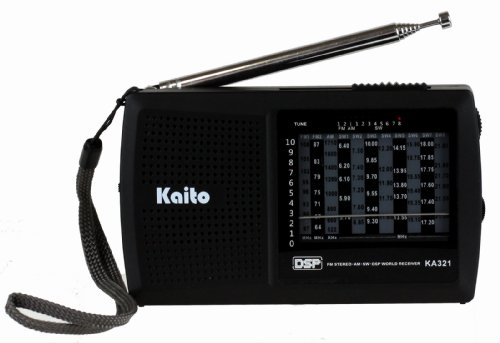
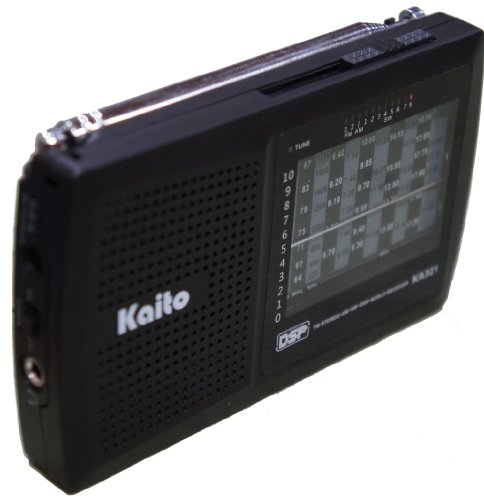
The front of the radio has the speaker, which is 1-3/4" in diameter. It sounds great for a speaker of this size and price! Also on the front is the frequency display. It's a non-LCD, and not backlit. The top of the display shows which band you're tuned into. There's FM1 (87MHz - 108MHz), FM2 (64MHz - 87MHz), AM (522KHz - 1710KHz), and eight shortwave bands (SW1, SW2, etc.) that go from 5700KHz to 21950KHz. The band is shown with a simple red dot that's painted on the slide and shows through a square on the display. Simple, but effective. The frequency display itself is basic; black and grey background with numbers on it. The numbers are easy to read, but the plastic screen does put out a lot of glare. When tuning, the metal bar moves up or down to indicate the frequency you're on.
The left side of the KA321 has four things: the wrist strap attachment, the power adapter jack, the on / off switch, and the headphone jack. The wrist strap attachment is just that; a slot to attach the wrist strap to. The wrist strap comes unattached, and is grey nylon about 8" long. The power adapter jack is a 5 volt DC input connector (150ma, center pin positive). No external power source or cable is included. Under this is the on / off switch, which is clearly labeled and is just a slide switch. It's stiff enough to not move accidentally. Under that is the headphone jack. It works as advertised, and is in stereo.
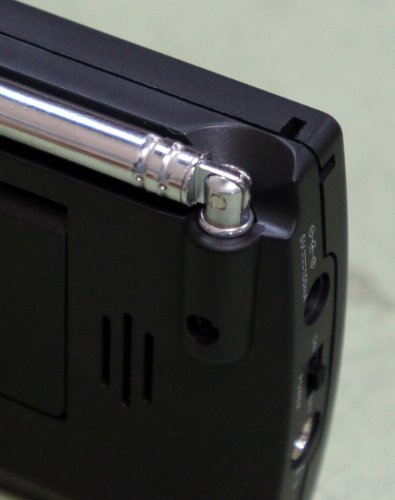
On the top of the KA321 is the antenna, which is 17-3/4" long when fully extended. It folds onto the top of the radio and is slightly recessed so it doesn't snag on things, and rotates 360 degrees. It's surprisingly well-made and sturdy. Also on the top is the band selector, which is a ridged, sliding switch. It has a soft "click" as it goes into each band. It's the same piece as the small red painted dot that indicates the band.
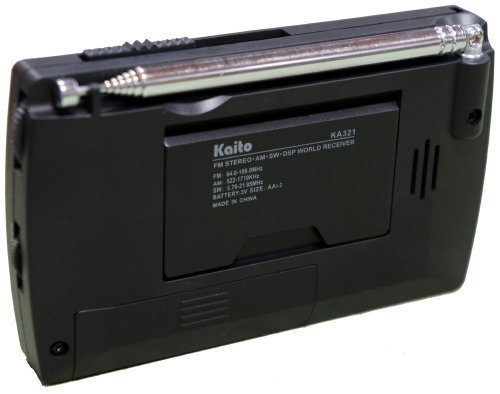
The back of the radio has the antenna (see above), the stand, and the battery compartment. The stand is just a piece of plastic that swivels to allow the radio to be set at a better-than-flat angle for viewing. It also lists the bands available. The battery compartment is on the bottom in the back. The battery door is just a removable piece of formed plastic, and is removed easily. Two AA batteries are needed for the radio to work, and this is labeled inside the battery compartment. A piece of nylon is there to help remove the batteries.
The underside of the radio has two small ridges to help it stand up if you want it to, but there's nothing else on the bottom.
The right side of the KA321 features the tuning and volume controls. They're just ridged dials, but they do their jobs. The volume can get really loud on this radio, which is pretty surprising for such a cheap thing. I did notice some distortion when getting really loud, but in all honesty, you won't use it that loud anyway. The tuning dial is a bit stiff, but I found that this helped not lose a channel once it was "locked in" with the DSP.
As far as reception, the KA321 is a mixed bag. The two FM bands come in very clear. The AM band is iffy, and often wouldn't pull in the same frequencies as other similar-sized radios that were inches away. The shortwave bands all work. I live in Ohio, and the frequencies I like picking up are on the other side of the world. This means that when it's daytime and I'm awake, there's nothing to listen to because it's night there. This isn't the radio's fault; if nobody is broadcasting, there's just static. I was able to pick up some stations that I couldn't even find on my Radio Shack shortwave, but a few of the local shortwave stations were better on the Radio Shack unit.
Overall, I'm very pleased with the KA321. It's small enough to fit in the back pocket of your pants and gets nice reception. My only reservation about getting it is if you want it for AM stations. Show me a better $20 radio that gets AM, FM, and shortwave.
The KA321 is a small radio. It's 4-3/4" long and 2-3/4" high, and is 5/8" thick. It weighs 3.7 ounces with the batteries inserted. Inside the box are the radio itself, an instruction sheet, product registration sheet, and a wrist strap. The KA321 is constructed rather well for a radio of this cost. Sure, it's hard plastic, but it feels sturdy. Two AA batteries are required to operate the radio; batteries aren't included. Another reviewer mentioned the KA321 as coming with rechargeable lithium batteries, but this isn't listed in the product description, nor were there any in the package. With fresh Rayovac alkalines, I got just under 170 hours of use. That's pretty good.
The front of the radio has the speaker, which is 1-3/4" in diameter. It sounds great for a speaker of this size and price! Also on the front is the frequency display. It's a non-LCD, and not backlit. The top of the display shows which band you're tuned into. There's FM1 (87MHz - 108MHz), FM2 (64MHz - 87MHz), AM (522KHz - 1710KHz), and eight shortwave bands (SW1, SW2, etc.) that go from 5700KHz to 21950KHz. The band is shown with a simple red dot that's painted on the slide and shows through a square on the display. Simple, but effective. The frequency display itself is basic; black and grey background with numbers on it. The numbers are easy to read, but the plastic screen does put out a lot of glare. When tuning, the metal bar moves up or down to indicate the frequency you're on.
The left side of the KA321 has four things: the wrist strap attachment, the power adapter jack, the on / off switch, and the headphone jack. The wrist strap attachment is just that; a slot to attach the wrist strap to. The wrist strap comes unattached, and is grey nylon about 8" long. The power adapter jack is a 5 volt DC input connector (150ma, center pin positive). No external power source or cable is included. Under this is the on / off switch, which is clearly labeled and is just a slide switch. It's stiff enough to not move accidentally. Under that is the headphone jack. It works as advertised, and is in stereo.
On the top of the KA321 is the antenna, which is 17-3/4" long when fully extended. It folds onto the top of the radio and is slightly recessed so it doesn't snag on things, and rotates 360 degrees. It's surprisingly well-made and sturdy. Also on the top is the band selector, which is a ridged, sliding switch. It has a soft "click" as it goes into each band. It's the same piece as the small red painted dot that indicates the band.
The back of the radio has the antenna (see above), the stand, and the battery compartment. The stand is just a piece of plastic that swivels to allow the radio to be set at a better-than-flat angle for viewing. It also lists the bands available. The battery compartment is on the bottom in the back. The battery door is just a removable piece of formed plastic, and is removed easily. Two AA batteries are needed for the radio to work, and this is labeled inside the battery compartment. A piece of nylon is there to help remove the batteries.
The underside of the radio has two small ridges to help it stand up if you want it to, but there's nothing else on the bottom.
The right side of the KA321 features the tuning and volume controls. They're just ridged dials, but they do their jobs. The volume can get really loud on this radio, which is pretty surprising for such a cheap thing. I did notice some distortion when getting really loud, but in all honesty, you won't use it that loud anyway. The tuning dial is a bit stiff, but I found that this helped not lose a channel once it was "locked in" with the DSP.
As far as reception, the KA321 is a mixed bag. The two FM bands come in very clear. The AM band is iffy, and often wouldn't pull in the same frequencies as other similar-sized radios that were inches away. The shortwave bands all work. I live in Ohio, and the frequencies I like picking up are on the other side of the world. This means that when it's daytime and I'm awake, there's nothing to listen to because it's night there. This isn't the radio's fault; if nobody is broadcasting, there's just static. I was able to pick up some stations that I couldn't even find on my Radio Shack shortwave, but a few of the local shortwave stations were better on the Radio Shack unit.
Overall, I'm very pleased with the KA321. It's small enough to fit in the back pocket of your pants and gets nice reception. My only reservation about getting it is if you want it for AM stations. Show me a better $20 radio that gets AM, FM, and shortwave.
Good little radio
james foster✓ Verified Purchase•July 23, 2023
I use a small radio when I'm carrying my mail route. I have went through 14 other small radios in the past ten years, mostly they get beat up. The last two (Sony) would no longer stay on the station after daily use, five hours a day six days a week in all types of weather. I ordered this radio based on other reviews and what was said concerning the DSP in it. I can say, what was said is true. I have a station that I like to listen to that plays classic country, the station is over 60 miles away. I can only receive the station on the car radio so I was shocked and happy when I found I could get the station on this little inexpensive pocket radio. No other small transistor radio I have used would bring in this far off station. It doesn't just receive it but its crystal clear, no static or fading in and out this thing locks on to the station and for the next five hours I never loose my music. The tuner nob on this radio is somewhat clunky makes it seem much cheaper, but for me I set it and forget it. If you like to constantly tune through the stations you won't be happy with the radio. I do like the separate on off switch, it's separate from the volume nob. The real test for this will come over the next year. I have never had a radio last me more then a year, most last much less. When I take a radio out with me on the mail route they get dropped, smashed, wet and hot and just generally knocked around. To sum it up, your safe buying this radio it works very well, like a much more expensive radio. The tuner knob cheapens it somewhat but if you don't change stations a lot it's ok. This is the first radio I have bought that has DSP and it works magic. I will give it the Timex test over the next six to twelve months and update this review. As for now I will buy this radio again and again even if it does last any longer the the others and for as long as Kaito keeps making them. If for no other reason then it picks up my favorite far off country radio station.
A Lot Of Bang For Your Buck
D. Thomas✓ Verified Purchase•June 23, 2023
These days, a $20 bill usually doesn't get you very much, but in the case of the Kaito KA321, it gets you a decent pocket radio. Right out of the box, I was amazed at just how small this receiver is (no bigger than a pack of cigarettes). What's even more amazing is just what all you get for your $20.
With the new Digital Signal Processing (DSP) receivers, tuning in stations take a bit more effort than the analog versions, but you will be rewarded with a rock-solid lock on the station that lasts until you turn the knob again. The KA321 has a thumbwheel tuning control that's a little stiff to turn, and I find once you get it in the "neighborhood" of the station you want, it's easier to use your fingernail to move the thumbwheel so I don't tune past the station. Tuning this radio takes some getting used to, but be patient and you'll get the hang of it. The dial itself if relatively easy to read, but as you would expect on a radio in this price range, the accuracy leaves a little to be desired. Some thoughtful features include a headphone jack (FM stereo, AM/SW mono), a pull-out antenna that swivels, a collapsible tabletop stand, a tuning indicator light, and carry strap. It even has a jack to plug in an AC adapter for power, but since two AA batteries last forever in this radio the jack is of little value to me.
Performance wise, this is where the little Kaito really stands out. The FM band picks up stations the average radio leaves out, on AM it works better than many radios costing twice the price, and it also brings in the stronger shortwave broadcasts with ease. The tiny size of this radio means it was necessary to use a tiny speaker, so it's not going to have the deep tone and loudness of a larger radio, but it's quite nice for what it is.
For those not familiar with shortwave broadcasting, don't be surprised if you find very little on the air during daylight hours. Shortwave is best after dark, and is much harder to tune in than an AM or FM station. Static and fading are common issues no matter what kind of radio you're using, and the number of foreign stations broadcasting in English to North America has dwindled in recent years. But there's still lots of stuff out there that the little KA321 brings in for me. RHC (Radio Habana Cuba) broadcasts every evening in English at 6.00 MHz, and comes in loud and clear on this radio, along with several other foreign broadcasters and stations here in the states.
Is this radio a good choice for somebody wanting to get into some serious shortwave listening? Probably not, but it is great for anyone who wants to start exploring shortwave on a budget. The Kaito KA321 is an ideal choice for somebody who just wants a low cost, pocket-sized radio that really performs on the FM/AM bands. It's tiny size, light weight, and low cost make this the ultimate bargain in shirt pocket sized worldwide receivers.
My bottom line: The Kaito KA 321 is the best low cost pocket radio you'll find anywhere near this price. I highly recommend it.
With the new Digital Signal Processing (DSP) receivers, tuning in stations take a bit more effort than the analog versions, but you will be rewarded with a rock-solid lock on the station that lasts until you turn the knob again. The KA321 has a thumbwheel tuning control that's a little stiff to turn, and I find once you get it in the "neighborhood" of the station you want, it's easier to use your fingernail to move the thumbwheel so I don't tune past the station. Tuning this radio takes some getting used to, but be patient and you'll get the hang of it. The dial itself if relatively easy to read, but as you would expect on a radio in this price range, the accuracy leaves a little to be desired. Some thoughtful features include a headphone jack (FM stereo, AM/SW mono), a pull-out antenna that swivels, a collapsible tabletop stand, a tuning indicator light, and carry strap. It even has a jack to plug in an AC adapter for power, but since two AA batteries last forever in this radio the jack is of little value to me.
Performance wise, this is where the little Kaito really stands out. The FM band picks up stations the average radio leaves out, on AM it works better than many radios costing twice the price, and it also brings in the stronger shortwave broadcasts with ease. The tiny size of this radio means it was necessary to use a tiny speaker, so it's not going to have the deep tone and loudness of a larger radio, but it's quite nice for what it is.
For those not familiar with shortwave broadcasting, don't be surprised if you find very little on the air during daylight hours. Shortwave is best after dark, and is much harder to tune in than an AM or FM station. Static and fading are common issues no matter what kind of radio you're using, and the number of foreign stations broadcasting in English to North America has dwindled in recent years. But there's still lots of stuff out there that the little KA321 brings in for me. RHC (Radio Habana Cuba) broadcasts every evening in English at 6.00 MHz, and comes in loud and clear on this radio, along with several other foreign broadcasters and stations here in the states.
Is this radio a good choice for somebody wanting to get into some serious shortwave listening? Probably not, but it is great for anyone who wants to start exploring shortwave on a budget. The Kaito KA321 is an ideal choice for somebody who just wants a low cost, pocket-sized radio that really performs on the FM/AM bands. It's tiny size, light weight, and low cost make this the ultimate bargain in shirt pocket sized worldwide receivers.
My bottom line: The Kaito KA 321 is the best low cost pocket radio you'll find anywhere near this price. I highly recommend it.
A Ham says, "Buy the Radio"
Artist/Writer "Vernon" from Dallas, Texas✓ Verified Purchase•June 22, 2023
I'm an Amateur Radio Operator (Ham) and own five other radios. I also use EchoLink on the Internet. I had been looking for a vintage Hallicrafters radio; one like I had in the 60's. They are hard to find in good shape, though, and pretty pricey when you do find them. So I found this Kaito for $20 and thought, hey, why not? But first, I put up a long wire antenna knowing that the telescoping antenna probably wouldn't do. The long wire is 22 ft long; just 10 ft. in the air with about a 8 - 10 ft. feedline that goes right into my radio shack. I soldered a alligator clip to connect to the telescoping antenna on the Kaito and by the time I got the radio, I was all set. It's about what I expected in terms of being a little hard to use. It's so small, just tuning it can be difficult. It's actually pretty darn sensitive. So be patient. Wait for the evenings and you'll likely get better reception. I'd also suggest that you need an earphone because if you have put up a good enough antenna, you'll likely be pulling in a lot of shortwave stations. First night I picked up China Radio International in Beijing on the 31 meter band (band 3 on the radio). It was an English broadcast and it came through loud and clear. Later the same night I picked up Radio Havana Cuba on the 25 meter band (band 4 on the radio). This broadcast was entirely in Spanish and with my rusty 2 years of high school Spanish, I could do a pretty fair job of figuring out the gist of what was being said. So, yeah. Get the radio. Spend the twenty bucks. But take some time to put up an outside antenna that might cost you another $5-$10. Then just have fun working with a fairly minimalist radio. Or, you can spend a few hundred dollars on a new set that has the same range of frequencies. Or, you might try to find a "boat anchor" vintage radio and hope it works for awhile until you blow a couple of tubes. For now, though, I'm very happy with the little Kaito.
Yes, buy this one
Old Pageturner✓ Verified Purchase•June 6, 2023
I read all the reviews, both good and bad and bought it anyway. For under twenty bucks? Can't be beat. That's less than parking for a day in most big cities. This is quite possibly the best thing i have purchased via Amazon. IT WORKS just as promised"¦..almost, and that's ok. The FM band is very sensitive. The AM band is OK"¦.but i didn't buy it for FM or AM. I bought it for the SW. And in SW it excels. I have other, far more expensive SW radios, and this one can blow them out of the water much of the time, using only its included 18 inch whip. Clipping on an aux long wire makes it even better. It grabs stations around the world all night, and many of them during daylight hours. Note: there are few controls. No LOC/DX switch, no tone switch, no SSB, no SYNC, no timer, no alarms"¦"¦just ON OFF and Volume, plus the physically analog tuning wheel. And, the wheel runs hard"¦"¦but, it GRABS STATIONS and holds them, by the hundreds. Keep in mind that with the analog tuning you will not be able to ABSOLUTELY identify the exact frequency of any station. But, with the Log scale, the Freq scale and a paper and pencil you can usually get back to them if you wish. Regarding sound quality, i am very impressed. I leave mine on the bench or front counter and it sounds like a real (big) radio. How this little tiny speaker can produce the sound it does without sounding like a little TINNY speaker is a mystery. Battery life is excellent. I have had it nearly two months and have waited till now to review it to make sure it would not fizzle out, and it is still going strong. Perhaps i got "a good one""¦..and if that is the case, I'm a lucky guy, but it really was the best twenty bucks i last year!
Page 1 of 2