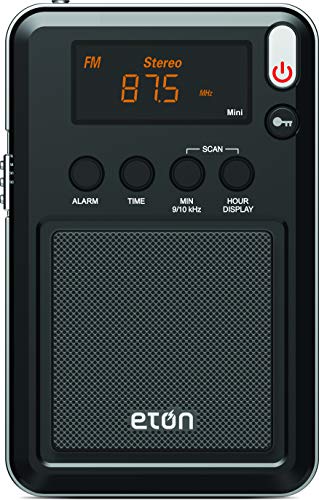
Eton Mini Compact AM/FM/Shortwave Radio, Black


Key features
- •MINI AM/FM/SHORTWAVE RADIO RECEIVER: Tune in to your favorite local stations or listen to news & music from across the globe. Features digital tuning, an internal AM antenna & a telescoping FM/SW antenna.
- •VERSATILE FEATURES: The Elite Mini radio digitally displays the time in bright orange and lets you wake up to the alarm clock or drift off to sleep while listening to music with the included sleep timer.
- •STAY SAFE & HAVE FUN: For over 30 years we've been dedicated to creating award-winning, innovative products for emergency preparedness & entertainment. We're a proud partner of the American Red Cross.
- •CONTINUING A LEGACY: For more than 30 years we've combined the best of old world analog electronics with the efficiency of modern day circuits & systems. Custom designed accessories like stitched satchels & pouches round out the Eton experience.
- •ETON'S COMMITMENT TO INFORMATION: We're committed to helping you stay entertained with access to the latest news, music & information. Whether you're listening to a local radio station or signals from a faraway land, make Eton's radios your go-to source.
Eton Mini Compact AM/FM/Shortwave Radio, Black
List Price: $68.69$61.82DEALYou Save: $6.87 (10%)
Free shippingFree Returns – 30 daysFree Order CancellationSecure Payment2–3 Days DeliveryGet It October 25, 2026In Stock (4)No marketing spamNo account requiredFulfilment by FedEx / Amazon / UPS / ShipwirePayPal / Card Buyer Protection
Customer Reviews
Reviews sourced from verified Amazon purchasers3.7
out of 5
Based on 10 reviews
5★
70%
4★
30%
3★
0%
2★
0%
1★
0%
Well worth your consideration.
Amazon Smile Customer✓ Verified Purchase•May 29, 2017
I'm 58 years old now. I've been interested in radio since I got a pair of toy G.I. Joe walkie-talkies as a child. Played extensively with CB radio in the 70s, use two way radio at work, and have an Amateur Technician Class license. On the other hand, I'm far from being an expert.
I think this radio is great for the price. It does what I want it to do. Are there better choices? Probably, but this is hard to beat for its size and price. Plenty of controls. So far, I haven't had a problem with the instructions, but you must read them and learn the controls to get the most from the radio.
There's an old truism in radio: The antenna is usually more important than the receiver/radio. With ANY radio the antenna is critically important. It has built-in AM and FM antennas, but it also comes with three connections for attaching external antennas. If you want to listen to distant shortwave broadcasts you'll have house an external antenna.
I think this radio is great for the price. It does what I want it to do. Are there better choices? Probably, but this is hard to beat for its size and price. Plenty of controls. So far, I haven't had a problem with the instructions, but you must read them and learn the controls to get the most from the radio.
There's an old truism in radio: The antenna is usually more important than the receiver/radio. With ANY radio the antenna is critically important. It has built-in AM and FM antennas, but it also comes with three connections for attaching external antennas. If you want to listen to distant shortwave broadcasts you'll have house an external antenna.
Eton Field -World Band radio.
Volker N.✓ Verified Purchase•November 9, 2016
I just purchased this radio. It took a little while to set the AM and FM stations that we normally listen to. A fine adjustment of Treble and Bass control gives this radio a wonderful sound. Shortwave stations come in very well. I need time to explore all the features that this radio offers. After using the radio for a while an annoying item surfaced. When switching from AM to FM with the radio off and when turn it on again, there is a good chance that the clock will display a different time. The correct time needs to be reset. I stopped switching broadcast bands.
Sliced Bread, Man
ReaderHal✓ Verified Purchase•October 2, 2016
So the Satellit arrived little more than an hour ago, in the same Amazon box as an order of AA alkaline batteries (I think 36 of them), so I quickly slapped four of them into the radio and switched it on. I also quickly somehow entered Memory mode, which slowed me down for a bit, but I went back to the regular mode (which I think is Weekday mode - yep) and tried out FM.
I didn't get very far because just a few Mhz across the dial showed me that I have a pretty sensitive FM radio on my hands. Stations that tend to come in noisy on my other models from this seat were clean. Okay, cool, I'll check the rest of the band later - I didn't buy the Satellit for FM, though I will be checking out its stereo performance with headphones later.
I wanted to check out my local AM, so I pushed the AM button - but I didn't get AM, I got SW. The 0 button beside it toggles between AM and LW, so I pressed that and got AM. Some of my locals that tend to come in noisy with my other radios came in clear as a bell. Nice. Promising. Even more promising, the Tulsa station that I, curiously (as it is only 120 miles away), have trouble receiving even at night was audible, if noisy. Grabbing the AN-100 loop and positioning it behind the Satellit eliminated the day-time noise, oh, about 85%, I'll estimate.
At night I get WWL 870 New Orleans (465 miles away) very clearly with the Crane, so I tried to see if I could hear it under the noise, both with and without the tuned loop. Surprise, with the loop it was intelligible. So looking forward to playing with AM tonight.
Then I flipped over to shortwave. My Panasonic and the Shack had left me thinking there was nothing listenable at my location.
Big, big surprise! I lost count of the stations, and it isn't as though I scanned all bands, either! Luckily, my nurse, Norma, whose first language is Spanish was here (she comes 8 hours per week) and was able to tell me one station was from Cuba, another from Mexico City, and there were other Spanish stations that I didn't stay on long enough to discover where they came from. Found English-speaking stations, too. I noticed Norma really enjoyed hearing those Spanish stations.
So my introduction to the Satellit was a very positive experience for me. Of course, consideration of what I was comparing it with must be taken into account, so I don't really know how good the radio may be, or how its MW performance will compare to the Crane-EP, which seems to have very good ears. I'll be discovering that pretty soon.
I also need to spend more time with the manual, as its controls are somewhat confusing, nor do I understand all its features. However, unlike those who've complained that it was too complex, I figure I have a radio that I can learn a few things from, and grow into. I find that a positive, so far, as opposed to a negative.
I like the way the radio feels in my hands. I like the size. I like that I can leave the light on dim during use (though you do have to remember to turn that off). The whip feels substantial, not wimpy. I like using the tuning knob. As I learn more about it, I'm sure I will find some things not to like so much, too. But right now, I think I chose a good hand-sized radio.
Later: Well, I sat down with my Crane CCRadio-EP (EP) and the new eton Satellit (Sat) to do what was meant to be an in-depth head-to-head AM dxing competition with stations listed and results with and without the Kaito AN-100 Tuned (Loop). I discovered a couple things which caused me to discontinue the fight.
The bad news: I fell a few days ago, and am sore, but then I fell again yesterday. On concrete this time. I'm black and blue and sore all over, and don't have the stamina to sit for long in a none-reclining chair because the toes I broke swell too much. LOL. How the mighty have fallen... literally. (I once was mighty.)
The better news: As my testing progressed it became very apparent that the Sat is just simply more sensitive than the EP, even without the loop. With the loop, the Sat could pull stations into intelligibility that were not so without it. Stations that the EP couldn't hear at all. And the EP is no slouch.
So if I were going to listen to a ballgame on my New Orleans station that I receive so well here, I might use the EP for it's better tone. Unless it started drifting, as it sometimes does (mostly not, though), then I'd grab the Sat. But let me tell the real truth. I'd grab the Sat anyway, because it's easier to grab, being smaller and lighter, and then not have to worry about drifting in the first place.
The Sat without the loop is very good, but with the loop I can hear way more stations than the EP. So, I have some work cut out for me identifying them now, but I did catch just a few seconds of Nashville WSM 650 (tentative) tonight which I've not been able to do at all with any of my radios. One of these nights when everything falls into alignment I may be able to confirm that catch. [I'm in Norman, OK]
With Chicago 780 tonight, the Sat heard it with a SS of 3-5 with steady intelligibility and a little noise. Adding the loop brought the SS up to 7-9, with even less noise. Either way it was entirely listenable but obviously better with the loop.
I experienced similar results with Des Moines and Omaha. Denver was a bit weaker but still intelligible, and again improved (though a little less dramatically) with the loop. This is all in a brick home with Wifi, more wall-warts than I can count, a 52" plasma TV (okay, I turned that off), multiple cordless phones and ceiling fans (which were on).
The loop was not connected, just capacitive induction at work.
By the way, the loop rarely helps the EP. Apparently something about that twin coil ferrite bar antenna provides all the signal the EP can use. Without going external, I mean.
So now I need to fix up a wire, and see how that works for both units.
Not sending the Sat back. I really didn't expect it to compete with the EP, but it seems to best it so far. When I heal up some (cracked a rib, too) then maybe I'll hang in better for some more head-to-head.
By the way, I also did a little brief FM Stereo headphone listening with the Sat before sundown, and it sounded good, very clean. Can't get that clean with my tuners using dipoles and rabbit ears, but have something in the works for that, too.
Both radios had fresh batteries for the test, by the way.
The EP is now our kitchen radio, while the Sat is MY toy, and I'm very surprised to admit that I love this little gal already. Poor EP, I still love you, too.
EDIT: I should also mention that since I don't get out of the house much, I am an armchair DXer. How these radios would compare in a more secluded quieter environment I wish I knew. I no longer drive, so I can't just run out of town in search of a likely spot. I'd like to do so, but arranging that isn't easy. The Sat does seem to handle the noisy home environment well.
Further Considerations:
I haven't even mentioned the display. Amber on black provides great contrast indoors, so that even my poor, tired vision can read the very small print. Funny how good contrast can make small characters readable. I have read that it doesn't fare as well outdoors, though I do think I also recall reading that outdoor visibility was since improved by adding a slight bluish tint - or was that a different radio? I think it was this one. At any rate, the display presents a wealth of information that is easily readable, at least indoors. I especially like the SS vertical bar-graph 'meter' which comes in very handy in conjunction with the tuned loop. Love the display and the ability to set low, medium and high 'dimming' settings as well as 'Off."
What I like about the display is the wealth of information available simultaneously. I have its display light set to dim as I type this, listening to headphones. A glance tells me that I'm listening to an Oldies station with RDS at 92.5 Mhz with Signal Strength maxed at 9, batteries in good condition, time 08:42 AM, in Weekday mode with today being Tues (which is '2' in display), that the station is stored in memory, and that I am in Slow tuning mode.
I can further find more RDS info (if available, which this station offers a lot) with a touch of that button, and choose whether I want to leave Stereo/Mono, ie "STEREO" in the display or "OLDIES" but since it is obvious by the sound that the radio is receiving good, clean stereo, I choose to leave the RDS info. A quick button press will inform me of stereo or mono info if I am in doubt. Another quick button press tells me the Page # and position in Memory for this station, which I could also choose to leave displayed rather than RDS, but, thanks, no, I press again and it reverts to RDS info. There are 100 pages of memory at 7 stations/page for a total of 700 memory slots, so I guess if one is a multi-time zone jet-setter... I don't know. I think I have enough memory.
The bad news is the operator's manual. [Okay, I deleted negative content here because I'm stoopid, and did not look over the manual as well as I should have, instead foolishly believing negative comments I read elsewhere. The manual is better than I'd been lead to believe.]
My radio does have the "Grundig Edition" moniker on the top, front chassis, as pictured in its Amazon ad.
Did I mention how much I love this little radio? Sliced bread, man, sliced bread.
EDIT: After several days using this radio - quite a few hours - the first set of batteries are still going strong, so that bodes well for the occasional power outage. This is the finest radio of its size I've ever encountered. While both my Crane and Sangean, being much larger, sound better, the handy size of the Satellit makes it a joy to use. As for sound quality, it is very good with headphones.
FURTHER EDIT: I notice remarks alleging the Satellit is not user-friendly in the matter of station selection. That is simply not the case - I can't imagine it being any friendlier in this regard. How do you like to tune in a station? Do you prefer to turn a knob? It's right there on the side of the radio, just turn it. Prefer up/down buttons? Yep, right on the front of the radio, just push. Prefer to enter frequency directly - some do - and it has that option, too. Or do you prefer to store stations and push a memory button? That option is available, as well. Finally, maybe you like to use scan - just press and hold the up/down tuning buttons and it will look for the next station - you can choose to scan-and-pause for 5 seconds, or to scan-and-stop, with a different button. So however you like to do it - it's at your fingertips.
I use all of those methods at one time or another. What I really think is cool, though is the fast and slow tuning choice for the knob. If you set it on slow, it moves up or down in 1 kHz steps for AM, so that if you need to detune slightly off-center to help avoid a strong adjacent channel, you can do so, but the really cool thing they did was to leave the up/down buttons on the regular 10khz scale. This means you can quickly jump to the next station without having to change the fast/slow tuning mode for the knob. That's evidence of well-thought-out design, in my book. Not that you'll need to do that often for MW - it has five bandwidths from which to select with a single button which scrolls through the choices, from 2 to 6 kHz.
For dxing MW (AM), I highly recommend using the Kaito AN-100 tuned loop antenna (or similar model) in conjunction with this radio. I have listened to KSL in Salt Lake City, almost 900 miles away, several times using this pairing. No wires to connect, they couple electromagnetically (via capacitive induction); just place them close together. The more I use this little radio, the more I like it. It's a real gem.
Here are a couple hints to get started:
When the manual says to quick-press buttons, that does not mean you have to enter a series of button pushes quickly or it times out on you, thank goodness. It simply means press the button and let it go immediately. If you let your finger linger too long that will trigger a different command. For instance, the up/down tuning buttons will tune the radio one step in whichever direction you choose, but if you hold the button down for a second or two, it scans. That is pretty common. So "quick-press" a button means not to hold it down. By the way, all the buttons provide very good feel - a definite click. You don't have to wonder. (The detented tuning knob has good tactile feedback, too - and quick-pressing it chooses between fast or slow knob tuning.)
Also, there is a button just above the up/down tuning buttons labeled Page/Time. That is where you choose to be in either the "Weekday" or "Memory" mode. Usually, you will probably want to be in weekday mode, unless you are using the memory buttons to recall or store stations. I think of Weekday as the Normal mode. The Page/Time button simply toggles between them, but buttons do different jobs depending on which mode you have chosen. Once you understand that, then the manual and the buttons (and their labels) make sense. So that gives you a head-start.
Also, be sure to set your time-zone code - the manual provides the codes, which are like -6 or +2 or whatever. Don't leave out the plus or minus.. And I suggest setting time manually to see local time with radio on, otherwise it automatically resets to Greenwich Time or whatever they call it.
I didn't get very far because just a few Mhz across the dial showed me that I have a pretty sensitive FM radio on my hands. Stations that tend to come in noisy on my other models from this seat were clean. Okay, cool, I'll check the rest of the band later - I didn't buy the Satellit for FM, though I will be checking out its stereo performance with headphones later.
I wanted to check out my local AM, so I pushed the AM button - but I didn't get AM, I got SW. The 0 button beside it toggles between AM and LW, so I pressed that and got AM. Some of my locals that tend to come in noisy with my other radios came in clear as a bell. Nice. Promising. Even more promising, the Tulsa station that I, curiously (as it is only 120 miles away), have trouble receiving even at night was audible, if noisy. Grabbing the AN-100 loop and positioning it behind the Satellit eliminated the day-time noise, oh, about 85%, I'll estimate.
At night I get WWL 870 New Orleans (465 miles away) very clearly with the Crane, so I tried to see if I could hear it under the noise, both with and without the tuned loop. Surprise, with the loop it was intelligible. So looking forward to playing with AM tonight.
Then I flipped over to shortwave. My Panasonic and the Shack had left me thinking there was nothing listenable at my location.
Big, big surprise! I lost count of the stations, and it isn't as though I scanned all bands, either! Luckily, my nurse, Norma, whose first language is Spanish was here (she comes 8 hours per week) and was able to tell me one station was from Cuba, another from Mexico City, and there were other Spanish stations that I didn't stay on long enough to discover where they came from. Found English-speaking stations, too. I noticed Norma really enjoyed hearing those Spanish stations.
So my introduction to the Satellit was a very positive experience for me. Of course, consideration of what I was comparing it with must be taken into account, so I don't really know how good the radio may be, or how its MW performance will compare to the Crane-EP, which seems to have very good ears. I'll be discovering that pretty soon.
I also need to spend more time with the manual, as its controls are somewhat confusing, nor do I understand all its features. However, unlike those who've complained that it was too complex, I figure I have a radio that I can learn a few things from, and grow into. I find that a positive, so far, as opposed to a negative.
I like the way the radio feels in my hands. I like the size. I like that I can leave the light on dim during use (though you do have to remember to turn that off). The whip feels substantial, not wimpy. I like using the tuning knob. As I learn more about it, I'm sure I will find some things not to like so much, too. But right now, I think I chose a good hand-sized radio.
Later: Well, I sat down with my Crane CCRadio-EP (EP) and the new eton Satellit (Sat) to do what was meant to be an in-depth head-to-head AM dxing competition with stations listed and results with and without the Kaito AN-100 Tuned (Loop). I discovered a couple things which caused me to discontinue the fight.
The bad news: I fell a few days ago, and am sore, but then I fell again yesterday. On concrete this time. I'm black and blue and sore all over, and don't have the stamina to sit for long in a none-reclining chair because the toes I broke swell too much. LOL. How the mighty have fallen... literally. (I once was mighty.)
The better news: As my testing progressed it became very apparent that the Sat is just simply more sensitive than the EP, even without the loop. With the loop, the Sat could pull stations into intelligibility that were not so without it. Stations that the EP couldn't hear at all. And the EP is no slouch.
So if I were going to listen to a ballgame on my New Orleans station that I receive so well here, I might use the EP for it's better tone. Unless it started drifting, as it sometimes does (mostly not, though), then I'd grab the Sat. But let me tell the real truth. I'd grab the Sat anyway, because it's easier to grab, being smaller and lighter, and then not have to worry about drifting in the first place.
The Sat without the loop is very good, but with the loop I can hear way more stations than the EP. So, I have some work cut out for me identifying them now, but I did catch just a few seconds of Nashville WSM 650 (tentative) tonight which I've not been able to do at all with any of my radios. One of these nights when everything falls into alignment I may be able to confirm that catch. [I'm in Norman, OK]
With Chicago 780 tonight, the Sat heard it with a SS of 3-5 with steady intelligibility and a little noise. Adding the loop brought the SS up to 7-9, with even less noise. Either way it was entirely listenable but obviously better with the loop.
I experienced similar results with Des Moines and Omaha. Denver was a bit weaker but still intelligible, and again improved (though a little less dramatically) with the loop. This is all in a brick home with Wifi, more wall-warts than I can count, a 52" plasma TV (okay, I turned that off), multiple cordless phones and ceiling fans (which were on).
The loop was not connected, just capacitive induction at work.
By the way, the loop rarely helps the EP. Apparently something about that twin coil ferrite bar antenna provides all the signal the EP can use. Without going external, I mean.
So now I need to fix up a wire, and see how that works for both units.
Not sending the Sat back. I really didn't expect it to compete with the EP, but it seems to best it so far. When I heal up some (cracked a rib, too) then maybe I'll hang in better for some more head-to-head.
By the way, I also did a little brief FM Stereo headphone listening with the Sat before sundown, and it sounded good, very clean. Can't get that clean with my tuners using dipoles and rabbit ears, but have something in the works for that, too.
Both radios had fresh batteries for the test, by the way.
The EP is now our kitchen radio, while the Sat is MY toy, and I'm very surprised to admit that I love this little gal already. Poor EP, I still love you, too.
EDIT: I should also mention that since I don't get out of the house much, I am an armchair DXer. How these radios would compare in a more secluded quieter environment I wish I knew. I no longer drive, so I can't just run out of town in search of a likely spot. I'd like to do so, but arranging that isn't easy. The Sat does seem to handle the noisy home environment well.
Further Considerations:
I haven't even mentioned the display. Amber on black provides great contrast indoors, so that even my poor, tired vision can read the very small print. Funny how good contrast can make small characters readable. I have read that it doesn't fare as well outdoors, though I do think I also recall reading that outdoor visibility was since improved by adding a slight bluish tint - or was that a different radio? I think it was this one. At any rate, the display presents a wealth of information that is easily readable, at least indoors. I especially like the SS vertical bar-graph 'meter' which comes in very handy in conjunction with the tuned loop. Love the display and the ability to set low, medium and high 'dimming' settings as well as 'Off."
What I like about the display is the wealth of information available simultaneously. I have its display light set to dim as I type this, listening to headphones. A glance tells me that I'm listening to an Oldies station with RDS at 92.5 Mhz with Signal Strength maxed at 9, batteries in good condition, time 08:42 AM, in Weekday mode with today being Tues (which is '2' in display), that the station is stored in memory, and that I am in Slow tuning mode.
I can further find more RDS info (if available, which this station offers a lot) with a touch of that button, and choose whether I want to leave Stereo/Mono, ie "STEREO" in the display or "OLDIES" but since it is obvious by the sound that the radio is receiving good, clean stereo, I choose to leave the RDS info. A quick button press will inform me of stereo or mono info if I am in doubt. Another quick button press tells me the Page # and position in Memory for this station, which I could also choose to leave displayed rather than RDS, but, thanks, no, I press again and it reverts to RDS info. There are 100 pages of memory at 7 stations/page for a total of 700 memory slots, so I guess if one is a multi-time zone jet-setter... I don't know. I think I have enough memory.
The bad news is the operator's manual. [Okay, I deleted negative content here because I'm stoopid, and did not look over the manual as well as I should have, instead foolishly believing negative comments I read elsewhere. The manual is better than I'd been lead to believe.]
My radio does have the "Grundig Edition" moniker on the top, front chassis, as pictured in its Amazon ad.
Did I mention how much I love this little radio? Sliced bread, man, sliced bread.
EDIT: After several days using this radio - quite a few hours - the first set of batteries are still going strong, so that bodes well for the occasional power outage. This is the finest radio of its size I've ever encountered. While both my Crane and Sangean, being much larger, sound better, the handy size of the Satellit makes it a joy to use. As for sound quality, it is very good with headphones.
FURTHER EDIT: I notice remarks alleging the Satellit is not user-friendly in the matter of station selection. That is simply not the case - I can't imagine it being any friendlier in this regard. How do you like to tune in a station? Do you prefer to turn a knob? It's right there on the side of the radio, just turn it. Prefer up/down buttons? Yep, right on the front of the radio, just push. Prefer to enter frequency directly - some do - and it has that option, too. Or do you prefer to store stations and push a memory button? That option is available, as well. Finally, maybe you like to use scan - just press and hold the up/down tuning buttons and it will look for the next station - you can choose to scan-and-pause for 5 seconds, or to scan-and-stop, with a different button. So however you like to do it - it's at your fingertips.
I use all of those methods at one time or another. What I really think is cool, though is the fast and slow tuning choice for the knob. If you set it on slow, it moves up or down in 1 kHz steps for AM, so that if you need to detune slightly off-center to help avoid a strong adjacent channel, you can do so, but the really cool thing they did was to leave the up/down buttons on the regular 10khz scale. This means you can quickly jump to the next station without having to change the fast/slow tuning mode for the knob. That's evidence of well-thought-out design, in my book. Not that you'll need to do that often for MW - it has five bandwidths from which to select with a single button which scrolls through the choices, from 2 to 6 kHz.
For dxing MW (AM), I highly recommend using the Kaito AN-100 tuned loop antenna (or similar model) in conjunction with this radio. I have listened to KSL in Salt Lake City, almost 900 miles away, several times using this pairing. No wires to connect, they couple electromagnetically (via capacitive induction); just place them close together. The more I use this little radio, the more I like it. It's a real gem.
Here are a couple hints to get started:
When the manual says to quick-press buttons, that does not mean you have to enter a series of button pushes quickly or it times out on you, thank goodness. It simply means press the button and let it go immediately. If you let your finger linger too long that will trigger a different command. For instance, the up/down tuning buttons will tune the radio one step in whichever direction you choose, but if you hold the button down for a second or two, it scans. That is pretty common. So "quick-press" a button means not to hold it down. By the way, all the buttons provide very good feel - a definite click. You don't have to wonder. (The detented tuning knob has good tactile feedback, too - and quick-pressing it chooses between fast or slow knob tuning.)
Also, there is a button just above the up/down tuning buttons labeled Page/Time. That is where you choose to be in either the "Weekday" or "Memory" mode. Usually, you will probably want to be in weekday mode, unless you are using the memory buttons to recall or store stations. I think of Weekday as the Normal mode. The Page/Time button simply toggles between them, but buttons do different jobs depending on which mode you have chosen. Once you understand that, then the manual and the buttons (and their labels) make sense. So that gives you a head-start.
Also, be sure to set your time-zone code - the manual provides the codes, which are like -6 or +2 or whatever. Don't leave out the plus or minus.. And I suggest setting time manually to see local time with radio on, otherwise it automatically resets to Greenwich Time or whatever they call it.
It really has some nice features. I like the fact that the light ...
Fixitwill✓ Verified Purchase•April 21, 2016
I have been into short wave and scanners since 1966 and i must say this is quite the receiver. It really has some nice features. I like the fact that the light comes on any time you touch anything on the radio and stays on for a few seconds and then goes back off or you can press the like button and hold it down and it'll stay on. The whole set up is pretty intuitive if you have used these kind of things before. I was able to use it without even looking at the manual. And I like to that. It's receiving POW ER is incredible and it has an antenna level button labeled ATT that cuts down the signal strength on strong stations close bye. The only thing it's missing is a scan feature. That would be nice. But as far as the radio goes it's undoubtedly one of the best ones That I have ever owned. I've been testing the battery life for several days now and the battery hasn't even gone down one notch so the battery life is excellent it holds four size D batteries and has input jacks or whatever you want to amplify jacks for external antennas and loads of other stuff. This is a excellent radio..
Pleasant Surprise
Kevin D.✓ Verified Purchase•March 26, 2015
I rarely write reviews but I felt like I needed to take the time and give my opinion of the new Traveler. It is a quarky radio with some features that I find unnecessary like the time zone switch unless you are truly a globetrodder. I would much rather prefer a keypad for direct entry in the space taken by the time zone switch. However, the performance of this little radio makes me quickly forget any missing features. Frankly, at this price point, you cannot get everything you want and I would much rather have a hot rig than a keypad.
I am absolutely blown away with this little radio's performance! Primarily, I am a MW DXer and the Traveler III will be my new go-to small portable. You might think I'm crazy but it is almost on-par with my CCrane 2E and Superadio II. In fact, it is a better MW performer and much easier on the ears than my Satellit 750. The only other small radio that I own or have owned that can compete with Traveler III on MW is the ultralight Sony SRF-T615. Not only is the radio very sensitive, it is also very selective. I live about 7 miles from a 50K watt blowtorch and this radio handles it well.
I am satisfied with FM reception as it can pick up my "reference" station without extending the antenna. Some other radios that can't find that station even with antannas extended are the older CCrane SWP, and the cheaper Sony ICF-S10MK2 and Sangean SR-35. The RDS feature works well.
I'm not a huge shortwave listener and definitely not an expert but performance seems above average. In a quick check of the band, the Traveler picked up the stronger stations like the US religious ones, Cuban radio, Radio China. I would recommend seeking reviews from more experienced shortwavers. I honestly cannot give a trusted review of the shortwave band.
All in all, if you are a stickler for sensitivity and selectivity in your radios then you need to add this guy to your collection. The controls are quarky and there is a bit of a learning curve but you will be pleased with the raw performance especially for the price and portability.
I am absolutely blown away with this little radio's performance! Primarily, I am a MW DXer and the Traveler III will be my new go-to small portable. You might think I'm crazy but it is almost on-par with my CCrane 2E and Superadio II. In fact, it is a better MW performer and much easier on the ears than my Satellit 750. The only other small radio that I own or have owned that can compete with Traveler III on MW is the ultralight Sony SRF-T615. Not only is the radio very sensitive, it is also very selective. I live about 7 miles from a 50K watt blowtorch and this radio handles it well.
I am satisfied with FM reception as it can pick up my "reference" station without extending the antenna. Some other radios that can't find that station even with antannas extended are the older CCrane SWP, and the cheaper Sony ICF-S10MK2 and Sangean SR-35. The RDS feature works well.
I'm not a huge shortwave listener and definitely not an expert but performance seems above average. In a quick check of the band, the Traveler picked up the stronger stations like the US religious ones, Cuban radio, Radio China. I would recommend seeking reviews from more experienced shortwavers. I honestly cannot give a trusted review of the shortwave band.
All in all, if you are a stickler for sensitivity and selectivity in your radios then you need to add this guy to your collection. The controls are quarky and there is a bit of a learning curve but you will be pleased with the raw performance especially for the price and portability.
Page 1 of 2