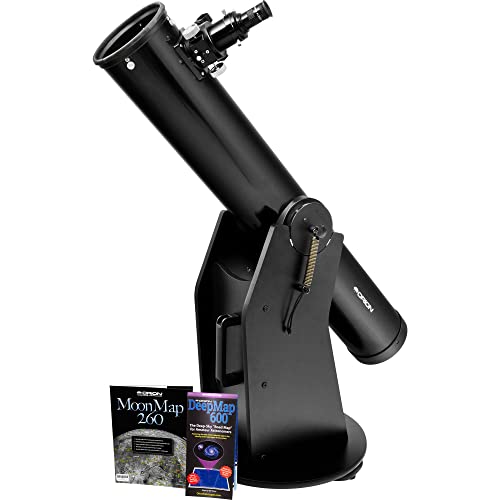
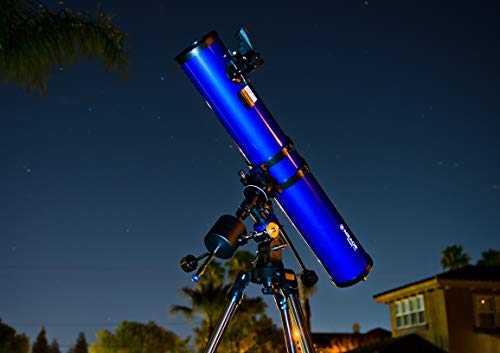
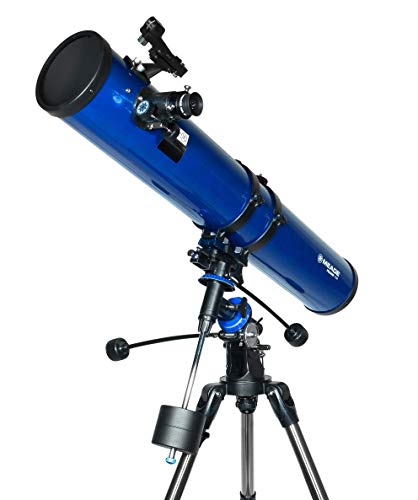
Meade Instruments – Polaris 114mm Aperture, Portable Backyard Reflecting Stargazing Astronomy Telescope for Beginners –Stable German Equatorial (GEM) Manual Mount – View the Moon, Planets & Stars, One Size, Blue


Key features
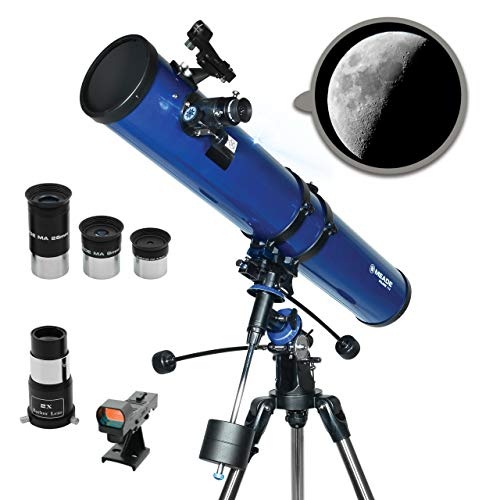
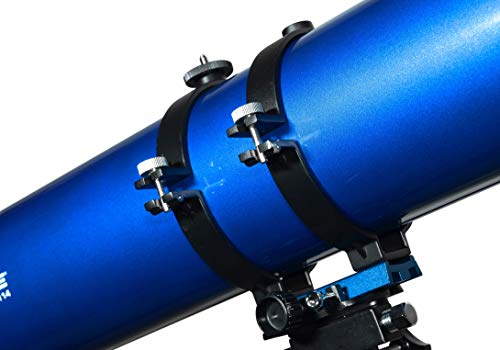
- •Aperture: 114mm(4.5"). Focal Length: 1000mm. Focal Ratio: f/8.8. Rack-and-Pinion Focuser, Setting Circles, Latitude Control w/Scale
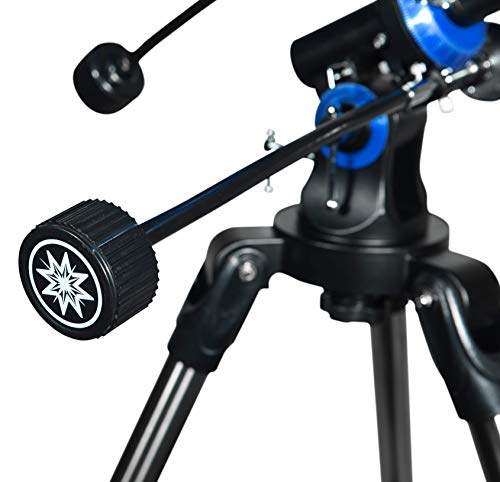
- •Large, stable German Equatorial mount with slow motion controls makes tracking celestial objects smooth and simple
- •Low (26mm), medium (9mm), and high (6.3mm) magnification eyepieces give you variety for any viewing situation & 2x barlow lens doubles the magnifying power of each eyepiece
- •Red dot viewfinder helps you point your scope at objects you want to observe & accessory tray stores accessories while observing
- •Includes Astronomical Software and Instructional DVD
Meade Instruments – Polaris 114mm Aperture, Portable Backyard Reflecting Stargazing Astronomy Telescope for Beginners –Stable German Equatorial (GEM) Manual Mount – View the Moon, Planets & Stars, One Size, Blue
List Price: $215.98$194.38DEALYou Save: $21.60 (10%)
Free shippingFree Returns – 30 daysFree Order CancellationSecure Payment2–3 Days DeliveryGet It October 26, 2026In Stock (1)No marketing spamNo account requiredFulfilment by FedEx / Amazon / UPS / ShipwirePayPal / Card Buyer Protection
Customer Reviews
Reviews sourced from verified Amazon purchasers3.9
out of 5
Based on 20 reviews
5★
75%
4★
25%
3★
0%
2★
0%
1★
0%
Shoot for the stars!
Deb✓ Verified Purchase•July 24, 2017
Wonderful telescope and very easy to use!
It was pretty good right out of the box and I used ...
ANTHONY VLASAK✓ Verified Purchase•April 3, 2017
I purchased this scope last May (2016) and have gotten to know it quite well over the past year. It was pretty good right out of the box and I used it for moon and planet observation. Then I decided to purchase a Cheshire and laser collimating tools. After a bit of a learning curve and several conversations with the Meade blog guys, I started to get it dialed in. I found that the secondary mirror was way off. Once I got that problem corrected I aligned the primary and wow! Now I am seeing many infects much more clearly.
I attended a star party at Mc
Donald Observatory near Ft. Davis, Tx and got to ask questions about other equipment and use it. After my latest efforts at columnization, I'm very happy with this scope.
I attended a star party at Mc
Donald Observatory near Ft. Davis, Tx and got to ask questions about other equipment and use it. After my latest efforts at columnization, I'm very happy with this scope.
Awesome telescope!
Jonathan✓ Verified Purchase•January 25, 2017
I am the type of person to get really excited about something, jump in, get a bunch of equipment for it and then wander on to something else, occasionally returning to the previous things in passing. As such a person, although I really wanted a 12" telescope with computer controls; I also didn't want to drop several thousand dollars just to wander off a few weeks later and have something too big to deal with and too hard to set up to bother with when I had a few days desire to play with it.
After weeks of browsing the Internet over several years of occasional looking; I bought this as I wanted a Parabolic rather than Spherical mirror available on the 127 series telescopes.
I have not regretted my decision at all. The Meade Poaris 130 is well built, has a great equipment kit for the money and looks really beautiful! It's also open enough that it quickly adjusts to temperature changes, going from indoors to out is a decently rapid process.
I am in a large, light polluting city in the Midwest, so the regularly viewable stars are not nearly as numerous as I would normally want. Just using this to view stars was worth it for me. I've used it to see satellites, stars, planets and the moon and have had a lot of fun doing so. Granted, planets aren't much more than a tiny dot; but it's still fun to see them.
The tripod is decent enough, I use it in my mostly wind sheltered back yard on an old wooden deck, and don't get too much wobble out of it. It is easy enough to set up now after I made a few changes, and sets up fast enough that I can usually go from decision to take it out to set up and looking within five to ten minutes.
The Meade Polaris 130 went together easily; I was able to set it up easily after glancing through the instructions. I had issues with the scope tube counterweight constantly tilting the axis forward in the tripod no matter how tight I tightened the adjustment bolts. The manual had no fix for this, so I checked the Internet for answers and found that The issue was not well finished bolts and nuts which caused too much friction between the threads. I disassembled all the nuts and bolts on the tripod, cleaned and deburred them, and then reassembled them with light camera oil I had.
My first time setting the tripod up and getting it properly adjusted took several hours. I drilled holes in my deck to put dowel pins in so that the next time I could just place it quickly in exactly the right spot. The second time I took it out and adjusted it, I marked register marks with a scribe on everything that moved so I could quickly set it to point at Polaris no matter where it had moved to. I also added a stop to the tube so I could quickly attach the tube and keep perfect balance on the tripod, and marked the counterweight rod in case the weight shifted. Now it takes me longer to take the telescope out of the closet and run it outside than it does to set it up.
I do take it to work when I am somewhere overnight, and it still takes me a bit to adjust it for the new location, but getting it set up at home afterwards is extremely fast. I intend to do more modifications to it later, but out of the box there was surprisingly little that needed to be done for the price of the telescope.
The tracking adjustment knobs are excellent and intuitive to use, searching with the Equatorial mount loose is easy once you play with it a bit and the red dot finder is really easy to search with.
On the downside, the red dot viewfinder can be bumped out of alignment easily and I've burned through a few batteries by leaving it on accidentally. I'm intending to make some registering pieces to make taking it off and putting it on easily, and getting a remote momentary use switch for it so I don't keep burning through the batteries. Also on what I find to be the downside, the aperture cover does not stick into the telescope tube, but rather just sits on top of it. I sometimes forget this and it falls off when I forget to hold the tube upright.
The stock lenses are good. The addition of the 2x Barlow prevented me from wanting to buy one of those kits you see, and the lenses are all good. Sometimes I see little rainbows around stars and some doubling of the lines on the moon under much higher power.
When I bought the telescope, I picked up an Orion 25% neutral density moon filter to go with it, and it's fine when the moon is fairly dim but it is not enough of a filter for me when we have a mostly full or full moon. I will be buying the 12% to go along with it along with a solar filter for daytime looking at the sun use... Because who doesn't love staring at the sun?
Overall, I could not be happier with this telescope at the price I paid ($179) and would remain a value for even more.
The photo attached was taken by hand with an iPhone hovering over the eyepiece. It was vastly more clear than that.
After weeks of browsing the Internet over several years of occasional looking; I bought this as I wanted a Parabolic rather than Spherical mirror available on the 127 series telescopes.
I have not regretted my decision at all. The Meade Poaris 130 is well built, has a great equipment kit for the money and looks really beautiful! It's also open enough that it quickly adjusts to temperature changes, going from indoors to out is a decently rapid process.
I am in a large, light polluting city in the Midwest, so the regularly viewable stars are not nearly as numerous as I would normally want. Just using this to view stars was worth it for me. I've used it to see satellites, stars, planets and the moon and have had a lot of fun doing so. Granted, planets aren't much more than a tiny dot; but it's still fun to see them.
The tripod is decent enough, I use it in my mostly wind sheltered back yard on an old wooden deck, and don't get too much wobble out of it. It is easy enough to set up now after I made a few changes, and sets up fast enough that I can usually go from decision to take it out to set up and looking within five to ten minutes.
The Meade Polaris 130 went together easily; I was able to set it up easily after glancing through the instructions. I had issues with the scope tube counterweight constantly tilting the axis forward in the tripod no matter how tight I tightened the adjustment bolts. The manual had no fix for this, so I checked the Internet for answers and found that The issue was not well finished bolts and nuts which caused too much friction between the threads. I disassembled all the nuts and bolts on the tripod, cleaned and deburred them, and then reassembled them with light camera oil I had.
My first time setting the tripod up and getting it properly adjusted took several hours. I drilled holes in my deck to put dowel pins in so that the next time I could just place it quickly in exactly the right spot. The second time I took it out and adjusted it, I marked register marks with a scribe on everything that moved so I could quickly set it to point at Polaris no matter where it had moved to. I also added a stop to the tube so I could quickly attach the tube and keep perfect balance on the tripod, and marked the counterweight rod in case the weight shifted. Now it takes me longer to take the telescope out of the closet and run it outside than it does to set it up.
I do take it to work when I am somewhere overnight, and it still takes me a bit to adjust it for the new location, but getting it set up at home afterwards is extremely fast. I intend to do more modifications to it later, but out of the box there was surprisingly little that needed to be done for the price of the telescope.
The tracking adjustment knobs are excellent and intuitive to use, searching with the Equatorial mount loose is easy once you play with it a bit and the red dot finder is really easy to search with.
On the downside, the red dot viewfinder can be bumped out of alignment easily and I've burned through a few batteries by leaving it on accidentally. I'm intending to make some registering pieces to make taking it off and putting it on easily, and getting a remote momentary use switch for it so I don't keep burning through the batteries. Also on what I find to be the downside, the aperture cover does not stick into the telescope tube, but rather just sits on top of it. I sometimes forget this and it falls off when I forget to hold the tube upright.
The stock lenses are good. The addition of the 2x Barlow prevented me from wanting to buy one of those kits you see, and the lenses are all good. Sometimes I see little rainbows around stars and some doubling of the lines on the moon under much higher power.
When I bought the telescope, I picked up an Orion 25% neutral density moon filter to go with it, and it's fine when the moon is fairly dim but it is not enough of a filter for me when we have a mostly full or full moon. I will be buying the 12% to go along with it along with a solar filter for daytime looking at the sun use... Because who doesn't love staring at the sun?
Overall, I could not be happier with this telescope at the price I paid ($179) and would remain a value for even more.
The photo attached was taken by hand with an iPhone hovering over the eyepiece. It was vastly more clear than that.
Good results required overcoming learning curve
Paul Adams✓ Verified Purchase•November 1, 2016
Pro: Quality telescope that required no further collimating on my part and has provided the best view of Saturn I have ever seen (rings and color bands!)
Con: This scope is bulky enough to make solo transport somewhat inconvenient. The red-dot targeting is too dim for daylight alignment and prone to self disassembly when using adjustment screws. I also mistook the latitude adjustment rod for a spare early on without which the mount was prone to sudden collapse back to zero. As a result finding targets of interest was an exercise in frustration my first night out. Despite all of this use has gotten easier with practice and I hope to begin astrophotography of the planets shortly.
Attached picture of Luna taken with iPhone SE using 26mm eyepiece.
Con: This scope is bulky enough to make solo transport somewhat inconvenient. The red-dot targeting is too dim for daylight alignment and prone to self disassembly when using adjustment screws. I also mistook the latitude adjustment rod for a spare early on without which the mount was prone to sudden collapse back to zero. As a result finding targets of interest was an exercise in frustration my first night out. Despite all of this use has gotten easier with practice and I hope to begin astrophotography of the planets shortly.
Attached picture of Luna taken with iPhone SE using 26mm eyepiece.
A really great beginners telescope
Amazon Customer✓ Verified Purchase•October 14, 2016
A really great beginners telescope. I like how it includes three eyepieces and a barlow lens. Most telescope just include a 25mm and a 9mm eyepiece. The EQ mount takes time to learn. I gave it 4 stars because of how difficult it is to use the mount but as you use it will be easy to use.
Page 1 of 4