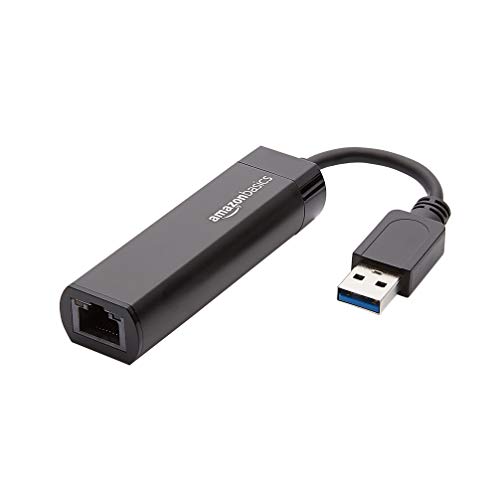
Amazon Basics USB 3.0 to 10/100/1000 Gigabit Ethernet Internet Adapter, Compatible with Windows and macOS, Black


Key features
- •Connects a USB 3.0 device (computer/tablet) to a router, modem, or network switch to deliver Gigabit Ethernet to your network connection
- •Supported features include Wake-on-LAN function, Green Ethernet & IEEE 802.3az-2010 (Energy Efficient Ethernet)
- •Supports IPv4/IPv6 pack Checksum Offload Engine (COE) to reduce Cental Processing Unit (CPU) loading
- •Compatible with Windows 10/8.1/8/7, and Chrome OS with latest system updates; does not support Windows RT or Android.
Amazon Basics USB 3.0 to 10/100/1000 Gigabit Ethernet Internet Adapter, Compatible with Windows and macOS, Black
List Price: $26.33$23.70DEALYou Save: $2.63 (10%)
Free shippingFree Returns – 30 daysFree Order CancellationSecure Payment2–3 Days DeliveryGet It October 24, 2026In Stock (30)No marketing spamNo account requiredFulfilment by FedEx / Amazon / UPS / ShipwirePayPal / Card Buyer Protection
Customer Reviews
Reviews sourced from verified Amazon purchasers4.0
out of 5
Based on 10 reviews
5★
70%
4★
30%
3★
0%
2★
0%
1★
0%
Wow!!!!! From 72.0 Mbps (wi-fi) to 100.0 Mbps (ethernet connection) to 1.0 Gbps on my new laptop using this adapter!!!!!
Amazon Customer✓ Verified Purchase•January 3, 2018
Wow!!!!! From 72.0 Mbps (wi-fi) to 100.0 Mbps (ethernet connection) on my old previous laptop to 1.0 Gbps on my new laptop using this adapter!!!!!
Since my new laptop came without an ethernet port "“ and because I really wanted this specific new laptop -- I resigned myself to using my wi-fi connection instead. My current internet provider seems notorious for slow internet speeds. Watching streaming video and even accessing the internet was trying my patience constantly but -- even if a higher speed was available in my area the cost would be more than I was willing and able to pay.
I googled this problem to see if others experienced same problem. Googling and speaking with a customer service representative at my internet providers suggested that "“ as an alternative -- I use an ethernet connection which would make a very noticeable difference in connection speeds. Using my ethernet connection my speed jumped from 72.0 Mbps to 100.0 Mbps; however, the speed was still lagging.
I was "shopping" here on Amazon (BTW, Amazon is my one-stop shopping with exception to my groceries. Amazon is amazing, and they are credible and reputable and stand behind their satisfaction guarantee as well as stepping in when a third-party seller did not measure up to their guarantee and return policies. Mind you, that only happened one time where Amazon had to step in to resolve the issue.
Anyway, I digress. Nothing usual! LOL. I was searching out of curiosity to find out if there was some way to connect to ethernet without an ethernet port available. I discovered this alternate solution. I was pleasingly surprised when I switched to just wi-fi connection on my new laptop just to see what the difference was between the Mbps and using this adapter. I was used to the wi-fi connection speed being 72.0 Mbps and never even thought of checking to see what it would be on my new laptop. I do not know why but my new laptop using wi-fi was a whopping 144.0 Mbps versus my old laptop internet connection speed. I do not know why this is, but I will take the "WIN".
Since my new laptop came without an ethernet port "“ and because I really wanted this specific new laptop -- I resigned myself to using my wi-fi connection instead. My current internet provider seems notorious for slow internet speeds. Watching streaming video and even accessing the internet was trying my patience constantly but -- even if a higher speed was available in my area the cost would be more than I was willing and able to pay.
I googled this problem to see if others experienced same problem. Googling and speaking with a customer service representative at my internet providers suggested that "“ as an alternative -- I use an ethernet connection which would make a very noticeable difference in connection speeds. Using my ethernet connection my speed jumped from 72.0 Mbps to 100.0 Mbps; however, the speed was still lagging.
I was "shopping" here on Amazon (BTW, Amazon is my one-stop shopping with exception to my groceries. Amazon is amazing, and they are credible and reputable and stand behind their satisfaction guarantee as well as stepping in when a third-party seller did not measure up to their guarantee and return policies. Mind you, that only happened one time where Amazon had to step in to resolve the issue.
Anyway, I digress. Nothing usual! LOL. I was searching out of curiosity to find out if there was some way to connect to ethernet without an ethernet port available. I discovered this alternate solution. I was pleasingly surprised when I switched to just wi-fi connection on my new laptop just to see what the difference was between the Mbps and using this adapter. I was used to the wi-fi connection speed being 72.0 Mbps and never even thought of checking to see what it would be on my new laptop. I do not know why but my new laptop using wi-fi was a whopping 144.0 Mbps versus my old laptop internet connection speed. I do not know why this is, but I will take the "WIN".
Nice and Fast Ethernet Adapter
NerdyPhysicsGuy✓ Verified Purchase•November 23, 2017
I wasn't satisfied with Wi-Fi performance in my room, so I figured I could get one of these to have faster, wired Internet. MacBooks no longer come with Ethernet ports, but this thing works pretty much as well as a laptop with a built-in Ethernet port.
It's not quite plug-and-play on macOS. You'll need to install drivers from the Asix website (the chip manufacturer for the adapter); I found it by searching "asix AX88179", navigating to their website, and scrolling down to their drivers section. It'll run you through the installer, and you will need to reboot at the end. Once it's done, it'll pretty much auto-detect and connect you to the network. If not, you can just go into the Network Preferences pane and check to see if "AX88179 USB 3.0 to Gigabit Ethernet" is connected.
It is indeed plug-and-play with Ubuntu, and probably will be for other Debian-based distros. I haven't had the chance to test on Windows, but network speeds on Ubuntu and macOS are pretty much the same as on my desktop with a built-in network card.
The Ethernet plug has the typical built-in LEDs to show activity and connection speed, and cables click in pretty solidly. I haven't moved it around much so I can't say much about cycle life. The USB cable feels a bit rigid, but I guess that's typical of USB 3.0 cables due to the increased number of conductors.
Anyways, it does what it should, and it does it pretty fast!
It's not quite plug-and-play on macOS. You'll need to install drivers from the Asix website (the chip manufacturer for the adapter); I found it by searching "asix AX88179", navigating to their website, and scrolling down to their drivers section. It'll run you through the installer, and you will need to reboot at the end. Once it's done, it'll pretty much auto-detect and connect you to the network. If not, you can just go into the Network Preferences pane and check to see if "AX88179 USB 3.0 to Gigabit Ethernet" is connected.
It is indeed plug-and-play with Ubuntu, and probably will be for other Debian-based distros. I haven't had the chance to test on Windows, but network speeds on Ubuntu and macOS are pretty much the same as on my desktop with a built-in network card.
The Ethernet plug has the typical built-in LEDs to show activity and connection speed, and cables click in pretty solidly. I haven't moved it around much so I can't say much about cycle life. The USB cable feels a bit rigid, but I guess that's typical of USB 3.0 cables due to the increased number of conductors.
Anyways, it does what it should, and it does it pretty fast!
Works Perfectly on macOS High Sierra once you download the correct driver
S. Sanders✓ Verified Purchase•September 26, 2017
Let me start off by saying I am using this on 2 different MacBook Pros running macOS High Sierra. This adapter worked perfectly once I installed the correct driver. The driver offered on the included disc does NOT WORK. You must go to the driver download page on the ASIX website to get the latest driver. Amazon will not allow direct links to external websites. You will need to search for AX88179 on the site - I downloaded and installed
'Apple Mac OS X 10.6 to 10.12 Drivers Installer' (revision v2.9.0 released on 2017-04-26).
Once installed and my Mac restarted the USB Gigabit device appeared in Network Preferences. I have 1000Mbps up and down fiber to the home. Usually I get much more on the DL side, but when I ran the test I did not limit other services. Primary picked this up to use for full Time Machine backups on my local network to the drive attached to my Airport Extreme Base Station as it is much faster than backing up ~300-400GB over wifi.
'Apple Mac OS X 10.6 to 10.12 Drivers Installer' (revision v2.9.0 released on 2017-04-26).
Once installed and my Mac restarted the USB Gigabit device appeared in Network Preferences. I have 1000Mbps up and down fiber to the home. Usually I get much more on the DL side, but when I ran the test I did not limit other services. Primary picked this up to use for full Time Machine backups on my local network to the drive attached to my Airport Extreme Base Station as it is much faster than backing up ~300-400GB over wifi.
Doubled the speed of my Raspberry Pi 3 NAS (from 11MB/s to 20MB/s)
Anonymous✓ Verified Purchase•July 27, 2017
Instructions for replacing your built-in (non-gigabit) ethernet:
1. Plug this into your Pi
2. Log into a terminal
3. Run: sudo reboot
4. Wait for boot, log in, run: ifconfig
5. Write down the HWaddr for eth0 (the built-in ethernet) and eth1 (this adapter)
6. Create the file: /etc/udev/rules.d/70-persistent-net.rules
7. Add the following two lines:
SUBSYSTEM=="net", ACTION=="add", DRIVERS=="?*", ATTR{address}=="new", ATTR{dev_id}=="0x0", ATTR{type}=="1", KERNEL=="eth*", NAME="eth0"
SUBSYSTEM=="net", ACTION=="add", DRIVERS=="?*", ATTR{address}=="old", ATTR{dev_id}=="0x0", ATTR{type}=="1", KERNEL=="eth*", NAME="eth1"
...replacing *new* with the Hwaddr of eth1 and *old* with the Hwaddr of eth0
8. Run: sudo shutdown -h now
9. Swap your ethernet cable from the old plug to new plug
10. Disconnect then reconnect power adapter from Pi
This new adapter will now be eth0 and the built-in adapter will be eth1. If you had rules or services in place that depended on eth0 they'll use the new, faster connection.
NOTE: Tested using Blackmagic disk speed test from networked Mac client. 20MB/s average read/write speed. The drive is an ext4 formatted WD My Passport 4TB (link below), shared from the Pi via netatalk AFP.
WD 4TB Black My Passport Portable External Hard Drive - USB 3.0 - WDBYFT0040BBK-WESN
1. Plug this into your Pi
2. Log into a terminal
3. Run: sudo reboot
4. Wait for boot, log in, run: ifconfig
5. Write down the HWaddr for eth0 (the built-in ethernet) and eth1 (this adapter)
6. Create the file: /etc/udev/rules.d/70-persistent-net.rules
7. Add the following two lines:
SUBSYSTEM=="net", ACTION=="add", DRIVERS=="?*", ATTR{address}=="new", ATTR{dev_id}=="0x0", ATTR{type}=="1", KERNEL=="eth*", NAME="eth0"
SUBSYSTEM=="net", ACTION=="add", DRIVERS=="?*", ATTR{address}=="old", ATTR{dev_id}=="0x0", ATTR{type}=="1", KERNEL=="eth*", NAME="eth1"
...replacing *new* with the Hwaddr of eth1 and *old* with the Hwaddr of eth0
8. Run: sudo shutdown -h now
9. Swap your ethernet cable from the old plug to new plug
10. Disconnect then reconnect power adapter from Pi
This new adapter will now be eth0 and the built-in adapter will be eth1. If you had rules or services in place that depended on eth0 they'll use the new, faster connection.
NOTE: Tested using Blackmagic disk speed test from networked Mac client. 20MB/s average read/write speed. The drive is an ext4 formatted WD My Passport 4TB (link below), shared from the Pi via netatalk AFP.
WD 4TB Black My Passport Portable External Hard Drive - USB 3.0 - WDBYFT0040BBK-WESN
It would be nice if Amazon provided the link to drivers for products
Kyle Black✓ Verified Purchase•July 15, 2017
I got this in combination with the AUKEY USB-C Hub with HDMI, 4 USB 3.0 Ports, Type-C Power Delivery Throughput Port for MacBook Pro, Dell XPS 15, Google Chromebook and More for my 2017 mackbook pro that only has usb-c ports. While it was not plug and play, I did get it to work on macOS 10.12.5 with the driver I found here (plugable.com/drivers/usb3ethernet/) for the ASIX 88179 released in April. It would be nice if Amazon provided the link to drivers for products that it sells under the amazon basics brand, but after about 30 minutes I was able to find the driver and get it working. Hope this helps and it works for you.
It would be nice if Amazon provided the link to drivers for products with the amazon basics branding.
It would be nice if Amazon provided the link to drivers for products with the amazon basics branding.
Page 1 of 2