FLIR Scout TK - Compact Thermal Imaging Monocular for Wildlife Viewing, Hunting & Outdoor




Key features
- •Notice: By purchasing the FLIR Scout TK the buyer acknowledges the product is subject to Export Administration Regulations (EAR)
- •Product cannot be exported, re-exported, resold, transferred or otherwise disposed of to any country without approval from the US. Dept. of Commerce, Bureau of Industry & Security in accordance with EAR, Title 15, Code of Federal Regulations part 730
- •Diversion contrary to U. S. law is prohibited
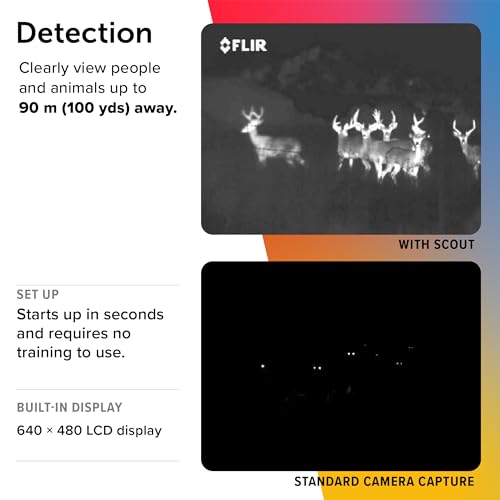
- •The Scout TK makes outdoor thermal imaging more accessible than ever with the ability to see heat signatures in total darkness.
- •Great everyday tool for personal and home security at night.
BrandFLIR
CategoryNight Vision Monoculars
Size6.0" x2"x 2" (L × W × H)
ColorGreen
WarrantyOutdoor & Tactical Systems (OTS) 2-3-10 Global Limited Warranty
FLIR Scout TK - Compact Thermal Imaging Monocular for Wildlife Viewing, Hunting & Outdoor
List Price: $835.16$751.64DEALYou Save: $83.52 (10%)
Free shippingFree Returns – 30 daysFree Order CancellationSecure Payment2–3 Days DeliveryGet It October 25, 2026In Stock (2)No marketing spamNo account requiredFulfilment by FedEx / Amazon / UPS / ShipwirePayPal / Card Buyer Protection
Customer Reviews
Reviews sourced from verified Amazon purchasers4.0
out of 5
Based on 10 reviews
5★
10%
4★
90%
3★
0%
2★
0%
1★
0%
Great little unit
Dylan✓ Verified Purchase•July 31, 2023
Was a dumbfounded by the idea of using this for my property, but it really lit up my world! Especially here where it's dark for 6 months a year, it's nice to see the creepy craw lies creeping around
Recommended without reservations
Fos✓ Verified Purchase•July 29, 2023
Alright, from pandemic to social unrest. Options, options, money money. You want night vision capability but you don't want/can't shell out the 3-7k? Plus that device can be used by only one person, so unless you have enough cash to buy night vision goggles for everyone in the family, at least those that can be of assistance if needed... If you're in this conundrum, I'll tell you what I did. I got some night vision binoculars (around $300), a night vision scope (around $700) and thermal imaging (this Flir). For a fraction of the price I have 3 devices that can be used separately, either by one person or by 2-3 people working as a team.
Now regarding this particular product: works well, day and night, really light and small, plenty of color palette to ensure thermal acquisition in different environments. Overall, this a relatively inexpensive when you consider the technology.
IF you're looking at this specifically for the reasons I mentioned at the beginning of the review and of you have enough ammo, food, water...AND you want to be able to have the capacity to identify if something is out there...AND you're not going to break the bank by purchasing it... Yes!, go ahead and have it. If not, focus on the above.
Now regarding this particular product: works well, day and night, really light and small, plenty of color palette to ensure thermal acquisition in different environments. Overall, this a relatively inexpensive when you consider the technology.
IF you're looking at this specifically for the reasons I mentioned at the beginning of the review and of you have enough ammo, food, water...AND you want to be able to have the capacity to identify if something is out there...AND you're not going to break the bank by purchasing it... Yes!, go ahead and have it. If not, focus on the above.
Great but not for over 100yards
derek✓ Verified Purchase•June 29, 2023
The media could not be loaded.
Got exactly what I was expecting and paid for
josh s✓ Verified Purchase•June 13, 2023
This is a good entry level thermal monocular. I have family members that have thermal devices that are upwards of $4000, but for me to get a thermal imager this Flir was in my price range. Price point is THE BIGGEST deciding factor to me in thermal quality, more money available to spend simply relates to better equipment. A friend of mine has the Leupold tracker LPO HD I believe and I was able to use it last night on a hog hunt side by side with my Flir TK Scout. The Leupold had better image quality and picked up heat signatures further out with better detail, BUT the light from the viewer will backlight your face or hunting blind as you must hold it about a foot away from your face and definitely can be seen by people and animals. This is a big draw back for me. The Leupold model I used was also around $850, which is about $350 more than the Flir TK Scout. I do not believe it's worth the additional money.
The Flir TK Scout will pick up heat signatures well over 100yds in an open field, yard or road under "good conditions". At 75 yds deer, hogs, dogs or people can easily be differentiated in open/semi open areas. In wooded conditions it of course depends on the thickness of the woods, but in mature forest animals can be picked up at 75yds easily. Brushy undergrowth, grown up fields and thickets will greatly reduce the thermals ability to pick up heat signatures. Rain, high humidity and high surrounding heat will mess with any thermal device to some degree.
I like the video and photo capture options. Biggest issue is battery life, battery life will last about 2 hours of intermittent use, keep in mind that this unit is rechargeable. There's pros and cons to that. The battery does seem to lose its charge during storage. Probably my biggest complaint with this unit.
When I was trying to decide which thermal device was right for me reviews like this would have been very helpful, so to sum up my review. This a good unit for the money, it does exactly what the manufacture states it will do, very easy and simple operation and is produced by a very reputable company. Would have given 5 stars if not for battery life. I'm overall happy with this product.
The Flir TK Scout will pick up heat signatures well over 100yds in an open field, yard or road under "good conditions". At 75 yds deer, hogs, dogs or people can easily be differentiated in open/semi open areas. In wooded conditions it of course depends on the thickness of the woods, but in mature forest animals can be picked up at 75yds easily. Brushy undergrowth, grown up fields and thickets will greatly reduce the thermals ability to pick up heat signatures. Rain, high humidity and high surrounding heat will mess with any thermal device to some degree.
I like the video and photo capture options. Biggest issue is battery life, battery life will last about 2 hours of intermittent use, keep in mind that this unit is rechargeable. There's pros and cons to that. The battery does seem to lose its charge during storage. Probably my biggest complaint with this unit.
When I was trying to decide which thermal device was right for me reviews like this would have been very helpful, so to sum up my review. This a good unit for the money, it does exactly what the manufacture states it will do, very easy and simple operation and is produced by a very reputable company. Would have given 5 stars if not for battery life. I'm overall happy with this product.
Be sure you know what to expect and not expect from it - it performs very nicely for its designed capabilities - almost 5-stars
Grits✓ Verified Purchase•May 15, 2023
I'm impressed. If you're not familiar with "night vision," be aware that this isn't like the majority of so-called night vision devices out there. First, there is no magnification. Second (and most important to understand), it is entirely passive - it does not operate on "reflected" infrared light, therefore it doesn't need an infrared illuminator. It displays heat differences FROM objects, and therefore can be used day or night. The first day I had it, I was able to clearly see a squirrel on an oak tree about 60 feet away. The tree was fairly dark grey, and the squirrel was a very distinct white (using the standard black/white scheme where white is warmer, and black is cooler). My own preference seems to be just this method of looking at things. The more color that is added in (there are multiple color schemes), the more confusing it seems to be if you want to pick out objects). Black/white (your preference which is cool vs. warm) seems to define the best.
Also be aware that this will NOT "see" through glass - such as looking into a vehicle with the windows up, or out through a window. You must have unimpeded space between you and what you're viewing - not the fault of the device, just a function of the technology.
My wife was skeptical (understatement!) that we "needed" this device, given the price. The first night turned that attitude around nicely. To be honest, we'd like to be able to "see" in the dark in the event of a power failure, particularly a longer term one. If undesirable folks are out at night with a long-term power outage, it would be nice to see without being seen - most IR night vision devices, particularly the less expensive ones, have a tell-tale dull red glow coming from the IR emitter. Therefore, someone else can spot you quite easily in the dark, due to the sudden red dot that is shining in their direction. But with this device, there's nothing for them to see. Short of them having their own night vision capability (unlikely with neighborhood "bad guys"), you can be standing straight up in the deep shadows and never be detected - yet they will stand out brilliantly. As a test, I had my wife watch me walk well out into the yard (at least 50 feet), and then crouch down behind some bushes. While she could slightly see the bushes, she said I was clearly visible, and if she hadn't known the bushes were there, she would not have known I'd gone behind anything (obviously the bushes have to have plenty of holes between branches or leaves, so the heat differential can be "seen" through the bushes). Just imagine wearing a glowing suit and someone is watching you through a monocular. As long as you're not behind a solid object, they'll be able to see the light coming through any bushes. It's the same with the heat signature this device "sees."
The device frequently re-calibrates itself (you'll see it in the view finder), so it adjusts to whatever the relative temperatures are regardless of time of day or temperatures of objects. Obviously, when it's quite cold you'll be able to see warm bodies far easier, and if temperatures are quite warm in the evening (no sun to artificially heat things up more), a body may not show up as easily due to less difference in temperatures, but it's still highly useful. It will be surprising to see how much difference there is in temperatures the first few times you look through it - big trees are much cooler than the leaves. In fact, looking at leaves on a tree vs. the clear sky behind the leaves at night, the contrast is stunning - the leaves are quite bright white, whereas the sky is providing no real heat of its own, thus it's black.
Finally, we have a bird feeder about 50 feet or so from the back of the house. The tiny sparrows don't show up during the day, but a few larger birds do show up, such as blue jays or woodpeckers. Obviously we can't check that out at night, but there probably wouldn't be much difference. And as for how much can be discerned, it is inherently fuzzy. A larger animal would definitely show up well within 100 feet, I'm sure, and be identifiable by shape. But smaller animals, even just 25-50 feet away, would be more problematic unless their shape was quite unique - the definition just isn't good enough to reliably do identification at that distance. And obviously, trying to identify facial features would not possible at any significant distance. It's even distorted due to color scheme presentation at a close distance (just a few feet).
So if you want identify a prowler, forget it. But if you want to identify the fact that you HAVE a possible prowler, it'll do a nice job certainly out to at least 100 feet or so (the farthest I've tried it). And it is of at least some use for trying to navigate around objects, if that was the only way you could do it (i.e. you had no flashlight, or it was unwise to use one), but if the difference in temperature is limited between nearby objects, you won't see very well. This will be of limited use to us, but of potential significant value in very occasional circumstances (kind of like auto or homeowners insurance - you pay for it in case you need it and hope you never do).
Also be aware that this will NOT "see" through glass - such as looking into a vehicle with the windows up, or out through a window. You must have unimpeded space between you and what you're viewing - not the fault of the device, just a function of the technology.
My wife was skeptical (understatement!) that we "needed" this device, given the price. The first night turned that attitude around nicely. To be honest, we'd like to be able to "see" in the dark in the event of a power failure, particularly a longer term one. If undesirable folks are out at night with a long-term power outage, it would be nice to see without being seen - most IR night vision devices, particularly the less expensive ones, have a tell-tale dull red glow coming from the IR emitter. Therefore, someone else can spot you quite easily in the dark, due to the sudden red dot that is shining in their direction. But with this device, there's nothing for them to see. Short of them having their own night vision capability (unlikely with neighborhood "bad guys"), you can be standing straight up in the deep shadows and never be detected - yet they will stand out brilliantly. As a test, I had my wife watch me walk well out into the yard (at least 50 feet), and then crouch down behind some bushes. While she could slightly see the bushes, she said I was clearly visible, and if she hadn't known the bushes were there, she would not have known I'd gone behind anything (obviously the bushes have to have plenty of holes between branches or leaves, so the heat differential can be "seen" through the bushes). Just imagine wearing a glowing suit and someone is watching you through a monocular. As long as you're not behind a solid object, they'll be able to see the light coming through any bushes. It's the same with the heat signature this device "sees."
The device frequently re-calibrates itself (you'll see it in the view finder), so it adjusts to whatever the relative temperatures are regardless of time of day or temperatures of objects. Obviously, when it's quite cold you'll be able to see warm bodies far easier, and if temperatures are quite warm in the evening (no sun to artificially heat things up more), a body may not show up as easily due to less difference in temperatures, but it's still highly useful. It will be surprising to see how much difference there is in temperatures the first few times you look through it - big trees are much cooler than the leaves. In fact, looking at leaves on a tree vs. the clear sky behind the leaves at night, the contrast is stunning - the leaves are quite bright white, whereas the sky is providing no real heat of its own, thus it's black.
Finally, we have a bird feeder about 50 feet or so from the back of the house. The tiny sparrows don't show up during the day, but a few larger birds do show up, such as blue jays or woodpeckers. Obviously we can't check that out at night, but there probably wouldn't be much difference. And as for how much can be discerned, it is inherently fuzzy. A larger animal would definitely show up well within 100 feet, I'm sure, and be identifiable by shape. But smaller animals, even just 25-50 feet away, would be more problematic unless their shape was quite unique - the definition just isn't good enough to reliably do identification at that distance. And obviously, trying to identify facial features would not possible at any significant distance. It's even distorted due to color scheme presentation at a close distance (just a few feet).
So if you want identify a prowler, forget it. But if you want to identify the fact that you HAVE a possible prowler, it'll do a nice job certainly out to at least 100 feet or so (the farthest I've tried it). And it is of at least some use for trying to navigate around objects, if that was the only way you could do it (i.e. you had no flashlight, or it was unwise to use one), but if the difference in temperature is limited between nearby objects, you won't see very well. This will be of limited use to us, but of potential significant value in very occasional circumstances (kind of like auto or homeowners insurance - you pay for it in case you need it and hope you never do).
Page 1 of 2