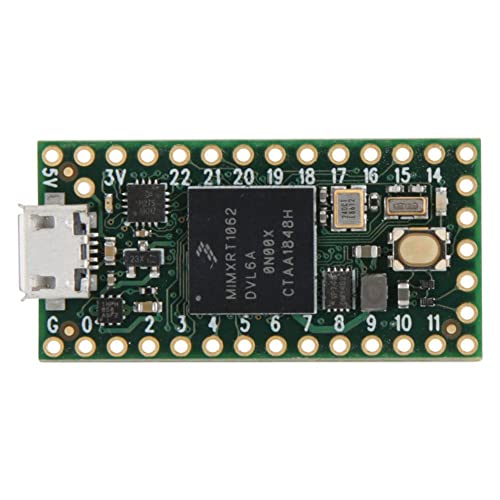
PJRC Teensy 4.0 Microcontroller Development Board Lockable Version Without Pins



Key features
- •LOCKABLE PROGRAM CODE: This lockable version of the Teensy 4.0 is suitable for commercial products and secure applications to protect your program code from unauthorized access and coping.
- •Features an ARM Cortex-M7 processor at 600MHz, with a NXP iMXRT1062 chip
- •1024K RAM (512K is tightly coupled); 2048K Flash (64K reserved for recovery & EEPROM emulation)
- •2 USB ports, both 480 MBit/sec; 3 CAN Bus (1 with CAN FD)
- •31 PWM pins; 40 digital pins, all interrupt capable; 14 analog pins, 2 ADCs on chip; 2 I2S Digital Audio
- •Same size and shape as the Teensy 3.2 and retains compatibility with most of its pin functions
PJRC Teensy 4.0 Microcontroller Development Board Lockable Version Without Pins
List Price: $46.97$42.27DEALYou Save: $4.70 (10%)
Free shippingFree Returns – 30 daysFree Order CancellationSecure Payment2–3 Days DeliveryGet It October 26, 2026In Stock (4)No marketing spamNo account requiredFulfilment by FedEx / Amazon / UPS / ShipwirePayPal / Card Buyer Protection
Customer Reviews
Reviews sourced from verified Amazon purchasers4.7
out of 5
Based on 10 reviews
5★
100%
4★
0%
3★
0%
2★
0%
1★
0%
Super-fast and Super-features!
Johann✓ Verified Purchase•November 16, 2023
Until recently I worked with all sorts of Arduinos: Uno, Mega, Nano, and Pro. A month ago I started a new project that required microsecond-timing and decided to use a Teensy 4.0. The result: I am blown away by the incredible speed of the Teensy, which I am estimating to be 10-100 times faster than that of the Arduinos. It is like entering a new world in which I need not fear writing CPU-intensive functions. Those are a drop in the bucket, not even noticeable when working with a Teensy 4.0. This, combined with the order of magnitude bigger memory space available on the Teensy make programming fun again. Forget about struggling to work around the Arduinos' resource limitations.
I am also extremely impressed by the extensive documentation on the Teensy developer's website (pjrc dot com). There are tens of libraries optimized for Teensys' spectacular performance, code examples, explanations, diagrams, and most importantly, a very active and helpful user forum.
After I installed the Teensyduino add-on (it took maybe 15 minutes) I could upload sketches straight from the customary Arduino IDE, without any problems. Except that the uploads are much faster with the Teensy than they were with the Arduino.
I could go on heaping praise on this little marvel, but I am too eager to get back to my Teensy project. I want to add, though, that I am not affiliated with Teensy in any way, nor have I received any kind of freebies. I am just a genuinely thrilled user.
I am also extremely impressed by the extensive documentation on the Teensy developer's website (pjrc dot com). There are tens of libraries optimized for Teensys' spectacular performance, code examples, explanations, diagrams, and most importantly, a very active and helpful user forum.
After I installed the Teensyduino add-on (it took maybe 15 minutes) I could upload sketches straight from the customary Arduino IDE, without any problems. Except that the uploads are much faster with the Teensy than they were with the Arduino.
I could go on heaping praise on this little marvel, but I am too eager to get back to my Teensy project. I want to add, though, that I am not affiliated with Teensy in any way, nor have I received any kind of freebies. I am just a genuinely thrilled user.
Awesome little board
Chris✓ Verified Purchase•October 27, 2023
I just got my little BoardForth running on a Teensy 4.0. Holy cow ... that board is fast! Not as fast as my PC, but MUCH faster than the other boards I have tried. As in, at least 100x faster the ATMega2560. And probably 10x faster than the Seeeduino XIAOU, Redboard-Turbo, and ESP-8266. I know, apples and oranges, but still. It's crazy.
I am loving Teensy. I have 2 of them now: the LC and the 4.0. They just work. I use the Arduino IDE. I had all these problems with the STM32F411 board - no problems at all with this.
I just hope I don't brick it when I solder the pins on.
I am loving Teensy. I have 2 of them now: the LC and the 4.0. They just work. I use the Arduino IDE. I had all these problems with the STM32F411 board - no problems at all with this.
I just hope I don't brick it when I solder the pins on.
Easy, fun little board, but overpriced IMO
Carl✓ Verified Purchase•October 24, 2023
With this board you get 3 CAN busses (when you add a transceiver, typically a $5 board per bus) and an easy to use Arduino experience. Plenty of IO, plenty of power. I've been amazed at how much this tiny little thing can handle. I started out with a simple CAN application, then realized I could drive long LED strips, and do BT stuff all on the same board at the same time.
It's flexible, power efficient, and tiny. FlexCAN_T4 is a fantastic CAN library - clean and straight forward, using simplified interface. I am more of a Swift/Kotlin/Java guy and the simpler the library, the more likely I am to build something cool. I got up and running with CAN bus stuff faster and cheaper on Teensy than I did with RaspberryPi and Python.
Back to the value question - As a sort of high performance catch all device, many using it for audio applications, it's going to have features you do not need. It's sitting between an RPi and traditional Arduino. For my exact application this means it's slightly over priced since I needed to pile on more and more accessories to get to something like an ESP32 which wifi and dual mode bluetooth for a fraction of the total cost. Even a Nano IOT starts to make me wonder why I picked a Teensy. Performance is the biggest trade off.
One thing you cannot put a price on though is the ease of use. If I waste hours messing with a shoddy complicated board, optimizing code so it fits or runs better on a less capable board, how much is that really worth? So I can move faster and create more interesting things without worrying about specs, but It's a double edged sword. Teensy is cost prohibitive if you start trying to productize your creation built upon it, even if to make a few copies. Make sure you really need the power and most of the features before committing to it. Otherwise there are cheaper options with different features that might fit better.
It's flexible, power efficient, and tiny. FlexCAN_T4 is a fantastic CAN library - clean and straight forward, using simplified interface. I am more of a Swift/Kotlin/Java guy and the simpler the library, the more likely I am to build something cool. I got up and running with CAN bus stuff faster and cheaper on Teensy than I did with RaspberryPi and Python.
Back to the value question - As a sort of high performance catch all device, many using it for audio applications, it's going to have features you do not need. It's sitting between an RPi and traditional Arduino. For my exact application this means it's slightly over priced since I needed to pile on more and more accessories to get to something like an ESP32 which wifi and dual mode bluetooth for a fraction of the total cost. Even a Nano IOT starts to make me wonder why I picked a Teensy. Performance is the biggest trade off.
One thing you cannot put a price on though is the ease of use. If I waste hours messing with a shoddy complicated board, optimizing code so it fits or runs better on a less capable board, how much is that really worth? So I can move faster and create more interesting things without worrying about specs, but It's a double edged sword. Teensy is cost prohibitive if you start trying to productize your creation built upon it, even if to make a few copies. Make sure you really need the power and most of the features before committing to it. Otherwise there are cheaper options with different features that might fit better.
original PRJC
Rock Dubois✓ Verified Purchase•October 22, 2023
not a clone, good manufacturing quality, works as expected.
A great board
Brian Smith✓ Verified Purchase•October 9, 2023
Overall an awesome development board. Great support on the PJRC website, and good user community. Works well with the Arduino IDE and libraries.
My only (very minor) issue is not breaking out the CAN3/FD pins on the headers - you can still get to them, but you have to solder wires to pads 30 and 31 on the bottom of the board. If you absolutely need CAN3/FD pins on the headers, get a Teensy 4.1 which has those pins broken out to the headers (and a microSD slot, and capacity for adding more memory).
My only (very minor) issue is not breaking out the CAN3/FD pins on the headers - you can still get to them, but you have to solder wires to pads 30 and 31 on the bottom of the board. If you absolutely need CAN3/FD pins on the headers, get a Teensy 4.1 which has those pins broken out to the headers (and a microSD slot, and capacity for adding more memory).
Page 1 of 2


