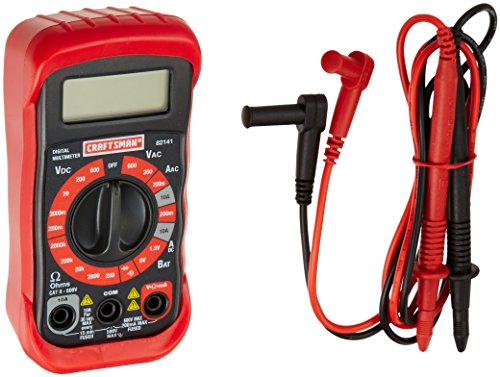
Extech EX330 Autoranging Mini Multimeter with NCV and Type K Temperature, orange and green


Key features
- •Built in non contact AC voltage detector (NCV)
- •4000 count autoranging multimeter measures AC/DC voltage and current, resistance, frequency, duty cycle and temperature
- •Cat III 600V UL listed
- •Includes Type K temperature probe
- •Rubber holster protects meter
BrandExtech
CategoryMulti Testers
SizeAutorange Multimeter with Thermometer
Colororange and green
Warranty1 year parts and labor
Extech EX330 Autoranging Mini Multimeter with NCV and Type K Temperature, orange and green
List Price: $66.34$59.71DEALYou Save: $6.63 (10%)
Free shippingFree Returns – 30 daysFree Order CancellationSecure Payment2–3 Days DeliveryGet It October 24, 2026In Stock (2)No marketing spamNo account requiredFulfilment by FedEx / Amazon / UPS / ShipwirePayPal / Card Buyer Protection
Customer Reviews
Reviews sourced from verified Amazon purchasers4.4
out of 5
Based on 10 reviews
5★
30%
4★
70%
3★
0%
2★
0%
1★
0%
A good cheap meter that gets the basics right
Skip✓ Verified Purchase•September 28, 2023
The basic functionality (volts, amps, ohms, circuit beep) works well in this meter. Like all autoranging meters I've used (even the Fluke meters), the auto-range is slow and not really that useful, except maybe for resistance if you're incredibly lazy. But, in fixed range the display is big and legible and responds quickly. I don't know if it's "true RMS" but at least the value shown gives you a rough idea of the general average level of the signal, as tested with different PWM signals. Similarly, the continuity beep is a clear tone, and also responds very quickly allowing you to move around a circuit and find shorts really quickly. The leads are long, flexible, and although they are sort of big for circuit diagnostic, they are probably the right size for general use. Unfortunately there are no clips for storing the leads on the meter so expect it getting tangled with everything in your toolbox. The meter itself fits just right in my hand and feels nice and grippy and is pretty stable on the tilting bale, in my opinion better than a Fluke in these respects. The buttons have a nice action and the main selection knob is okay, good considering the price. One big downside is the packaging clearly says "Max Hold" on the front, but the hold button just freezes the current value on the screen. Don't get this meter if you expect a max hold function, which is why it gets 4 stars. This meter gets the basic and important functions right, it doesn't get in your way and is easy to use.
I don't know what I'd do without it!
R. Harmon✓ Verified Purchase•September 8, 2023
I love this little multimeter! I never realized how much life could improve just by switching to a real instrument over the $10 analog model I bought from Home Depot. I've had it for something like a year now, and it's pretty amazing.
I can't say enough good things about it, but I'll try to focus on the highest of the highlights: the NCV button! It's so nice to be able to diagnose so many electrical problems just by holding down a button and gently moving the device along a cable or a wall, listening for the spot where the current stops. And it's a great relief to be able to flip an unlabeled (of course) breaker, press the NCV button, and know if that was the switch for the circuit I'm about to work on.
Say I'm on the outside of a trailer, working on the water heater that's only accessible by removing an exterior wall panel. As described above, I've found the breaker that goes to this circuit. But that was yesterday; did my father-in-law flip it back on in the meantime? I'd better get down off of the ladder, walk around the house, and have the lady who lives here walk me back to the bedroom (awkward) where the breaker box is so I can check it, right? No way! I can just hit the NCV button and find out. (And then, just because I've been stung too many times by "disconnected" electric fences back on the farm, I go ahead and test it with the probes to confirm. But it's good.)
I've also used the NCV function to find faults in power cords on sump pumps, among other things. One little nick in the insulation, it turns out, can corrode an entire length of wire... But I digress.
Another great feature is the... What is it called? The one where you switch it to measure resistance and then toggle the mode a couple of times. Then you touch points with the probes and if they're connected (i.e., sufficiently low resistance), it makes a noise. You don't even have to look at the meter! It's great. I use that all the time to see which points in one place match up to which points in another place. Handy for when wires change colors on the other side of something that would be a pain to move, and the audible signal means I can focus on touching the right points instead of trying to watch the display.
I've used most of the functions at one time or another, but those are the most common ones for me. At work yesterday, I fixed a multi-thousand-dollar refrigerated centrifuge with it by using a combination of the DC voltmeter, ohmmeter, and frequency functions. I've fixed a lot of other things with it, too, but that was all for yesterday.
I'm not an electrician or anything, just a guy who likes to tinker with stuff and works in a laboratory. I really ought to have my boss invest in one of these for the lab so that I won't have to keep carrying mine back and forth from home. I've gotten to the point where I look at it and think, "If I don't take it with me, I'm sure to need it." And it's true.
Despite my enthusiasm for it, there are a few things I would change about it if I could:
1. I would include some leads with alligator clips with it. Come on, those are just too handy not to have. I suppose I can buy them separately, but it would have been nice to include them.
2. I really wish it had some little clips on the side to hold the probes. I have to wrap the wires around it or let them dangle; neither is satisfactory, and both leave you with surprisingly sharp points sticking out. I guess I should invest in a nice rubber band, and maybe something to cap the points. I don't know, like I said, I'm not a professional or anything.
3. The temperature probe is a separate attachment that I almost never have with me, because who wants to carry that, too? I don't know how to fix this, but it would be nice if it could be improved somehow. Also, the cable for the temp probe is really stiff. I don't know how necessary that is for the functionality of it, but if it could be as pliable as the two contact probes (or leads, whatever; I'm an amateur), that would be a step in the right direction. I'm kind of worried about it snapping due to metal fatigue, honestly. It's that stiff.
I can't say enough good things about it, but I'll try to focus on the highest of the highlights: the NCV button! It's so nice to be able to diagnose so many electrical problems just by holding down a button and gently moving the device along a cable or a wall, listening for the spot where the current stops. And it's a great relief to be able to flip an unlabeled (of course) breaker, press the NCV button, and know if that was the switch for the circuit I'm about to work on.
Say I'm on the outside of a trailer, working on the water heater that's only accessible by removing an exterior wall panel. As described above, I've found the breaker that goes to this circuit. But that was yesterday; did my father-in-law flip it back on in the meantime? I'd better get down off of the ladder, walk around the house, and have the lady who lives here walk me back to the bedroom (awkward) where the breaker box is so I can check it, right? No way! I can just hit the NCV button and find out. (And then, just because I've been stung too many times by "disconnected" electric fences back on the farm, I go ahead and test it with the probes to confirm. But it's good.)
I've also used the NCV function to find faults in power cords on sump pumps, among other things. One little nick in the insulation, it turns out, can corrode an entire length of wire... But I digress.
Another great feature is the... What is it called? The one where you switch it to measure resistance and then toggle the mode a couple of times. Then you touch points with the probes and if they're connected (i.e., sufficiently low resistance), it makes a noise. You don't even have to look at the meter! It's great. I use that all the time to see which points in one place match up to which points in another place. Handy for when wires change colors on the other side of something that would be a pain to move, and the audible signal means I can focus on touching the right points instead of trying to watch the display.
I've used most of the functions at one time or another, but those are the most common ones for me. At work yesterday, I fixed a multi-thousand-dollar refrigerated centrifuge with it by using a combination of the DC voltmeter, ohmmeter, and frequency functions. I've fixed a lot of other things with it, too, but that was all for yesterday.
I'm not an electrician or anything, just a guy who likes to tinker with stuff and works in a laboratory. I really ought to have my boss invest in one of these for the lab so that I won't have to keep carrying mine back and forth from home. I've gotten to the point where I look at it and think, "If I don't take it with me, I'm sure to need it." And it's true.
Despite my enthusiasm for it, there are a few things I would change about it if I could:
1. I would include some leads with alligator clips with it. Come on, those are just too handy not to have. I suppose I can buy them separately, but it would have been nice to include them.
2. I really wish it had some little clips on the side to hold the probes. I have to wrap the wires around it or let them dangle; neither is satisfactory, and both leave you with surprisingly sharp points sticking out. I guess I should invest in a nice rubber band, and maybe something to cap the points. I don't know, like I said, I'm not a professional or anything.
3. The temperature probe is a separate attachment that I almost never have with me, because who wants to carry that, too? I don't know how to fix this, but it would be nice if it could be improved somehow. Also, the cable for the temp probe is really stiff. I don't know how necessary that is for the functionality of it, but if it could be as pliable as the two contact probes (or leads, whatever; I'm an amateur), that would be a step in the right direction. I'm kind of worried about it snapping due to metal fatigue, honestly. It's that stiff.
Good first multimeter - lasted me 8 years
ACES✓ Verified Purchase•August 18, 2023
This has been a great first multimeter. I bought it in 2015 and it served me well for 8 years. Unfortunately, I'm guessing due to heat generated from the internal electronics, some plastic on the back of the dial has deformed, causing it to stop working.
Though I'm disappointed, about $6 per year for a good multimeter isn't too bad!
Though I'm disappointed, about $6 per year for a good multimeter isn't too bad!
Complete review (tearing apart)
Luis Bernardo Monroy Jaramillo✓ Verified Purchase•August 5, 2023
Cons:
-Clipping battery connector is fragile, no contacts embedded in case.
-The sensitivity of NCV, even in HI, is poor.
-Microampere shunt is 3000 ohms, it gives very high burden voltage.
-The maximum voltage in DIODE is just 1,55V, so it can not turn on an LED.
-Slow autorrange, specially in ohms.
-Holster is slippery. Meter slips in table when turning knob with one hand.
-You must remove holster to change battery.
-Flimsy tilting bail.
-There is no AWG reference on the cables of the probes.
-The first left position of the selector is not OFF.
-By default, the microampere position is AC, not DC.
-Peak-min-max operates only in ACV
-Beeps when changing function.
-HOLD function is very basic.
-Smart-Hold not convincing.
-Too basic quick-start manual in paper for several models.
It should be given full specifications in paper, not CD.
-Backlight should stay on indefinitely.
Pros:
-Heatshrinked PTCs and MOVs, also blast shields, give confidence on input protection and CAT ratings.
-Screwed banana-jacks for the probes.
-Continuity is audible and visual for noisy environments.
-Very good viewing angles of LCD.
-Cat IV probes with caps to use them as CAT II.
-Battery cover is held in place with two screws that don't fall.
-REL key is good feature.
-Backlight stays on a long time.
-Very good bargraph.
-VDC and VAC are separated functions.
-Turning force for the knob is high.
-Capacitance goes as high as 10 millifarads.
-Well crafted thermocouple.
-No 10A fuse to blow.
There are photos and video to form your own opinion.
-Clipping battery connector is fragile, no contacts embedded in case.
-The sensitivity of NCV, even in HI, is poor.
-Microampere shunt is 3000 ohms, it gives very high burden voltage.
-The maximum voltage in DIODE is just 1,55V, so it can not turn on an LED.
-Slow autorrange, specially in ohms.
-Holster is slippery. Meter slips in table when turning knob with one hand.
-You must remove holster to change battery.
-Flimsy tilting bail.
-There is no AWG reference on the cables of the probes.
-The first left position of the selector is not OFF.
-By default, the microampere position is AC, not DC.
-Peak-min-max operates only in ACV
-Beeps when changing function.
-HOLD function is very basic.
-Smart-Hold not convincing.
-Too basic quick-start manual in paper for several models.
It should be given full specifications in paper, not CD.
-Backlight should stay on indefinitely.
Pros:
-Heatshrinked PTCs and MOVs, also blast shields, give confidence on input protection and CAT ratings.
-Screwed banana-jacks for the probes.
-Continuity is audible and visual for noisy environments.
-Very good viewing angles of LCD.
-Cat IV probes with caps to use them as CAT II.
-Battery cover is held in place with two screws that don't fall.
-REL key is good feature.
-Backlight stays on a long time.
-Very good bargraph.
-VDC and VAC are separated functions.
-Turning force for the knob is high.
-Capacitance goes as high as 10 millifarads.
-Well crafted thermocouple.
-No 10A fuse to blow.
There are photos and video to form your own opinion.
Good, cheap DMM with some battery harness problems.
Michael Barclay✓ Verified Purchase•June 25, 2023
I do a fair amount of electrical work for my job so I have experience with electrical equipment. Needed a cheap meter that I could keep at home and had enough features to cover a wide array of home and vehicle projects. At a cheap price, this fills the role nicely. Works as advertised and shipping was fast.
The only reason I give this 4 out of 5 stars is due to the battery harness which does not appear to hold the batteries as well as one would hope. Impacts to the meter, (In this case dropping the meter face up from about a foot or two off the ground) can cause one or more of the batteries to come dislodged. A swift hit in the opposite direction is enough to jostle the batteries back into position. While not a deal breaker, this can be annoying. A simple fix, I have found, is to simply place a nylon washer or plastic spacer between the battery cover and the batteries. I find it strange a problem this noticeable and easy to remedy made it past quality control.
Also its worth noting the leads for this are simple touch probes. I have seen other, similarly priced, DMMs that come with interchangeable probes and alligator clips. For whatever reason I thought this meter was going to come similarly equipped with both test lead and alligator clips. This is not a fault with the meter or seller, just something I thought I would point out.
The only reason I give this 4 out of 5 stars is due to the battery harness which does not appear to hold the batteries as well as one would hope. Impacts to the meter, (In this case dropping the meter face up from about a foot or two off the ground) can cause one or more of the batteries to come dislodged. A swift hit in the opposite direction is enough to jostle the batteries back into position. While not a deal breaker, this can be annoying. A simple fix, I have found, is to simply place a nylon washer or plastic spacer between the battery cover and the batteries. I find it strange a problem this noticeable and easy to remedy made it past quality control.
Also its worth noting the leads for this are simple touch probes. I have seen other, similarly priced, DMMs that come with interchangeable probes and alligator clips. For whatever reason I thought this meter was going to come similarly equipped with both test lead and alligator clips. This is not a fault with the meter or seller, just something I thought I would point out.
Page 1 of 2