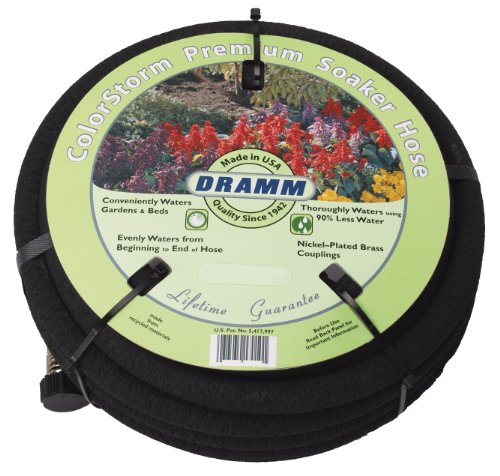
Dramm 17010 ColorStorm Premium 50 Foot Soaker Garden Hose, Black


Key features
- •Soaker hose
- •Conveniently water gardens and beds
- •Evenly waters from beginning to end
- •50 foot Soaker Hose made from recycled material
- •Thoroughly waters using 90% less water than conventional watering
- •Conveniently waters garden and beds
Dramm 17010 ColorStorm Premium 50 Foot Soaker Garden Hose, Black
List Price: $83.28$74.95DEALYou Save: $8.33 (10%)
Free shippingFree Returns – 30 daysFree Order CancellationSecure Payment2–3 Days DeliveryGet It August 10, 2026In Stock (30)No marketing spamNo account requiredFulfilment by FedEx / Amazon / UPS / ShipwirePayPal / Card Buyer Protection
Customer Reviews
Reviews sourced from verified Amazon purchasers4.4
out of 5
Based on 10 reviews
5★
80%
4★
20%
3★
0%
2★
0%
1★
0%
Worth the extra cost..
Martha W.✓ Verified Purchase•August 15, 2023
It arrived on time and worked perfectly! I'm a little concerned about the fitting. It seems a bit cheap. Suppose time will tell!
Great hose
Kindle Customer✓ Verified Purchase•August 9, 2023
Great product, super fast delivery!
Superior quality, U.S.A. - made!
Madam H✓ Verified Purchase•July 30, 2023
Using this hose (many, actually) to irrigate the numerous shrub and perimeter beds on around our home. (about 1/3-acre, not an expansive property.) I love Dramm, finding their products superior to others I've tried over the years. (soaker hoses, as well as Dramm's other irrigation tools.)
Have permanently installed these, laid atop the soil over the root zones of azaleas, acubas, cleyeras, etc., pinned down with steel L-shaped stakes, then covered with mulch and compost. Covering the hoses not only makes the beds more attractive and hides the hoses, but also retains the water used, for further conservation.
Our landscape has an in-ground sprinkler system, but my goal is to use that for watering only the turf areas, utilizing these soaker hoses to maintain the non-turf areas, about half of the total area. Sod requires too much water in our area, (north central Texas,) and I know much of the water used to maintain the more moisture-sensitive shrubs, such as azaleas, is wasted when running the sprinklers. Multiple soaker hoses can be connected to each other for longer runs, and sometimes using multiple shorter hoses instead of one very loooong one can be beneficial in the event the hose(s) must be moved for some reason. Simply disconect one or two 50-footers, instead of one 100-footer.
I have different beds connected together with sections of regular garden hose, and have either buried the regular hose just beneath the sod across the lawn area, or covered with mulch in a non-sodded area. This allows me to water one entire side of the yard at once, instead of having to connect/disconnect various hoses from the spigot(s). A 'Y' connector here and there allows the branching of a couple of soaker hoses to different areas for greater coverage.
Two more suggestions for anyone contemplating a project such as this: replace the black pvc cap(s) on these hoses with brass caps, usually available at your local hardware store. If you live in a climate where the hoses will be left outside in the winter, eventually the plastic caps will crack and degrade, resulting in leaks. Plastic caps will also break if stepped on, or run over with the mower or other lawn equipment. Brass quick-disconnects are also invaluable for any gardener who uses hoses and various watering devices. Don't bother with the cheapo plastic versions.... they don't last long and can't be left outside in freezing weather. Except for occasionally replacing the rubber washers, brass connectors last indefinitely, and are well worth the higher initial cost. Just make sure the male and female components are made by the same manufacturer; one brand may not crossover (fit) another brand, so buy a female coupler for each spigot or hose end, and one male end for each watering tool or hose-end device. And get a couple extra male ends in case you buy more watering tools, but don't forget to remove these brass pieces in the even you have to replace a worn-out hose or tool.
And finally, if your municipality uses the Water Department as a profit center like ours does, water conservation is not only beneficial to the planet, but beneficial to your pocketbook as well.
Have permanently installed these, laid atop the soil over the root zones of azaleas, acubas, cleyeras, etc., pinned down with steel L-shaped stakes, then covered with mulch and compost. Covering the hoses not only makes the beds more attractive and hides the hoses, but also retains the water used, for further conservation.
Our landscape has an in-ground sprinkler system, but my goal is to use that for watering only the turf areas, utilizing these soaker hoses to maintain the non-turf areas, about half of the total area. Sod requires too much water in our area, (north central Texas,) and I know much of the water used to maintain the more moisture-sensitive shrubs, such as azaleas, is wasted when running the sprinklers. Multiple soaker hoses can be connected to each other for longer runs, and sometimes using multiple shorter hoses instead of one very loooong one can be beneficial in the event the hose(s) must be moved for some reason. Simply disconect one or two 50-footers, instead of one 100-footer.
I have different beds connected together with sections of regular garden hose, and have either buried the regular hose just beneath the sod across the lawn area, or covered with mulch in a non-sodded area. This allows me to water one entire side of the yard at once, instead of having to connect/disconnect various hoses from the spigot(s). A 'Y' connector here and there allows the branching of a couple of soaker hoses to different areas for greater coverage.
Two more suggestions for anyone contemplating a project such as this: replace the black pvc cap(s) on these hoses with brass caps, usually available at your local hardware store. If you live in a climate where the hoses will be left outside in the winter, eventually the plastic caps will crack and degrade, resulting in leaks. Plastic caps will also break if stepped on, or run over with the mower or other lawn equipment. Brass quick-disconnects are also invaluable for any gardener who uses hoses and various watering devices. Don't bother with the cheapo plastic versions.... they don't last long and can't be left outside in freezing weather. Except for occasionally replacing the rubber washers, brass connectors last indefinitely, and are well worth the higher initial cost. Just make sure the male and female components are made by the same manufacturer; one brand may not crossover (fit) another brand, so buy a female coupler for each spigot or hose end, and one male end for each watering tool or hose-end device. And get a couple extra male ends in case you buy more watering tools, but don't forget to remove these brass pieces in the even you have to replace a worn-out hose or tool.
And finally, if your municipality uses the Water Department as a profit center like ours does, water conservation is not only beneficial to the planet, but beneficial to your pocketbook as well.
Highly Recommend
Delores✓ Verified Purchase•July 18, 2023
The hose works great. Much better than the flat hose I was using. I unrolled the nose and removed the coils so it would lay flay. Then let it lay flat on the concrete for one day. It now lays out flat along the foundation of the house.
I can turn the water pressure so low that I can leave the soaker hose on overnight so the water soaks into the ground without making a puddle and the water still makes it to the end of the hose. Recommend.
I can turn the water pressure so low that I can leave the soaker hose on overnight so the water soaks into the ground without making a puddle and the water still makes it to the end of the hose. Recommend.
Best on the market!
DWA✓ Verified Purchase•June 22, 2023
I shopped the hell out of these.
These are, by far, the best on the market, both the hose material and the brass connectors.
I added stainless steel hose clamps to beef up each brass connector collar based on some online reviews, but as I was doing it, I felt it was probably overkill. I also replaced the plastic end caps with brass ones. Those will last forever, and can be used later when I finally need to replace these.
I installed brass quick connectors on these to attach to my garden hose. The most likely failure will be from repeated screwing/unscrewing, stressing rubber hose material at the connector which isn't super flexible. This eliminates that, and again, the quick connectors can be reused forever.
We'll see how long they hold up buried in my mulch. Though I know they won't last forever out there. But I think, for my application, they'll work for many many years.
These are, by far, the best on the market, both the hose material and the brass connectors.
I added stainless steel hose clamps to beef up each brass connector collar based on some online reviews, but as I was doing it, I felt it was probably overkill. I also replaced the plastic end caps with brass ones. Those will last forever, and can be used later when I finally need to replace these.
I installed brass quick connectors on these to attach to my garden hose. The most likely failure will be from repeated screwing/unscrewing, stressing rubber hose material at the connector which isn't super flexible. This eliminates that, and again, the quick connectors can be reused forever.
We'll see how long they hold up buried in my mulch. Though I know they won't last forever out there. But I think, for my application, they'll work for many many years.
Page 1 of 2