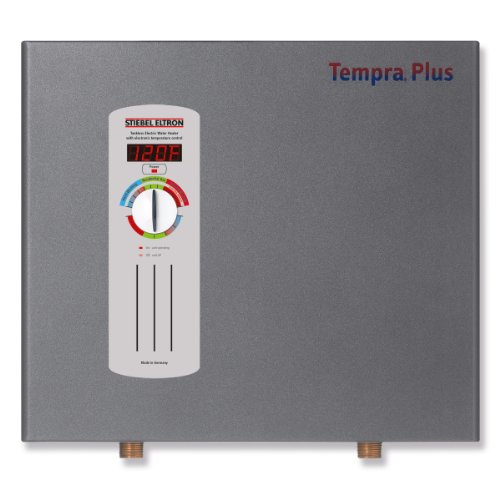
Stiebel Eltron 224196 240V, 1 Phase, 50/60 Hz, 12 kW Tempra 12 Plus Whole House Tankless Electric Water Heater, Advanced Flow Control


Key features
- •Digital temperature control
- •Proven reliability
- •No venting required
- •Sleek design fits anywhere
- •Save at least 15-20% on the hot water portion of your electric bill
Stiebel Eltron 224196 240V, 1 Phase, 50/60 Hz, 12 kW Tempra 12 Plus Whole House Tankless Electric Water Heater, Advanced Flow Control
List Price: $785.69$707.12DEALYou Save: $78.57 (10%)
Free shippingFree Returns – 30 daysFree Order CancellationSecure Payment2–3 Days DeliveryGet It October 27, 2026In Stock (1)No marketing spamNo account requiredFulfilment by FedEx / Amazon / UPS / ShipwirePayPal / Card Buyer Protection
Customer Reviews
Reviews sourced from verified Amazon purchasers4.4
out of 5
Based on 10 reviews
5★
70%
4★
30%
3★
0%
2★
0%
1★
0%
Tiny Monster
Peter A. Haan✓ Verified Purchase•December 29, 2023
Terrifically well-built device, obviously european. This unit went into a ski house in the Sierras where gas was not available, replacing an older conventional electric tank unit that was constantly burning itself out when renters would try to winterize the home, draining that tank and system while leaving the electrical in a low water state.
Things to keep in mind: It requires three 50 amp 240-208v circuits, 28,800 watts.... and a ground wire, namely a whopping 150 amps to run, so you must have at least a 200amp service present for this sized unit. You would think that Stiebel also makes arc welders, for heavens sake. It requires at least .4 gallon per minute to activate; some bathroom faucets may be less than this. The hot and cold water connections on the Stiebel do not attach to the can in complete holes but in odd open-sided slots; the result is a less than totally secure means of attachment of them to the can when you wrench-tighten your own system leads to the Stiebel connections. Meanwhile holding onto the Stiebel connections is not easy as they are complex shapes and delicate. They can rotate out of these slots, you see, stressing the internal Stiebel system as well inside. Care is required mainly; this is not a huge problem, but clearly not an old-fashioned sort of set-up and subtle.
It is remarkable how tiny the unit is, considering the electrical power it consumes. Remember the efficiency of an electric unit is nearly 100%, the drawback is the cost of same. Stiebel says do not allow the unit to freeze, but leaves it at that. So in winterizing, what do you do, demount the unit? Nonsense. Worse it appears there is no way (other than compressed air) to absolutely completely drain the installed unit too, as water will sit in the bottom small portions of the three copper chambers in which it is heated, their inlets and outlets being above bottom in there. It appears that what small water remains might not be sufficient to allow for freezing damage however. Although Stiebel has been in business forever, the unit is quite modern and microprocessor controlled, extraordinarily compact and well-made; the product literature is peculiarly "undersized" and untechnical aside from the installation requirements of wire size, gpm, this sort of thing. It compares poorly to Takagi in this respect, although Takagi does not make electric units. Missing info: recirculation schematics, ganging these units in commercial use, error code in troubleshooting, high altitude installations and winterizing.
Professionally installing the unit is best achieved on Superstrut, as you can then also use Superstrut to attach per code your electrical (in my case three 3/4 flex), your hot and cold connections (using vibra clamps of course) and a nearby new expansion tank sized to the home (4 gal cap). Remember that you must have three separate means of disconnect right at the unit if the supplying electrical panel is out of sight or more than something like 50ft away (I am recalling). Don't skimp in this respect. I used three SquareD 60amp disconnects ($14.00 each). To supply the Stiebel, I used #8 copper THHN, running 24 ft in EMT conduit from the load center to the unit.
Things to keep in mind: It requires three 50 amp 240-208v circuits, 28,800 watts.... and a ground wire, namely a whopping 150 amps to run, so you must have at least a 200amp service present for this sized unit. You would think that Stiebel also makes arc welders, for heavens sake. It requires at least .4 gallon per minute to activate; some bathroom faucets may be less than this. The hot and cold water connections on the Stiebel do not attach to the can in complete holes but in odd open-sided slots; the result is a less than totally secure means of attachment of them to the can when you wrench-tighten your own system leads to the Stiebel connections. Meanwhile holding onto the Stiebel connections is not easy as they are complex shapes and delicate. They can rotate out of these slots, you see, stressing the internal Stiebel system as well inside. Care is required mainly; this is not a huge problem, but clearly not an old-fashioned sort of set-up and subtle.
It is remarkable how tiny the unit is, considering the electrical power it consumes. Remember the efficiency of an electric unit is nearly 100%, the drawback is the cost of same. Stiebel says do not allow the unit to freeze, but leaves it at that. So in winterizing, what do you do, demount the unit? Nonsense. Worse it appears there is no way (other than compressed air) to absolutely completely drain the installed unit too, as water will sit in the bottom small portions of the three copper chambers in which it is heated, their inlets and outlets being above bottom in there. It appears that what small water remains might not be sufficient to allow for freezing damage however. Although Stiebel has been in business forever, the unit is quite modern and microprocessor controlled, extraordinarily compact and well-made; the product literature is peculiarly "undersized" and untechnical aside from the installation requirements of wire size, gpm, this sort of thing. It compares poorly to Takagi in this respect, although Takagi does not make electric units. Missing info: recirculation schematics, ganging these units in commercial use, error code in troubleshooting, high altitude installations and winterizing.
Professionally installing the unit is best achieved on Superstrut, as you can then also use Superstrut to attach per code your electrical (in my case three 3/4 flex), your hot and cold connections (using vibra clamps of course) and a nearby new expansion tank sized to the home (4 gal cap). Remember that you must have three separate means of disconnect right at the unit if the supplying electrical panel is out of sight or more than something like 50ft away (I am recalling). Don't skimp in this respect. I used three SquareD 60amp disconnects ($14.00 each). To supply the Stiebel, I used #8 copper THHN, running 24 ft in EMT conduit from the load center to the unit.
AWSOME UNITS. BUT BEWARE of a FEW SIMPLE THINGS to CONSIDER before buying
Allen✓ Verified Purchase•December 22, 2023
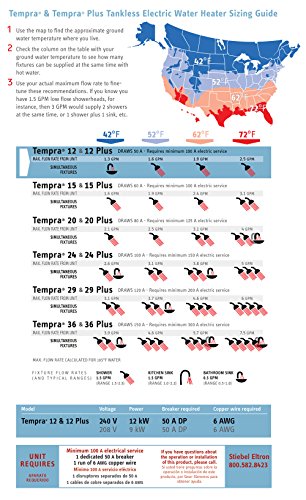
Obviously the waive of the future is tank less water heaters. GAS or ELECTRIC. They both seem to be very energy efficient. But not economically efficient. This is due to their initial expense. Important to realize, after the initial install, when it comes time to replace the old unit the next time won't be as bad as everything is already in place that you will need. For starters, since this unit is electric, I can just about guarantee even if your old unit was an electric 240 or 208 volt tank, that you do not have the wiring in place for one of these. This particular unit requires TWO, 240 volt (or 208 volt if you're 3 phase) two pole 60 amp circuits with a minimum of 6 AWG wire. When operating at full power at 120 degrees Fahrenheit, I measured up to 44 amperes with my Fluke clamp meter on each line. That's a total of 88 amperes at the panel or over 21,000 watts (Yes that's OVER TWENTY-ONE THOUSAND WATTS). This thing requires a minimum of a 200 amp load center to be installed at the property. The largest unit from this manufacturer's line-up requires THREE of these same circuits and a 300 amp load center. So as you can see, if you're not an electrician or at the very least well versed in the electrical field, the average home do it yourselfer is not going to be able to install one of these on his own. Therefore the cost, as I said before is not economical. The gas ones have similar issues in that they may require larger gas lines for volume than the average home is built with. Again, just things to consider. Lastly, don't take the writing on the box for how many simultaneous showers this thing will be able to deliver as gospel. That greatly depends upon water flow and ground temperatures. It actually does say that on the box in small print. During the summer in warmer southern climates, you'll find the water where you normally set your shower is way too hot. During the winter you may find that you have to turn the handle all the way up just to keep the water warm. (Notice I didn't say HOT) Now, add another simultaneous shower, and it may not be able to keep up. Again, just things to consider. My recommendation, buy bigger than you think you're going to need. No need to go overboard, just figure what you think you're going to need, and go one size up. Once your service is upgraded to support one of these, the actual installation of a tank less water heater is a breeze. Very easy. Last thing, for those of you doing the math, yes this things sucks electricity like you wouldn't believe. Go out and look at you're meter when it's on. Your AC won't make your meter spin like that. In lieu of all of this you must come to realize that this thing is only doing that when you're using maximum hot water. In other words, if you're just running the hot water faucet at the kitchen sink, its not running at maximum power. If every hot water faucet is on in the house or multiple showers are running (especially if the ground temperature is low) then you probably are running maximum power, or close to it. However, if you're not running any hot water at all, it's idle. There is no tank to keep hot, it doesn't cycle on and off throughout the day when no one's home. It only runs when a hot water faucet is opened. For that reason, if you have kids in the house, be sure they shut that water off at the sink; or you'll be unpleasantly surprised on bill day. This unit in particular is a very good and dependable unit. It has stood the test of time for me and I have already bought and installed another one at an alternate location. Have fun.......
Fantastic !! 5 stars for sure.
Linda E. Wightman✓ Verified Purchase•December 14, 2023
Our Stiebel has been running for 2 years now with a perfect track record so far. It supplies hot water to 2 bedrooms in the back of the house. We live in OKC, OK and can have some pretty cold temps outside but the Tempra 24 keeps up and can kick out enough hot water even on those really cold mornings when you need a good HOT shower.
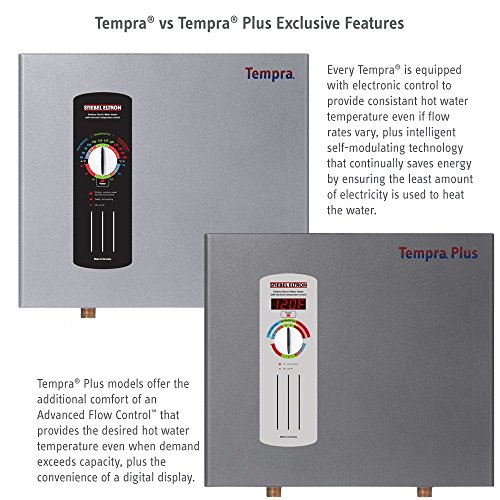
I got the Tempra "Plus" because it will restrict flow rate to maintain water outlet temp if necessary, something the standard Tempra will not do. Also, its nice to have the digital display on the front of the unit, so you can see whats going on when the unit is in operation. We have the temp set to 128F; the max output temp is 140F. It's totally silent in operation, only thing I notice is that it actually will slightly dim the lights in the house when it kicks on.
Installation is simple enough, with the electric feed being the most difficult part to get done at my house. We have the heater mounted in a closet in our hallway, where it just hangs on the wall taking up no room at all. The 24 does require very heavy electric feed to produce such a large temp rise with cold inlet temps, while keeping total flow rate high enough for a hot shower. The electric requirement is 2 x 60 amp single phase 240v circuits. That's a total of 240 amps maximum going to this beast - more than many homes can supply having only 200A service at the main panel (240 amps because each 240v single phase circuit consists of 2 legs of 120v so you'll need room for 4 60A breakers in your panel - plus the main CB must support the 240A max draw)
Efficiency: all I can say is WOW. Ditching out liquid propane fired hot water tank was one of the best decisions I've made. Now we only pay for the hot water we use instead of keeping 50 gallons hot 24/7. This has reduced our LP use a bunch - our monthly LP bill dropped substantially. I can't precisely say how much we're saving by ditching the LP system (since we also run LP heat here on very cold days) but its between $20 and $40 bucks a month. Our electric bill hasn't changed either, and we have a precise record of our electric use as reported by our "smart" meter on the house.
All in all, I give it 5 stars because of its superb performance, efficiency, ease of installation, and high quality design + construction.
I got the Tempra "Plus" because it will restrict flow rate to maintain water outlet temp if necessary, something the standard Tempra will not do. Also, its nice to have the digital display on the front of the unit, so you can see whats going on when the unit is in operation. We have the temp set to 128F; the max output temp is 140F. It's totally silent in operation, only thing I notice is that it actually will slightly dim the lights in the house when it kicks on.
Installation is simple enough, with the electric feed being the most difficult part to get done at my house. We have the heater mounted in a closet in our hallway, where it just hangs on the wall taking up no room at all. The 24 does require very heavy electric feed to produce such a large temp rise with cold inlet temps, while keeping total flow rate high enough for a hot shower. The electric requirement is 2 x 60 amp single phase 240v circuits. That's a total of 240 amps maximum going to this beast - more than many homes can supply having only 200A service at the main panel (240 amps because each 240v single phase circuit consists of 2 legs of 120v so you'll need room for 4 60A breakers in your panel - plus the main CB must support the 240A max draw)
Efficiency: all I can say is WOW. Ditching out liquid propane fired hot water tank was one of the best decisions I've made. Now we only pay for the hot water we use instead of keeping 50 gallons hot 24/7. This has reduced our LP use a bunch - our monthly LP bill dropped substantially. I can't precisely say how much we're saving by ditching the LP system (since we also run LP heat here on very cold days) but its between $20 and $40 bucks a month. Our electric bill hasn't changed either, and we have a precise record of our electric use as reported by our "smart" meter on the house.
All in all, I give it 5 stars because of its superb performance, efficiency, ease of installation, and high quality design + construction.
Great Water Heater - Different Functionality/Limitations.
Alex✓ Verified Purchase•December 1, 2023
I am very happy with my decision to switch to an on-demand style water heater. This unit, SE Tempra 29 Plus, has performed very well during the first week of use. It is capable of running at 3.3 GPM with incoming water at 49 degrees F and output at 122F. This will fill my garden tub and run a shower at the same time, or run two showers and a faucet with the flow slightly reduced.
Different functionality/Limitations- Please remember when you switch to a on-demand style heater that the flow (or max number of points of use) will be limited by the power rating of the unit; however, you will not be limited by the amount of time you can use the heater. I found this ideal for the garden tub as a tank style heater can fill the tub, but is then out of commission for about an hour. The same goes for showers. Two showers and a washing machines could be ran with the tank, but after doing this the tank was down for an hour. This does not happen with the on-demand style and it will continue to put out hot water as long as you want to run it.
Minor temperature fluctuations with well water - I do notice small temperature fluctuations while using the unit. I believe these are associated with the pressure tank and cycling of the well pump. When the tank is charging (well pump is running), the water drops a couple of degrees (just noticeable enough to feel, not enough to adjust the water temp). I believe this is due to the water bypassing the pressure tank and coming directly to the heater. This incoming water is slightly colder than the water that has warmed up inside the pressure tank in the crawl space. This water then makes its way through the heater and reduces the output on the hot line side (because of the constant temperature control of the plus unit). The cold line side rises in pressure due to the pump pressurizing the tank and mixes slightly more cold water. I believe this could be eliminated by adding a buffer tank (5-20gal) between the pressure tank and house inlet that would allow the water to mix and acclimate, but this would only be added if someone was extremely sensitive to temperature variations.
Some other positives:
Easy installation. If you know plumbing and electricity this can be installed in an afternoon if your lucky with the placement of everything. It took me a weekend by myself to install. Most of the time was spent routing the power cables and mounting boxes.
Saves space, No Footprint! This unit was ideal for my house. I had a 50gal tank in my half-bath and it was an eyesore and a space hog. The SE 29 was wall mounted on the garage side of the wall without taking any floor space and minimal wall space that wasn't being utilized.
Others: Unlimited hot water, Better looking than a tank heater, and easily adjustable temp.
Different functionality/Limitations- Please remember when you switch to a on-demand style heater that the flow (or max number of points of use) will be limited by the power rating of the unit; however, you will not be limited by the amount of time you can use the heater. I found this ideal for the garden tub as a tank style heater can fill the tub, but is then out of commission for about an hour. The same goes for showers. Two showers and a washing machines could be ran with the tank, but after doing this the tank was down for an hour. This does not happen with the on-demand style and it will continue to put out hot water as long as you want to run it.
Minor temperature fluctuations with well water - I do notice small temperature fluctuations while using the unit. I believe these are associated with the pressure tank and cycling of the well pump. When the tank is charging (well pump is running), the water drops a couple of degrees (just noticeable enough to feel, not enough to adjust the water temp). I believe this is due to the water bypassing the pressure tank and coming directly to the heater. This incoming water is slightly colder than the water that has warmed up inside the pressure tank in the crawl space. This water then makes its way through the heater and reduces the output on the hot line side (because of the constant temperature control of the plus unit). The cold line side rises in pressure due to the pump pressurizing the tank and mixes slightly more cold water. I believe this could be eliminated by adding a buffer tank (5-20gal) between the pressure tank and house inlet that would allow the water to mix and acclimate, but this would only be added if someone was extremely sensitive to temperature variations.
Some other positives:
Easy installation. If you know plumbing and electricity this can be installed in an afternoon if your lucky with the placement of everything. It took me a weekend by myself to install. Most of the time was spent routing the power cables and mounting boxes.
Saves space, No Footprint! This unit was ideal for my house. I had a 50gal tank in my half-bath and it was an eyesore and a space hog. The SE 29 was wall mounted on the garage side of the wall without taking any floor space and minimal wall space that wasn't being utilized.
Others: Unlimited hot water, Better looking than a tank heater, and easily adjustable temp.
If you are comfortable replacing a circuit breaker
J. Monroe✓ Verified Purchase•November 13, 2023
We bought this 1 year ago and installed it in our house in mid-New Hampshire. Our house runs on a well, and I was concerned that the cold (40 F) ground water would create a challenge for this water heater. I was wrong.
I installed this Stiebel-Eltron Tempra 29 Plus to replace a propane powered water heater that the previous owner had used. Our home was wired for electric heat in the 1970's, so it has a 200a service, and I wanted to avoid fossil fuels.
We heat with 2 pellet stoves. We have back-up electric heat as well. I was concerned that the current draw for this unit would cause a problem with many electric appliances running at once. We didn't have a problem, even when we had guests and multiple showers running at once. Plus, the winter of 2013 was quite cold here with some mornings as low as -15F, and still no problems.
I would consider myself to have above average handyman skills. I installed this unit myself and had no problems at all. If you are comfortable replacing a circuit breaker, you can install the electrical portion of this, but I caution you, if you aren't 100% confident, then hire a professional, because working near the bus in the breaker box can be dangerous, and 200a could probably cook you like a hot dog if your screwdriver slips. I have several years of experience working for an electrical contractor during the summers when I was a teen, so I felt comfortable taking on this project.
I used shark bite fittings to plumb this unit. I got 2 valves to shut it off so it can be cleaned/flushed annually and I used 2 braided stainless steel connections to hook into the unit directly. I found these fittings on the shelf at Home depot. I also got the 8/2 wire at Home Depot. Total cost to install myself was ~$100 for wire (125 ft), ~$30 for 3 50a breakers, ~$60 for all sharkbite fittings. I had some other misc items on hand (screws, wire straps, tools, etc).
My impressions of this unit over the year we have had it are very positive. There are some quirks, because this is not the type of system most of us are accustomed to as Americans. Contrary to the experience of another reviewer, I notice a slight, but noticeable increase in the temperature of the water when I'm in the shower and another tap is opened. It is not enough to scald, but it is occasionally uncomfortable. There is also a minor dimming of the lights when the water heater comes on. It does draw a lot of current, but not 150 amps. We have it set at 106F, which is the temperature I prefer in the shower. I can have the electric oven and range on, the microwave on, lights on around the house, the stoves going, and fill a pot with hot water in the kitchen. You won't have problems hosting guests.
My inlaws were concerned that we weren't running the water hot enough to kill germs in the dishwasher and the clothes washer. I say hogwash. I haven't gotten sick more often or noticed dirtier dishes or clothes. The water at their house burns my hands straight out of the faucet.
My monthly electric bill with 2 people living in the house is somewhere around $100. It went as high as $150. last winter with stoves and humidifiers going, and as low as $80 this summer with no AC running. I don't have previous bills to compare to since we installed this water heater as soon as we moved in.
As always, YMMV, but I have been very pleased with this water heater. I probably could have gotten away with the unit one size down (tempra 24), but I like to do it once and do it right. The endless hot water and excellent efficiency are wonderful benefits, and we've had no significant drawbacks. If we ever move, I'll get one of these for our new house.
I installed this Stiebel-Eltron Tempra 29 Plus to replace a propane powered water heater that the previous owner had used. Our home was wired for electric heat in the 1970's, so it has a 200a service, and I wanted to avoid fossil fuels.
We heat with 2 pellet stoves. We have back-up electric heat as well. I was concerned that the current draw for this unit would cause a problem with many electric appliances running at once. We didn't have a problem, even when we had guests and multiple showers running at once. Plus, the winter of 2013 was quite cold here with some mornings as low as -15F, and still no problems.
I would consider myself to have above average handyman skills. I installed this unit myself and had no problems at all. If you are comfortable replacing a circuit breaker, you can install the electrical portion of this, but I caution you, if you aren't 100% confident, then hire a professional, because working near the bus in the breaker box can be dangerous, and 200a could probably cook you like a hot dog if your screwdriver slips. I have several years of experience working for an electrical contractor during the summers when I was a teen, so I felt comfortable taking on this project.
I used shark bite fittings to plumb this unit. I got 2 valves to shut it off so it can be cleaned/flushed annually and I used 2 braided stainless steel connections to hook into the unit directly. I found these fittings on the shelf at Home depot. I also got the 8/2 wire at Home Depot. Total cost to install myself was ~$100 for wire (125 ft), ~$30 for 3 50a breakers, ~$60 for all sharkbite fittings. I had some other misc items on hand (screws, wire straps, tools, etc).
My impressions of this unit over the year we have had it are very positive. There are some quirks, because this is not the type of system most of us are accustomed to as Americans. Contrary to the experience of another reviewer, I notice a slight, but noticeable increase in the temperature of the water when I'm in the shower and another tap is opened. It is not enough to scald, but it is occasionally uncomfortable. There is also a minor dimming of the lights when the water heater comes on. It does draw a lot of current, but not 150 amps. We have it set at 106F, which is the temperature I prefer in the shower. I can have the electric oven and range on, the microwave on, lights on around the house, the stoves going, and fill a pot with hot water in the kitchen. You won't have problems hosting guests.
My inlaws were concerned that we weren't running the water hot enough to kill germs in the dishwasher and the clothes washer. I say hogwash. I haven't gotten sick more often or noticed dirtier dishes or clothes. The water at their house burns my hands straight out of the faucet.
My monthly electric bill with 2 people living in the house is somewhere around $100. It went as high as $150. last winter with stoves and humidifiers going, and as low as $80 this summer with no AC running. I don't have previous bills to compare to since we installed this water heater as soon as we moved in.
As always, YMMV, but I have been very pleased with this water heater. I probably could have gotten away with the unit one size down (tempra 24), but I like to do it once and do it right. The endless hot water and excellent efficiency are wonderful benefits, and we've had no significant drawbacks. If we ever move, I'll get one of these for our new house.
Page 1 of 2